Preheat and Interpass Temperature in Structural Steel Welding
Preheat and interpass temperature control are the primary metallurgical tools for preventing hydrogen-induced cold cracking (HICC) — the most common and dangerous weld defect in carbon and low-alloy structural steels. By regulating the thermal cycle experienced by the heat-affected zone (HAZ), the welding engineer controls HAZ peak hardness, hydrogen diffusion kinetics, and residual stress magnitude, all three of which determine susceptibility to delayed cracking. This article provides a rigorous treatment of the governing physics, the two principal carbon equivalent formulae, the major code frameworks (AWS D1.1, EN ISO 1011-2), and an interactive preheat calculator.
Key Takeaways
- Preheat reduces HAZ cooling rate, suppresses martensite, and drives diffusible hydrogen out of the joint before cracking can initiate.
- CE(IIW) = C + Mn/6 + (Cr+Mo+V)/5 + (Ni+Cu)/15 is used for steels with C > 0.18%; Pcm is preferred for modern low-carbon HSLA grades (C < 0.18%).
- AWS D1.1 provides prescriptive preheat tables by steel category and thickness; EN ISO 1011-2 offers formula-based and graphical approaches using CE, HD, and section thickness.
- Maximum interpass temperature is just as important as minimum preheat — exceeding it degrades HAZ toughness and can over-temper Q&T base metals.
- Hydrogen content of the welding consumable (classified H5, H10, H15 per AWS A5 or equivalent) is the single most controllable factor in reducing preheat requirements.
- HICC is “delayed” — cracks may not appear until 24–72 hours after welding, making post-weld inspection timing critical.
Preheat Temperature Calculator
CE(IIW) and Pcm methods — EN ISO 1011-2 / AWS D1.1 guidance
Step-by-Step Calculation
The Metallurgical Basis for Preheating
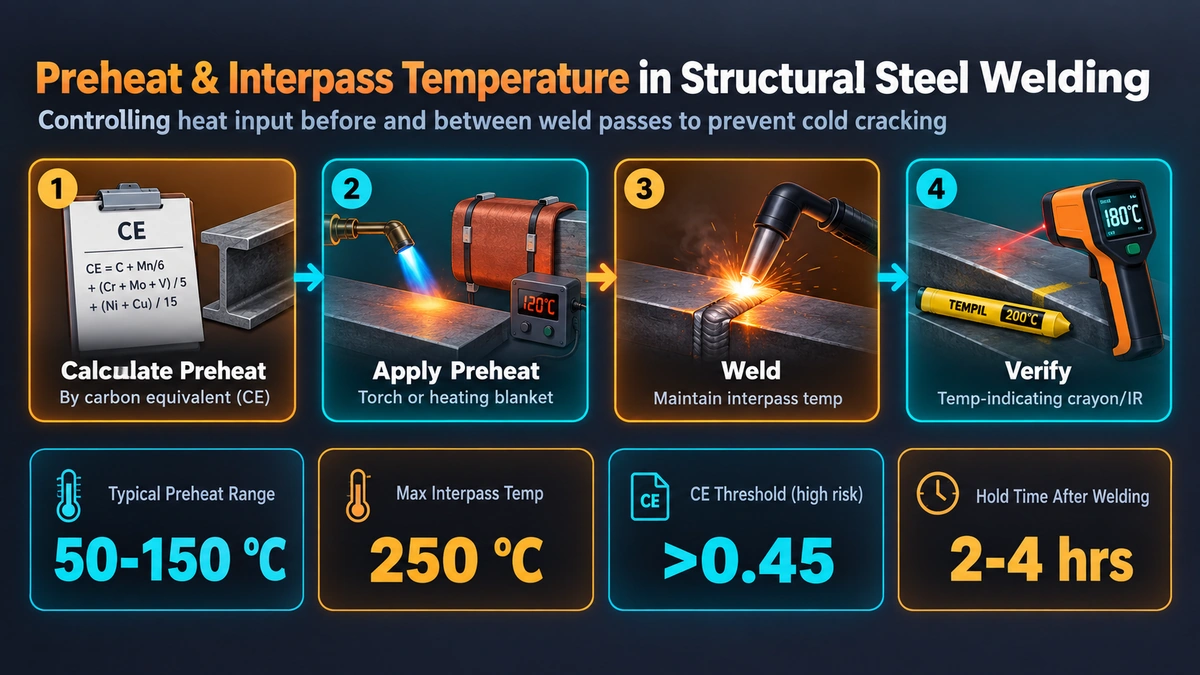
Hydrogen-induced cold cracking (also called hydrogen-assisted cracking, underbead cracking, or delayed cracking) requires three simultaneous conditions: a susceptible microstructure (hard martensite or bainite), a source of diffusible hydrogen, and tensile residual stress. Preheat addresses all three, but primarily the first two.
Effect on Cooling Rate and Microstructure
The weld thermal cycle imposes rapid heating and cooling on the HAZ. The cooling time from 800°C to 500°C, denoted t8/5, is the critical parameter. Faster cooling (shorter t8/5) drives the HAZ transformation toward martensite and bainite; slower cooling (longer t8/5) favours ferrite-pearlite or acicular ferrite, which are tougher and less hydrogen-sensitive. Preheating slows the overall cooling rate by reducing the temperature differential between the weld and the surrounding base metal, thereby extending t8/5 and suppressing martensite formation. For a given steel with a known CCT diagram, you can calculate the minimum t8/5 that avoids fully martensitic HAZ transformation and, from that, derive the minimum preheat.
The relationship between preheat temperature (Tp), heat input (E), and t8/5 for thick plate (3D heat flow) is:
t₅⁄₅ = (6700 × E) / (F²) × [1/(500 - Tp)² - 1/(800 - Tp)²]

where:
  E  = net heat input (kJ/mm) = (arc voltage × current × 60) / (1000 × travel speed mm/min) × thermal efficiency
  F  = plate thickness (mm)
  Tp = preheat (interpass) temperature (°C)
For thin plate (2D heat flow), a different formulation applies, and the transition thickness depends on the heat input and plate thermal properties. In practice, most structural fabrication codes use the empirical CE-based preheat tables described below rather than direct t8/5 calculation.
Effect on Hydrogen Diffusion
Hydrogen enters the weld pool from moisture in flux, cellulosic electrode coatings, rust, or surface contamination. In the solid weld metal, it exists as atomic hydrogen in interstitial sites. Diffusivity of hydrogen in iron increases strongly with temperature: at 200°C, hydrogen diffuses roughly 100 times faster than at 20°C. Preheating therefore accelerates hydrogen effusion from the joint before the weld cools to the temperature range (<150°C) where cracking becomes possible. Post-weld hydrogen bake-out treatments (typically 200–300°C for 1–4 hours) exploit the same principle when preheat alone is insufficient.
Effect on Residual Stress
A preheated joint is more uniformly heated, reducing the thermal gradient between the weld bead and surrounding plate. This reduces the differential thermal contraction on cooling and therefore the peak residual tensile stress in the HAZ. A reduction in residual stress directly lowers the crack-driving force even when hydrogen is present. Joint restraint — quantified by restraint intensity or stress intensity factor in analytical models — interacts with preheat: highly restrained thick-section joints require more preheat for the same hydrogen content than unrestrained thin-section joints.
Carbon Equivalent Formulae
Carbon equivalent (CE) parameters condense the hardenability contribution of multiple alloying elements into a single number that correlates with HAZ hardness and cold-cracking susceptibility. No single formula is universally optimal; the choice depends on the steel composition range.
CE(IIW) — International Institute of Welding
CE(IIW) = C + Mn/6 + (Cr + Mo + V)/5 + (Ni + Cu)/15

Units: wt% of each element
Valid range: C = 0.12–0.45%, Mn = 0.5–1.7%
Typical threshold: CE ≤ 0.40% → no preheat required (thin sections, low HD)
                   CE > 0.60% → high preheat or low-hydrogen process mandatory
CE(IIW) was derived from regression of HAZ hardness data on medium-carbon structural steels in the 1960s. Manganese contributes one-sixth the hardenability of carbon because it widens the martensite start temperature range rather than displacing it dramatically. Chromium, molybdenum, and vanadium are strong carbide-formers and hardenability agents, grouped at one-fifth. Nickel and copper have a weaker effect, grouped at one-fifteenth.
Pcm — Ito-Bessyo Parameter
Pcm = C + Si/30 + (Mn + Cu + Cr)/20 + Ni/60 + Mo/15 + V/10 + 5B

Units: wt% of each element
Valid range: C = 0.07–0.22%, Si ≤ 0.60%, Mn ≤ 1.60%, Ni ≤ 2.0%
Typical threshold: Pcm ≤ 0.20% → low cracking risk
                   Pcm > 0.28% → high preheat required
Pcm gives a much larger weighting to boron (factor 5B) because trace boron (0.0005–0.003 wt%) dramatically suppresses grain-boundary ferrite nucleation and dramatically increases hardenability in low-carbon steels. Silicon, though a mild hardenability agent, appears in Pcm at Si/30 to account for its role in HSLA steels. On modern S355 or A572 Gr.50 steels, Pcm gives more accurate preheat predictions than CE(IIW).
CET — EN 1011-2 Method B Parameter
CET = C + (Mn + Mo)/10 + (Cr + Cu)/20 + Ni/40

Valid for C = 0.05–0.32%, used with EN 1011-2 Method B charts
Interpass temperature from chart: T_p = f(CET, HD, heat input, section thickness)
CET was developed specifically for thermomechanically controlled processed (TMCP) steels and is the basis for the EN 1011-2 Method B graphical approach. It avoids the vanadium and boron terms that complicate CE(IIW) for this steel family.
Preheat Determination Methods
AWS D1.1 Prescriptive Tables
AWS D1.1:2020 Clause 7.7 classifies steels into Groups I through IV based on specified minimum yield strength and carbon equivalent, then provides a table of minimum preheat and interpass temperatures by group and material thickness. The table is conservative and process-agnostic, intended to cover the full range of heat inputs typical of the listed welding process (SMAW, GMAW, FCAW, SAW). AWS D1.1 Table 7.3 (Category Tables) is the most commonly referenced in North American structural fabrication.
| AWS D1.1 Category | Typical Grades | Thickness < 19 mm | 19–38 mm | 38–65 mm | > 65 mm |
|---|---|---|---|---|---|
| A (CE ≤ 0.40) | A36, S235, S275 | None* | None* | 10°C (50°F) | 65°C (150°F) |
| B (CE 0.40–0.45) | A572 Gr50, S355 | None* | 65°C (150°F) | 110°C (225°F) | 150°C (300°F) |
| C (CE 0.45–0.50) | A588, A709 Gr50W | 10°C (50°F) | 110°C (225°F) | 150°C (300°F) | 200°C (400°F) |
| D (CE > 0.50) | A514, S690, HY80 | 65°C (150°F) | 110°C (225°F) | 200°C (400°F) | 230°C (450°F) |
*”None” means no preheat required provided ambient temperature is ≥ 0°C and joint is free from moisture. D1.1 Clause 7.7.4 requires that any steel, regardless of category, be preheated to at least 10°C when ambient temperature is below 0°C. Combined thickness = sum of thicknesses of all elements meeting at the weld joint.
EN ISO 1011-2 Method A — Formula Approach
EN ISO 1011-2 Method A uses CE(IIW) or Pcm with section thickness and hydrogen class to calculate a preheat temperature Tp directly. The formula for CE(IIW)-based calculation of the critical cracking parameter Ccp and minimum preheat Tp0 for the case of no restraint is:
Step 1: Hydrogen parameter
  C_H = 0.00      for HD ≤ 5 ml/100 g
  C_H = 0.35      for 5 < HD ≤ 10 ml/100 g
  C_H = 0.70      for 10 < HD ≤ 15 ml/100 g
  C_H = 1.00      for HD > 15 ml/100 g

Step 2: Thickness parameter
  C_T = 0.005 × d    (d = combined thickness, mm)

Step 3: Restraint parameter (Method A, unrestrained = 0)
  C_R = 0 (unrestrained)  or  0.35 (medium restraint)
                           or  0.70 (high restraint)

Step 4: Cracking parameter
  C_cp = CE(IIW) + C_H + C_T + C_R

Step 5: Minimum preheat (Method A)
  T_p0 = 697 × C_cp - 220   (°C)

  (minimum 0°C; if T_p0 < 0, no preheat required)
EN ISO 1011-2 Method B — Graphical / CET Approach
Method B uses the CET parameter with section thickness, diffusible hydrogen class, and heat input on a set of pre-computed nomographs published in EN ISO 1011-2 Annex B. The graphical approach is particularly useful for TMCP steels with very low CE where Method A can give unrealistically low preheat values. Method B is also favoured for thin sections where 2D heat flow dominates.
Interpass Temperature — Maximum Limits
Interpass temperature (Tinterpass) is the temperature of the weld area immediately before each successive pass is deposited. While preheat sets a minimum, interpass temperature has a maximum that is equally critical.
Why Excessive Interpass Temperature is Harmful
- Grain coarsening: Extended time above 900°C causes austenite grain growth in the HAZ. Coarser austenite grains produce coarser martensitic or bainitic transformation products, reducing toughness.
- Prolonged time in temper embrittlement range: Multi-pass welding with high interpass temperatures can cause repeated cycling through the 350–550°C range, promoting temper embrittlement in susceptible steels (particularly Cr-Mo-V grades).
- Base metal over-tempering: For Q&T steels (A514, S690), interpass temperatures exceeding the original tempering temperature (≈620–680°C for many grades) can reduce yield and tensile strength below specified minimums through carbide coarsening.
- Reduced strength in TMCP steels: TMCP steels derive strength from fine grain size and dislocation substructure. Excess heat input and interpass temperature erases this processing benefit, effectively reverting the steel toward normalised properties.
| Steel Grade / Type | Typical Max Interpass Temperature | Basis |
|---|---|---|
| Carbon-manganese (S235, S275, A36) | 250°C | Toughness & general guidance |
| HSLA (S355, A572 Gr50) | 200–250°C | WPS / EN 1011-2 |
| TMCP high-strength (S460M, S500M) | 200°C | Steel producer datasheet |
| Q&T high-strength (S690, A514) | 200–250°C | Below tempering temp. |
| Cr-Mo creep-resistant (P91, P22) | 300°C (maintain until PWHT) | ASME B31.1 / B31.3 |
| Austenitic stainless (316L) | 150°C (sensitisation risk) | Corrosion resistance preservation |
For Cr-Mo steels such as P91, the interpass temperature is not just a maximum but also effectively a minimum held for the entire weld: the joint must be maintained at preheat temperature (200–300°C) continuously from start of welding until the mandatory post-weld heat treatment (PWHT) begins, as cooling to ambient would cause hydrogen cracking in the hard untempered martensite.
Practical Measurement and Verification
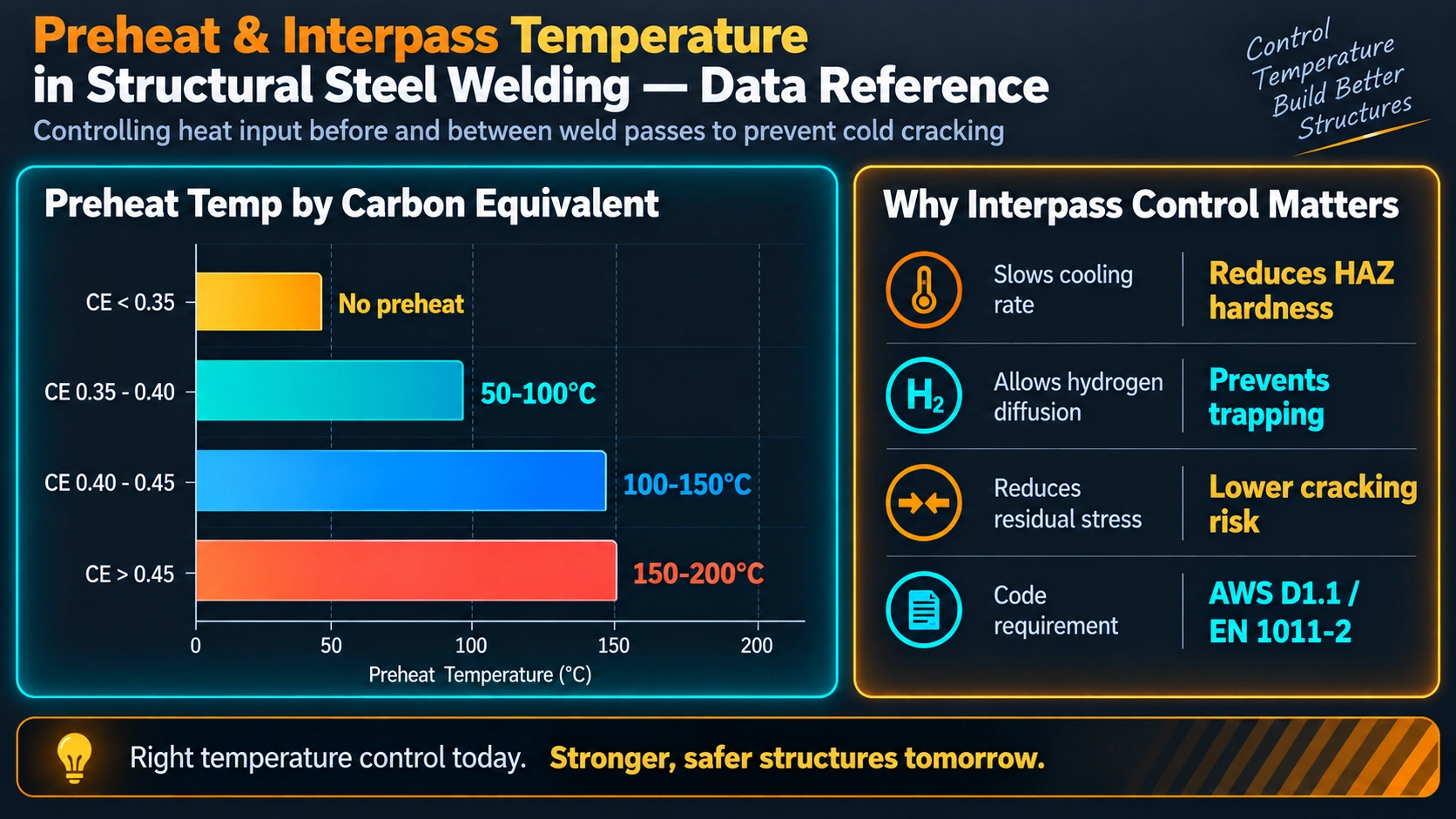
Measurement Location and Timing
AWS D1.1 Clause 7.7.3 and EN ISO 13916 both specify that preheat temperature shall be measured at a distance of at least 75 mm (3 inches) from the edge of the weld joint, on the surface opposite to the applied heat source. This requirement prevents the reading from being inflated by the direct radiant heat of the flame or induction coil. Time must be allowed for the heat to soak through the full section thickness — a common guideline is 2 minutes per 25 mm of thickness after removing the heat source, before taking the measurement.
Measurement Tools
- Temperature-indicating crayons (Tempilstik): Inexpensive, require no power, available in increments of approximately 5–14°C. Accuracy ±1% of rated temperature. Ideal for site use. The crayon smear changes from solid to liquid at the rated temperature, giving a clear go/no-go indication.
- Contact thermocouples: Type K thermocouples with portable digital readout give ±1–2°C accuracy. Require firm contact with the steel surface and a brief dwell time for equilibration. Best for precise qualification and recording of WPS parameters.
- Infrared thermometers: Non-contact, fast, practical for large structures. Require correct emissivity setting for bare carbon steel (ε ≈ 0.80–0.90). Calibration drift, angle of incidence, and surface condition (scale, paint, oil) all affect accuracy. Should not be the sole method for WPS qualification.
- Thermal imaging cameras: Provide a map of temperature uniformity across the entire joint area. Valuable for identifying cold spots and verifying that heating patterns are adequate for thick, complex joints.
Heating Methods
Gas flame heating (oxy-acetylene, propane/butane) is the most common site method. Electrical resistance heating blankets offer superior temperature uniformity and are preferred for quality-critical work (pressure vessels, pipework). Induction heating provides the most rapid and controllable heating for heavy section pipe. Whatever the method, the heat must soak through the full thickness — surface-only heating with rapid torch application does not constitute compliant preheating.
Diffusible Hydrogen Content and Consumable Selection
The welding consumable is the primary controllable source of diffusible hydrogen (HD). Hydrogen originates from moisture in electrode coatings, flux, shielding gas contamination, and from rust or hydrocarbon contamination on the joint faces. Consumable classification for hydrogen content is defined by:
- AWS A5 specifications: Suffix designations H4, H8, H16 on SMAW electrode classifications (e.g., E7018-H4R) specify HD ≤ 4, 8, 16 ml/100 g respectively. The “R” suffix denotes moisture-resistant coating.
- EN ISO 2560 / 3580: Hydrogen designators H5, H10, H15 for ≤5, ≤10, ≤15 ml/100 g.
| HD Class | AWS A5 Suffix | ISO Designator | HD (ml/100 g) | Preheat Effect |
|---|---|---|---|---|
| Very low | H4 | H5 | ≤ 5 | Minimum preheat required |
| Low | H8 | H10 | 5–10 | Moderate preheat |
| Medium | H16 | H15 | 10–15 | Higher preheat |
| High | — | — | > 15 | Maximum preheat or process change |
Basic low-hydrogen SMAW electrodes (E7018) must be stored in a drying oven at 120–150°C and issued in heated quivers to welders. Reconditioning (re-baking) is typically permitted once; electrodes left exposed to ambient humidity for more than 4 hours should be re-baked or discarded. GMAW/FCAW solid wires typically contribute very low HD (≤ 3 ml/100 g) provided the shielding gas is dry and wire is free of drawing lubricant contamination. SAW is inherently low-hydrogen provided flux is properly dried and stored.
Interaction with Post-Weld Heat Treatment
PWHT (stress relief or tempering at typically 580–720°C) and preheat address different aspects of cracking risk. Preheat prevents cold cracking in the as-welded condition; PWHT reduces residual stress and tempers martensite in the final joint. For many structural applications, PWHT is not required and preheat alone is the control measure. For creep-resistant alloy steels (P91, P22, Cr-Mo grades), PWHT is mandatory regardless of preheat, and preheat ensures the joint survives until PWHT can be applied. For HAZ microstructure control in these steels, the continuous hold at preheat temperature post-weld (hydrogen bake) followed by immediate PWHT is the standard practice.
Industrial Applications and Code Compliance
In structural steelwork fabrication to AWS D1.1, the welding inspector (CWI) verifies preheat compliance as part of the hold-point inspection sequence. The WPS must specify the preheat method, minimum temperature, and interpass maximum; the welder is responsible for maintaining these throughout the pass sequence. For offshore structures to AWS D1.1 or DNVGL-OS-C401, preheat control is critical because hydrogen cracking in primary structural members can be difficult to detect by conventional RT or UT until the crack has propagated to a detectable size — and delayed cracking means inspection immediately post-weld may give a false-clear result.
In pressure vessel fabrication to ASME Section IX and Section VIII, essential variable P-4 (preheat temperature) and P-11 (interpass temperature) are defined: reducing preheat below the qualified value by more than 55°C (100°F), or increasing interpass temperature above the qualified maximum, requires requalification of the WPS by PQR. This gives the preheat temperature legal force under the ASME Code.
In pipeline welding to API 1104, preheat requirements are embedded in the qualified WPS and are particularly stringent for high-strength grades (X70, X80) where the combination of higher CE, thicker wall, and high restraint creates maximum cold-cracking risk. Cellulosic electrodes historically used for downhill pipeline root passes introduce very high HD and therefore require higher preheat than basic low-hydrogen alternatives.
Frequently Asked Questions
What is the purpose of preheating in welding?
What is the difference between CE(IIW) and Pcm?
What maximum interpass temperature should be used for high-strength steels?
How is preheat temperature measured and verified on site?
Can preheat temperature be set too high?
What is the role of diffusible hydrogen content in preheat determination?
Does heat input affect preheat requirements?
What standards govern preheat requirements in structural steel welding?
What is the CET carbon equivalent used for in EN 1011-2?
Recommended References and Tools
AWS D1.1 Structural Welding Code — Steel
The definitive North American code for structural steel welding, including preheat and interpass temperature tables, WPS qualification requirements, and inspection criteria.
View on AmazonBhadeshia & Honeycombe — Steels: Microstructure and Properties
The leading academic text on steel metallurgy. Chapters on HAZ microstructure, martensite, and hydrogen cracking are essential reading for welding engineers.
View on AmazonTempilstik Temperature Indicating Sticks
Industry-standard temperature-indicating crayons for verifying preheat and interpass temperatures on site. Available in a range rated for welding applications.
View on AmazonLincoln Electric VIKING 3350 Welding Helmet
Auto-darkening welding helmet with 4C lens technology. Suitable for SMAW, GMAW, FCAW, and TIG welding in structural fabrication environments.
View on AmazonDisclosure: MetallurgyZone participates in the Amazon Associates programme. If you purchase through these links, we may earn a small commission at no extra cost to you. This helps support free technical content on this site.
Further Reading
Hydrogen-Induced Cold Cracking
Mechanism, critical conditions, test methods (Implant, CTS, Tekken), and mitigation strategies.
HAZ Microstructure in Steel Welds
Thermal zones, grain coarsening, CGHAZ martensite, and toughness implications.
Post-Weld Heat Treatment
Stress relief, tempering, ASME Section VIII requirements, and heating/cooling rate limits.
Martensite Formation in Steel
Shear transformation mechanism, Ms temperature, Koistinen-Marburger equation, and hardness.
Acicular Ferrite and Weld Metal Toughness
Nucleation at inclusions, interlocking morphology, and role in achieving high CVN impact energy.
CCT vs TTT Diagrams Explained
How continuous cooling transformation diagrams differ from isothermal TTT curves and their use in welding.
SMAW, GMAW, FCAW, SAW: Process Selection
Comparing arc welding processes on heat input, hydrogen potential, and suitability for structural applications.
Welding Calculators Hub
All MetallurgyZone interactive calculators: carbon equivalent, heat input, t8/5, and more.
