Quenching Steel: Complete Guide to Cooling Rates, Media, and Microstructure
Quenching is the controlled rapid cooling of austenitised steel to suppress diffusional phase transformations and force the formation of martensite — the hard, metastable BCT phase that is the foundation of high-strength ferrous engineering. Despite its apparent simplicity, quenching is a complex thermomechanical process: the choice of medium, bath temperature, agitation, and component geometry profoundly determine the final microstructure, achievable hardness at depth, residual stress distribution, and the risk of distortion or cracking. This article covers the complete metallurgical basis of quenching, from austenitising practice through TTT/CCT diagram interpretation, quench media physics, hardenability assessment, and industrial case studies.
Key Takeaways
- Quenching suppresses pearlite and bainite formation by cooling faster than the critical cooling rate (CCR), producing martensite with hardness determined primarily by carbon content.
- The Grossmann H-value quantifies quench severity; always select the mildest medium that still achieves the required depth of hardness to minimise cracking and distortion risk.
- TTT diagrams describe isothermal transformation kinetics; CCT diagrams are more representative of industrial quenching practice and should be used for process design.
- Martensite hardness follows a well-established empirical relationship with %C, peaking near 65 HRC at 0.6–0.8% C; above 0.8% C, retained austenite becomes a significant concern.
- Quench distortion arises from both thermal stress gradients and transformation volume expansion (~4% for martensite); these effects compete and their balance determines the nature of residual stress in the quenched part.
- Tempering must follow quenching within 30–60 minutes to relieve quench stresses and prevent delayed cracking at stress concentrations.
Fundamentals of Austenitising Before Quenching
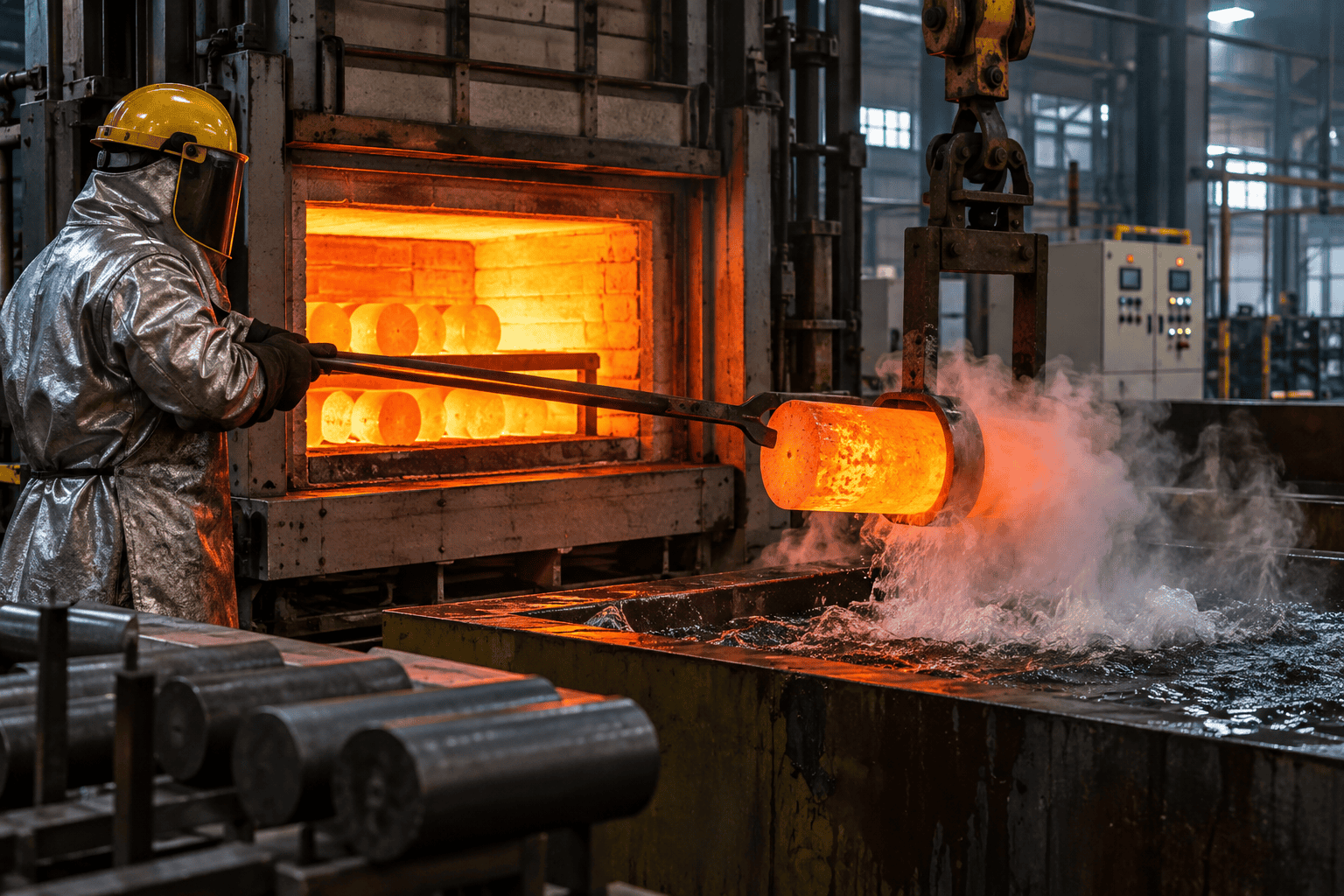
Before quenching can occur, the steel must be fully austenitised — heated into the face-centred cubic (FCC) austenite phase field to dissolve all carbon into a homogeneous solid solution. For hypoeutectoid steels (below 0.77% C), the austenitising temperature is typically 30–50°C above the upper critical temperature (Ac3), placing it in the range 820–900°C depending on composition. For hypereutectoid steels (above 0.77% C), heating to just above Ac1 (730–770°C) is standard practice; this deliberately retains a distribution of undissolved carbides that pin austenite grain boundaries and inhibit grain growth.
Soak time at austenitising temperature must be sufficient to achieve complete carbon dissolution and through-section temperature homogeneity. A widely used rule of thumb is one hour per 25 mm of ruling section, although this varies with furnace loading, atmosphere, prior microstructure, and steel grade. High-carbon tool steels and heavily alloyed grades require longer soaks due to slower carbide dissolution kinetics. Insufficient austenitising time creates carbon gradients in the austenite, resulting in variable martensite hardness and soft spots after quenching — one of the most frequent causes of heat treatment non-conformance.
Austenite Grain Size and Its Influence on Transformation Behaviour
Austenite grain size established during austenitising has a direct effect on subsequent transformation kinetics and the final mechanical properties after quenching and tempering. Coarse austenite grains (low ASTM grain size numbers, large grain diameter) reduce the total grain boundary area available for nucleation of ferrite and pearlite. This shifts the TTT nose to longer times, increasing hardenability. However, very coarse austenite grains also increase the tendency for plate (twinned) martensite in medium-to-high carbon steels, which is significantly more brittle and more susceptible to quench cracking than lath martensite.
Most engineering specifications target a prior austenite grain size of ASTM 5–8 (approximately 25–50 µm average diameter), balancing hardenability against toughness requirements. Grain refining elements such as aluminium (as AlN), niobium, vanadium, and titanium are routinely added to control grain size during austenitising. See the article on the Iron-Carbon Phase Diagram for the relevant phase boundaries governing the austenite field.
The TTT Diagram: Predicting Austenite Decomposition
The Time-Temperature-Transformation (TTT) diagram — also called an isothermal transformation (IT) diagram — maps the kinetics of austenite decomposition as a function of temperature and holding time under isothermal conditions. It is constructed by austenitising multiple identical small specimens, rapidly quenching each to a specific sub-critical temperature, holding for measured intervals, then metallographic or dilatometric determination of transformation progress. The resulting C-curve shape reflects the competing effects of thermodynamic driving force (increases as undercooling increases below Ae1) and atomic diffusivity (decreases exponentially with falling temperature).
Key Features of the TTT Diagram
The major regions of a TTT diagram for a plain carbon eutectoid steel are:
- Pearlite nose: The C-curve minimum for pearlitic transformation, located at approximately 550–600°C for plain carbon steels. This is where transformation nucleation and growth is fastest — as little as 1 second for high-carbon steels. For heavily alloyed steels, the nose may be displaced to hundreds of seconds.
- Bainite bay: The lower C-curve region from approximately 250°C to 550°C. Upper bainite (lath morphology, coarser carbides) forms at higher temperatures within this range; lower bainite (more refined carbide distribution, better toughness) forms closer to Ms.
- Ms temperature: The temperature at which martensite starts to form on continuous cooling. Ms is a function of chemistry only — not time — and is entirely independent of cooling rate above the critical cooling rate. It decreases with increasing carbon and most alloying elements (Cr, Ni, Mn, Mo).
- Mf temperature: The temperature at which martensite formation is essentially complete (conventionally 95%). For plain carbon steels with >0.5% C, Mf falls below ambient temperature, meaning retained austenite is always present at room temperature in as-quenched high-carbon steel.
For a deeper treatment of TTT and CCT diagrams, see the dedicated MetallurgyZone articles on TTT Diagram Interpretation and the CCT Diagram Guide.
Critical Cooling Rate and the CCT Diagram
The critical cooling rate (CCR) is the minimum rate that, if maintained continuously, prevents any pearlite or bainite formation — yielding 100% martensite from surface to core. On a CCT (Continuous Cooling Transformation) diagram, the CCR corresponds to the cooling curve tangent to the leading edge of the pearlite nose. Note that CCT curves are shifted to longer times and lower temperatures compared to their TTT equivalents; using a TTT diagram to design a continuous quench process overestimates the required cooling rate and is non-conservative.
Steels with high hardenability (heavily alloyed grades: 4340, H13, D2) have CCRs as low as 1–5°C/s, achievable by oil quenching or high-pressure nitrogen. Plain carbon steels (1045, 1080) require cooling rates of 100–200°C/s, necessitating water or brine quenching. For detailed martensite formation mechanics, including the Bain correspondence and habit plane crystallography, see the dedicated article.
Martensite: Structure, Hardness, and the Role of Carbon
When austenite is cooled faster than the CCR, diffusion of carbon becomes kinetically impossible. The FCC austenite lattice undergoes a cooperative, diffusionless shear transformation to a body-centred tetragonal (BCT) structure, trapping carbon atoms at octahedral interstitial sites in a strained configuration. The resulting martensite is characterised by:
- An extremely high dislocation density (~1015 m-2), approximately 1,000 times higher than annealed ferrite
- Lattice tetragonality (c/a ratio) that increases linearly with carbon content, generating coherency strains throughout the crystal
- A lath morphology in low-to-medium carbon steels (<0.6% C) — parallel bundles of martensite laths separated by thin retained austenite films, with excellent toughness
- A plate or twinned morphology in high-carbon steels (>0.6% C) — lens-shaped plates with midrib twinning, higher hardness but significantly reduced toughness
The maximum attainable martensite hardness is controlled almost entirely by carbon content, as shown in the table below. Alloying elements (Cr, Mo, Ni) contribute only modestly to martensite hardness directly, but significantly affect hardenability and tempering response.
| Carbon (% C) | Max. Hardness (HRC) | Approx. UTS (MPa) | Dominant Morphology |
|---|---|---|---|
| 0.20 | 40 | ~1,300 | Lath |
| 0.35 | 52 | ~1,700 | Lath |
| 0.50 | 58 | ~2,000 | Lath + Plate |
| 0.60 | 63 | ~2,200 | Mixed |
| ≥0.80 | 65–67 | >2,400 (brittle) | Plate (twinned) |
For the complementary microstructures suppressed by quenching — pearlite colony growth and bainite microstructure — see the dedicated MetallurgyZone articles.
Quench Media: Severity, Selection, and Physics
The quench medium controls the rate at which heat is extracted from the part surface and transferred to the bulk fluid. Quench severity is quantitatively characterised by the Grossmann H-value — a dimensionless coefficient proportional to the convective heat transfer coefficient of the medium divided by twice the thermal conductivity of the steel. Higher H-values extract heat faster, increase depth of hardening, but also generate steeper thermal gradients and higher residual stresses.
| Medium | H-value (agitated) | Typical Application | Key Considerations |
|---|---|---|---|
| Brine (10% NaCl) | 1.5–2.0 | Plain carbon steels, simple shapes | Highest severity; corrosive; minimises vapour blanket |
| Water (30°C, agitated) | 0.9–1.2 | Low-alloy steels, carburised parts | Risk of cracking on re-entrant corners and complex geometry |
| Fast quench oil (60°C) | 0.5–0.7 | Medium-alloy steels | Short vapour stage; good severity; fire risk |
| Standard oil (80°C) | 0.3–0.4 | Most alloy steels (4140, 4340) | Best balance of hardness and distortion for alloy grades |
| PAG polymer (10%) | 0.5–0.7 | Aluminium alloys; lower-alloy steels | Adjustable severity; non-flammable; clean process |
| PAG polymer (25%) | 0.3–0.4 | Higher-alloy steels, die steels | Slower than oil; excellent temperature uniformity |
| Forced air / N2 (1 bar) | 0.03–0.05 | Air-hardening tool steels (A2, M2) | Minimal distortion; no liquid phase |
| N2 gas (6–20 bar, vacuum) | 0.25–0.7 (pressure-dependent) | High-speed steels, die steels, aerospace | Clean, bright surface; precisely controllable H-value |
The Three Stages of Liquid Quenching
When a hot steel part is immersed in a liquid quenchant, heat transfer proceeds through three distinct stages that determine the overall cooling curve:
- Vapour blanket stage (film boiling): A continuous vapour film envelops the part surface immediately after immersion. This film acts as thermal insulation, dramatically slowing heat transfer. Uneven collapse of the vapour film across the part surface creates localised soft spots — the primary failure mode associated with this stage. Fast quench oils and brine contain additives or dissolved salts that nucleate vapour film disruption and minimise this stage duration.
- Nucleate boiling stage: The vapour film collapses as the surface temperature drops below the Leidenfrost point. Vigorous bubble nucleation across the surface creates maximum heat transfer coefficients — typically 2–5 times higher than the convective stage. The critical cooling through the pearlite and bainite nose temperatures occurs during this stage.
- Convection stage: Once the surface temperature falls below the liquid boiling point, heat transfer slows to convective levels. Most martensitic transformation occurs in this stage. Residual stresses generated here are lower, and this is when agitation most effectively promotes temperature homogeneity across the bath.
Distortion and Quench Cracking: Mechanisms and Prevention
Quench distortion and cracking are the most commercially significant defects arising from the heat treatment process. They originate from two simultaneous, competing stress sources:
- Thermal stresses: Temperature gradients during cooling generate non-uniform thermal contraction. The surface cools and attempts to contract while the still-hot core resists, placing the surface in tension during the early stages of quenching. This stress reverses when the core eventually cools.
- Transformation stresses: Martensitic transformation is accompanied by a volume expansion of approximately 4% relative to austenite. If transformation is non-simultaneous through the section thickness — surface transforms first in mild quenches; core transforms last — residual stresses develop from the mismatch in transformation strain.
The resultant residual stress state in a quenched component is determined by which of these mechanisms dominates. In water quenching of large sections, thermal stresses dominate: the surface eventually ends up in residual compression (net beneficial for fatigue), but the transition period of high surface tension can cause cracking if it coincides with the brittle as-quenched martensite condition. Longitudinal cracking is more typical when transformation stresses dominate.
Design and Process Guidelines to Minimise Distortion
- Select the mildest quench medium that achieves the required depth of hardness at the critical section — unnecessary severity generates avoidable stress.
- Avoid abrupt section changes, sharp re-entrant corners, blind holes, and keyways adjacent to heavily stressed surfaces where possible in component design; if unavoidable, machine such features after heat treatment.
- Control austenitising temperature tightly — excessive temperature increases grain size and increases both cracking sensitivity and distortion.
- Entry orientation into the quench tank matters: lower the part vertically with the largest cross-section entering first to ensure uniform quench front progression.
- Temper immediately after quenching — within 30 to 60 minutes — to relieve residual stresses before delayed cracking can initiate. For high-carbon or complex-geometry parts, reduce this to under 20 minutes.
- Consider press quenching for thin rings, discs, and gears, where the part is constrained in a hydraulic or mechanical fixture during quenching to mechanically resist distortion.
- Marquenching (martempering) — quenching into a hot salt bath at Ms + 20°C, equalising section temperature before air cooling — is the most effective process solution for complex precision components where distortion tolerance is tight.
Hardenability: The Jominy End-Quench Test
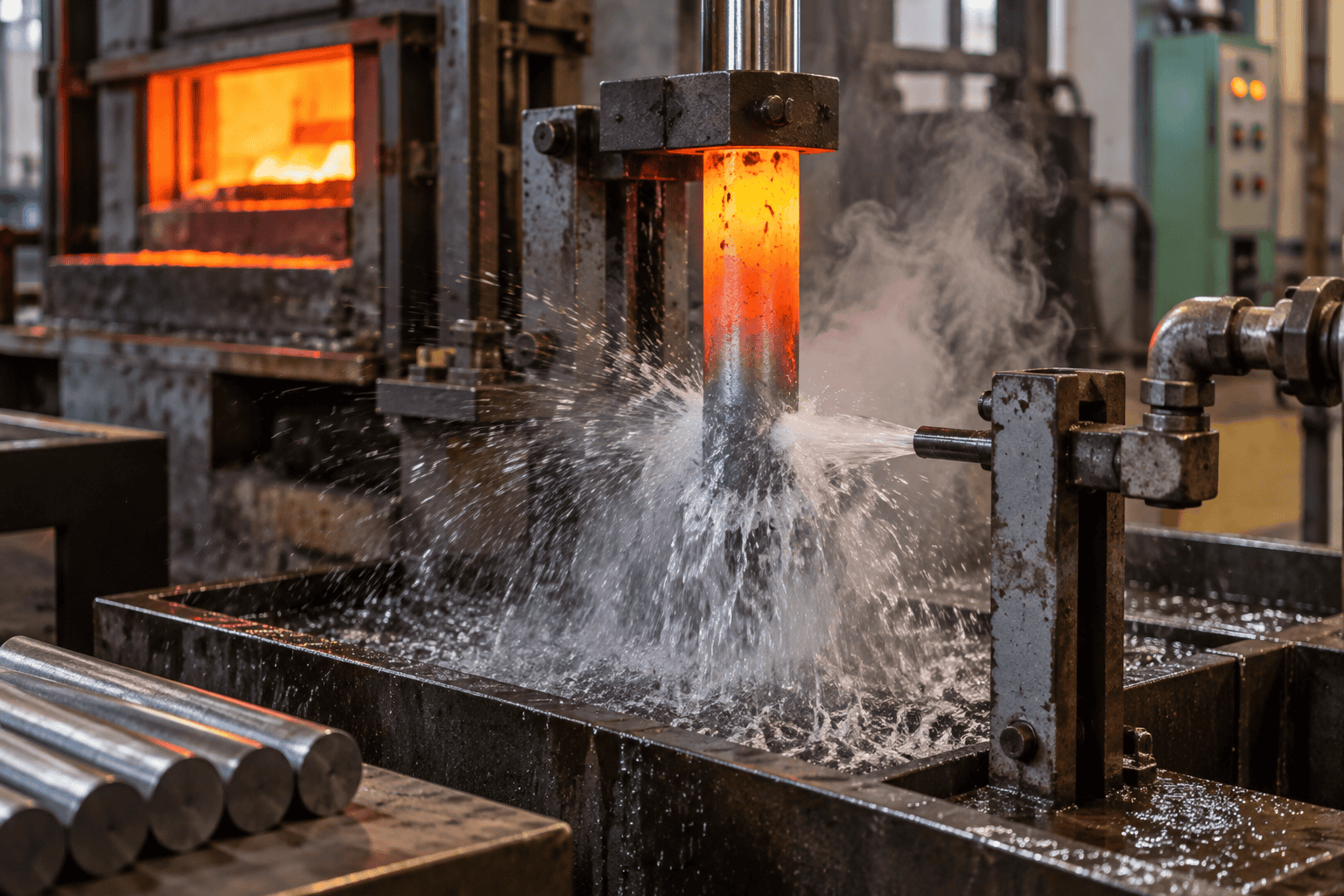
Hardenability is the capacity of a steel to achieve a given hardness level at a specified depth below the quenched surface — it is not a measure of maximum attainable hardness (which is governed by carbon content), but rather how effectively the quench is transmitted through the section. A steel with high hardenability can be fully hardened to martensite at its centre even in large section sizes or with mild quench media; a low-hardenability steel requires a severe quench and is limited to thin sections.
Hardenability is measured quantitatively by the Jominy end-quench test (ISO 642 / ASTM A255): a 25 mm diameter × 100 mm round bar is austenitised and water-quenched from one end face only. The resulting controlled cooling rate gradient along the bar — fastest at the quenched end, slowest at the opposite end — is correlated with hardness measured at 1.5 mm intervals from the quenched end, producing a hardenability curve (J-curve). The J-curve for a steel grade is specified as a band in applicable material standards (e.g., SAE J1268 hardenability bands for H-steels).
Grossmann Equivalent Radius and Section Hardness Prediction
Using Grossmann’s equivalent radius charts, a specific Jominy distance can be mapped to the cooling rate at the centre or surface of a round bar of known diameter quenched in a medium of known H-value. This allows prediction of attainable core hardness in a production component from the J-curve alone — eliminating trial heat treatment iterations.
Hardenability Estimation: Carbon Equivalent Approach
The influence of alloying elements on hardenability can be estimated using empirical carbon equivalent relationships. A simplified form useful for comparative assessment is:
DIN Carbon Equivalent (Ceq):

Ceq = C + Mn/6 + (Cr + Mo + V)/5 + (Ni + Cu)/15

Where all elements in wt%.

Higher Ceq → greater hardenability → TTT pearlite nose shifted
to longer times → milder quench medium achieves full hardness depth
More rigorous hardenability prediction uses the Grossmann multiplying factors for each element, which account for their effect on the ideal critical diameter (DI). These are tabulated in ASM Handbook Vol. 4A. For alloys with significant boron additions, note that even trace levels of boron (5–30 ppm) dramatically increase hardenability by segregating to austenite grain boundaries and retarding ferrite nucleation. See the MetallurgyZone article on martensite formation for the thermodynamic basis of alloying element effects on Ms temperature and transformation driving force.
Tempering After Quenching: Restoring Toughness
As-quenched martensite is almost universally too brittle for engineering service. The extreme lattice distortion, high dislocation density, and residual stress state produce a microstructure that is hard but has near-zero fracture toughness in high-carbon grades. Tempering — reheating the quenched steel to 150–700°C and holding — allows controlled recovery of the martensite structure through a sequence of overlapping reactions:
- Stage 1 (80–200°C): Precipitation of transition carbides (epsilon-carbide, Fe2.4C) from the supersaturated martensite matrix; partial relief of carbon tetragonality.
- Stage 2 (200–300°C): Decomposition of retained austenite to bainite; important in high-carbon steels with significant retained austenite.
- Stage 3 (250–400°C): Dissolution of transition carbides and precipitation of cementite (Fe3C) on lath boundaries; major dislocation recovery begins.
- Stage 4 (400–700°C): Rapid cementite spheroidisation, recovery and recrystallisation of the ferrite matrix, lath coarsening — significant hardness loss with major toughness gain.
The practical consequence for 4140 steel (a widely used alloy) is shown in the tempering response table below. This data is representative of 25 mm diameter oil-quenched bars tempered 2 hours.
| Temper Temp. (°C) | Hardness (HRC) | UTS (MPa) | 0.2% YS (MPa) | Charpy (J at 20°C) |
|---|---|---|---|---|
| 200 | 54 | 1,860 | 1,570 | 25 |
| 300 | 50 | 1,720 | 1,450 | 35 |
| 400 | 44 | 1,450 | 1,280 | 55 |
| 500 | 38 | 1,200 | 1,050 | 90 |
| 600 | 30 | 980 | 840 | 130 |
For the full scientific basis of tempering reactions including secondary hardening in tool steels and high-speed steels, see the MetallurgyZone guide on quenching and tempering steel. The annealing and normalising guide covers the contrasting heat treatment processes used when hardness reduction is the objective.
Industrial Quenching Operations
Automotive Powertrain Components
Crankshafts, camshafts, output shafts, ring gears, and bearing races are among the highest-volume quenched components in manufacturing. These are routinely produced from medium-carbon alloy steels (5140, 8620, 4340) and either through-hardened or selectively induction hardened then oil or polymer quenched in automated production lines. Cycle times are 30–120 seconds per part. Computer-controlled quench tanks with agitators, bath thermostats, and quench rate recording ensure consistent H-values across thousands of parts per shift, with statistical process control on hardness measurements at the end of line.
Tool and Die Manufacturing
High-speed steels (M2, M4), hot-work tool steels (H13), and cold-work steels (D2, A2) demand extremely controlled quenching to achieve the correct secondary hardening carbide distribution with minimal distortion. Vacuum hardening furnaces with high-pressure nitrogen gas quenching (typically 6–20 bar) have become the industry standard for precision tooling. The furnace atmosphere prevents surface decarburisation and oxidation, producing bright, dimensionally stable tools. The quench gas pressure is selected to achieve the required cooling rate for the specific steel: 6 bar N2 for H13, up to 20 bar for D2 in large sections.
Aerospace Structural Components
Safety-critical aerospace components from 4340, 300M, and maraging steels are quenched and tempered to extremely tight mechanical property bands, then 100% inspected by magnetic particle or liquid penetrant testing for quench cracks before any further processing. The quench process is formally documented: oil temperature ±5°C, agitation speed verified by calibrated flow meter, and part temperature checked with contact thermocouple before tempering. Any non-conformance in the quench record triggers full batch quarantine. Refer to the MetallurgyZone article on HAZ microstructure for the analogous thermal cycle effects in welding of these high-strength materials.
Case Study: Quench Crack Failure in a 4140 Gear Shaft
A precision engineering facility reported longitudinal quench cracking in 4140 gear shafts (35 mm diameter, 380 mm length) after oil quenching from 860°C. Failure analysis included:
Metallographic findings: Cracks initiated at the base of a keyway — a sharp re-entrant corner with estimated stress concentration factor Kt ≈ 3.5. Microstructure was 100% lath martensite, hardness 56 HRC — metallurgically correct for the process. No evidence of surface decarburisation, seams, or pre-existing defects. Grain size ASTM 6–7 (appropriate).
Root cause: The combination of high quench severity (H ≈ 0.7 for fast oil), sharp keyway geometry, and a 90-minute quench-to-temper delay allowed residual stress accumulation — potentially exacerbated by diffusible hydrogen from pickling — to initiate and propagate cracking at the stress concentration. The ductility of fresh martensite is insufficient to relax stress concentrations plastically at temperatures below about 120°C.
Corrective actions: (1) Transitioned to polymer quench medium (H ≈ 0.55) — reduced cooling rate by ~20% without compromising core hardness at this section size. (2) Keyway machined after heat treatment rather than before. (3) Quench-to-temper time reduced to <20 minutes as a mandatory process hold. Subsequent 500-part production run showed zero quench cracks on 100% MT inspection.
Frequently Asked Questions
What is the purpose of quenching steel?
What is the difference between a TTT diagram and a CCT diagram?
What is marquenching (martempering) and when should it be used?
How does carbon content affect martensite hardness?
What is the Grossmann H-value and why does it matter?
Can aluminium alloys be quenched?
Why must steel be tempered immediately after quenching?
What is the effect of prior austenite grain size on quench cracking risk?
Recommended Reference Books
ASM Handbook Vol. 4A: Steel Heat Treating Fundamentals
The definitive reference for steel heat treatment: austenitising, quenching, tempering, hardenability, distortion, and industrial processes. Essential for any heat treatment engineer.
View on AmazonSteels: Microstructure and Properties — Bhadeshia & Honeycombe
Authoritative graduate-level text covering the physical metallurgy of all steel microstructures including martensite, bainite, pearlite, and their transformation kinetics. 4th edition.
View on AmazonSteel Heat Treatment: Metallurgy and Technologies — Totten (ed.)
Comprehensive multi-author reference covering TTT/CCT diagrams, quench media, hardenability, distortion control, carburising, nitriding, and case hardening. CRC Press.
View on AmazonPrinciples of Heat Treatment — Grossmann & Bain
The foundational classic establishing the H-value concept, hardenability theory, and ideal critical diameter method. Essential historical and technical reference for quenching engineers.
View on AmazonDisclosure: MetallurgyZone participates in the Amazon Associates programme. If you purchase through these links, we may earn a small commission at no extra cost to you. This helps support free technical content on this site.
References
- ASM Handbook Vol. 4A: Steel Heat Treating Fundamentals and Processes. ASM International, 2013.
- Totten, G.E. (ed.), Steel Heat Treatment: Metallurgy and Technologies. CRC Press, 2007.
- Bhadeshia, H.K.D.H. and Honeycombe, R., Steels: Microstructure and Properties. 4th ed. Butterworth-Heinemann, 2017.
- Grossmann, M.A. and Bain, E.C., Principles of Heat Treatment. ASM International, 1964.
- ISO 642:1999 — Steel: Hardenability test by end quenching (Jominy test).
- ASTM A255 — Standard Test Methods for Determining Hardenability of Steel.
- AMS 2759 — Heat Treatment of Steel Parts: General Requirements.
Further Reading
Iron-Carbon Phase Diagram
Phase fields, critical temperatures, and the eutectoid reaction that governs all steel heat treatment.
Martensite Formation in Steel
Bain correspondence, habit plane crystallography, Ms temperature, and lath vs plate morphology.
Bainite Microstructure
Upper and lower bainite transformation mechanisms, mechanical properties, and industrial significance.
Pearlite Colony Growth
Cooperative growth of ferrite and cementite lamellae, interlamellar spacing, and pearlite hardness.
Annealing and Normalising
Subcritical, full, and process annealing; normalising temperatures and microstructural outcomes.
Quenching and Tempering Guide
Complete Q&T process design: tempering stages, secondary hardening, and mechanical property prediction.
Grain Boundaries: Types and Segregation
LAGB vs HAGB, grain boundary energy, segregation of P and Sn causing temper embrittlement.
Hydrogen-Induced Cracking
Mechanisms, susceptibility of high-strength martensite, and prevention strategies for HAC in steel.
