The Iron-Carbon Phase Diagram: A Complete Technical Guide
The iron-carbon binary phase diagram is the single most important diagram in ferrous metallurgy. It encodes the thermodynamic equilibrium between phases in Fe-C alloys as a function of temperature and composition, providing the theoretical foundation for predicting every steel and cast iron microstructure. This guide explains every phase region, boundary line, and invariant reaction point of the Fe-Fe3C metastable system, demonstrates lever rule calculations, and connects the diagram to practical heat treatment, microstructure prediction, and manufacturing outcomes.
Key Takeaways
- The Fe-Fe3C diagram contains three invariant reactions: the eutectoid (0.77% C, 727°C), eutectic (4.30% C, 1,148°C), and peritectic (0.17% C, 1,493°C).
- Austenite (FCC) dissolves up to 2.14% C; ferrite (BCC) dissolves only 0.022% C — the difference drives all carbon partitioning during heat treatment.
- The lever rule gives the weight fraction of each phase in any two-phase field at a known temperature and composition.
- The steel-cast iron boundary is 2.14% C (maximum solubility in austenite at the eutectic temperature); commercial cast irons typically contain 2.5–4.0% C.
- The standard Fe-C diagram is the metastable Fe-Fe3C system; the stable system uses graphite instead of cementite as the equilibrium carbon-rich phase.
- Every alloying element shifts the critical temperatures and eutectoid composition: austenite stabilisers (Ni, Mn) lower A1; ferrite stabilisers (Cr, Mo) raise A1 and shrink the γ-loop.
Iron-Carbon Lever Rule Calculator
Select a temperature regime and enter your steel or cast iron composition to calculate phase fractions using the lever rule. Results include a full step-by-step derivation.
Allotropy of Iron: The Foundation of Steel Heat Treatment
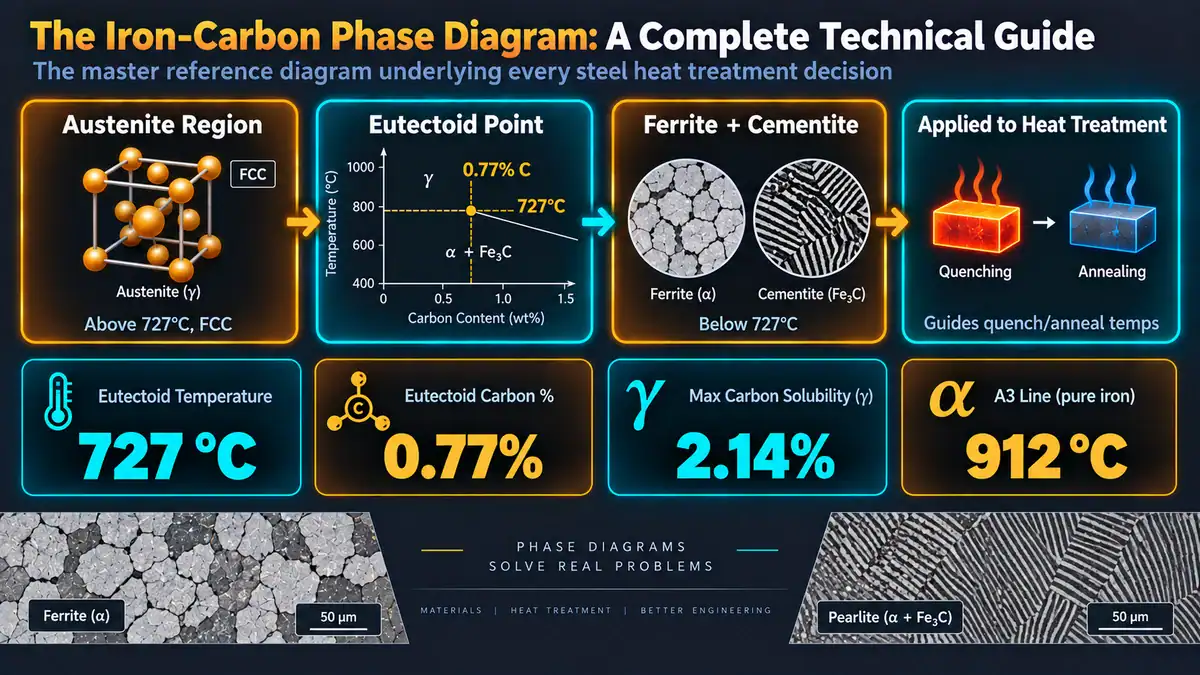
Pure iron undergoes two solid-state allotropic transformations with temperature, and it is these transformations that make steel heat treatment thermodynamically possible:
- α-iron (ferrite, BCC): Stable from room temperature to 912°C. Ferromagnetic below 770°C (Curie temperature, A2). The tetrahedral interstitial sites in BCC iron are smaller than those in FCC, limiting carbon solubility to just 0.022 wt% at 727°C (the maximum, at the A1 temperature) and less than 0.008 wt% at room temperature.
- γ-iron (austenite, FCC): Stable from 912°C to 1,394°C. Paramagnetic. The larger octahedral interstitial sites in the FCC lattice accommodate carbon atoms with far less lattice strain, giving a maximum solubility of 2.14 wt% C at 1,148°C. This enormous difference in solubility (2.14% vs 0.022%) is the thermodynamic engine of all steel heat treatment — heating into the austenite field dissolves carbides; controlled cooling re-partitions carbon into the desired transformation product.
- δ-iron (delta-ferrite, BCC): Stable from 1,394°C to the melting point of 1,538°C. Dissolves up to 0.09 wt% C. Important mainly in the peritectic reaction and in continuous casting solidification.
Boundary Lines and Critical Temperatures
The A1 Line — 727°C, the Eutectoid Isotherm
The horizontal line at 727°C is the most important single line in ferrous metallurgy. It defines the eutectoid temperature: the invariant temperature at which the eutectoid reaction occurs. Any steel heated above 727°C into the austenite (or α+γ) field and slowly cooled will pass through this line, triggering the eutectoid or proeutectoid transformations. Every heat treatment — hardening, annealing, normalising — is defined relative to A1. The heating equivalent is denoted Ac1 (approximately 30–50°C higher than A1 for typical heating rates due to transformation hysteresis); the cooling equivalent is Ar1 (lower than A1 during cooling).
The A3 Line
The A3 boundary separates the γ-austenite single-phase field from the (α+γ) two-phase field in hypoeutectoid steels (0–0.77% C). It curves from 912°C at 0% C down to 727°C at 0.77% C. To fully austenitise a hypoeutectoid steel (dissolve all ferrite), it must be heated above its A3 temperature. The equivalent on heating is Ac3. See the complete treatment of the eutectoid reaction in steel for the thermodynamic derivation of the 727°C transition temperature.
The Acm Line
Acm is the upper phase boundary for hypereutectoid steels (0.77–2.14% C), separating the γ-austenite single-phase field from the (γ+Fe3C) two-phase field. It rises from 727°C at 0.77% C to 1,148°C at 2.14% C. To fully dissolve proeutectoid cementite and achieve a homogeneous austenite, a hypereutectoid steel must be heated above its Acm. In practice, hardening of hypereutectoid tool steels is often performed just above A1 (not Acm) to retain fine undissolved carbide particles that limit austenite grain growth and improve wear resistance after hardening.
Liquidus and Solidus Lines
The liquidus marks the temperature above which the alloy is entirely liquid; the solidus marks the temperature below which it is entirely solid. Between these lines exists a two-phase liquid-plus-solid mushy zone. In continuous casting, the slab centre traverses this mushy zone slowly, creating the conditions for dendritic solidification, microsegregation, and centreline porosity. The eutectic composition (4.30% C) has the lowest liquidus temperature in the Fe-C system (1,148°C), which is why cast irons have lower melting points and better casting fluidity than steels.
Invariant Reactions
The Eutectoid Reaction: 0.77% C, 727°C
The eutectoid is a three-phase invariant reaction in which a single solid phase (austenite) simultaneously transforms into two different solid phases (ferrite and cementite) at a fixed temperature and composition:
Eutectoid Reaction (on cooling):
  γ (0.77% C) → α (0.022% C) + Fe₃C (6.67% C)
  Temperature: 727°C (A1)

Product microstructure: PEARLITE
  — Alternating lamellae of ferrite and cementite
  — Interlamellar spacing inversely proportional to undercooling:
      Coarse pearlite (650–700°C): spacing ~0.5 µm, ~160–200 HBW
      Fine pearlite / sorbite (550–600°C): spacing ~0.1–0.2 µm, ~350–400 HBW
The eutectoid reaction is invariant: at exactly 727°C, three phases coexist in fixed proportions, and no change in temperature can occur until one phase is fully consumed. In a 0.77% C steel, 100% of the austenite transforms to pearlite at 727°C. In hypoeutectoid steels, only the austenite remaining after proeutectoid ferrite precipitation undergoes this reaction. For a thorough treatment of nucleation and growth kinetics see the guide on pearlite colony growth.
The Eutectic Reaction: 4.30% C, 1,148°C
Eutectic Reaction (on cooling):
  L (4.30% C) → γ (2.14% C) + Fe₃C (6.67% C)
  Temperature: 1,148°C

Product microstructure: LEDEBURITE
  — Interpenetrating network of austenite and cementite
  — On further cooling below 727°C, the austenite in ledeburite
    transforms to pearlite → “transformed ledeburite”
Ledeburite is the characteristic eutectic microstructure of white cast iron. All cast iron compositions above 2.14% C pass through the eutectic reaction during solidification. Whether the carbon-rich phase solidifies as cementite (white iron) or graphite (grey iron) depends on the carbon equivalent CE = C + Si/3 and the cooling rate. Silicon destabilises Fe3C relative to graphite; slow cooling and high CE promote graphitisation.
The Peritectic Reaction: 0.17% C, 1,493°C
Peritectic Reaction (on cooling):
  L (0.53% C) + δ (0.09% C) → γ (0.17% C)
  Temperature: 1,493°C

  A liquid phase and a solid phase react to produce
  a single new solid phase.
The peritectic reaction occurs in steels near 0.10–0.17% C and is primarily important in continuous casting. The δ → γ solid-state transformation involves a volume contraction (BCC → FCC, ~0.5% linear contraction) that creates a gap between the solidifying shell and the mould wall, reducing heat extraction and causing the shell to become irregular. This produces longitudinal surface cracks — a persistent quality problem for medium-carbon peritectic steels in continuous casting. Dynamic soft reduction and mould taper optimisation are used to mitigate this effect.
Applying the Lever Rule
The lever rule is a mass balance applied across a two-phase field to determine the weight fraction of each phase at a given temperature and overall composition. It derives from the constraint that the total carbon must be conserved between the two phases.
For overall composition C₀ in a two-phase field (Cₐ, Cₙ):
  where Cₐ = composition of the carbon-lean phase endpoint
        Cₙ = composition of the carbon-rich phase endpoint
        Cₐ < C₀ < Cₙ

  Fraction of carbon-rich phase (B) = (C₀ − Cₐ) / (Cₙ − Cₐ)
  Fraction of carbon-lean phase (A) = (Cₙ − C₀) / (Cₙ − Cₐ)
  Sum = 1.0 (they must sum to 100%)

The “lever” analogy: C₀ is the fulcrum; the fraction of each
phase is inversely proportional to its arm length from C₀.
Worked Example: 0.4% C Steel at Room Temperature
At equilibrium below 727°C, the two phases are ferrite (CA = 0.008% C at room temperature) and cementite (CB = 6.67% C). For C0 = 0.40% C:
Fraction Fe₃C = (0.40 − 0.008) / (6.67 − 0.008)
               = 0.392 / 6.662 = 0.0589 = 5.89%

Fraction α   = (6.67 − 0.40) / (6.67 − 0.008)
               = 6.27 / 6.662 = 0.9411 = 94.11%

Check: 5.89% + 94.11% = 100.00% ✓
Worked Example: Proportion of Pearlite in 0.4% C Steel
Immediately below 727°C, to find the fraction that is pearlite (as opposed to proeutectoid ferrite), use the lever rule across the eutectoid tie-line with CA = 0.022% (ferrite) and CB = 0.77% (eutectoid austenite → pearlite):
Fraction pearlite = (0.40 − 0.022) / (0.77 − 0.022)
                  = 0.378 / 0.748 = 0.505 = 50.5%

Fraction proeutectoid ferrite = (0.77 − 0.40) / (0.77 − 0.022)
                               = 0.37 / 0.748 = 0.495 = 49.5%

∴ A 0.4% C steel is approximately 50% pearlite + 50% proeutectoid ferrite
  (at equilibrium, slow cooling from fully austenitic condition).
This simple calculation predicts the microstructure of a normalised or annealed hypoeutectoid steel with no further information about the phase diagram. Use the lever rule calculator above to explore other compositions and temperature regimes.
Microstructures Predicted by the Phase Diagram
Hypoeutectoid Steels (0–0.77% C)
On slow cooling from fully austenitic conditions above A3: proeutectoid ferrite nucleates first at austenite grain boundaries (see the grain boundaries guide for why boundaries are preferred nucleation sites), growing as polygonal grains or, at faster cooling rates, as Widmanstätten plates. As ferrite forms, the remaining austenite is enriched in carbon and its composition tracks down the A3 boundary. At 727°C, the remaining austenite (now at 0.77% C) transforms to pearlite. The approximate fraction of pearlite is 1.3 × %C (valid for steels up to 0.6% C). The proportion of ferrite increases, and that of pearlite decreases, as carbon content decreases toward 0%.
Eutectoid Steel (0.77% C)
No proeutectoid phase forms. The entire cross-section of austenite at the A1 temperature has exactly the eutectoid composition. On slow cooling below 727°C, the entire microstructure transforms to 100% pearlite. Eutectoid steels (∼AISI 1080) are used for high-strength wire (piano wire, prestress strand) and rails, where the high percentage of cementite lamellae in pearlite provides hardness and wear resistance. See the pearlite colony growth guide for lamellar spacing and transformation kinetics.
Hypereutectoid Steels (0.77–2.14% C)
On slow cooling from above Acm: proeutectoid cementite nucleates at austenite grain boundaries as a thin, continuous network. At 727°C, the remaining austenite (at 0.77% C) transforms to pearlite. The cementite network is brittle and detrimental to toughness — it is eliminated by spheroidising annealing (heating just below A1 for extended times), which converts the network into discrete spheroidal carbide particles within a ferrite matrix. Spheroidised microstructures are required for machining and cold-forming high-carbon steels. For the heat treatment details, see the guide on annealing and normalising in steel.
After quenching from above A3 (hypoeutectoid) or above A1 (hypereutectoid), the carbon is trapped in solution as supersaturated martensite rather than partitioning to cementite. The result is a hard, brittle body-centred tetragonal (BCT) phase. See the martensite formation guide for the crystallographic mechanism and the quenching and tempering guide for how tempering recovers toughness by controlled cementite precipitation.
Cast Irons and the Phase Diagram
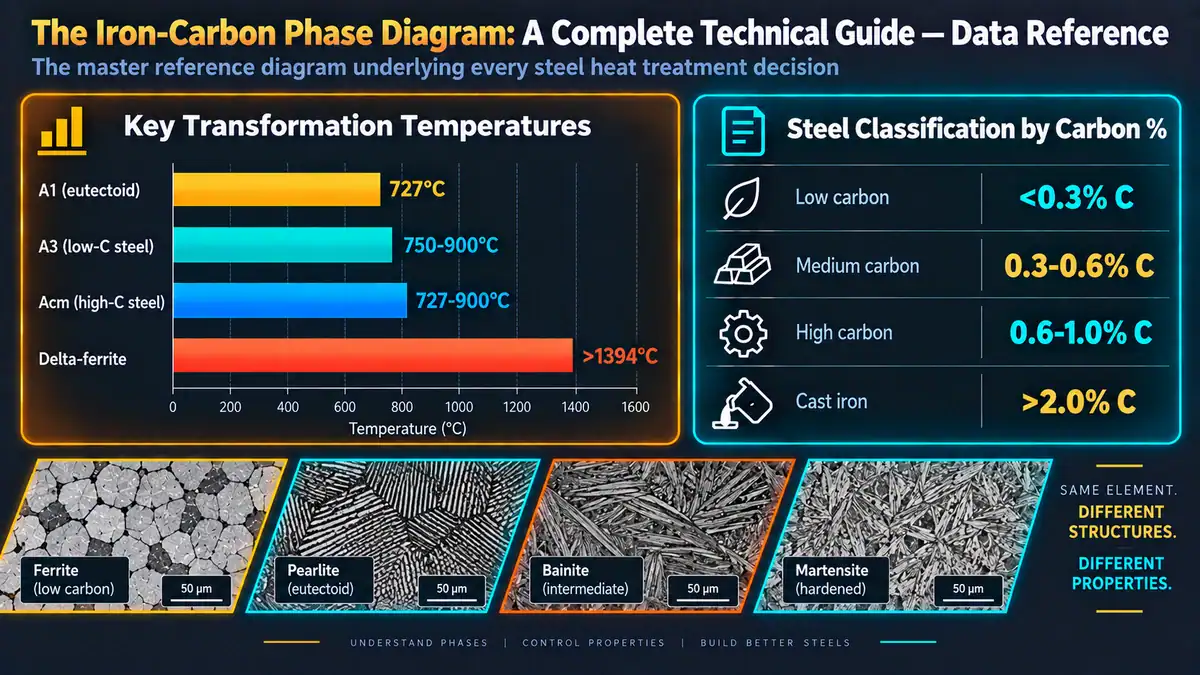
Alloys containing more than 2.14 wt% C are cast irons — they pass through the eutectic reaction during solidification and cannot be fully austenitised during solid-state heat treatment. Commercial cast irons contain 2.5–4.0% C. The type of cast iron produced depends on the carbon equivalent CE = C + Si/3 and the solidification cooling rate:
| Cast Iron Type | CE Range | Cooling Rate | Primary Carbon Phase | Key Properties |
|---|---|---|---|---|
| White iron | Low CE | Fast | Fe3C (cementite) | Hard (>700 HBW), brittle, wear-resistant |
| Grey iron (flake graphite) | High CE | Slow | Graphite flakes | Good machinability, damping; low tensile strength |
| Ductile / SG iron | Medium–High CE | Moderate | Graphite nodules (Mg-treated) | High strength + ductility; TS >400 MPa |
| Malleable iron | Low–Medium CE | Solidified as white; annealed | Temper carbon (graphite rosettes) | Ductile after anneal; for small castings |
Silicon’s role is critical: it reduces the stability of Fe3C relative to graphite by modifying the free energy of both phases. In grey iron (CE > 4.3 — hypereutectic compositions), graphite flakes nucleate and grow before the eutectic. In hypoeutectic grey iron, graphite forms as part of the eutectic at the eutectic isotherm of the stable Fe-C system (1,154°C, slightly higher than the metastable eutectic at 1,148°C).
The Metastable vs Stable Fe-C System
The diagram discussed throughout this guide is technically the metastable Fe-Fe3C system, in which cementite (Fe3C) is the carbon-rich equilibrium phase. The stable Fe-C (graphite) system has slightly higher transformation temperatures (stable eutectic at 1,154°C vs metastable at 1,148°C; stable eutectoid at ~738°C vs 727°C) and uses graphite instead of cementite as the equilibrium phase.
Cementite is kinetically stable in steels under normal service conditions — decomposition to iron and graphite requires thousands of years at ambient temperature. However, in grey cast iron and during prolonged annealing above 700°C, graphitisation is thermodynamically driven and practically significant. Elevated-temperature service of steel components (>700°C for extended periods) can cause graphitisation in the weld HAZ of carbon-molybdenum steels, reducing creep strength — a well-documented degradation mechanism in petrochemical pressure vessels. See also the HAZ microstructure guide for related high-temperature degradation mechanisms.
Effect of Alloying Elements on the Phase Diagram
Every alloying element modifies the thermodynamics of the Fe-C system, shifting the critical temperatures and eutectoid composition:
| Element | Type | Effect on A1 | Effect on Eutectoid Composition | Practical Consequence |
|---|---|---|---|---|
| Mn | Austenite stabiliser | Lowers | Shifts to lower %C | High Mn (>12%) gives room-temp austenite (Hadfield steel) |
| Ni | Austenite stabiliser | Lowers | Slight left shift | >25% Ni suppresses BCC completely (austenitic stainless) |
| Cr | Ferrite stabiliser + carbide former | Raises | Strong left shift; forms Cr23C6, Cr7C3 | High Cr shrinks γ-loop; ferritic stainless has no γ-field at RT |
| Mo | Ferrite stabiliser + carbide former | Raises | Left shift | Mo2C formation; retards austenite grain growth |
| Si | Ferrite stabiliser (non-carbide-former) | Raises | Left shift | Promotes graphitisation in cast irons; strengthens ferrite in steel |
| N | Austenite stabiliser | Lowers | Slight right shift | Critical in duplex stainless steels for phase balance control |
In highly alloyed systems (stainless steels, tool steels, Ni superalloys), multi-component phase diagrams computed by CALPHAD software (Thermo-Calc, JMatPro) are required for accurate phase boundary prediction. The binary Fe-C diagram remains the conceptual foundation, but quantitative phase equilibria in real alloys require multi-component Gibbs energy minimisation.
Industrial Applications: Reading the Diagram for Heat Treatment Design
Every industrial steel heat treatment is designed by reading the Fe-C diagram (with appropriate corrections for alloying elements) to select the austenitising temperature, predict the expected microstructure, and verify that the intended phase transformation will occur:
- Annealing / normalising: Heat 30–50°C above A3 (hypoeutectoid) or A1 (hypereutectoid) to fully austenitise; control cooling rate to produce pearlite or ferrite-pearlite. Details at annealing and normalising in steel.
- Hardening: Heat above A3 (hypoeutectoid) to dissolve all ferrite; quench to suppress diffusional transformations and produce martensite. See martensite formation.
- Isothermal annealing / austempering: Quench to a temperature in the bainite field (between A1 and Ms) for controlled bainite transformation. See bainite microstructure.
- Carburising: Heat low-carbon steel to 900–980°C (in the γ-field) and expose to carbon-rich atmosphere to increase surface carbon by diffusion.
- Hardness testing: Verifying predicted hardness from microstructure requires knowledge of phase fractions. Use the hardness testing guide for correlating Vickers, Rockwell, and Brinell values to microstructural constituents.
Frequently Asked Questions
What are the three invariant reactions in the Fe-C phase diagram?
The three invariant reactions are: (1) the eutectoid at 727°C and 0.77% C — austenite simultaneously transforms to ferrite plus cementite (pearlite); (2) the eutectic at 1,148°C and 4.30% C — liquid transforms simultaneously to austenite plus cementite (ledeburite); (3) the peritectic at 1,493°C and 0.17% C — liquid plus delta-ferrite react to form gamma-austenite. All three are invariant because at the exact reaction temperature, three phases coexist and the system has zero degrees of thermodynamic freedom (Gibbs phase rule: F = C − P + 2 = 2 − 3 + 1 = 0 for the isobaric case).
Why can austenite dissolve more carbon than ferrite?
Austenite (FCC, γ-iron) dissolves up to 2.14 wt% C at 1,148°C because its octahedral interstitial sites (radius 0.052 nm) are significantly larger than those in ferrite (BCC, α-iron, radius 0.036 nm). Carbon atoms have an effective radius of approximately 0.077 nm. Although both crystal structures require lattice dilation to accommodate carbon, the FCC site imposes proportionally less elastic strain energy, reducing the chemical potential of dissolved carbon and enabling far greater equilibrium solubility. Ferrite’s maximum carbon solubility is only 0.022 wt% at 727°C — 100 times less than austenite at its peak.
What is the lever rule and how is it applied to the Fe-C diagram?
The lever rule is a mass balance that determines weight fractions of phases in a two-phase field. For overall composition C0 between phase endpoints CA and CB: fraction of phase B = (C0 − CA) / (CB − CA); fraction of phase A = (CB − C0) / (CB − CA). For example, a 0.40% C steel at room temperature has 5.9% cementite and 94.1% ferrite. The same steel just below 727°C has approximately 50.5% pearlite and 49.5% proeutectoid ferrite, calculated using the eutectoid endpoints (0.022% and 0.77% C).
What is the difference between the stable and metastable Fe-C phase diagrams?
The metastable Fe-Fe3C diagram treats cementite (Fe3C) as the equilibrium carbon-rich phase with transformation temperatures A1 = 727°C and eutectic at 1,148°C. The stable Fe-C (graphite) diagram has slightly higher temperatures (A1 ∼738°C, eutectic at 1,154°C) and graphite as the equilibrium phase. Cementite is kinetically stable in steel under normal conditions for thousands of years but will graphitise at elevated temperatures (>700°C) over extended times. Silicon in cast irons destabilises Fe3C and promotes graphitisation, which is why grey irons contain graphite flakes rather than cementite.
Why is the eutectoid point at 0.77% C and not at some other value?
The eutectoid composition is set by thermodynamics — specifically by the common tangent of the free energy curves for ferrite and cementite at 727°C. These curves are highly asymmetric because ferrite (BCC metal) and cementite (orthorhombic complex carbide) have very different crystal structures and bonding, placing the common tangent intersection at 0.77% C. In alloyed steels, the eutectoid composition shifts: Cr, Mo, and V shift it to lower carbon contents; Ni and Mn also shift it, generally to lower values. The eutectoid temperature is simultaneously shifted by alloying elements as described.
What is proeutectoid ferrite and how does it form?
Proeutectoid ferrite is ferrite that precipitates from austenite above the A1 temperature during slow cooling of hypoeutectoid steels (0–0.77% C). As the steel is cooled below A3, it enters the (α+γ) two-phase field and ferrite nucleates at austenite grain boundaries. The remaining austenite becomes progressively enriched in carbon as ferrite forms (carbon partitions to the remaining austenite). At 727°C, the remaining austenite reaches exactly 0.77% C and transforms to pearlite. The fraction of proeutectoid ferrite in the final microstructure decreases linearly with increasing carbon content, reaching zero at 0.77% C.
How do alloying elements such as Cr and Ni shift the Fe-C diagram?
Austenite stabilisers (Ni, Mn, Cu, N) lower A1 and A3, expanding the gamma-field to lower temperatures. Ni above ~25% suppresses the BCC transformation entirely at room temperature. Ferrite stabilisers (Cr, Mo, W, V, Si, Al) raise A1, shrink the gamma-loop, and shift the eutectoid to lower carbon content. High-Cr ferritic stainless steels have a drastically reduced or absent gamma-field. Carbide-forming elements (Cr, Mo, V, Nb, Ti) replace cementite with alloy carbides, further reducing the effective eutectoid carbon content. Multi-component CALPHAD calculations are required for quantitative accuracy in complex alloy systems.
Why is the peritectic reaction important in continuous casting?
At the peritectic composition (~0.17% C), the δ-ferrite to γ-austenite solid-state transformation involves a volume contraction (~0.5% linear) as the structure changes from BCC to the denser FCC. This contraction creates a gap between the solidifying shell and the continuous casting mould, reducing heat transfer and causing the shell thickness to become uneven. The resulting thermal stress concentration produces longitudinal surface cracks in continuously cast slabs — a significant quality problem for medium-carbon steels in the peritectic composition range. Mould taper optimisation and controlled meniscus cooling are used to mitigate this.
What carbon content separates steel from cast iron in the Fe-C diagram?
The boundary is 2.14 wt% C, the maximum solubility of carbon in austenite at the eutectic temperature (1,148°C). Alloys below 2.14% C can be fully austenitised during heat treatment; alloys above 2.14% C cannot be fully austenitised (undissolved carbides or graphite always persist above A1) and are classified as cast irons. In commercial practice, steels rarely exceed 1.2% C and cast irons typically contain 2.5–4.0% C, well above the boundary.
Recommended References
Disclosure: MetallurgyZone participates in the Amazon Associates programme. If you purchase through these links, we may earn a small commission at no extra cost to you. This helps support free technical content on this site.
Further Reading
