Hardness Testing: Vickers, Rockwell, Brinell, and Microhardness Methods
Hardness is the resistance of a material to localised permanent deformation under an applied contact force. It is among the most widely performed mechanical tests in metals production and quality assurance, valued for its speed, minimal specimen preparation, and near-non-destructive character. This article provides a graduate-engineer-level treatment of all principal hardness methods — Vickers, Rockwell, Brinell, Knoop, and Leeb — covering their physical principles, indenter geometry, applicable load ranges, governing standards, hardness scale conversion per ASTM E140, and their specific roles in weld inspection, sour-service qualification, heat treatment control, and case depth measurement.
Key Takeaways
- Hardness measures resistance to localised plastic deformation; it correlates with flow stress and, for steels, provides a reliable empirical estimate of tensile strength (UTS ≈ 3.45 × HBW for carbon and low-alloy steels).
- Vickers (ISO 6507 / ASTM E92) uses a 136° square-pyramid diamond; HV is load-independent from HV5 to HV100 and is the preferred scale for weld hardness surveys and NACE compliance verification.
- Rockwell C (ASTM E18, ISO 6508) uses a 120° diamond Brale indenter at 150 kgf total load; HRC is the production QC standard for heat-treated steels. Minimum specimen thickness ≈ 1.5 mm for typical tool-steel hardness.
- Brinell HBW (ASTM E10, ISO 6506) with a 10 mm tungsten carbide ball at 3000 kgf is the standard for cast irons, forgings, and plate materials; the large impression averages over microstructural heterogeneity.
- NACE MR0175/ISO 15156 limits carbon and low-alloy steel weld and HAZ hardness to 22 HRC = 248 HV10 = 237 HBW in H2S service.
- Leeb portable hardness (ASTM A956) enables in-situ testing of large components; conversion to HRC/HB/HV is equipment-embedded but carries greater uncertainty than laboratory methods.
Hardness Conversion Calculator
Convert between HRC, HV, HBW, and approximate tensile strength for carbon and low-alloy steels (ASTM E140 Table 1). Valid range: HRC 20–68.
⚠ Conversions are approximate per ASTM E140 Table 1 (carbon and low-alloy steels). Do not apply to aluminium alloys, cast irons, austenitic stainless steels, or non-ferrous metals without material-specific conversion data.
The Physical Basis of Hardness
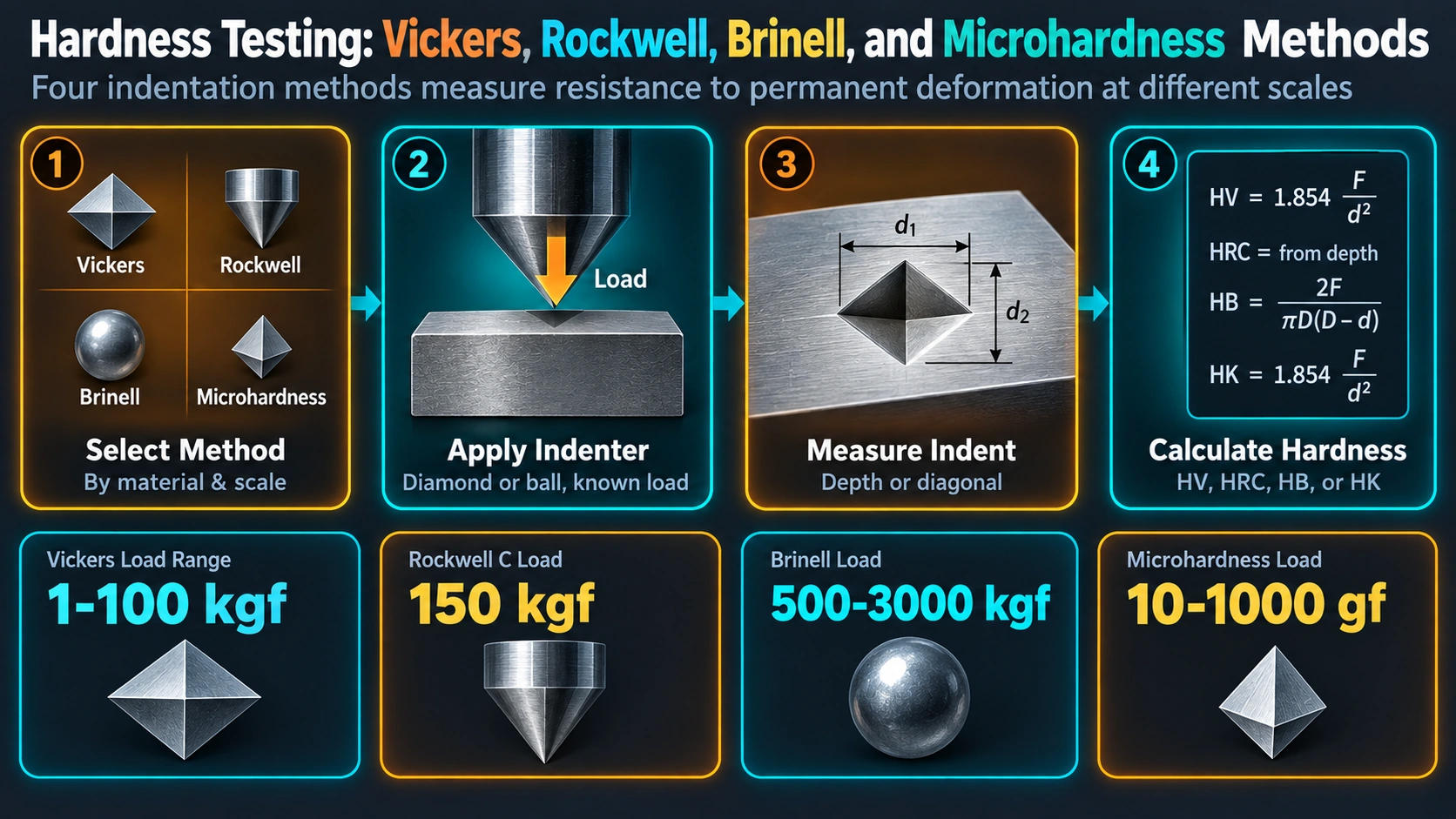
Hardness is not a fundamental material property in the thermodynamic sense — it is an engineering measure that depends on both the elastic and plastic response of the material under the specific indentation conditions of the chosen test. At the micro-scale, resistance to indentation is governed by dislocation density and mobility, grain boundary strengthening, solid-solution hardening, and precipitate strengthening. The martensite present in an as-quenched steel has the highest dislocation density and highest hardness of any ferrous microstructure; annealed ferritic steel has the lowest. Understanding which microstructural state is present — and whether it is appropriate for the application — is one reason hardness testing remains central to metallurgical QC.
For steels, the empirical correlation between Brinell hardness and tensile strength is one of the most practically useful relationships in materials engineering:
UTS (MPa)  ≈ 3.45 × HBW       [SI units]
UTS (psi)  ≈ 500  × HBW       [imperial]

Basis: ASTM A370, ASME Section II Part D Appendix 2
Valid range: 100 – 400 HBW (approximately 56 – 1380 MPa)
Accuracy: ± 7% for carbon and low-alloy steels in this range

Do NOT apply to:
  • Austenitic stainless steels
  • Aluminium alloys (separate empirical constants apply)
  • Cast irons (heterogeneous microstructure invalidates the relationship)
  • Cold-worked metals (work hardening raises HBW without proportional UTS increase)
Vickers Hardness Test (HV)
Principle and Indenter Geometry
The Vickers test, developed by Smith and Sandland at Vickers Ltd. in 1921, uses a square-based diamond pyramid with a 136° included face angle (the angle between opposite faces). The indenter is pressed into the polished test surface under a known load F for a dwell time of 10–15 seconds; the square impression left in the surface is measured optically using the two diagonals d1 and d2. The Vickers hardness number is the load divided by the contact area of the impression:
HV = (2F sin(136°/2)) / d²  ≈  1.8544 F / d²

Where:
  F  = applied test force, kgf  (N ÷ 9.807)
  d  = mean diagonal = (d₁ + d₂) / 2, mm

Example: F = 10 kgf (HV10), d = 0.320 mm
  HV = 1.8544 × 10 / 0.320² = 18.544 / 0.1024 = 181 HV10

Notation: HV[load][dwell time if not standard]
  e.g. 240 HV10 = Vickers 240 under 10 kgf, 15 s dwell (default omitted)
Load Range and Scale Designations
The Vickers test is uniquely versatile because the hardness value is theoretically independent of test force across the macro range (HV5 to HV100). This property — geometrical similarity of the impression — follows from the 136° pyramid geometry: as load increases, the impression scales proportionally and the ratio F/d² remains constant. In practice, deviations occur at very low loads where the indentation size effect (ISE) causes apparent hardness to increase as load decreases below approximately HV0.5, and at very high loads on inhomogeneous materials.
| Designation | Test Force (kgf / N) | Typical Application | Governing Standard |
|---|---|---|---|
| HV0.01 | 0.01 / 0.098 | Thin PVD coatings (<1 μm) | ISO 6507-1, ASTM E384 |
| HV0.025–HV0.1 | 0.025–0.1 / 0.25–0.98 | Individual phases, carburised layers, thin films | ISO 6507-1 |
| HV0.2–HV1 | 0.2–1 / 1.96–9.81 | Microhardness traverse, case depth, HAZ profile | ISO 6507-1, ASTM E384 |
| HV5, HV10 | 5–10 / 49–98 | Standard weld hardness surveys, NACE compliance | ISO 6507-1, ASTM E92, EN ISO 9015-1 |
| HV30, HV50, HV100 | 30–100 / 294–981 | Bulk hardness of heavy sections, forgings | ISO 6507-1, ASTM E92 |
| ASTM E92 and ISO 6507-1 define macro Vickers (HV1 and above); ASTM E384 and ISO 6507-1 define micro Vickers (below HV1). | |||
Weld Hardness Surveys per EN ISO 9015-1
EN ISO 9015-1 prescribes the traverse pattern for Vickers weld hardness surveys: indents are placed in the weld metal, fusion line, HAZ, and base metal in a defined pattern. For butt welds in plate, the standard requires at least three rows of indents (top surface row, mid-thickness row, and root row). Indent spacing must be a minimum of three times the diagonal length from centre to centre and from any edge. HV5 or HV10 is specified; individual indent results are reported and the maximum value compared against the applicable acceptance criterion (typically 248 HV10 for NACE compliance or 350 HV for general weld quality). For further context on HAZ microstructure and why hardness limits matter, see the dedicated MetallurgyZone guide.
Rockwell Hardness Test (HR)
Principle: Differential Depth Measurement
The Rockwell test, invented by Stanley Rockwell and patented in 1919, differs fundamentally from Vickers and Brinell in that it measures the depth of penetration under load rather than the size of the residual impression. The test sequence has three stages:
- Pre-load (minor load): A preliminary load of 10 kgf (98 N) is applied, seating the indenter and establishing a reference depth, eliminating the effect of surface roughness. This reference position is set to zero.
- Major load application: The additional major load (140 kgf for HRC, giving 150 kgf total) is applied slowly and held for a dwell time of 2–6 seconds.
- Major load removed: The major load is removed; the pre-load remains. The permanent depth increase h (the increment from pre-load to final position after elastic recovery) is measured. The Rockwell number is calculated as a constant minus the penetration depth in units of 0.002 mm.
HRC = 100 − (h / 0.002)

Where:
  h = additional permanent penetration depth beyond pre-load reference, mm
  Each Rockwell unit = 0.002 mm depth increment

Example: h = 0.100 mm permanent penetration
  HRC = 100 − (0.100 / 0.002) = 100 − 50 = 50 HRC

For HRB scale (ball indenter, minor load 10 kgf, major load 100 kgf total):
  HRB = 130 − (h / 0.002)
Rockwell Scales and Their Applications
| Scale | Indenter | Total Load (kgf) | Range | Typical Application |
|---|---|---|---|---|
| HRC | Diamond Brale 120° | 150 | 20–70 | Heat-treated alloy steels, tool steels, hard castings |
| HRB | 1/16 in WC ball | 100 | 35–100 | Soft steels, annealed steels, Cu alloys, Al alloys |
| HRA | Diamond Brale | 60 | 60–88 | Cemented carbides, very hard thin coatings |
| HRD | Diamond Brale | 100 | 40–77 | Medium cemented carbides, thin hard materials |
| HR15N | Diamond Brale | 15 (superficial) | 70–94 | Thin case-hardened layers, nitrided surfaces |
| HR30N | Diamond Brale | 30 (superficial) | 42–86 | Sheet metal, thin cases |
| HR45N | Diamond Brale | 45 (superficial) | 20–77 | Sheet metal where 30N is insufficient depth |
| HRF | 1/16 in ball | 60 | 60–100 | Annealed copper alloys, thin soft sheet |
| Source: ASTM E18 Table 1 / ISO 6508-1 Table 1. WC = tungsten carbide; diamond ball indenters prohibited above 100 HRB (risk of diamond fracture). | ||||
HRC scale validity range: ASTM E18 specifies the valid range of HRC as 20–70 HRC. Results below 20 HRC should be reported on the HRB or Rockwell 15N scale; results above 70 HRC (very hard carbides, ceramics) are outside the calibrated range. The HRC scale is also invalid for thin specimens where the impression depth exceeds the substrate thickness limit (minimum approximately 10× the depth of penetration).
Brinell Hardness Test (HBW)
Principle and Geometry
The Brinell test, developed by Johan August Brinell and presented at the Paris World Exhibition in 1900, uses a hardened tungsten carbide (WC) ball pressed into the test surface under a known load. The Brinell Hardness Number (now designated HBW — H for hardness, B for Brinell, W for tungsten carbide ball) is the load divided by the curved surface area of the spherical impression:
HBW = (2F) / (πD(D − √(D² − d²)))

Where:
  F = applied test force, kgf
  D = ball diameter, mm (standard: 10 mm)
  d = mean impression diameter, mm  (average of two perpendicular measurements)

Note: Previous designation HBS (steel ball) is deprecated; all modern tests use WC ball.

Standard conditions for steel and cast iron:
  Ball: D = 10 mm WC
  Load: F = 3000 kgf (29.42 kN)  ⇒ Load/diameter ratio F/D² = 30
  Dwell: 10–15 s

Valid hardness range: 16–650 HBW10/3000
Practical upper limit: 450 HBW (above this, Vickers is preferred to avoid ball deformation)
Why Brinell for Forgings, Castings, and Plate
The large 10 mm ball produces a large impression (typically 2.5–6 mm diameter), which samples a significant volume of material and naturally averages over microstructural heterogeneity — grain clusters, pearlite colonies, graphite nodules in ductile iron, and inclusion stringers. This makes Brinell more representative than Vickers or Rockwell for coarse-grained materials, large forgings, and weld overlays where local microstructural variation is significant. Mill test certificates for structural plate (SA-516, SA-387), pressure vessel forgings (SA-105, SA-182), and pipe (API 5L) routinely report HBW values measured on the mill floor with portable Brinell testers. For context on iron-carbon phase diagram regions and how microstructure controls hardness, see the MetallurgyZone phase diagram guide.
Knoop Microhardness Test (HK)
Knoop hardness, developed at the National Bureau of Standards by Frederick Knoop in 1939, uses a diamond pyramid indenter with an elongated rhombic base: the long diagonal is approximately 7.11 times the short diagonal, giving an aspect ratio of approximately 7:1. The hardness is calculated from the long diagonal only:
HK = 14.229 F / l²

Where: F = applied force, kgf;  l = long diagonal, mm
The extremely shallow Knoop impression (depth ≈ l/30, compared to l/7 for Vickers) makes it ideal for:
- Thin PVD/CVD coatings where Vickers indentation would crack or penetrate through the coating
- Brittle materials (ceramics, cemented carbide phases, intermetallics) that crack under Vickers loads
- Anisotropy measurement: the elongated impression responds differently to slip in directions parallel and perpendicular to the long axis, enabling detection of crystallographic anisotropy or fibre alignment in composites
Leeb Rebound Hardness Test (HL)
Leeb hardness (also called dynamic or portable hardness) uses a spring-propelled impact body that strikes the test surface and rebounds. The ratio of rebound velocity to impact velocity, measured by an electromagnetic coil surrounding the impact tube, gives the Leeb hardness value:
HL = (vR / vI) × 1000

Where:
  vR = rebound velocity of impact body, m/s
  vI = impact velocity of impact body, m/s
  HL = dimensionless (typically 300–900 for metals)

Device types (ISO 16859-1):
  D  — standard WC tip, most common
  DC — WC tip, compact device for confined access
  DL — WC tip, deep bore testing
  C  — WC tip, smaller mass, for lighter sections
  G  — WC tip, large mass, for rough cast surfaces
  S  — WC ball (spherical) tip, softer metals
Leeb values are converted to HRC, HBW, HV, or UTS using calibration curves embedded in the portable instrument. The conversions carry greater uncertainty than laboratory methods (typically ±3 HRC or ±15 HBW) because they depend on the material’s elastic modulus and acoustic impedance, which vary between alloy families. For in-situ testing of large pressure vessels, heat exchanger shells, and structural steelwork where laboratory testing is impractical, Leeb is the standard. ASTM A956/A956M and ISO 16859 govern testing and conversion procedures.
Shore Hardness (Scleroscope)
The Shore scleroscope (patented 1907) drops a diamond-tipped hammer of fixed mass from a fixed height onto the test surface and measures the rebound height. Shore hardness (HSc or HSd depending on hammer size) is expressed as 100 times the rebound height fraction of the drop height. The method is entirely non-marking on polished surfaces and was historically used for large rolls, bearing surfaces, and tool steel dies before Leeb instruments became widely available. It is now largely superseded by Leeb in industrial practice, though Shore D is still widely used for plastics and elastomers (ASTM D2240).
Hardness Scale Conversion and the ASTM E140 Tables
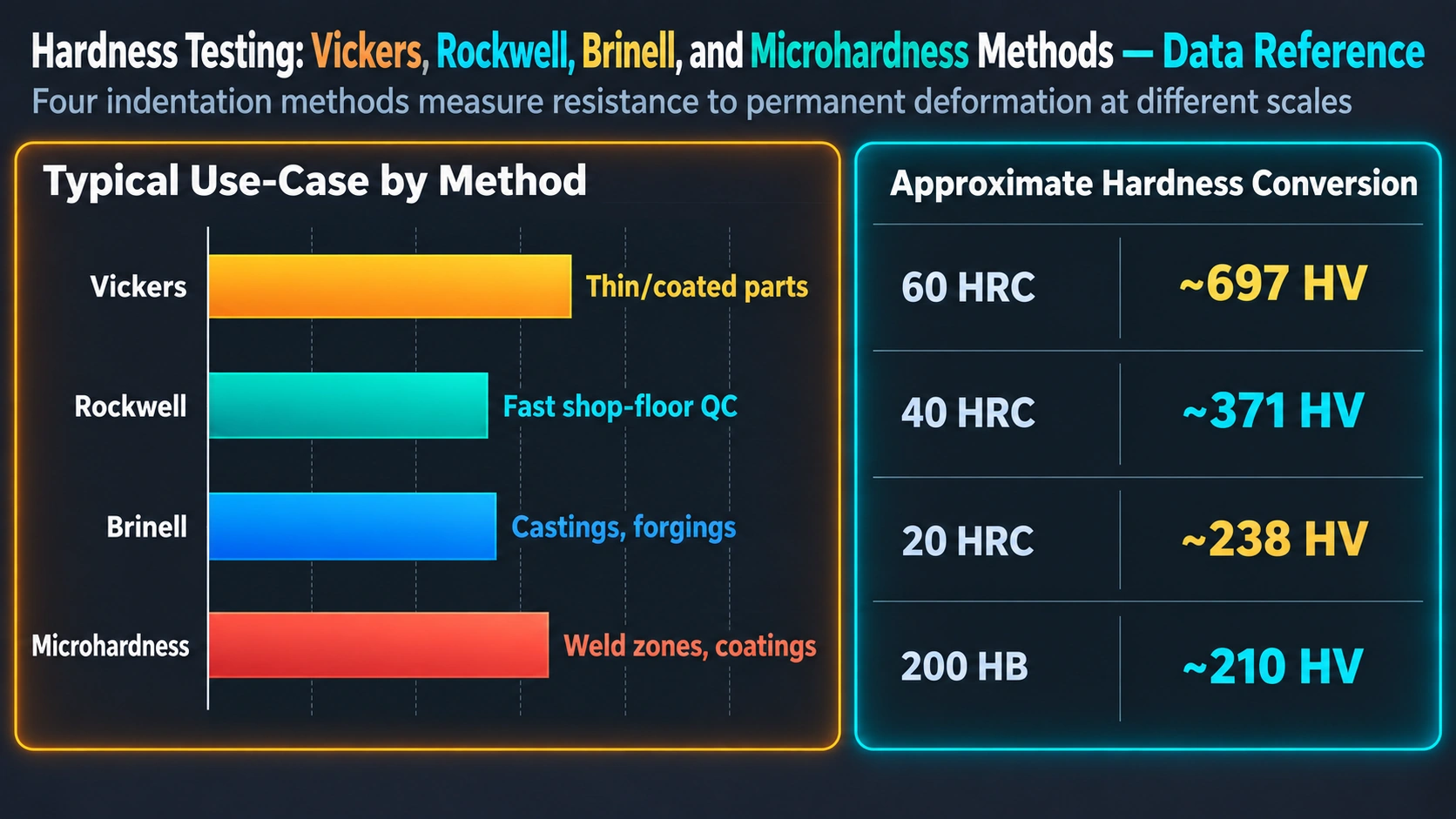
Converting between hardness scales is a routine requirement in metallurgical practice — a material certificate reports HBW but the acceptance criterion is specified in HRC, or a portable Leeb tester gives HL which must be compared against HV10. ASTM E140 (Standard Hardness Conversion Tables for Metals) provides the primary reference for carbon and low-alloy steels, austenitic stainless steels, nickel alloys, cartridge brass, and copper alloys. The following table reproduces the key reference points from ASTM E140 Table 1 (carbon and low-alloy steels), exactly as preserved from the original MetallurgyZone article data:
| HRC | HV (Vickers) | HBW (10/3000) | Approx. UTS (MPa) | Typical Condition / Steel |
|---|---|---|---|---|
| 68 | 940 | — | 3090 | File-hard, as-quenched high-carbon steel |
| 62 | 746 | — | 2450 | As-quenched high-carbon steel (>0.6%C) |
| 58 | 633 | 603 | 2080 | Case-hardened bearing steel |
| 52 | 512 | 488 | 1680 | Hardened H13 / H11 tool steel |
| 45 | 432 | 411 | 1420 | Austempered ductile iron; spring steel tempered |
| 40 | 381 | 363 | 1250 | S690 Q+T structural steel; high-strength bolt |
| 35 | 336 | 320 | 1100 | Bainitic / spring steel; 4340 Q+T |
| 22 | 248 | 237 | 820 | NACE MR0175 max for C&LA steel weld/HAZ |
| 20 | 238 | 226 | 783 | Lower practical limit of HRC scale |
| — | 180 | 170 | 590 | Normalised SA-516 Gr.70 / A36 plate |
| — | 140 | 131 | 455 | Annealed low-carbon steel |
| — | 100 | 95 | 325 | Pure iron, fully annealed |
| Source: ASTM E140-12b Table 1. The highlighted row is the NACE MR0175/ISO 15156-2 acceptance limit for H₂S service. UTS = 3.45 × HBW (ASTM A370). Above ~450 HBW, Brinell is not reliable; Vickers or Rockwell should be used. | ||||
Critical limitation: ASTM E140 conversions apply only to the specified alloy/condition columns. Applying the carbon steel table to austenitic stainless steel, aluminium alloys, or titanium will give systematically incorrect results. Each alloy family has its own conversion table in ASTM E140.
Applications in Weld Inspection and Code Compliance
NACE MR0175 / ISO 15156 Sour Service
The 22 HRC (248 HV10) hardness limit for carbon and low-alloy steel weld metal and HAZ in hydrogen sulphide service is one of the most cited code requirements in oil and gas fabrication. The physical basis is the sharp increase in hydrogen embrittlement susceptibility above approximately 250 HV, where untempered or high-dislocation-density martensite becomes susceptible to hydrogen-enhanced decohesion (HEDE) cracking at stress intensities well below KIC. Post-weld heat treatment (PWHT) is frequently required to temper hard HAZ martensite to below the limit. For a complete treatment of PWHT requirements and procedures, see the dedicated MetallurgyZone article.
ASME Section IX and Weld Procedure Qualification
While ASME Section IX does not mandate hardness limits as a test of weld procedure qualification in most cases, many purchaser specifications and supplementary requirements (such as API 2B, NACE compliance, or EPC specifications) add hardness testing to the PQR acceptance criteria. HV10 traverses per EN ISO 9015-1 across the full weld cross-section are reported on the PQR and must demonstrate compliant maximum hardness. Hardness results are also an essential audit finding during in-service inspection under API 510 and API 570 for equipment in sour or hydrogen service. For context on weld metallurgy, see the MetallurgyZone guide on hydrogen-induced cracking and HAZ microstructure.
Case Depth Measurement by Microhardness Traverse
The effective case depth (ECD) of carburised, carbonitrided, or nitrided components is measured by Vickers microhardness traverse. A polished cross-section perpendicular to the treated surface is prepared, and HV0.1 or HV0.3 indents are placed at intervals of 0.1–0.15 mm from the surface inward until hardness falls below the specified limit (typically 550 HV for case-hardened steel per ISO 2639; 400–450 HV for nitrided layers). The traverse produces a hardness-depth profile from which ECD is read. Surface hardness values above 750 HV indicate properly developed carburised martensite; values below 650 HV at the surface may indicate decarburisation, insufficient carbon potential, or inadequate quench. The relationship between hardness profile and microstructure is discussed in the MetallurgyZone article on quenching and tempering.
Surface Preparation, Spacing, and Test Validity Requirements
The validity of any hardness measurement depends critically on surface condition, indent spacing, section thickness, and operator technique. The principal requirements from ASTM E92 (Vickers), ASTM E18 (Rockwell), and ASTM E10 (Brinell) are:
- Surface finish: For macro Vickers (HV5–HV100), a 320-grit or finer grinding finish is adequate. For micro Vickers below HV1, a metallographic polish (1 μm diamond or finer) is required to resolve impressions accurately.
- Minimum thickness: The specimen must be thick enough that the deformation zone does not extend to the back face. Rules: Vickers — minimum thickness ≥ 10× diagonal; Rockwell C — minimum thickness ≥ 10× depth (approximately 1.5 mm for HRC 45–60); Brinell — minimum thickness ≥ 10× maximum impression depth (approximately 8× d/D).
- Indent spacing: Vickers — centre-to-centre spacing ≥ 3× diagonal; edge distance ≥ 2.5× diagonal. Brinell — centre-to-centre ≥ 3× d; edge distance ≥ 2.5× d. Rockwell — centre-to-centre ≥ 3 mm.
- Anvil and support: The specimen must be fully supported; any rocking will cause asymmetric impression and artificially low hardness. Curved surfaces require V-block supports or a curved anvil correction per ASTM E18 Appendix.
Standards Quick Reference
| Method | ASTM Standard | ISO Standard | Calibration / Reference Blocks |
|---|---|---|---|
| Vickers (macro, HV1–HV100) | ASTM E92 | ISO 6507-1/2/3 | ASTM E92 Annex; ISO 6507-3 |
| Vickers / Knoop (micro, <HV1) | ASTM E384 | ISO 6507-1, ISO 4545 | ASTM E384 Annex; certified micro-HV blocks |
| Rockwell (all scales) | ASTM E18 | ISO 6508-1/2/3 | ASTM E18 Annex A2; ISO 6508-3 |
| Brinell | ASTM E10 | ISO 6506-1/2/3 | ASTM E10 Annex; ISO 6506-3 |
| Leeb (portable/dynamic) | ASTM A956/A956M | ISO 16859-1/2/3 | ISO 16859-3; impact device calibration jig |
| Knoop | ASTM E384 | ISO 4545-1/2/3 | Shared with micro Vickers blocks |
| Hardness conversion tables | ASTM E140 | ISO 18265 | N/A (tabulated data) |
| Weld hardness surveys | AWS B4.0 | EN ISO 9015-1/2 | Per applicable Vickers standard above |
| All instruments must be verified using certified reference blocks traceable to national metrology institutes (NIST, NPL, PTB) at the frequency specified in the applicable standard. | |||
Instrument Calibration and Traceability
All hardness testing machines must be calibrated using certified reference blocks traceable to national standards laboratories. ASTM E92, E18, E10, and E384 all specify direct verification (applying the test to a certified hardness reference block and checking that the result falls within a specified tolerance of the certified value) and indirect verification (calibration of the loading mechanism, measuring system, and indenter geometry). Direct verification is required daily before any production testing; indirect verification intervals are typically annual for fixed laboratory instruments and per-job for portable instruments in field service. Hardness reference blocks must be recertified periodically and must not be used on both faces (to prevent work-hardening from previous indentations affecting results).
The Knoop and Vickers hardness scales are related to SI units through the definition of HV and HK in terms of force (N) divided by impression area (mm²); Rockwell and Brinell are defined through their specific procedures and have no direct SI-unit form, though Brinell can be expressed in units of kgf/mm² numerically equal to the HBW number. The relationship between hardness and Charpy impact toughness is not straightforward — two steels at the same hardness can have very different toughness values depending on microstructure — but for a given steel and heat treatment condition, both hardness and toughness are governed by the same microstructural variables, making concurrent hardness and impact testing the standard approach in weld procedure qualification.
Frequently Asked Questions
What is the difference between Vickers and Rockwell hardness?
What hardness limit applies to carbon steel welds in sour service?
How is Brinell hardness converted to tensile strength?
What load should be used for Vickers hardness testing of steel welds?
Can Rockwell C scale be used on thin sheet metal?
What is the Knoop hardness test used for?
How does the Leeb rebound hardness test work?
Why are hardness conversion tables approximate, not exact?
What is effective case depth and how is it measured?
Recommended Reference Books and Equipment
Disclosure: MetallurgyZone participates in the Amazon Associates programme. If you purchase through these links, we may earn a small commission at no extra cost to you. This helps support free technical content on this site.
