Annealing Processes in Steel: Full, Process, Spheroidise, Normalising, and Stress Relief
Annealing is a broad term covering any heat treatment that reduces hardness, relieves residual stresses, or improves ductility and machinability in ferrous alloys. In practice, the term encompasses five distinct processes — full annealing, process (subcritical) annealing, spheroidising annealing, normalising, and stress relieving — each targeting a specific metallurgical outcome and differing fundamentally in austenitising temperature, cooling rate, and the microstructure produced. Selecting the correct annealing process is one of the most consequential decisions in steel manufacturing: the wrong choice produces either insufficient softening, loss of key mechanical properties, or unnecessary cost. This article explains the phase diagram basis for each process, the governing metallurgical mechanisms, the resulting microstructures, and the industrial applications where each process is specified.
Key Takeaways
- All annealing processes are positioned relative to the critical temperatures Ac1 (~727°C) and Ac3 (912°C for pure iron, decreasing to 727°C at 0.77%C): processes above Ac3 involve austenitisation; those below operate purely on the ferrite + carbide microstructure.
- Full annealing produces the softest possible microstructure (coarse pearlite, 140–220 HBN for 0.1–0.8%C) through very slow furnace cooling at 10–30°C/hr; normalising uses air cooling for a finer pearlite with higher strength but at significantly lower cycle cost.
- Spheroidising annealing is mandatory before cold heading and cold drawing of high-carbon steel: it converts brittle lamellar cementite to globular carbides, which are essential for cold formability and machinability of bearing and tool steels.
- Process (subcritical) annealing operates below Ac1 on cold-worked low-carbon steel, restoring ductility through recrystallisation without any phase transformation and without requiring long furnace-cool cycles.
- Stress relieving at 550–650°C reduces residual stresses by 50–80% through dislocation recovery without measurable change in microstructure or hardness; post-weld stress relief temperature must always be below the original tempering temperature in Q&T steels.
- In alloy steels with high hardenability, normalising may produce bainite or surface martensite rather than pearlite; isothermal annealing below the pearlite nose guarantees a fully soft, pearlitic microstructure when air cooling is insufficient.
Annealing Temperature Calculator
Enter carbon content and select steel class. Recommended temperatures are calculated for each annealing process relative to Ac1 and Ac3.
The Iron-Carbon Phase Diagram as the Basis for Annealing
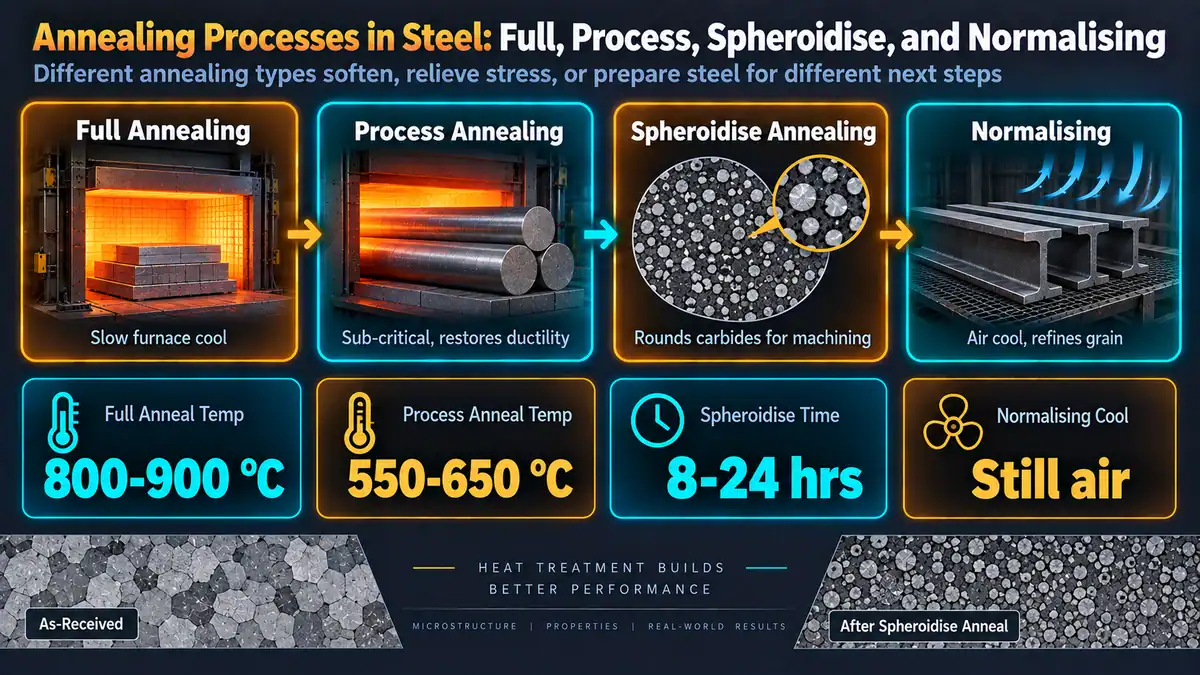
Every annealing process is defined by its position relative to the critical transformation temperatures of the iron-carbon phase diagram. These temperatures are:
- Ac1 (lower critical temperature): Approximately 727°C for plain carbon steels. Below Ac1, steel exists as ferrite + cementite (or ferrite + pearlite). Above Ac1, austenite begins to form by the reverse eutectoid reaction. The 0.77%C eutectoid composition transforms isothermally to 100% austenite at exactly Ac1.
- Ac3 (upper critical temperature): 912°C for pure iron, decreasing nonlinearly to 727°C at 0.77%C as carbon content increases. Above Ac3, hypoeutectoid steels are fully austenitic with no proeutectoid ferrite.
- Acm (upper cementite boundary): Applies to hypereutectoid steels (>0.77%C). Above Acm, all carbides are dissolved in austenite. Acm increases with carbon above 0.77%C, reaching approximately 900°C at 1.2%C.
The prefix “Ac” derives from the French chauffage (heating); on cooling, the equivalent temperatures are “Ar” (refroidissement) and are 10–30°C lower due to transformation hysteresis at practical heating and cooling rates. Heat treatment specifications always reference Ac temperatures for austenitising targets, since the steel is heated to and soaked at these temperatures.
Empirical Equations for Ac1 and Ac3
For plain carbon and low-alloy steels, the following empirical relationships (after Andrews, 1965) give a practical estimate of Ac1 and Ac3 from chemical composition:
Andrews (1965) empirical equations:

  Ac1 (°C) = 723 - 10.7×%Mn - 16.9×%Ni + 29.1×%Si
               + 16.9×%Cr + 290×%As + 6.38×%W

  Ac3 (°C) = 910 - 203×√(%C) - 15.2×%Ni + 44.7×%Si
               + 104×%V + 31.5×%Mo + 13.1×%W
               - 30×%Mn - 11×%Cr - 20×%Cu + 700×%P + 400×%Al

Simplified (plain carbon steels only):
  Ac1 (°C) ≈ 723
  Ac3 (°C) ≈ 910 - 203×√(%C)   [hypoeutectoid, valid 0 to 0.77%C]
  Acm (°C) ≈ 727 + 23×(%C - 0.77)  [hypereutectoid, rough estimate]
These equations form the basis of the annealing temperature calculator above. For detailed composition-adjusted calculations including Mn, Cr, Mo, and other alloying element effects, refer to the full Andrews equations or dedicated software (JMatPro, Thermo-Calc).
Full Annealing
Process Description and Temperature Selection
Full annealing is the most thorough softening treatment available for carbon and low-alloy steels. The process involves heating to 30–50°C above Ac3 (for hypoeutectoid steels, <0.77%C) or above Ac1 (for hypereutectoid steels, >0.77%C, to avoid dissolving all grain-boundary cementite and causing grain growth), soaking for sufficient time to achieve complete, uniform austenitisation through the section, then cooling in the furnace at a controlled rate of 10–30°C/hr through the transformation range.
Resulting Microstructure
The very slow furnace cooling allows the maximum possible time for carbon diffusion during transformation. Austenite transforms to coarse pearlite — ferrite and cementite lamellae with interlamellar spacings of 200–500 nm. For hypoeutectoid steels, proeutectoid ferrite precipitates first at prior austenite grain boundaries above Ar1 before pearlite forms. The coarse lamellar structure provides:
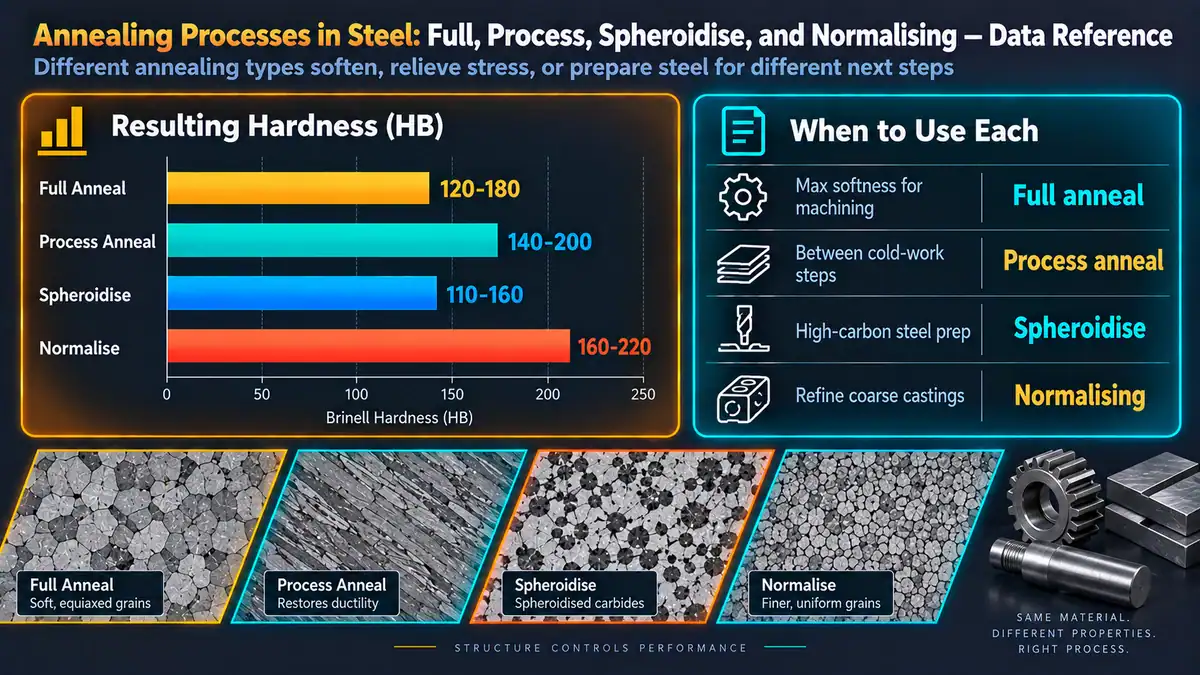
- Minimum hardness for the carbon content: 140–220 HBN for 0.1–0.8%C steels
- Maximum ductility and workability for cold forming operations
- A homogeneous, banding-free microstructure when starting from segregated as-rolled material
The microstructural basis for pearlite softness versus fine pearlite is covered in detail in the pearlite colony growth article.
Industrial Applications
- Maximum machinability of medium-carbon bar: AISI 1040–1060 bar full-annealed before automatic screw machine operations requiring precise chip control
- Elimination of banding in plate and bar: Compositional segregation (Mn, C banding) aligned with rolling direction is removed by homogenisation at full-anneal temperatures
- Restoration of ductility after severe cold working: For cold-drawn bar or wire that requires re-forming after intermediate drawing passes
- Pre-machining condition for complex components: Before precision boring, tapping, or broaching operations where maximum tool life requires minimum steel hardness
Process (Subcritical) Annealing
Mechanism and Temperature Range
Process annealing is performed entirely below Ac1 — typically at 550–700°C — on cold-worked, low-carbon steels (generally <0.25%C). No austenite forms and no phase transformation occurs. Instead, three sequential solid-state recovery mechanisms reduce stored cold-work energy and restore ductility:
- Recovery (lower temperature range, ~200–400°C): Thermal energy allows dislocations to climb, cross-slip, and rearrange into lower-energy configurations (sub-grain walls, polygonisation). Dislocation density decreases modestly. Strength drops slightly; ductility improves slightly. Residual stresses are partially relieved. X-ray diffraction peak broadening decreases measurably.
- Recrystallisation (~400–650°C for cold-worked low-C steel): New, strain-free grains nucleate at sites of high stored energy (deformation bands, prior grain boundaries, inclusion surfaces) and grow, consuming the deformed, work-hardened matrix. Strength drops dramatically; ductility is restored to near-unworked values. The recrystallisation temperature is not fixed — it decreases with increasing prior cold work level (more stored energy = lower nucleation barrier) and with increasing purity.
- Grain growth (>650°C or extended time): After recrystallisation is complete, normal grain growth coarsens the new grain structure by grain boundary migration driven by surface energy reduction. Excessive grain growth degrades surface finish in subsequent deep drawing or ironing operations (“orange peel” texture) and reduces toughness.
Industrial Applications
Process annealing is the workhorse treatment for flat-rolled steel strip, wire, and tube production:
- Cold-rolled strip in bell furnaces (batch annealing): Coils stacked in an inert atmosphere (H2 or N2-H2 mix) bell furnace at 580–680°C for 12–40 hours. Widely used for ultra-low carbon (ULC) and interstitial-free (IF) deep drawing quality steels.
- Continuous annealing lines (CAL): Strip passes through a furnace at 700–780°C for 30–120 seconds. Faster cycles and better flatness control than batch annealing. Used for automotive exposed quality (EQ) and paintability (P) grades requiring very consistent properties.
- Wire drawing between passes: High-carbon wire (music wire, PC strand) or stainless wire may require inter-strand process annealing to restore ductility before the next drawing die.
- Tube drawing: Cold-drawn seamless or welded tubes in light-gauge hydraulic and instrument service.
Spheroidising Annealing
Why Spheroidising Is Necessary
In medium and high-carbon steels (0.35–2.14%C), the lamellar cementite in pearlite and the continuous grain-boundary cementite network in hypereutectoid steels are the principal obstacles to cold formability and machinability. Cementite (Fe3C) is extremely hard (~1,200 HV) and brittle: lamellar cementite acts as a stress concentrator during cold deformation, limiting drawing reductions before cracking, and dulls cutting tools rapidly during machining. Spheroidising annealing converts these detrimental morphologies into discrete globular (spheroidal) carbide particles dispersed in a soft ferrite matrix, fundamentally transforming the steel’s workability.
Spheroidised microstructure is required before:
- Cold heading of medium and high-carbon fasteners: Bolts, studs, socket-head cap screws in 1035–1541 steel; forming reductions up to 80% without cracking
- Cold drawing of high-carbon wire: Spring wire (ASTM A228), valve spring wire, PC wire requiring total reductions of 80–95% from rod
- Precision machining of bearing steels: AISI 52100 bearing rings and rollers, which require close-tolerance turning, grinding, and lapping to Ra < 0.1 μm
- Cold forming of tool steel blanks: D2, M2, and other tool steels before die sinking or precision grinding
Spheroidising Process Methods
Three principal routes achieve spheroidisation, differing in time, complexity, and applicability:
Sub-Critical Spheroidising
Hold at 700–720°C (5–20°C below Ac1) for 8–40 hours. Cementite lamellae fragment spontaneously by surface-energy minimisation: high-curvature lamella terminations and lamellar intersections dissolve while flat sections thicken. This is thermodynamically driven by the tendency to minimise total ferrite–cementite interfacial area. Simple and reliable; widely used in continuous wire rod annealing furnaces. The main limitation is very long cycle time.
Cycling (Oscillatory) Spheroidising
Repeatedly cycle temperature between just above Ac1 (730–740°C) and just below (700–710°C) for 10–20 cycles. Each up-cycle partially dissolves cementite; each down-cycle re-precipitates it as rounded particles rather than reformed lamellae. Cycle frequency is typically 1–4 cycles per hour. This route is 2–4× faster than sub-critical spheroidising and is the standard process for AISI 52100 bearing steel, high-carbon cold-heading wire, and spring steel rod.
Isothermal Spheroidising After Low-Temperature Austenitise
Austenitise at 780–790°C (above Ac1 but well below Acm, so undissolved carbides remain as nuclei), then cool rapidly to 680–720°C and hold isothermally for 3–6 hours. The undissolved carbide fragments act as nuclei for spheroidal carbide growth. Fastest route; requires precise temperature control and is used for high-value precision components or where furnace time is a bottleneck.
Microstructure and Hardness of Spheroidised Steel
A fully spheroidised microstructure consists of globular carbides 0.5–2 μm in diameter distributed uniformly in a ferrite matrix, with no lamellar regions and no continuous grain-boundary carbide network. Hardness is 170–230 HBN for 1.0%C steel — comparable to full-annealed low-carbon grades despite the much higher carbon content. The degree of spheroidisation is assessed by ASTM A892 rating charts; a minimum rating of 3 (at least 80% spheroidal carbide) is typically specified before cold drawing or cold heading operations.
Normalising
Process Description
Normalising heats steel to 40–60°C above Ac3, soaks briefly to achieve uniform austenitisation, then cools in still air (or forced air for heavy sections to ensure adequate cooling rate through the transformation range). The cooling rate is inherently faster than furnace cooling, producing a finer pearlite structure with interlamellar spacings of 80–150 nm and a more uniform prior austenite grain size. Normalised steel is harder and stronger than full-annealed steel of the same composition, but has significantly better and more uniform mechanical properties compared to as-cast, as-forged, or as-rolled conditions.
| Grade & Condition | Hardness (HBN) | YS (MPa) | UTS (MPa) | Elongation (%) |
|---|---|---|---|---|
| 1040 — Full Annealed | 167 | 415 | 620 | 25 |
| 1040 — Normalised | 197 | 490 | 710 | 21 |
| 1060 — Full Annealed | 179 | 420 | 670 | 20 |
| 1060 — Normalised | 229 | 510 | 790 | 16 |
| 4140 — Full Annealed | 197 | 655 | 1,020 | 26 |
| 4140 — Normalised | 302 | 655 | 1,020 | 20 |
Advantages of Normalising Over Full Annealing
- Cost and cycle time: No furnace cool required; cycle is 2–4× faster than full annealing, with proportional energy and furnace capacity savings.
- Machinability of some grades: Finer pearlite in medium-carbon steels (1040, 1045) chips more consistently than coarse pearlite, improving surface finish in turning operations.
- Conditioning for Q&T: Normalising before quench and temper heat treatment produces a homogeneous, fine-grained baseline microstructure that austenitises uniformly and responds consistently to quenching. Starting from as-forged or as-cast stock directly risks patchy martensite due to grain size and composition inhomogeneity.
- Structural and pressure vessel codes: Many standards (ASTM A36, EN 10025 S355N, ASME SA-516) specify normalising as the delivery condition. Normalised and tempered (N+T) is a recognised supply condition for structural plate and pressure vessel shells.
Isothermal Annealing for High-Hardenability Alloy Steels
In alloy steels with high hardenability — grades such as 4340, 8620, H13, or EN36 — the TTT diagram pearlite nose is shifted to very long times by the combined effect of Cr, Mo, Mn, and Ni. Air cooling may be fast enough to bypass the pearlite nose entirely, producing bainite or surface martensite rather than the expected fine pearlite. The result is a harder-than-specified structure that cannot be machined or cold-worked as intended.
For these steels, isothermal annealing is required: austenitise at Ac3 + 30°C, then cool rapidly to a temperature just above the pearlite nose (typically 650–680°C), hold isothermally until transformation is complete (verified by metallographic examination or dilatometry), then air cool. This guarantees a fully pearlitic microstructure regardless of hardenability. Refer to the dedicated TTT diagram article at MetallurgyZone for the basis of this approach and martensite formation for the competing transformation that must be avoided.
Stress Relieving
Mechanism and Process Parameters
Stress relieving is performed at 450–650°C — well below Ac1 — for 1–4 hours, followed by slow furnace cooling. No phase transformation or recrystallisation occurs. At these temperatures, thermally activated dislocation climb and cross-slip allow local plastic flow at the microscale that relieves macro-scale residual stresses. The driving force is the residual stress itself: elastic strain energy stored as residual stress is converted to heat and irreversible plastic deformation through dislocation motion. The result is a 50–80% reduction in peak residual stress magnitude without any measurable change in hardness, microstructure, or tensile properties — provided the temperature is kept below the original tempering temperature of any previously Q&T components.
Post-weld stress relief requirements (ASME VIII Div. 1, UCS-56):

  Carbon and low-alloy steel P-No. 1:
    Temperature: 595–650°C (1,100–1,200°F)
    Hold time:   1 hr/25 mm of weld metal thickness, min 1 hr

  Low-alloy steel P-No. 3, 4 (Cr-Mo grades):
    Temperature: 595–720°C (grade-dependent)
    Hold time:   1 hr/25 mm, min 1 hr

  Heating rate above 315°C: max 55 to 220°C/hr (section-dependent)
  Cooling rate to 315°C:    max 55 to 275°C/hr (section-dependent)

  Stress reduction achieved: 50–80% of peak residual stress
  Hardness change: negligible (<5 HBN at 650°C for 1 hr in 1040 steel)
Applications
- Post-weld heat treatment (PWHT) of pressure vessels and piping: Reduces HAZ residual stresses, lowers susceptibility to stress corrosion cracking (SCC) in sour service, and improves fatigue life. ASME VIII Div. 1, AS 1210, and equivalent codes mandate PWHT above specific wall thickness thresholds. See the MetallurgyZone guide on hydrogen-induced cracking for why residual stress reduction is critical in sour service environments.
- Precision machined components: Removes machining stresses from complex components (turbine casings, die blocks, precision jigs) before final grinding or lapping to stable dimensional tolerances.
- Castings before finish machining: Grey iron and ductile iron castings carry significant residual stresses from solidification and cooling; stress relief at 500–550°C prevents dimensional drift during service.
- Straightened or press-formed components: Residual bending stresses from cold straightening are relieved to prevent spring-back and distortion in service.
Process Selection Guide
The five-card summary below and the full comparison table provide a decision framework for selecting the correct annealing process based on the desired outcome, starting condition, and carbon content.
| Objective | Recommended Process | Key Requirement | What to Avoid |
|---|---|---|---|
| Maximum softness for machining, medium-C steel | Full anneal | Furnace cool at ≤30°C/hr | Air cooling (produces finer, harder pearlite) |
| Maximum cold formability, high-C steel | Spheroidise anneal | Globular carbide morphology (ASTM A892 rating ≥3) | Using full anneal (lamellar cementite remains) |
| Restore ductility of cold-worked low-C strip or wire | Process anneal | Below Ac1; achieve full recrystallisation | Excessive time at temperature (grain coarsening) |
| Uniform microstructure after forging or casting | Normalise | Air cool; full austenitisation achieved | Using normalise on high-hardenability alloy steels without verifying microstructure |
| Relieve weld or machining residual stresses | Stress relief PWHT | Below Ac1; below original temper temp for Q&T steel | Exceeding original tempering temperature |
| Prepare for Q&T heat treatment | Normalise | Homogeneous, fine-grained prior austenite structure | Skipping normalise in as-cast or heavily segregated stock |
| Guaranteed soft pearlite in high-hardenability alloy steel | Isothermal anneal | Cool to just above pearlite nose; hold isothermally | Air normalising (bainite/martensite risk) |
Industrial Applications of Steel Annealing
Automotive Cold-Formed Components
The automotive industry is the largest consumer of spheroidise-annealed and process-annealed steel. Medium-carbon cold-headed fasteners (grades 8.8 and 10.9 bolts), cold-formed suspension components, and steering rack bars are produced from spheroidised rod (AISI 1035–1541) that can withstand the forming reductions required to cold upset heads and form thread profiles without cracking. The process anneal of cold-rolled high-strength low-alloy (HSLA) steel strip in continuous annealing lines at steel mills produces the dual-phase and TRIP steel grades used for automotive body panels.
Bearing and Tool Steel Processing
AISI 52100 bearing steel (1.0%C, 1.5%Cr) is invariably supplied in the spheroidise-annealed condition for all subsequent machining and grinding operations. Bearing ring blanks are turned, bored, and ground to dimensional tolerances of 1–5 μm in the soft spheroidised condition, then through-hardened by oil quenching from 830–860°C to achieve 62–64 HRC for service. Any remaining lamellar microstructure from incomplete spheroidisation causes premature tool wear during turning and dimensional scatter in the hardened ring. The grain boundary structure of the spheroidised condition also affects fatigue crack initiation sites in the hardened bearing, making microstructure cleanliness a critical specification.
Pressure Vessel Fabrication
Post-weld stress relief (PWHT) is mandated by ASME VIII Div. 1 for carbon steel pressure vessels above 38 mm wall thickness and for P-No. 4 (Cr-Mo) steels at any thickness in certain service conditions. The HAZ microstructure created by welding contains residual stresses approaching yield strength; PWHT reduces these to below 20% of yield, which is critical for vessels in hydrogen service, sour (H2S) environments, and elevated-temperature cyclic service where creep-fatigue interaction is a concern.
Frequently Asked Questions
What is the difference between annealing and normalising?
Why does normalising sometimes produce harder-than-expected results in alloy steels?
What is spheroidising annealing and when is it required?
Can stress relieving over-temper a quenched and tempered steel?
What is the difference between Ac1/Ac3 and Ar1/Ar3 temperatures?
What is bright annealing?
How long does a typical spheroidising anneal take?
What temperature range is used for post-weld stress relief of carbon steel?
Why is coarse pearlite softer than fine pearlite even though both are the same phase mixture?
Recommended Reference Books
ASM Handbook Vol. 4A: Steel Heat Treating Fundamentals
The definitive reference for all steel heat treatment processes: annealing, normalising, quenching, tempering, carburising. Essential for any heat treatment engineer or metallurgist.
View on AmazonSteels: Microstructure and Properties — Bhadeshia & Honeycombe (4th ed.)
Graduate-level text covering pearlite, bainite, martensite, and all annealing microstructures with full thermodynamic and kinetic treatment. Essential reading for heat treatment metallurgists.
View on AmazonSteel Metallurgy for the Non-Metallurgist — J. D. Verhoeven
ASM International publication bridging practical heat treatment and phase diagram theory. Excellent companion for engineers specifying annealing and normalising in manufacturing.
View on AmazonSteels: Processing, Structure & Performance — G. Krauss (2nd ed.)
Comprehensive coverage of all steel processing routes from annealing through to quench-and-temper, with emphasis on microstructure-property relationships. Graduate and professional reference.
View on AmazonDisclosure: MetallurgyZone participates in the Amazon Associates programme. If you purchase through these links, we may earn a small commission at no extra cost to you. This helps support free technical content on this site.
References
- ASM Handbook Vol. 4A: Steel Heat Treating Fundamentals and Processes. ASM International, 2013.
- Bhadeshia, H.K.D.H. and Honeycombe, R., Steels: Microstructure and Properties. 4th ed. Butterworth-Heinemann, 2017.
- Verhoeven, J.D., Steel Metallurgy for the Non-Metallurgist. ASM International, 2007.
- Andrews, K.W., “Empirical Formulae for the Calculation of Some Transformation Temperatures.” Journal of the Iron and Steel Institute, 203, 721–727, 1965.
- ASTM A892: Standard Specification for Spheroidized Medium and High Carbon Steel Bars. ASTM International.
- ASME Boiler and Pressure Vessel Code, Section VIII Division 1, UCS-56: Post Weld Heat Treatment. ASME International.
- Krauss, G., Steels: Processing, Structure, and Performance. 2nd ed. ASM International, 2015.
Further Reading
Iron-Carbon Phase Diagram
Complete guide to the Fe-C diagram: phase fields, critical temperatures, and eutectic and eutectoid reactions.
The Eutectoid Reaction in Steel
Austenite to pearlite transformation at 0.77%C and 727°C — the basis of all annealing process design.
Pearlite Colony Growth
Cooperative ferrite–cementite growth, interlamellar spacing, and the hardness–spacing relationship.
Quenching and Tempering
Process design for Q&T, tempering stages, secondary hardening, and temper embrittlement.
Martensite Formation
Bain correspondence, Ms temperature, lath vs plate morphology — the competing transformation in normalising of alloy steels.
Bainite Microstructure
Upper and lower bainite mechanisms and properties — the undesired product of normalising high-hardenability steels.
Grain Boundaries and Segregation
Grain growth kinetics, grain boundary energy, and segregation effects relevant to annealing cycle design.
HAZ Microstructure
Weld thermal cycle effects on steel microstructure and why post-weld stress relief is required for pressure vessels.
