Boiler Steel Grades and Applications
A single power boiler routes steam through a wide temperature range — from a relatively cool economizer to a superheater outlet that can exceed 600°C — and no single steel grade economically serves that entire span. This guide walks through the boiler steel grade progression, why creep rather than tensile strength governs high-temperature selection, and how the leading chromium-molybdenum grades culminating in P91/P92 fit into that progression.
Key Takeaways
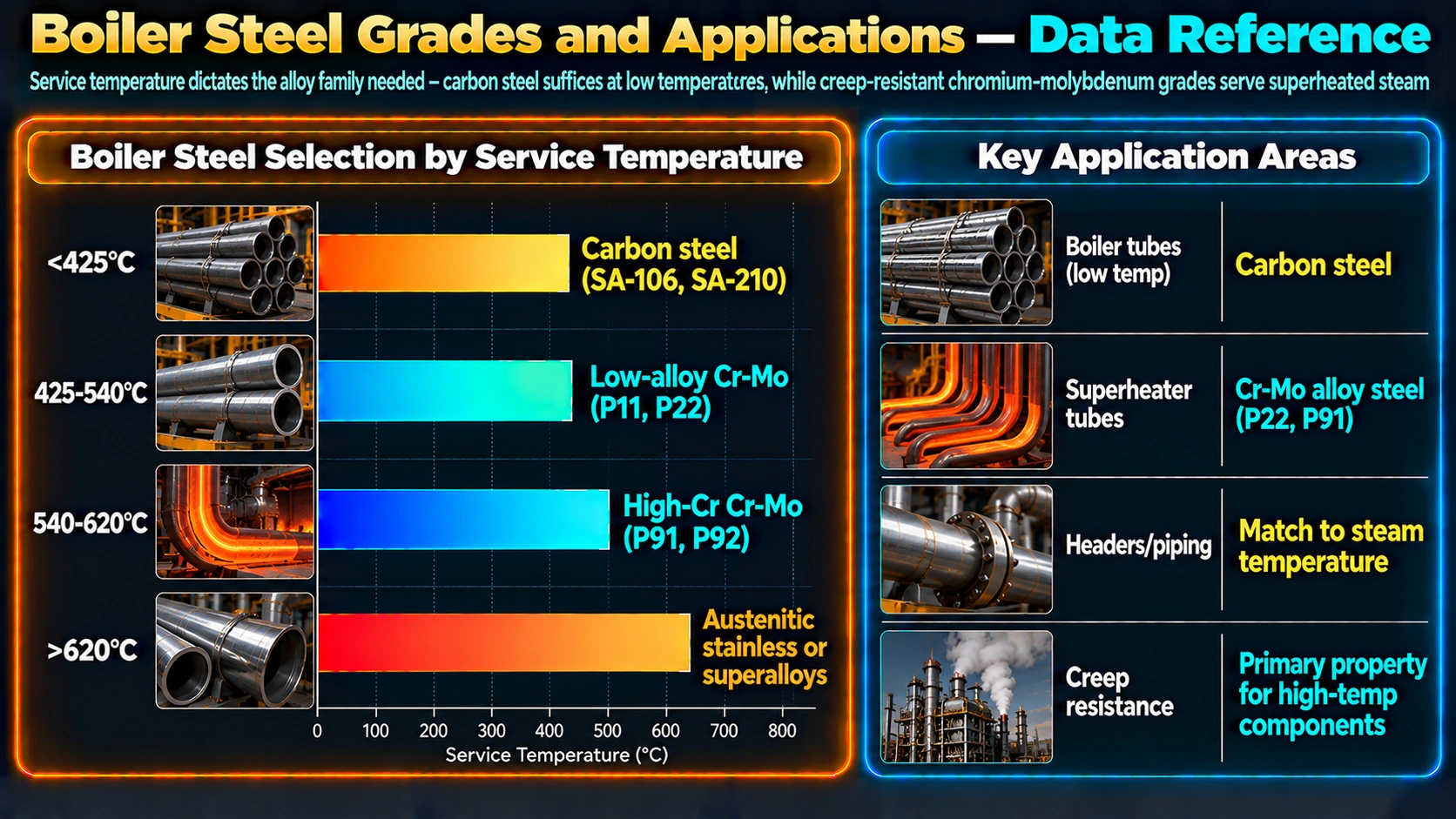
- Boiler steel grade selection tracks temperature zone: carbon steel for waterwalls/economizers, carbon-molybdenum and low-Cr-Mo grades for moderate superheater zones, high-Cr-Mo grades (T91/T92) for the hottest superheater/reheater sections.
- Above roughly 0.4 times absolute melting temperature, creep rupture strength — not short-term tensile strength — becomes the controlling design property.
- Chromium content correlates with both oxidation resistance and creep strength across the grade family: 1.25% Cr (T11) → 2.25% Cr (T22) → 9% Cr modified (T91/T92).
- P91 and P92 achieve high creep strength through a tempered martensite matrix strengthened by fine vanadium and niobium carbonitrides, not simply through higher chromium content alone.
- Higher-alloy grades demand stricter preheat, interpass control, and mandatory PWHT to avoid untempered martensite in the weld HAZ.
- Using the lowest-alloy grade that satisfies each zone’s requirement, rather than one grade throughout, is standard economical boiler design practice.
1. Why Boiler Steel Selection Varies by Zone
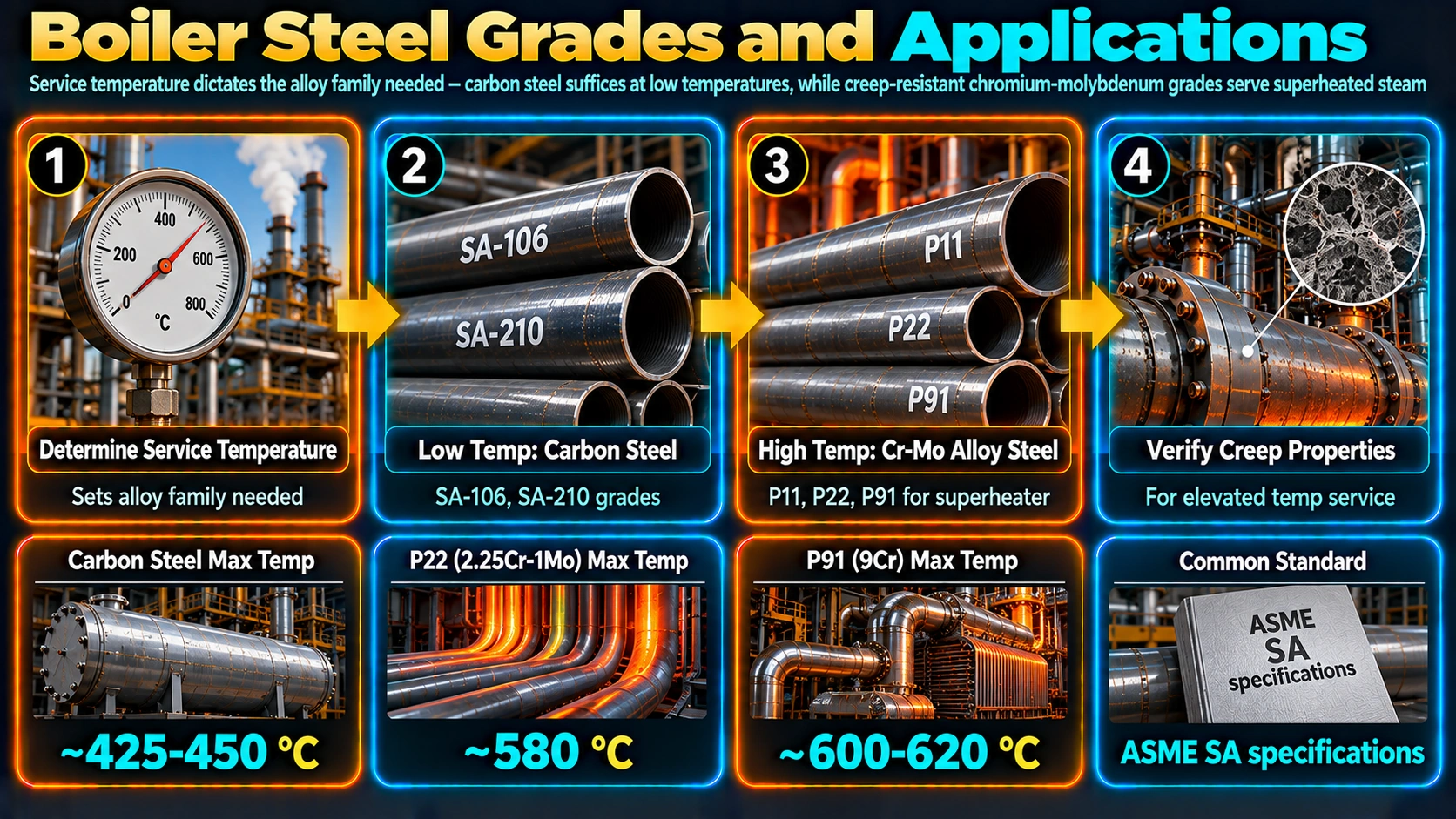
A boiler’s economizer, waterwall, superheater, and reheater sections operate across a wide temperature span at a common design pressure, and the metallurgical demand on the tube or pipe material shifts fundamentally as temperature rises. At lower temperatures, pressure-containing capacity is governed essentially by short-term yield and tensile strength. Above roughly 0.4 times the absolute melting temperature of the alloy, a slow, time-dependent deformation mechanism called creep becomes the controlling design consideration instead, and grade selection pivots from a strength-only decision to a creep-rupture-strength decision.
2. Carbon Steel Grades — Lower Temperature Zones
2.1 SA-178 and SA-192
SA-178 covers electric-resistance-welded carbon steel boiler tubes, and SA-192 covers seamless carbon steel boiler tubes for high-pressure service, both intended for the relatively cooler zones of a boiler such as waterwalls and economizers where creep is not yet the governing failure mode.
2.2 SA-210 — Medium Carbon Seamless Tubes
SA-210 covers seamless medium-carbon steel boiler and superheater tubes (Grades A1 and C), offering higher strength than SA-178/192 through modestly increased carbon and manganese content, while still relying on the same basic iron-carbon phase diagram strengthening mechanisms rather than alloy additions aimed at elevated-temperature creep resistance.
3. Carbon-Molybdenum and Low-Chromium Grades — Moderate Superheater Zones
3.1 SA-209 T1 (Carbon-Molybdenum)
SA-209 T1 adds roughly 0.5% molybdenum to a carbon steel base, providing a first step up in creep strength through molybdenum’s carbide-stabilizing effect at elevated temperature, suited to lower superheater and reheater zones just beyond where plain carbon steel becomes marginal.
3.2 SA-213 T11 and T22 (1.25Cr-0.5Mo and 2.25Cr-1Mo)
SA-213 T11 (nominally 1.25% Cr, 0.5% Mo) and T22 (2.25% Cr, 1% Mo) form the classic low-alloy chromium-molybdenum family that has served moderate-to-higher superheater and reheater zones for decades. Increasing chromium content improves both steam-side oxidation resistance and, through finer, more stable carbide precipitation, creep rupture strength relative to T1.
4. High-Chromium Creep-Strength-Enhanced Grades
4.1 SA-213 T91 (Grade 91)
T91 is a modified 9% chromium, 1% molybdenum martensitic steel, strengthened well beyond older 9Cr grades through controlled additions of vanadium, niobium, and nitrogen that precipitate as fine, stable carbonitrides during a normalizing-and-tempering heat treatment. The resulting tempered martensite structure — closely related to the microstructures discussed in the site’s martensite formation article — delivers roughly double the creep rupture strength of T22 at comparable temperature, enabling thinner sections and higher allowable steam pressure and temperature for the same design life.
4.2 SA-213 T92 (Grade 92)
T92 further modifies the T91 chemistry with tungsten and reduced molybdenum, along with boron additions in some variants, pushing creep rupture strength and allowable temperature capability higher still, and represents the practical ceiling of the conventional ferritic-martensitic boiler steel family before designers must move to austenitic stainless or nickel-based alloys for the very highest steam temperatures.
Larson-Miller parameter (creep rupture life correlation,
illustrative form used across boiler steel design data):

    P = T x (C + log(t_r))

  where T   = absolute temperature (Rankine or Kelvin,
              per the specific data source convention)
        t_r = time to rupture (hours)
        C   = material constant (commonly ~20 for many
              ferritic steels, grade-specific)

Higher P at a given stress indicates a material can sustain
that stress for a longer time before creep rupture — this is
the basis for comparing T22, T91, and T92 rupture strength
across temperature and design-life combinations.
4.3 Comparison Table — Boiler Grade Progression
| Grade | Nominal Composition | Typical Max Service Temp. | Relative Creep Strength |
|---|---|---|---|
| SA-210 A1/C | Carbon steel | ~450°C | Baseline |
| SA-209 T1 | C-0.5Mo | ~475°C | Modest increase over carbon steel |
| SA-213 T11 | 1.25Cr-0.5Mo | ~540°C | Meaningful step up, established baseline low-alloy grade |
| SA-213 T22 | 2.25Cr-1Mo | ~565°C | Higher than T11, long industry track record |
| SA-213 T91 | 9Cr-1Mo-V-Nb-N | ~600°C+ | Roughly double T22 at comparable temperature |
| SA-213 T92 | 9Cr-0.5Mo-1.8W-V-Nb-N-B | ~620°C+ | Higher still than T91 |
5. Welding and Post-Weld Heat Treatment Considerations
Chromium-molybdenum boiler steels are air-hardenable — a rapidly cooled weld HAZ readily forms untempered martensite, which is hard, brittle, and susceptible to hydrogen-assisted cracking, closely paralleling the concerns discussed in the site’s hydrogen cracking article. Controlled preheat and interpass temperature, low-hydrogen filler metal matched to the base metal’s alloy content, and mandatory post-weld heat treatment (PWHT) to temper the HAZ back into a ductile, creep-resistant tempered martensite are non-negotiable steps for these grades, with T91 and T92 requiring particularly tight PWHT temperature and time control since both under- and over-tempering degrade their design creep strength.
6. Industrial Applications and Significance
Correct boiler steel grade selection directly determines a unit’s achievable steam conditions, wall thickness, weight, and ultimately thermal efficiency — advanced ultra-supercritical plants specifically depend on P91/P92-class grades to reach the higher steam temperatures and pressures that drive efficiency gains, while retrofits or lower-pressure units continue to rely economically on the older carbon and low-alloy grades in zones that don’t demand the added creep strength. Because higher-alloy grades cost substantially more and carry stricter fabrication controls, matching each boiler zone to the lowest-alloy grade that meets its actual creep and corrosion demand — rather than defaulting to the highest available grade — remains a core materials engineering decision on every new boiler design and every major retrofit.
7. Frequently Asked Questions
What steel grades are used for boiler tubes and piping?
Why does boiler steel selection change with temperature zone?
What is the difference between SA-210 and SA-213 boiler tube specifications?
What role does chromium play in boiler steel grades?
What is creep and why does it govern high-temperature boiler design?
How do P91 and P92 fit into the boiler steel grade progression?
What welding precautions apply to chromium-molybdenum boiler steels?
Why can’t higher-strength boiler steel grades simply replace lower grades everywhere?
Recommended Reference Materials
Creep-Resistant Steels Reference Handbook
Covers creep mechanisms, Larson-Miller parameters, and P91/P92-class alloy design.
View on AmazonBoiler and Pressure Vessel Materials Guide
Practical reference on ASME boiler tube and pipe specifications by service zone.
View on AmazonWelding Metallurgy Reference Text
Background on preheat, PWHT, and HAZ control for air-hardenable Cr-Mo steels.
View on AmazonPhysical Metallurgy of Heat-Resistant Alloys
In-depth coverage of carbide precipitation and creep strengthening mechanisms.
View on AmazonDisclosure: MetallurgyZone participates in the Amazon Associates programme. If you purchase through these links, we may earn a small commission at no extra cost to you. This helps support free technical content on this site.
Further Reading
