API 5CT Casing and Tubing Steel Grades Explained
API 5CT governs the steel grades used to manufacture casing and tubing — the oil country tubular goods (OCTG) that line and produce oil and gas wells. This guide covers the grade designation system, chemistry and heat treatment differences between grades, sour-service qualification, connection types, and how casing/tubing grade selection differs from API 5L line pipe.
Key Takeaways
- API 5CT grade names combine a chemistry/heat-treatment letter with a minimum yield strength number in ksi — L80 means the L family at 80,000 psi minimum yield.
- Casing lines and structurally supports the wellbore; tubing conveys produced fluids inside the casing — both are covered by the same specification.
- L80, C90, T95, and C110 are the standard sour-service-qualified grades, governed jointly by API 5CT and NACE MR0175/ISO 15156.
- Sour-service grades require quenched-and-tempered, hardness-controlled microstructures to resist sulfide stress cracking, not just a target yield strength.
- High-strength grades like P110 and Q125 address deep, high-collapse wells but are not automatically sour-service qualified.
- Standard API connections (STC, LTC, BTC) suit many wells; premium proprietary connections are used where gas-tight sealing or higher tensile efficiency is required.
1. Scope of API 5CT
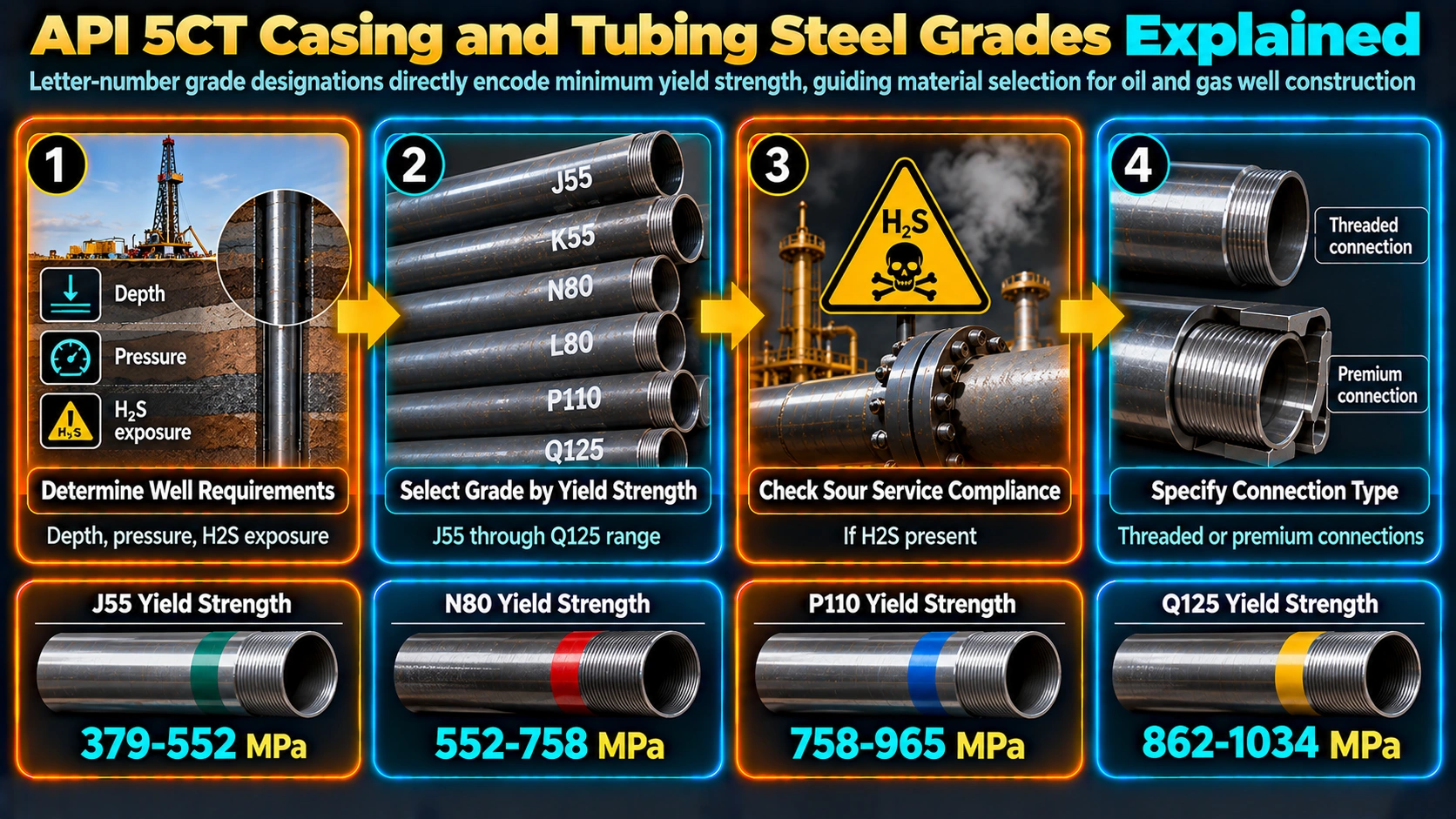
API 5CT, Specification for Casing and Tubing, covers seamless and welded steel pipe manufactured for use as casing or tubing in oil and gas wells. It specifies permissible chemical composition ranges, minimum and maximum mechanical properties, dimensional and straightness tolerances, thread and coupling requirements, and the testing (mechanical, NDT, hydrostatic) each pipe must pass before certification.
1.1 Casing vs Tubing
Casing is run in progressively smaller-diameter strings (surface, intermediate, production casing) and cemented in place to stabilize the wellbore wall, isolate formations, and provide the structural backbone the wellhead and subsequent strings hang from. Tubing is a smaller-diameter string run inside the innermost casing string specifically to convey produced hydrocarbons to surface, and is typically retrievable for workover without disturbing the casing itself.
2. Grade Designation System
Each API 5CT grade is denoted by a letter (chemistry and heat treatment family) followed by a number (minimum yield strength in ksi, thousands of psi). The letter groups grades that share a similar chemistry philosophy and heat treatment route, even though their exact yield strength differs.
| Grade | Min. Yield (ksi) | Heat Treatment | Sour Service |
|---|---|---|---|
| H40 | 40 | As-rolled or normalized | No |
| J55 / K55 | 55 | As-rolled or normalized | No |
| N80 | 80 | Normalized (Type 1) or Q&T (Type Q) | Type Q only, limited |
| L80 | 80 | Quenched and tempered | Yes |
| C90 | 90 | Quenched and tempered | Yes |
| T95 | 95 | Quenched and tempered | Yes |
| C110 | 110 | Quenched and tempered | Yes |
| P110 | 110 | Quenched and tempered or normalized | Generally no |
| Q125 | 125 | Quenched and tempered | No |
2.1 Reading the Grade Beyond the Basic Table
Some grades carry an additional suffix indicating a specific chemistry type within the same letter/number family (for example L80 Type 1, Type 9Cr, or Type 13Cr, which use progressively higher chromium content for enhanced CO2 corrosion resistance rather than differing in yield strength). This is analogous to how the iron-carbon phase diagram underpins strength differences purely from carbon content, while alloying additions like chromium instead target corrosion behaviour independent of base strength.
3. Chemistry and Heat Treatment
3.1 Non-Sour Grades (H40, J55/K55, standard N80)
These grades rely on plain carbon-manganese chemistry, typically as-rolled or normalized rather than quenched and tempered, since sour-service hardness control is not required. They are the most economical grades and are used in surface casing and shallow, sweet (H2S-free) wells.
3.2 Sour-Service Grades (L80, C90, T95, C110)
These grades are quenched and tempered to produce a uniform tempered martensite structure with tightly controlled maximum hardness — analogous to the microstructural control discussed in quenching and tempering of steel — because untempered or heterogeneous hardness zones are preferentially susceptible to hydrogen-assisted sulfide stress cracking in H2S environments. Achieving the target yield strength while staying under the sour-service hardness ceiling is the defining metallurgical challenge that separates these grades from their non-sour counterparts of similar strength.
Sour-service hardness constraint (NACE MR0175/ISO 15156,
illustrative form for carbon/low-alloy steel casing/tubing):

    HRC_max ≤ 22   (typical ceiling for many sour-qualified
                       carbon/low-alloy CRA-free grades)

Achieving Sy ≥ specified minimum (e.g. 80 ksi for L80)
while HRC stays at or below this ceiling requires tight
control of tempering temperature and time, since higher
tempering temperature lowers both strength and hardness
together — the two constraints must be satisfied
simultaneously, not traded off independently.
3.3 High-Strength Non-Sour Grades (P110, Q125)
Deep or high-pressure wells with severe collapse or burst loading but limited H2S exposure use higher-strength grades like P110 or Q125, which are not necessarily constrained by the same low hardness ceiling and can therefore be processed to reach higher strength without the sour-service trade-off. Using a non-sour high-strength grade in an H2S environment without proper qualification is a common and serious material selection error.
4. Mechanical Properties and Testing
| Property | Test Method | Significance |
|---|---|---|
| Yield and tensile strength | Tension test per API 5CT/ASTM A370 | Confirms grade classification and burst/collapse design basis |
| Hardness | Rockwell C, per grade-specific ceiling | Sour service qualification, sulfide stress cracking resistance |
| Charpy impact (where specified) | Charpy V-notch test | Low-temperature toughness, arctic/deepwater service |
| Hydrostatic test | 100% of production, per pipe body rating | Confirms pressure integrity before shipment |
| NDT (UT/EMI) | Full-body inspection | Detects laminations, seams, and wall thickness anomalies |
5. Connection Types
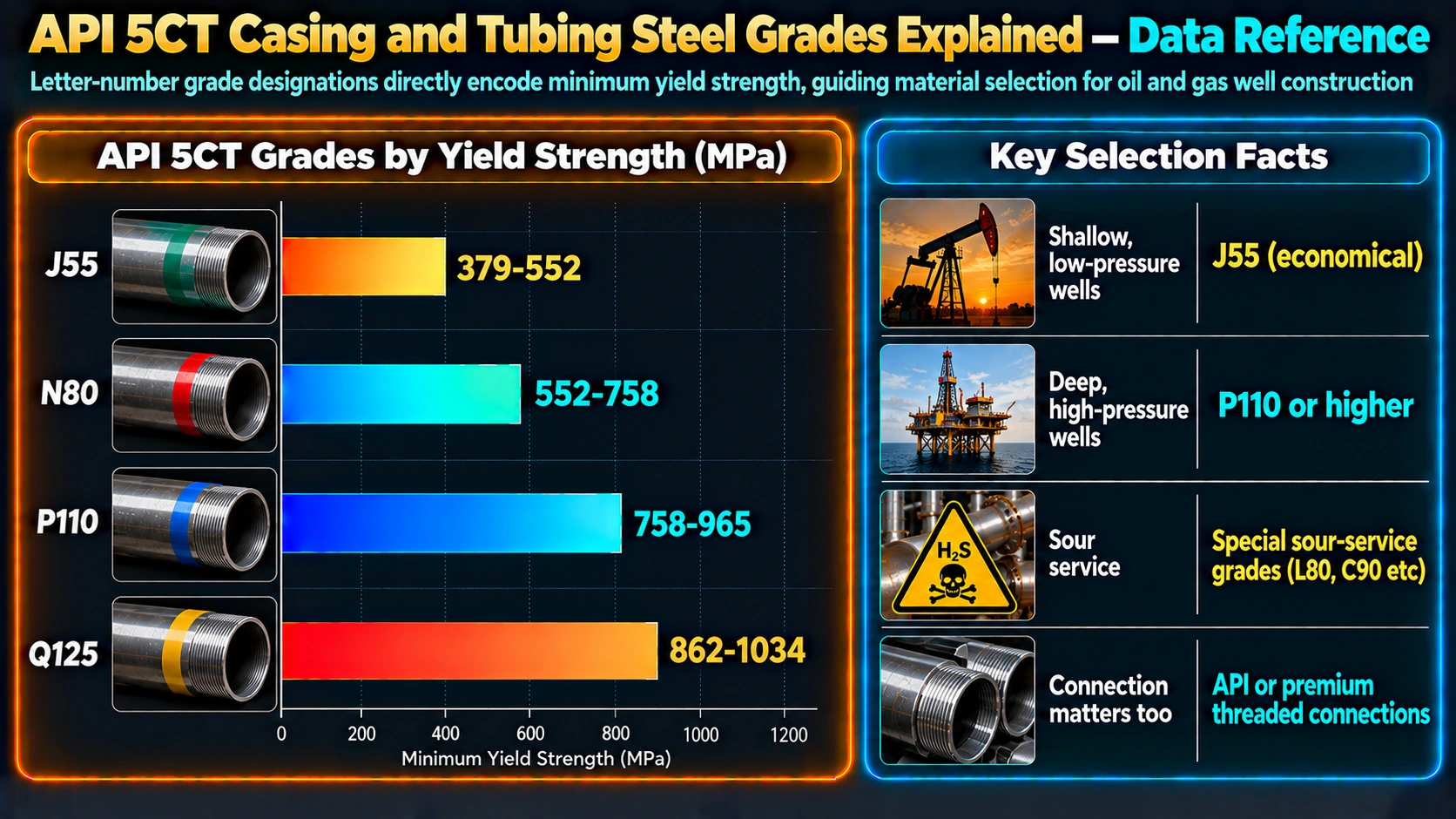
API 5CT defines several standard threaded connections, each suited to a different combination of load and sealing requirement:
- Short round thread casing (STC) — basic round-thread coupling, lower tensile efficiency, adequate for lighter loads.
- Long round thread casing (LTC) — longer thread engagement than STC, improved tensile and sealing performance for the same thread form.
- Buttress thread casing (BTC) — a stronger, asymmetric thread profile giving higher tensile efficiency, common on deeper or heavier casing strings.
Where standard API threads cannot meet the required gas-tight sealing, torque capacity, or tensile efficiency — particularly in high-angle deviated wells or high-pressure gas wells — operators specify proprietary premium connections, which sit outside API 5CT’s base thread forms but are typically manufactured on API 5CT-grade pipe bodies.
6. API 5CT vs API 5L — Casing/Tubing vs Line Pipe
| Aspect | API 5CT (Casing/Tubing) | API 5L (Line Pipe) |
|---|---|---|
| Primary function | Downhole wellbore lining and production conveyance | Surface/subsea transport of hydrocarbons over distance |
| Governing loads | Collapse, burst, tension from wellbore and formation | Internal pressure, girth-weld integrity, external environment |
| Grade system | Letter + yield strength in ksi (e.g. L80) | PSL1/PSL2, X-grade by yield strength in ksi (e.g. X65) |
| Toughness/weldability emphasis | Secondary to hardness control (sour grades) | Primary — girth weldability is central to the specification |
| Connections | Threaded (STC/LTC/BTC or premium) | Typically girth-welded in the field |
Despite both falling under the API oilfield tubular umbrella, a casing/tubing grade and a line pipe grade with numerically similar strength are not interchangeable — their chemistry, heat treatment, and qualification testing are optimized for fundamentally different service conditions.
7. Industrial Applications and Significance
Correct API 5CT grade selection directly determines a well’s mechanical integrity across its producing life: undersized burst or collapse rating risks catastrophic failure under downhole pressure differentials, while selecting a non-sour grade for an H2S-bearing reservoir risks sulfide stress cracking failures that can occur without warning. Grade selection is therefore a joint decision between the drilling/completion engineer (load case, depth, pressure) and the materials engineer (chemistry, heat treatment, sour-service qualification per NACE MR0175/ISO 15156) — the same metallurgical principles covered in this site’s martensite formation and hydrogen cracking articles apply directly to why sour-service OCTG grades are processed the way they are.
8. Frequently Asked Questions
What is API 5CT and what does it cover?
What do the letter and number in an API 5CT grade designation mean?
What is the difference between casing and tubing under API 5CT?
Which API 5CT grades are qualified for sour service?
How does heat treatment differentiate API 5CT grades of similar strength?
What are the high-strength API 5CT grades used for deep or high-pressure wells?
What connection types are used with API 5CT casing and tubing?
How does API 5CT relate to API 5L line pipe?
Recommended Reference Materials
Oil Country Tubular Goods Handbook
Reference on casing, tubing, connections, and OCTG material selection.
View on AmazonSour Gas and Corrosion-Resistant Alloy Reference
Covers NACE MR0175/ISO 15156 material qualification for sour service.
View on AmazonWell Completion Design Textbook
Casing and tubing string design, load cases, and grade selection logic.
View on AmazonPhysical Metallurgy of Quenched and Tempered Steels
Underlying metallurgy behind sour-service grade heat treatment.
View on AmazonDisclosure: MetallurgyZone participates in the Amazon Associates programme. If you purchase through these links, we may earn a small commission at no extra cost to you. This helps support free technical content on this site.
Further Reading
