PED 2014/68/EU Pressure Equipment Directive: A Complete Overview
PED 2014/68/EU is the EU-wide legal framework governing the design, manufacture, and conformity assessment of pressure equipment placed on the European market. This overview covers its scope, the fluid-group and category logic that determines how strictly a vessel or piping system is assessed, the conformity assessment modules, and the material and NDT requirements a manufacturer must satisfy to affix CE marking.
Key Takeaways
- PED applies to pressure equipment and assemblies with maximum allowable pressure PS > 0.5 bar, replacing the earlier 97/23/EC directive.
- Categorisation (Category I-IV) depends on fluid group (Group 1 hazardous, Group 2 other), physical state, and the PS×V or PS×DN product read from Annex II charts.
- Conformity assessment modules scale with category, from internal production control (Module A) up to full quality assurance plus design examination (Modules H1, B+D, B+F) for Category IV.
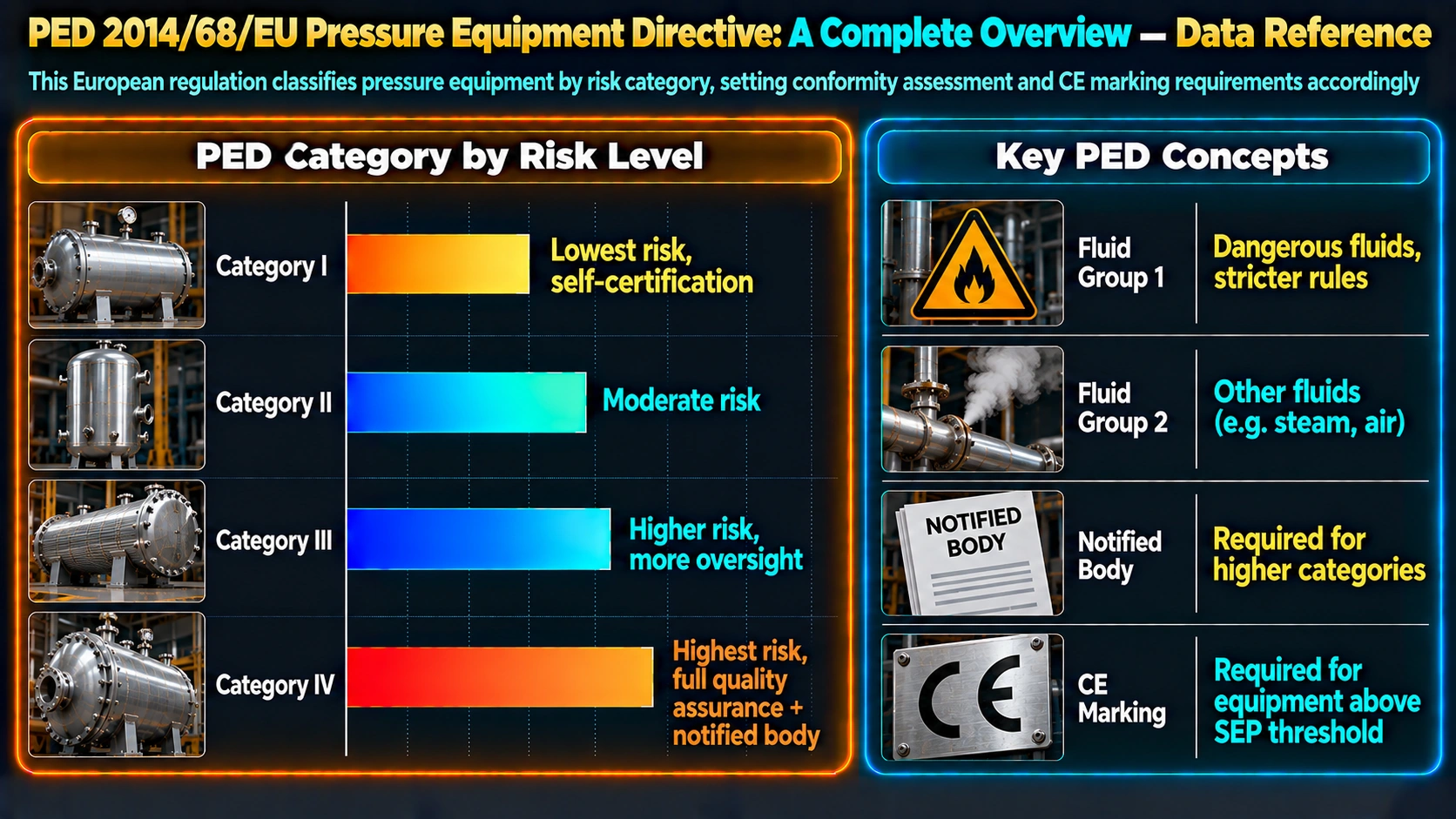
- Notified body involvement is mandatory from Category II upward but generally not required for Category I equipment.
- Harmonised standards such as EN 13445 (vessels) and EN 13480 (piping) give a presumption of conformity with PED’s essential safety requirements.
- Material traceability, mechanical property verification, and NDT extent (commonly linked to weld joint coefficient) scale directly with equipment category.
1. Scope of PED 2014/68/EU
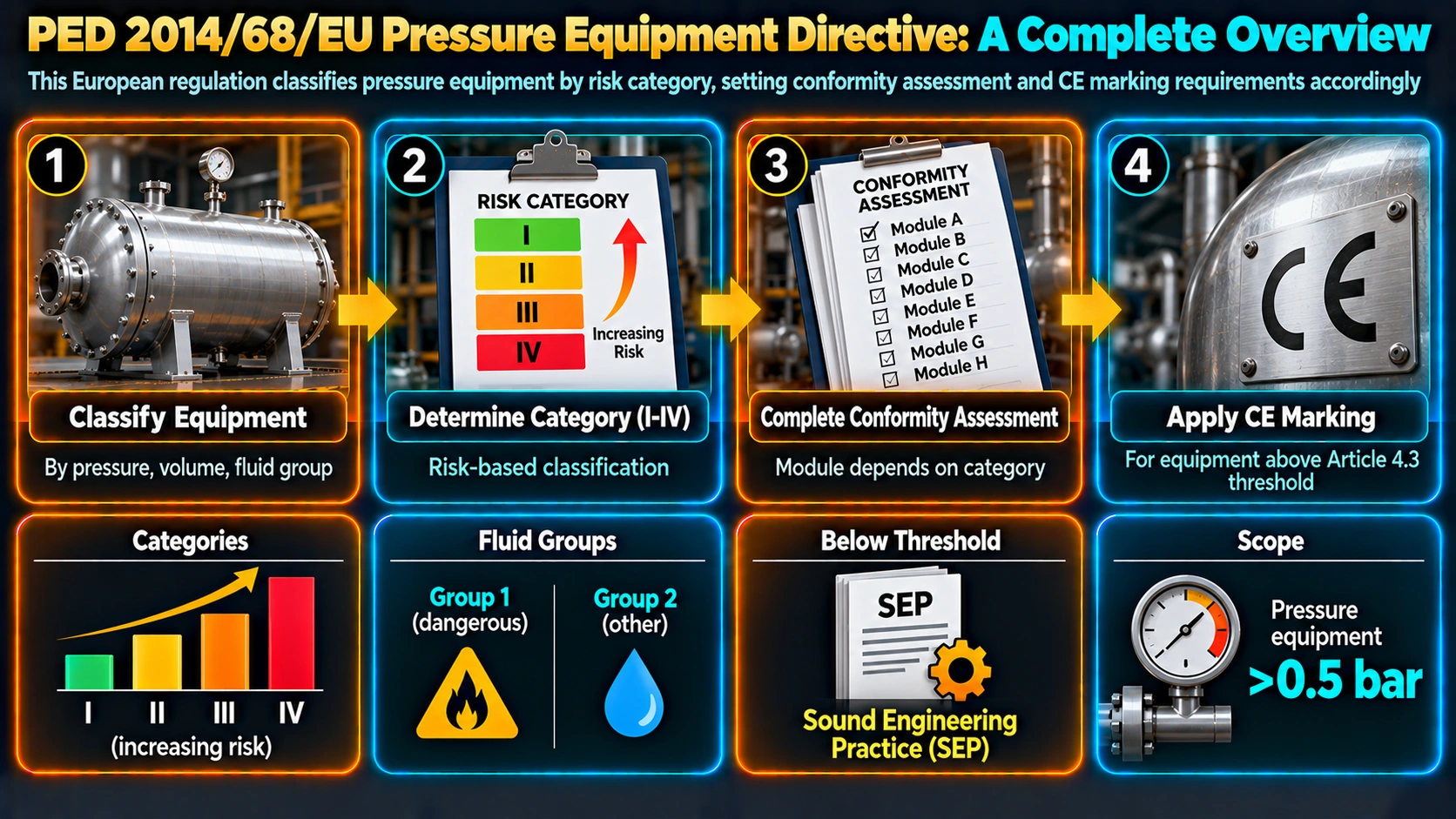
PED applies to the design, manufacture, and conformity assessment of pressure equipment — vessels, piping, safety accessories, and pressure accessories — and assemblies of such equipment, where the maximum allowable pressure PS exceeds 0.5 bar. It entered into force in July 2016, replacing the earlier 97/23/EC directive, and sits within the EU’s New Legislative Framework alongside directives like the Machinery Directive and ATEX.
1.1 Key Exclusions
- Equipment specifically designed for nuclear applications, where failure may cause a radioactive release, which falls under separate nuclear safety regimes.
- Simple pressure vessels covered by the dedicated Simple Pressure Vessels Directive (2014/29/EU).
- Pipelines and equipment for the transport of fluids to or from an installation (as opposed to equipment within the installation boundary), which are often governed by separate transport-pipeline regulation.
- Equipment where the calculated risk is negligible, per the low-risk criteria set out in Annex I.
2. Fluid Groups and Category Assignment
PED splits contained fluids into two groups: Group 1 covers substances classified as explosive, extremely flammable, highly flammable, flammable (in certain conditions), toxic, or oxidising — inherently hazardous fluids where a failure carries elevated consequence. Group 2 covers everything else, including steam, compressed air, and most process fluids without those hazard classifications.
2.1 Category Determination
Annex II provides category-assignment charts specific to each equipment type (vessels, piping, boilers, safety accessories). The relevant variables are typically the maximum allowable pressure PS, the volume V (for vessels) or nominal diameter DN (for piping), and the fluid group and state (gas/liquid). Reading the correct chart places the equipment into Category I (lowest risk) through Category IV (highest risk).
| Category | Typical Risk Level | Notified Body Involvement |
|---|---|---|
| I | Low risk | Not required (manufacturer self-declaration, Module A) |
| II | Moderate risk | Required — surveillance-level assessment |
| III | Higher risk | Required — design examination or quality assurance audit |
| IV | Highest risk | Required — full quality assurance plus design examination, or unit verification |
3. Conformity Assessment Modules
PED’s conformity assessment modules define exactly what evidence and third-party oversight a manufacturer must produce before affixing CE marking, and the applicable module (or combination) is selected from a table cross-referenced against the equipment’s category.
- Module A — internal production control; manufacturer self-certifies, no notified body, applies to Category I.
- Modules A2 / C2 — internal production control with periodic notified body surveillance of specific checks.
- Modules D1 / E1 — quality assurance of production or final inspection, notified body audited.
- Module B (design examination) combined with D or F — notified body reviews the design and either audits the production quality system (D) or performs product verification (F).
- Module H1 — full quality assurance with design examination and final assessment by the notified body, and Module G — unit (one-off) EC verification, both typically used for Category IV equipment or bespoke, low-volume high-risk items.
4. Material Requirements (Annex I, Section 4)
Materials used for pressure-bearing parts must have properties suitable across the equipment’s full range of intended service conditions, including adequate ductility and fracture toughness at the minimum design temperature — a requirement closely tied to the material’s Charpy impact transition behaviour and, for higher-category equipment, verified against project-specific low-temperature toughness criteria. Materials must be accompanied by a certificate of specific product control (or equivalent inspection documentation) that traces heat number, chemical composition, and mechanical test results, and must either conform to a harmonised material standard, hold a European Approval of Materials, or undergo a particular material appraisal by the manufacturer or notified body.
4.1 Manufacturer Qualification Requirements
For welded pressure equipment, PED requires that welding personnel and procedures be qualified to a recognised standard (commonly EN ISO 15614 series for procedures and EN ISO 9606 for welders), and that permanent joints on Category II-IV equipment be produced and NDT-inspected by, or under oversight of, appropriately qualified and (for higher categories) notified-body-approved personnel — see the parallel welder qualification logic discussed in the ISO 9606 welder qualification guide.
5. Harmonised Standards and Presumption of Conformity
| Standard | Scope |
|---|---|
| EN 13445 | Unfired pressure vessels — design, materials, manufacture, inspection |
| EN 13480 | Metallic industrial piping |
| EN 12952 / EN 12953 | Water-tube and shell boilers |
| EN ISO 15614 series | Welding procedure qualification (referenced, not PED-specific) |
| EN ISO 9712 | Qualification of NDT personnel |
Designing and manufacturing in full accordance with a harmonised standard gives a presumption of conformity with the corresponding essential safety requirements of PED — the manufacturer does not need to separately re-derive compliance for aspects the harmonised standard already addresses. A manufacturer may instead use alternative technical solutions, but then carries the burden of demonstrating equivalent safety, typically requiring closer notified body scrutiny.
6. NDT and Final Assessment
Final assessment under PED includes a final inspection of the completed equipment and a pressure test — hydrostatic, or an equivalent method where hydrostatic testing is impractical — performed at a pressure above the design pressure with a margin defined by the applicable harmonised standard. Non-destructive testing of welded joints, typically radiographic or ultrasonic testing per established NDT method selection principles, is required to an extent that scales with the weld joint coefficient assumed in the design calculation: a fully radiographed joint permits a joint coefficient of 1.0, while spot-radiographed or unexamined joints require a correspondingly lower coefficient and therefore thicker material for the same design pressure.
Design thickness relationship (thin-wall cylindrical shell,
illustrative form used across EN 13445-style calculations):

    t = (PS x Di) / (2 x f x z - PS)

  where PS = design pressure
        Di = internal diameter
        f  = allowable design stress (material and temperature dependent)
        z  = weld joint coefficient (0.7 - 1.0, depending on
             NDT extent and joint type)

Lower z (less NDT coverage) increases required thickness t
for the same PS and Di.
7. Industrial Applications and Significance
PED is the gatekeeping regulation for placing pressure vessels, boilers, and industrial piping on the EU market, and its category system is the practical reason why a small compressed-air receiver can be self-certified while a large hazardous-fluid reactor vessel requires full notified body design review and quality system audit. For a materials or welding engineer, PED compliance converts directly into concrete requirements on welding procedure qualification, material traceability, and NDT extent — the same technical building blocks covered elsewhere on this site under AWS D1.1 and ISO 9606, applied here within a specifically European regulatory and CE-marking context.
8. Frequently Asked Questions
What is PED 2014/68/EU?
What equipment falls within the scope of PED?
How does PED categorise pressure equipment?
What are the conformity assessment modules under PED?
What role does a notified body play under PED?
What material requirements does PED impose?
How does PED relate to harmonised standards like EN 13445?
What NDT and testing requirements apply under PED?
Recommended Reference Materials
Pressure Vessel Design and Compliance Handbook
Covers PED, ASME VIII, and EN 13445 side by side for design engineers.
View on AmazonCE Marking and EU Product Compliance Guide
Reference on the New Legislative Framework, conformity modules, and notified body process.
View on AmazonWelding Inspection Technology (CWI Prep)
Covers NDT methods and acceptance criteria referenced in PED final assessment.
View on AmazonCorrosion Engineering Reference Handbook
Material selection background relevant to pressure equipment service conditions.
View on AmazonDisclosure: MetallurgyZone participates in the Amazon Associates programme. If you purchase through these links, we may earn a small commission at no extra cost to you. This helps support free technical content on this site.
Further Reading
