UOE Pipe Forming Process for Linepipe Steel
The UOE process converts wide, heavy-gauge TMCP steel plate into large-diameter, longitudinally welded linepipe through a fixed sequence of cold-forming and welding operations: edge crimping, U-forming, O-forming, double submerged arc welding, and mechanical expansion. This guide walks through each stage, explains how the forming sequence affects final mechanical properties relative to the starting plate, and positions UOE against the JCOE and spiral pipe alternatives used across the API 5L linepipe supply chain.
Key Takeaways
- UOE takes its name from its forming sequence: edge Crimping, U-forming, O-forming, welding, and mechanical Expansion of TMCP plate into round pipe.
- Edge crimping pre-bends the plate edges to the target radius before U- and O-pressing, since press dies otherwise leave the plate edges relatively flat.
- The longitudinal seam is joined by double submerged arc welding: an internal pass followed by an external pass, giving full-penetration, properly shaped weld caps on both surfaces.
- Mechanical expansion (typically ~0.8-1.5% diametral) corrects roundness and dimensional tolerance and sets a controlled circumferential residual stress state.
- Cumulative cold forming produces measurable work hardening and a Bauschinger effect, giving UOE pipe a rounded stress-strain curve and longitudinal-versus-circumferential property differences relative to the parent plate.
- UOE competes with JCOE (progressive press-bending) and spiral (helically welded) pipe forming, each suited to different diameter, wall thickness, and capital-cost trade-offs.
Step 1: Edge Crimping
Incoming TMCP plate, already cut to the width required for the target pipe circumference, first passes through an edge crimping press that pre-bends both longitudinal edges to approximately the target pipe curvature. This step exists because subsequent U- and O-press dies apply bending moment most effectively toward the plate centre; without edge crimping, the plate edges would remain comparatively flat and the finished pipe would show a flattened region at the seam rather than a continuous circular cross-section.
Step 2: U-Forming
The crimped plate is pressed between a punch and a U-shaped die, progressively bending the plate into a U cross-section along its full length. This operation is typically performed in a single press stroke across the plate width, applying substantial cold bending strain concentrated at the plate’s outer and inner fibre surfaces.
Step 3: O-Forming
The U-shaped plate is then pressed in an O-press, which closes the open U section into a nearly complete circular cross-section by bringing the plate edges together, leaving a narrow gap that is subsequently closed by tack welding ahead of the main seam welding operation.
Step 4: Seam Welding
The closed pipe is joined along its longitudinal seam using double submerged arc welding (commonly abbreviated SAWL for the resulting product designation): an internal weld pass is deposited first from inside the pipe bore, followed by an external pass from outside. This sequence achieves full through-thickness penetration and correctly shaped weld caps on both the inside and outside pipe surfaces, which is difficult to guarantee from a single-sided weld pass on the heavy wall thicknesses typical of transmission linepipe. Weld and heat-affected zone microstructure control follows the same principles discussed in the HAZ microstructure guide, and carbon equivalent limits inherited from the TMCP plate chemistry directly govern seam weldability, as covered in the TMCP guide.
Step 5: Mechanical Expansion
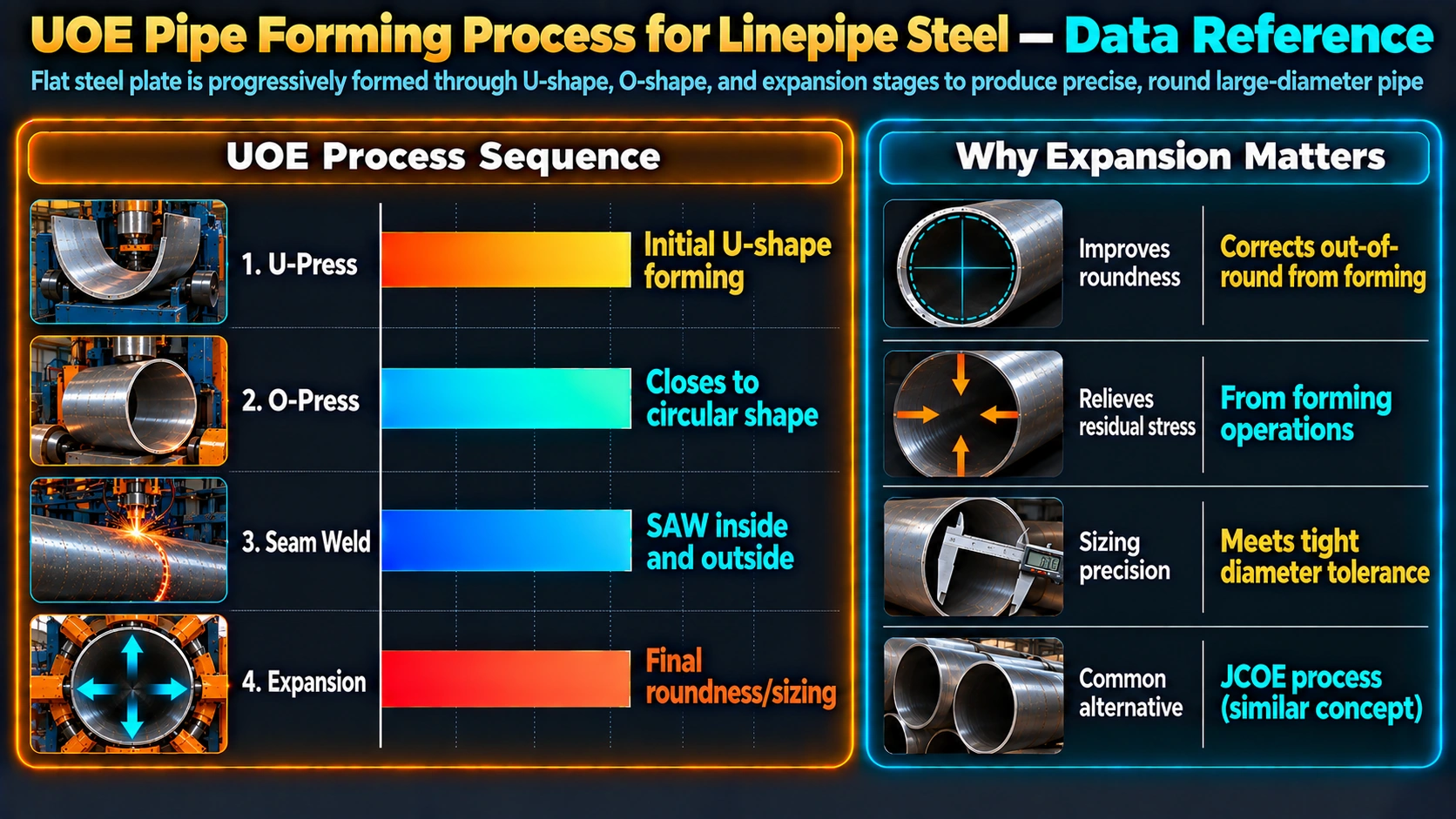
After welding, the pipe is mechanically expanded using a segmented internal expander that applies radial force to plastically stretch the pipe diameter by a controlled amount.
Expansion ratio (%) = (D_final - D_after_welding) / D_after_welding × 100

Typical UOE expansion ratio: 0.8% to 1.5%
Expansion corrects out-of-roundness and residual distortion introduced by forming and welding, tightens the pipe to final diameter and out-of-roundness tolerance required by API 5L, and produces a more uniform circumferential residual stress distribution than the as-welded pipe would otherwise carry.
Effect of UOE Cold Forming on Mechanical Properties
The cumulative cold bending strain applied through crimping, U-forming, O-forming, and expansion work-hardens the pipe body relative to the parent TMCP plate and introduces a Bauschinger effect: material strained in tension during one forming step and then compression during a later step shows a reduced yield stress in the second, reversed-loading direction. The practical consequence is that finished UOE pipe typically exhibits a rounded (Luders-strain-free but gradually yielding) stress-strain curve rather than the sharper yield point of the original plate, along with measurable differences between longitudinal and circumferential yield strength. These effects are a standard consideration in API 5L mechanical property qualification, which specifies test specimen orientation to capture the relevant direction for the pipe’s intended service loading.
UOE Compared with Alternative Large-Diameter Pipe Forming Routes
| Process | Feedstock | Seam orientation | Typical diameter range |
|---|---|---|---|
| UOE | Cut plate, full-width forming | Longitudinal (SAWL) | Large diameter, wide wall thickness range |
| JCOE / JCO | Cut plate, progressive press-bending | Longitudinal (SAWL) | Flexible; wide diameter and thickness range |
| Spiral (helical) welded | Coiled skelp, continuous forming | Helical (SAWH) | Wide diameter range from narrower coil widths |
JCOE mills use a series of smaller, movable press strokes to progressively bend the plate edge-to-edge rather than forming the full width in single U- and O-press strokes, which generally allows a JCOE line to cover a broader combination of diameters and wall thicknesses with comparatively flexible tooling and lower capital cost than a dedicated UOE press line, though UOE remains widely used at established large-diameter linepipe mills. Spiral pipe forms a helical seam from continuously fed coil, which can produce a wide range of finished diameters from a narrower range of input coil widths, but the helical seam geometry carries different weld inspection and fitness-for-service considerations relative to a straight longitudinal seam.
Quality Control and API 5L Requirements
API 5L requires hydrostatic testing of every finished length of SAWL pipe, nondestructive examination of the weld seam (typically ultrasonic and/or radiographic testing) across its full length, and mechanical property verification on both pipe body and weld seam. Testing specimen orientation and location requirements in the specification directly reflect the longitudinal-versus-circumferential property variation introduced by the UOE forming sequence, and sour service grades additionally carry the hardness and cracking-resistance qualification requirements covered in the NACE MR0175/ISO 15156 guide. Post-service corrosion and weld-zone condition on installed UOE pipe are tracked using the monitoring techniques discussed in the corrosion monitoring guide.
Frequently Asked Questions
What does UOE stand for in pipe manufacturing?
Why are the plate edges crimped before U-forming?
Why is the pipe welded twice, once inside and once outside?
What is the purpose of mechanical expansion in the UOE process?
Does UOE cold forming affect the steel’s mechanical properties?
What is the difference between UOE and JCOE pipe forming?
How does UOE pipe differ from spiral (helical) welded pipe?
What API 5L testing applies specifically to UOE (SAWL) pipe?
Recommended Reference Reading
Pipeline Pigging and Integrity Technology
Reference on installed pipeline integrity practice complementing UOE pipe manufacturing.
View on AmazonWelding Metallurgy (Kou)
Foundational reference on submerged arc welding metallurgy relevant to UOE seam welding.
View on AmazonMicroalloyed Steels: Metallurgy and Applications
Reference on TMCP plate chemistry and processing feeding into UOE pipe production.
View on AmazonSteel Rolling Technology Handbook
Plate mill reference covering the TMCP plate feedstock used in UOE pipe forming.
View on AmazonDisclosure: MetallurgyZone participates in the Amazon Associates programme. If you purchase through these links, we may earn a small commission at no extra cost to you. This helps support free technical content on this site.
Further Reading
