Weld Cooling Time t8/5 Calculator
The t8/5 cooling time — how long the heat-affected zone takes to cool from 800°C to 500°C — is the thermal parameter that determines whether a weld’s HAZ ends up tough and bainitic, brittle and martensitic, or soft and coarse-grained. This calculator computes t8/5 directly from your welding parameters using the established Uwer-Degenkolbe two-dimensional and three-dimensional heat flow equations, automatically selecting thin- or thick-plate behaviour based on a calculated transition thickness.
Key Takeaways
- t8/5 governs HAZ microstructure: short t8/5 favors martensite (hardness and hydrogen cracking risk), long t8/5 favors coarse ferrite (toughness loss).
- Three-dimensional (thick plate) heat flow applies above a calculated transition thickness; two-dimensional (thin plate) heat flow applies below it.
- Transition thickness increases with heat input and depends on preheat temperature — it is not a fixed value.
- Higher preheat/interpass temperature lengthens t8/5 for the same heat input, which is the core mechanism behind preheat as a hydrogen-cracking control.
- Joint shape factor (F) accounts for how much surrounding steel mass restricts heat flow compared to an open bead-on-plate deposit.
- Calculated t8/5 is a process design aid — production welding still requires a qualified WPS with limits verified by procedure qualification testing.
Calculate t8/5 Cooling Time
Enter your welding parameters. Heat flow mode defaults to Auto (selected from the calculated transition thickness) but can be forced to 2D or 3D.
Martensitic
Bainite/Acicular F.
Ferrite+Pearlite
Coarse Ferrite
1. Why t8/5 Controls HAZ Microstructure
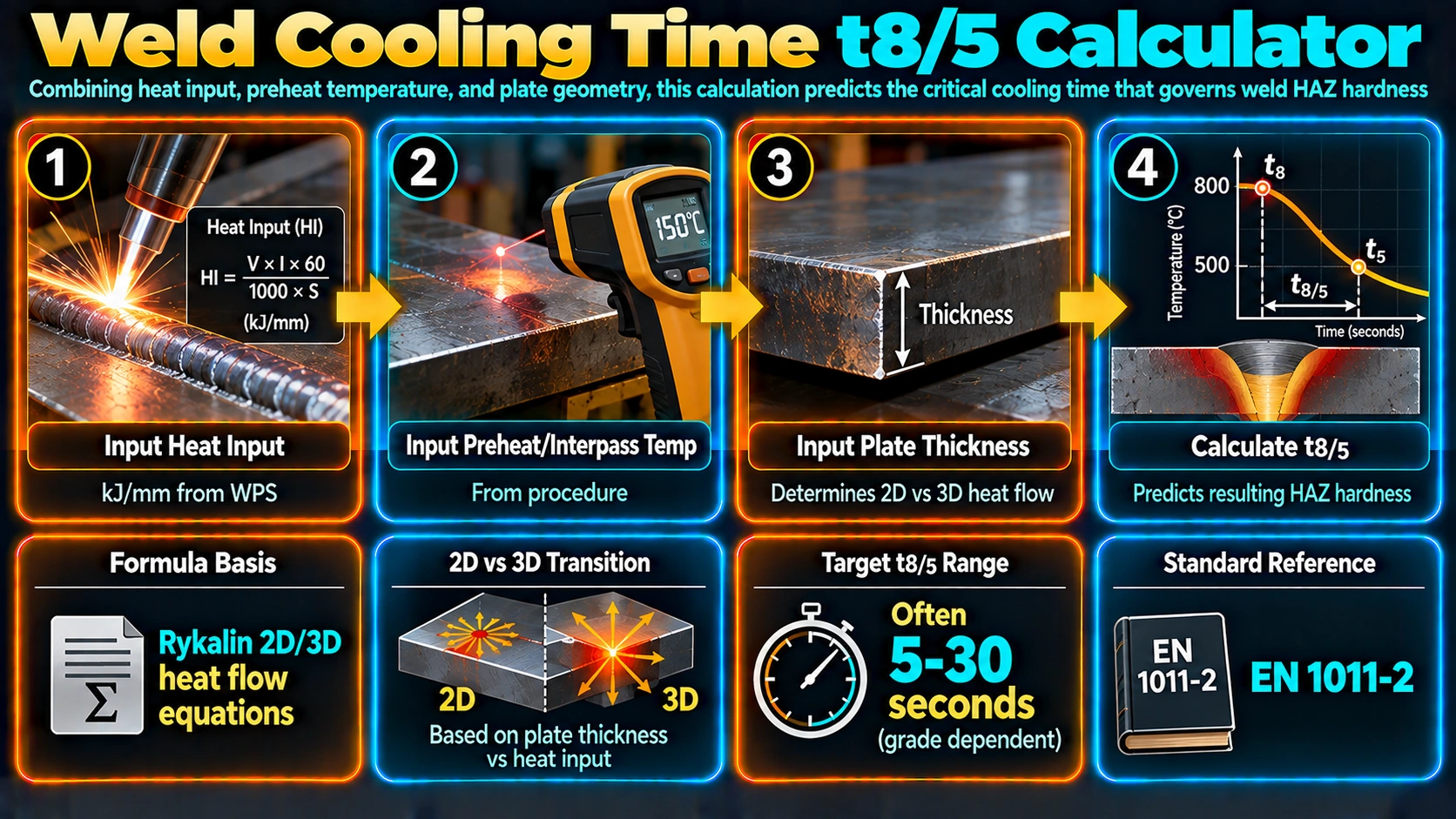
The 800-500°C range spans the temperature window where austenite in the HAZ decomposes into its room-temperature transformation products. How quickly the material passes through this window determines whether the resulting microstructure is martensite, bainite, acicular ferrite, or coarse ferrite and pearlite — the same continuous-cooling-transformation logic discussed in the site’s quenching and tempering article, applied here to a weld thermal cycle rather than a furnace heat treatment. A short t8/5 corresponds to fast cooling and favors hard, potentially crack-susceptible martensite; a long t8/5 corresponds to slow cooling and favors softer but coarser ferrite-pearlite structures with reduced toughness. Between these extremes sits the range most welding procedures target for optimal HAZ toughness.
2. The Uwer-Degenkolbe Heat Flow Equations
This calculator implements the internationally established two-region heat flow model for arc welding, distinguishing three-dimensional (thick plate) heat flow from two-dimensional (thin plate) heat flow, consistent with the approach referenced in EN 1011-2/ISO 17671-2 and the site’s own welding heat input calculator.
Three-dimensional heat flow (thick plate):

  t8/5 = (6700 - 5 x T0) x Qnet x [1/(500-T0) - 1/(800-T0)] / (2 x pi x lambda)

Two-dimensional heat flow (thin plate):

  t8/5 = (4300 - 4.3 x T0) x (Qnet/d)^2 x [1/(500-T0)^2 - 1/(800-T0)^2] / (4 x pi x lambda x rho_c)

Where:
  T0      = preheat / interpass temperature (degC)
  Qnet    = net heat input (kJ/mm) = eta x F x Qarc
  d       = plate thickness (mm)
  lambda  = thermal conductivity, ~0.040 kJ/(mm.s.K) for carbon/low-alloy steel
  rho_c   = volumetric heat capacity, ~5x10^-6 kJ/(mm^3.K) for carbon/low-alloy steel
3. Heat Input and Shape Factor
Net heat input is calculated the same way as on the site’s dedicated heat input calculator: arc energy corrected first by process thermal efficiency (η), then by a joint shape factor (F) that accounts for how much the surrounding steel mass and joint geometry restrict heat flow away from the weld compared to an idealized open bead-on-plate deposit.
Arc energy:
  Qarc (kJ/mm) = (I x U x 60) / (v x 1000)

Net heat input:
  Qnet = Qarc x eta x F
4. Transition Thickness — Choosing 2D vs 3D
Whether a given plate behaves as a thick (3D) or thin (2D) heat-flow body is not a fixed property of the plate alone — it depends on how the calculated 2D and 3D cooling times compare at that thickness, which in turn depends on heat input and preheat temperature. The transition thickness is the specific plate thickness at which the two formulas predict identical t8/5; above it, 3D heat flow (which gives a longer, thickness-independent t8/5) is the physically appropriate model, and below it, 2D heat flow (where t8/5 depends strongly on thickness) governs.
Transition thickness:

  d_trans = sqrt{ Qnet x [(4300-4.3T0)/(6700-5T0)]
                  x [bracket_2D / bracket_3D] / (2 x rho_c) }

The calculator's Auto mode compares your entered plate
thickness d against this calculated d_trans and selects
the appropriate formula automatically.
Because transition thickness rises with heat input, the same 12 mm plate can be correctly modeled as thin (2D) at low heat input and thick (3D) at high heat input — this is precisely why the Auto mode recalculates the transition point for every set of inputs rather than applying a single fixed thickness rule.
5. Interpreting the Result
| t8/5 Range | Typical HAZ Microstructure | Practical Implication |
|---|---|---|
| < 5 s | Martensite / lower bainite dominant | High hardness; hydrogen cracking risk if moisture/hydrogen present |
| 5-15 s | Upper bainite / acicular ferrite | Commonly targeted range; good Charpy toughness for many structural grades |
| 15-35 s | Polygonal ferrite + pearlite | Reduced toughness and hardness versus the optimal range |
| > 35 s | Coarse ferrite, Widmanstätten plates | Grain coarsening; poor HAZ toughness |
This generalized interpretation applies to many carbon and low-alloy structural steels with moderate carbon equivalent (roughly CE 0.35-0.45); it does not apply directly to quenched-and-tempered high-strength steels, creep-resistant Cr-Mo grades, or stainless/duplex alloys, which have their own project-specific t8/5 windows established through HAZ microstructure control requirements and qualification testing.
6. Relationship to Preheat and Hydrogen Cracking
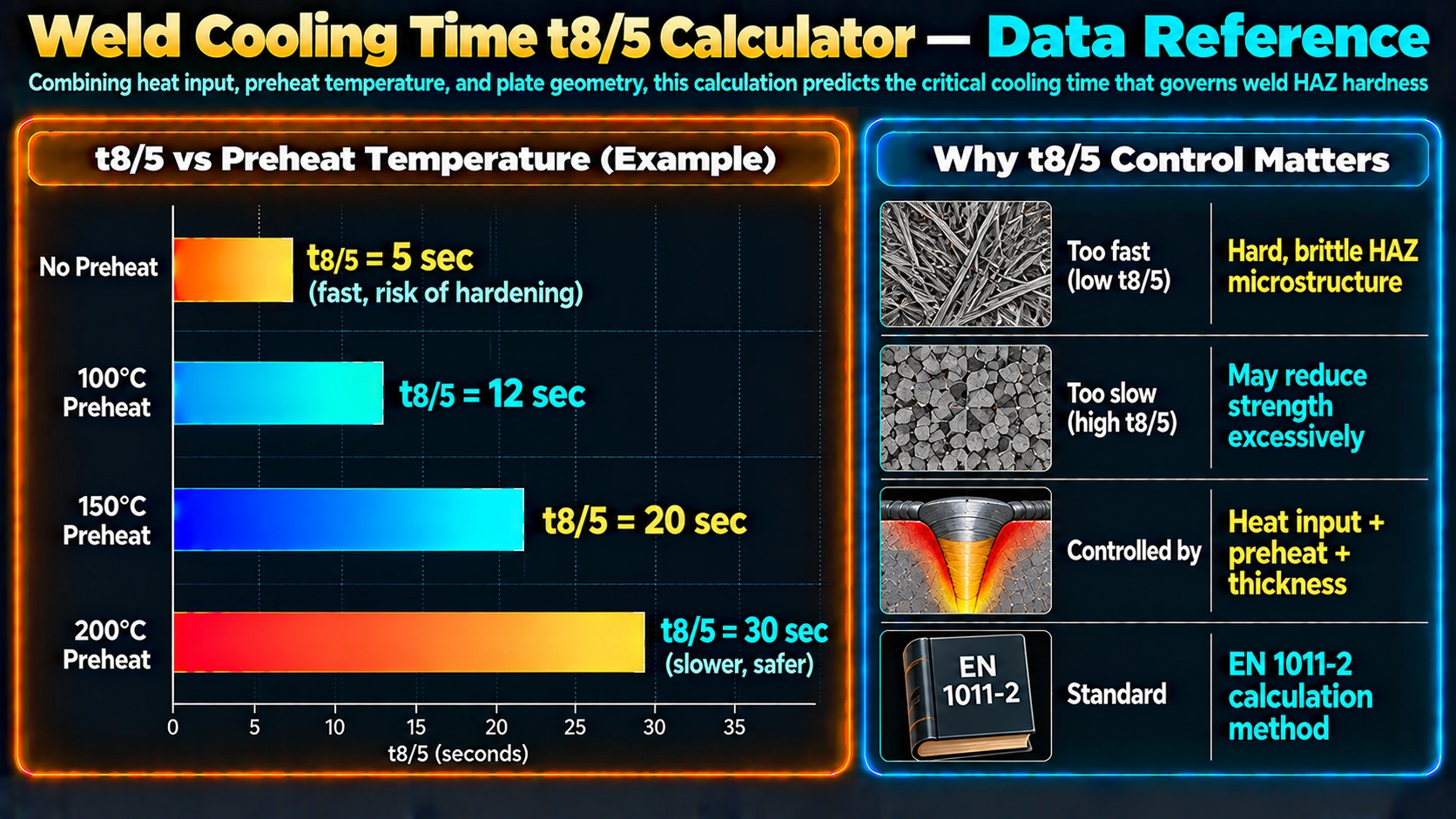
Increasing preheat or interpass temperature is one of the primary tools for lengthening t8/5 without changing heat input, because raising T0 reduces the temperature differential driving conduction away from the weld — visible directly in both formulas above, where every bracketed term shrinks as T0 rises. This is precisely the mechanism preheat exploits to avoid a fast, martensite-forming cooling cycle and reduce hydrogen-induced cracking risk in hardenable steels, complementing rather than replacing heat input control.
7. Limitations
Important Limitations
- The internal thermal property constants (λ, ρc) used here are representative values for carbon and low-alloy structural steel; other alloy families conduct and store heat differently and are not covered by this model.
- Multi-pass welds, preheat maintained by prior passes, and complex joint geometries beyond the four shape factor options can shift actual cooling behaviour from the calculated value.
- Calculated t8/5 values commonly carry meaningful uncertainty (often cited around 10% or more, worse near the 2D/3D transition thickness) relative to values measured with embedded thermocouples on an actual test weld.
- This tool is a process design aid, not a substitute for procedure qualification testing per the applicable welding code.
8. Industrial Applications and Significance
t8/5 calculation is central to writing a defensible welding procedure specification for hardenable steels: heat input and preheat limits on a WPS exist largely to keep t8/5 within a range that avoids both martensitic hydrogen cracking risk and excessive grain coarsening. Because heat input, preheat, and plate thickness interact non-linearly through the transition-thickness logic covered above, quick iteration with a calculator like this one — before committing to expensive procedure qualification testing — is standard practice for welding engineers developing new WPS documents or troubleshooting HAZ toughness failures.
9. Frequently Asked Questions
What is t8/5 and why is it important in welding?
How does this calculator determine t8/5 from welding parameters?
What is the difference between 2D and 3D heat flow in welding?
What is transition thickness and why does this calculator compute it?
How does preheat temperature affect the calculated t8/5?
What is the shape factor (F) used in this calculator?
What t8/5 range is generally considered favorable for structural steel HAZ toughness?
Can this calculator replace WPS qualification testing?
Recommended Reference Materials
AWS Welding Handbook Vol. 1 — Welding Science & Technology
Authoritative reference covering heat flow, HAZ thermal cycles, and t8/5 calculation methodology.
View on AmazonWelding Metallurgy Reference Text
Foundational coverage of continuous cooling transformation and HAZ microstructure control.
View on AmazonTempilstik Temperature Indicating Sticks — Preheat Verification
Phase-change temperature sticks for verifying preheat and interpass temperature on the workpiece.
View on AmazonWelding Inspection Technology (CWI Prep)
Covers heat input, preheat, and HAZ inspection criteria for structural and pressure welding.
View on AmazonDisclosure: MetallurgyZone participates in the Amazon Associates programme. If you purchase through these links, we may earn a small commission at no extra cost to you. This helps support free technical content on this site.
Further Reading
