Cooling Rate Calculator for Steel Quenching: Water, Oil and Air Quench Comparison
Quenching cooling rate governs whether austenite transforms to martensite, bainite or pearlite, yet it depends jointly on quenchant type, agitation, section geometry and bar diameter in ways that are easy to underestimate. This calculator uses a Newtonian lumped-capacitance heat transfer model to estimate average cooling rate through the critical 800-500 C range for water, oil and air quenchants across a range of section sizes.
Key Takeaways
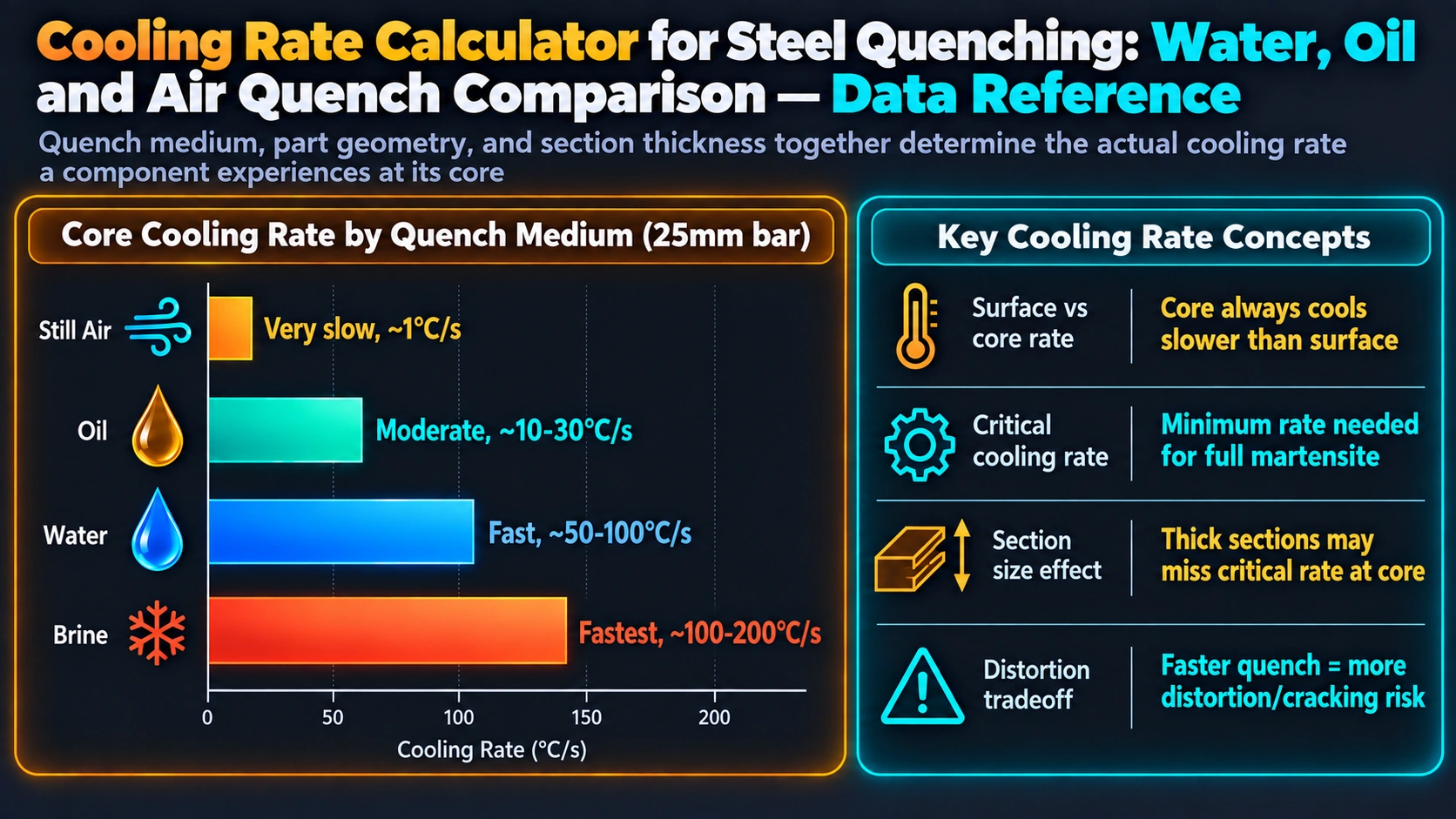
- Water quenchants extract heat roughly 5-20x faster than oil and 20-100x faster than still air, driven by heat transfer coefficient differences, not just temperature difference.
- Quenching in a liquid proceeds through three stages: vapor blanket (slow), nucleate boiling (fastest), and convection (slower again) as the part cools.
- Cooling rate falls off sharply with increasing section diameter because surface-area-to-volume ratio decreases, which is why heavy sections resist through-hardening even in aggressive quenchants.
- The lumped capacitance model used here is valid only when the Biot number is below about 0.1; larger sections develop a significant core-to-surface temperature gradient that this simple model does not capture.
- Quench severity (how fast the medium cools) and hardenability (how deep a given steel will harden) are separate properties that must both be adequate to through-harden a part.
- Actual transformation product depends on the full cooling curve relative to the steel’s CCT diagram, not average cooling rate alone; treat calculator output as a comparative screening tool, not a substitute for CCT-based analysis.
Quench Cooling Rate Calculator
Estimates average cooling rate using a Newtonian lumped-capacitance model. Best suited to thin-to-moderate sections; see the Biot number check in the results.
The Physics of Quench Cooling Rate
When a hot steel part enters a liquid quenchant, heat leaves the surface by a sequence of boiling and convective mechanisms rather than at a constant rate. In the vapor blanket (film boiling) stage, a continuous, insulating vapor film forms at the surface and cooling is comparatively slow because heat must conduct through this film. As the surface cools, the film becomes unstable and collapses into the nucleate boiling stage, where vapor bubbles form and detach rapidly, producing by far the highest heat transfer rates of the cycle. Once the surface temperature drops below the quenchant’s boiling point, boiling ceases and the convection stage takes over, with cooling rate falling again to a level set by ordinary liquid convection. This non-monotonic cooling curve, illustrated in Figure 1, is why oils formulated to shorten or destabilize the vapor blanket stage (“fast oils”) can meaningfully change hardening response without changing the bulk quenchant type.
Lumped Capacitance (Newtonian) Cooling Model
For a part small enough that internal temperature gradients are negligible, the rate of heat loss from the surface can be equated to the rate of internal energy loss, giving an exponential decay of temperature with time known as Newtonian or lumped-capacitance cooling. This is the same mathematical form used to describe many first-order thermal decay processes, though the physical justification here rests specifically on the assumption of a spatially uniform part temperature.
Lumped capacitance cooling:

  T(t) - Tm = (T0 - Tm) · exp(-t / τ)

  τ = ρ · Cp · Lc / h

  where
    T(t) = part temperature at time t
    Tm   = quenchant (medium) temperature
    T0   = initial part temperature
    ρ    = density of steel (≈ 7850 kg/m3)
    Cp   = specific heat of steel (≈ 490 J/kg·K, avg. over 500-800 C)
    Lc   = characteristic length = Volume / Surface area
    h    = quenchant heat transfer coefficient (W/m2K)

  Time to cool from T1 to T2:
    t = τ · ln[ (T1 - Tm) / (T2 - Tm) ]

  Average cooling rate over the interval:
    Rate_avg = (T1 - T2) / t
Characteristic length Lc = D/4 for an infinite cylinder, D/6 for a sphere, and t/2 for a plate cooled from both faces (D or t = diameter/thickness).
Validity check — Biot number:

  Bi = h · Lc / k_steel     (k_steel ≈ 35 W/m·K, nominal average)

  Bi < ~0.1   -> lumped model reasonable, small internal gradient
  Bi >= ~0.1  -> surface cools significantly faster than core;
                 treat the result as an upper-bound surface estimate,
                 not the true core cooling rate
Typical Heat Transfer Coefficients by Quenchant
The following nominal values are representative order-of-magnitude figures used by this calculator; actual heat transfer coefficients vary with agitation intensity, quenchant chemistry, temperature, additives and part surface condition, and should be validated against quenchant supplier data or plant trials for critical applications.
| Quenchant | Nominal h (W/m2K) | Approx. relative Grossmann H |
|---|---|---|
| Still air | ~50 | ~0.02 |
| Forced air | ~150 | ~0.05-0.1 |
| Still oil | ~350 | ~0.25-0.30 |
| Agitated oil | ~750 | ~0.4-0.5 |
| Still water | ~2000 | ~1.0 |
| Agitated water | ~4500 | ~1.5-2.0 |
| Agitated brine | ~8000 | ~4-5 |
Grossmann H-Value and Jominy Correlation
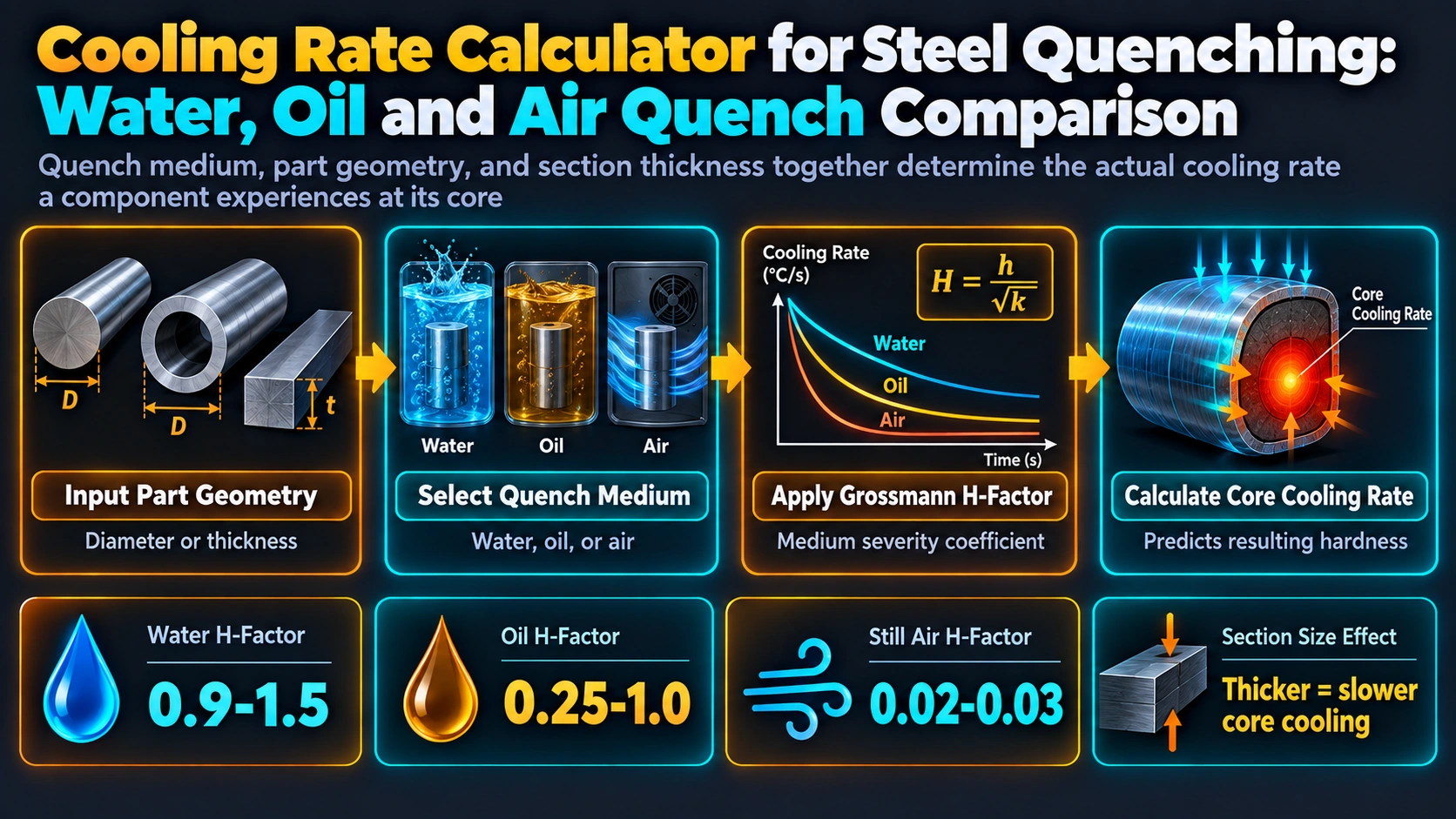
Grossmann’s quench severity factor, H = h / 2k, provides an industry-standard way to characterize quenchant aggressiveness independent of part geometry, and is the basis of classic diameter-versus-hardening (Grossmann/Lamont) charts that relate bar diameter, H-value and an “equivalent Jominy distance” for the center and surface of a round bar. That equivalent Jominy distance is then read against the actual Jominy end-quench hardenability curve for the specific steel grade to predict as-quenched hardness at any location in the cross-section. This calculator’s cooling-rate output is a complementary, first-principles estimate; for production hardening predictions on a specific steel grade, the Grossmann/Jominy method remains the standard engineering approach because it is empirically anchored to real hardenability data rather than a simplified heat transfer model.
Quench severity is not the same as hardenability
A water quench (high H-value) will not through-harden a low-hardenability plain carbon steel bar beyond a shallow case if the bar diameter is large, because the core cooling rate falls below the steel’s critical cooling rate regardless of how aggressive the surface quench is. Conversely, a highly alloyed, high-hardenability steel can through-harden even in a slow oil or air quench. Always evaluate quench severity and hardenability together for a given section size.
Practical Implications for Heat Treatment
Section size sensitivity explains why identical steel bars of different diameters, quenched in the same tank, can end up with entirely different microstructures and hardness: a 10 mm bar may fully martensite-harden in oil while a 75 mm bar of the same grade in the same tank only hardens a shallow surface case. This underlies alloy steel selection for heavy sections, where increased hardenability (via alloying for deeper hardening response) is often preferred over simply switching to a more severe quenchant, since aggressive quenchants on large sections sharply increase the risk of quench cracking and distortion from steep internal thermal and transformation-strain gradients.
Frequently Asked Questions
Why does water quench faster than oil?
What are the three stages of the quenching cooling curve?
What is the Grossmann H-value?
Why does a lumped capacitance model break down for large bar diameters?
What cooling rate is needed to form martensite in steel?
Does agitation really make a significant difference in quench severity?
How does bar diameter affect quenching cooling rate?
What is the difference between quench severity and hardenability?
Why is the 800 to 500 C range often used to characterize cooling rate?
Can brine quench faster than plain water?
Reference Reading
ASM Handbook Vol. 4: Heat Treating
The definitive ASM reference on quenching theory, quenchant selection, Grossmann H-values and hardenability practice.
View on AmazonTotten, Steel Heat Treatment: Metallurgy and Technologies
A comprehensive graduate-level text on quenching heat transfer, cooling curve analysis and quenchant technology.
View on AmazonIncropera, Fundamentals of Heat and Mass Transfer
The standard reference for lumped capacitance analysis, Biot number and transient conduction fundamentals used in this calculator.
View on AmazonCallister, Materials Science and Engineering: An Introduction
Foundational coverage of TTT/CCT diagrams, hardenability and quench-and-temper microstructure development.
View on AmazonDisclosure: MetallurgyZone participates in the Amazon Associates programme. If you purchase through these links, we may earn a small commission at no extra cost to you. This helps support free technical content on this site.
Further Reading
Quenching and Tempering of Steel
The full hardening and tempering sequence this calculator’s cooling stage feeds into.
Martensite Formation in Steel
The transformation product produced when cooling rate exceeds the critical cooling rate.
Bainite Microstructure
The intermediate transformation product formed at moderate cooling rates such as oil quenching.
Hardness Testing Methods
How as-quenched hardness is measured and correlated to cooling rate and Jominy distance.
Iron-Carbon Phase Diagram
The austenitizing temperature reference for the quench starting condition.
Pearlite Colony Growth
The slow-cooling transformation product this calculator’s air-quench case produces.
Carbon Equivalent Calculator
A companion calculator addressing hardenability-driven weld HAZ cracking risk.
Metallurgy Calculators Hub
All interactive calculators across MetallurgyZone in one place.
