Offshore Structural Steel Requirements
Offshore structures live in one of the most demanding combinations of loading and environment a steel structure can face — decades of wave-induced cyclic loading, low ambient and seawater temperature, thick heavily welded connections, and continuous seawater corrosion exposure. This guide covers the grade selection logic, through-thickness property requirements, fatigue-driven detailing, and corrosion protection strategy that distinguish offshore structural steel from typical onshore structural design.
Key Takeaways
- Offshore steel specifications add through-thickness properties, low-temperature toughness, and fatigue detailing requirements on top of a base fabrication code such as AWS D1.1.
- Governing frameworks include DNV/DNVGL-OS material standards, API RP 2A, ISO 19902, and NORSOK M-120, depending on region and structure type.
- Z-grade steel with guaranteed through-thickness reduction of area is essential at highly restrained tubular joints to prevent lamellar tearing.
- Charpy toughness requirements are set against the structure’s coldest service temperature, often -10°C to -40°C depending on region.
- Fatigue design using detail-specific S-N curves frequently governs connection design even when static strength has ample margin.
- Corrosion protection is zone-specific: coating in the atmospheric zone, corrosion allowance in the splash zone, and cathodic protection below the waterline.
1. Why Offshore Steel Requirements Go Beyond Onshore Codes
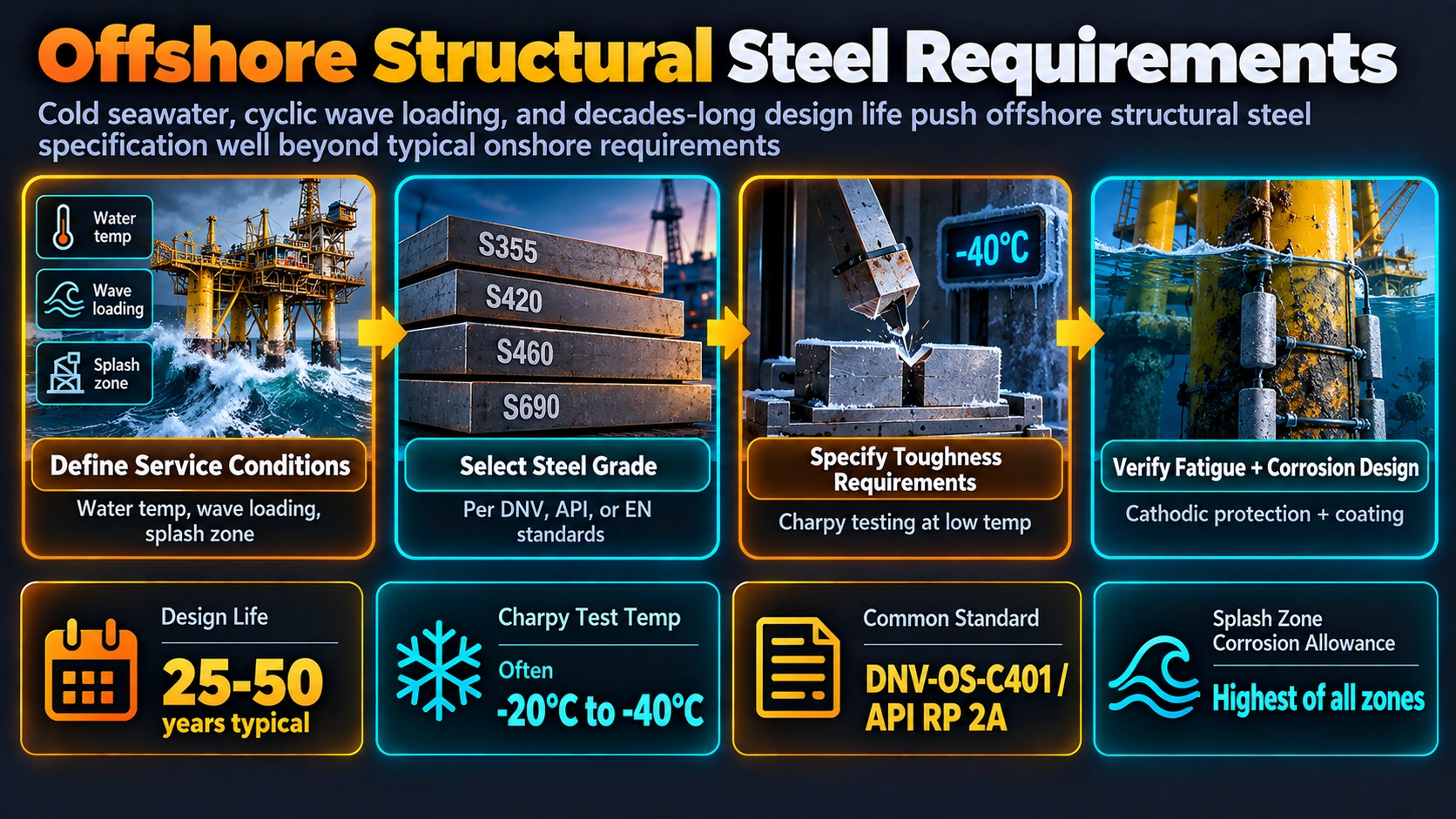
An onshore structural steel building faces largely static or moderate cyclic loading, moderate temperature ranges, and a comparatively benign corrosion environment, and codes such as AWS D1.1 (covered in the site’s dedicated AWS D1.1 overview) are calibrated accordingly. Offshore structures instead face millions of wave-induced load cycles across a multi-decade design life, seawater and low ambient temperatures, thick-section, highly restrained welded connections, and continuous seawater exposure — a combination that demands additional grade properties and detailing rules layered on top of the base fabrication code rather than replacing it.
2. Governing Frameworks
| Framework | Scope |
|---|---|
| DNV-RP / DNVGL-OS material standards | Steel grade, toughness, and through-thickness property requirements for classed structures |
| API RP 2A | Planning, design, and construction of fixed offshore platforms |
| ISO 19902 | International standard for fixed steel offshore structures |
| NORSOK M-120 | Material data sheets for structural steel, Norwegian continental shelf |
| AWS D1.1 | Base structural welding requirements, often referenced alongside the above |
3. Grade Selection and Strength Classes
Offshore structural steel grades are commonly organized by yield strength class (for example, DNV NV grades or equivalent), with normal-strength grades used for less critical secondary structure and higher-strength grades reserved for primary load-bearing members where reduced section weight offsets the higher material cost. Grade selection interacts closely with the plate thickness and welding process planned, since thicker sections and higher-strength grades both raise the hydrogen cracking risk discussed in the site’s hydrogen cracking article, requiring correspondingly higher preheat and stricter consumable hydrogen control.
4. Through-Thickness (Z-Direction) Properties
Rolled plate is inherently anisotropic: non-metallic inclusions, particularly elongated manganese sulfide stringers, become flattened and aligned parallel to the rolling plane during hot rolling, leaving the plate with markedly lower ductility when loaded through its thickness than when loaded in-plane. Offshore tubular joints and other heavily restrained thick-plate connections impose exactly this through-thickness strain during weld shrinkage, which is why Z-grade steel — plate specifically tested and guaranteed for minimum through-thickness reduction of area — is specified at the most highly restrained node connections.
4.1 Lamellar Tearing
Lamellar tearing is a characteristic step-like crack running parallel to the plate surface, driven by weld shrinkage strain acting through the plate thickness onto those elongated inclusion stringers, which act as internal crack initiation sites once the local strain capacity of the surrounding matrix is exceeded. Prevention combines Z-grade steel with controlled low sulfur content (which reduces the volume fraction of the offending inclusions), joint design that reduces restraint where practical, and welding sequence control that spreads out shrinkage strain rather than concentrating it at a single highly restrained detail.
Through-thickness ductility check (simplified concept):

    Required: Z-grade minimum short transverse
              reduction of area, RA_z >= specified minimum
              (commonly 15-25% depending on grade class)

    Restraint risk increases with:
      - plate thickness
      - joint restraint (T/K/Y tubular nodes are severe)
      - sulfur content / inclusion volume fraction
      - weld shrinkage strain concentration

Z-grade specification targets the ductility side of this
balance; joint design and welding sequence target the
restraint and strain-concentration side.
5. Low-Temperature Toughness
Offshore structures must demonstrate adequate Charpy V-notch impact toughness at a design temperature that reflects the coldest ambient air or seawater condition the structure will realistically experience — commonly as low as -10°C to -40°C depending on the operating region, well below what many onshore structural applications require. Brittle fracture at the structure’s minimum service temperature is treated as a distinct governing design case, separate from and in addition to the static strength and fatigue checks, because a structure that easily satisfies static strength margins can still be vulnerable to sudden brittle fracture if its toughness at the coldest expected temperature is inadequate.
6. Fatigue Design
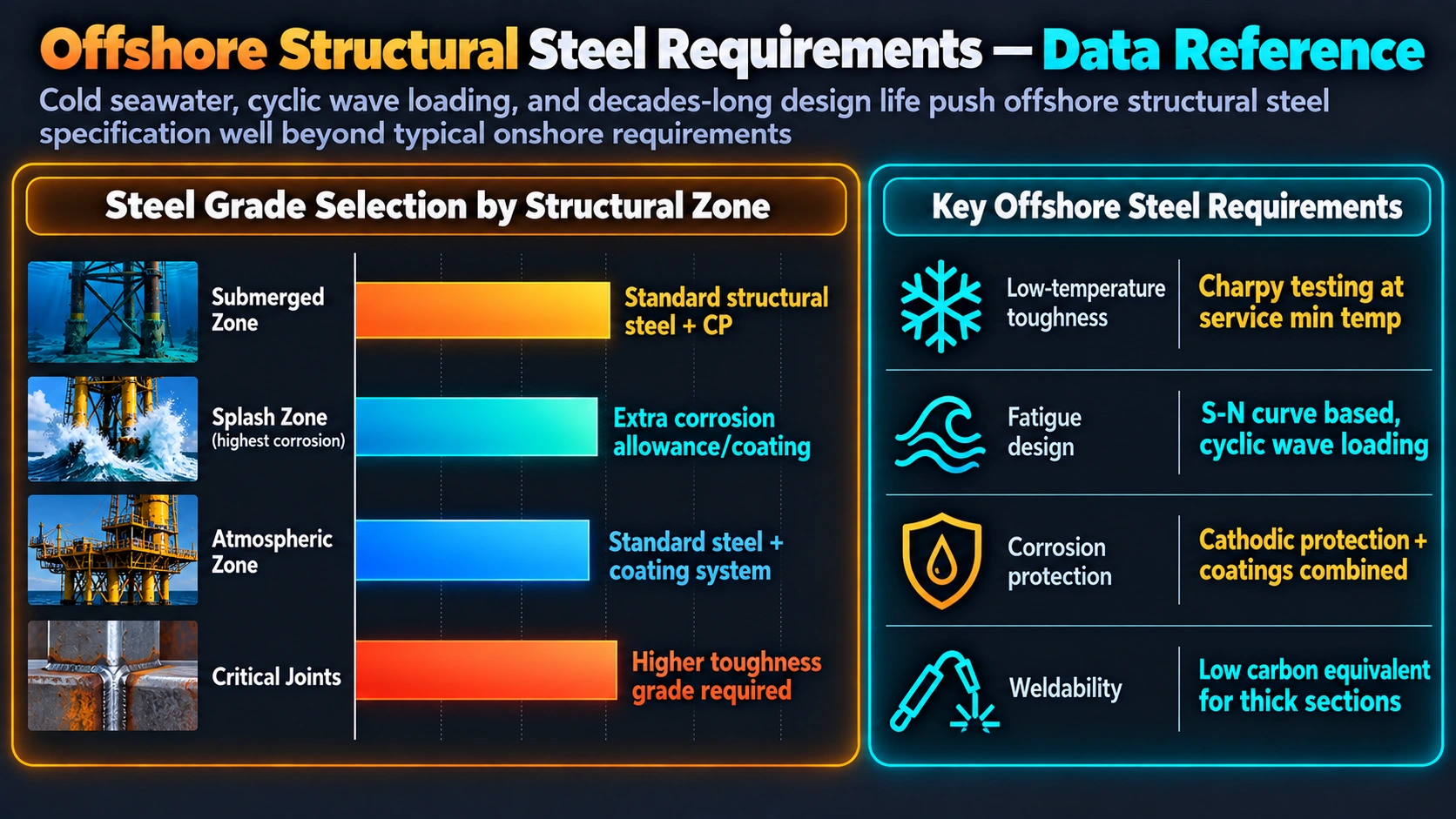
Offshore structures accumulate millions of wave-induced stress cycles over a multi-decade design life, so fatigue — governed by detail-category-specific S-N curves rather than by static strength alone — frequently controls connection design even where static capacity has generous margin. This drives strong preferences for full penetration welds at fatigue-critical joints, smooth weld toe profiles free of undercut or abrupt geometric transitions, and, at the most fatigue-sensitive locations such as tubular joint welds, post-weld improvement techniques like toe grinding or hammer peening to reduce the local stress concentration that initiates fatigue cracking.
7. Corrosion Protection Strategy
No single protection method adequately covers a structure’s full exposure range from atmosphere through full immersion, so offshore structures use a zone-specific strategy:
- Atmospheric zone — protective coating systems, since cathodic protection cannot reach above the waterline.
- Splash zone — the most aggressive corrosion environment on the structure, combining wet-dry cycling with wave impact abrasion; protected by a corrosion allowance (extra sacrificial plate thickness) in addition to coating, since cathodic protection is least reliably effective in this intermittently wetted zone.
- Submerged zone — cathodic protection, using sacrificial anodes (commonly aluminum or zinc alloy) or an impressed current system, effectively suppresses corrosion once the steel is continuously immersed and electrically connected to the protection system.
The underlying electrochemical principles behind cathodic protection and why the splash zone resists it are covered in more depth in the site’s corrosion mechanisms article.
8. Weld Quality Controls
Offshore fabrication typically calls for more extensive NDT than a comparable onshore structure — full ultrasonic and, where applicable, radiographic examination of critical tubular joint welds rather than the more selective sampling common onshore — alongside tighter weld profile control and toe-grinding requirements aimed specifically at fatigue performance. Procedure qualification testing for offshore work commonly must demonstrate through-thickness properties and low-temperature Charpy toughness on the actual joint configuration being used in production, rather than relying on generic base-metal certification alone.
9. Industrial Applications and Significance
Offshore structural steel requirements exist because a fixed platform or floating structure must survive fatigue, brittle fracture, and corrosion threats simultaneously, over decades, in a location where inspection and repair are vastly more expensive and operationally constrained than onshore. The combination of Z-grade through-thickness properties, low-temperature toughness, fatigue-driven detailing, and zone-specific corrosion protection reflects decades of offshore failure investigation feeding back into design practice — understanding how these requirements interact, rather than treating them as an independent checklist, is central to specifying offshore structural steel correctly.
10. Frequently Asked Questions
What makes offshore structural steel requirements different from onshore structural steel?
What classification society or code frameworks govern offshore structural steel?
What are through-thickness (Z-direction) properties and why do they matter offshore?
What is lamellar tearing and how is it prevented in offshore fabrication?
What low-temperature toughness requirements apply to offshore structural steel?
How does fatigue design influence offshore structural steel and detailing?
What corrosion allowance and protection measures apply to offshore structural steel?
What weld quality controls are specific to offshore structural fabrication?
Recommended Reference Materials
Offshore Structural Engineering Handbook
Covers fixed and floating platform design, material selection, and fatigue detailing.
View on AmazonCorrosion Engineering Reference Handbook
Cathodic protection design and marine corrosion zone-specific strategy.
View on AmazonFatigue Design of Welded Steel Structures
S-N curve methodology and weld detail categories for cyclic-loaded structures.
View on AmazonWelding Metallurgy Reference Text
Background on lamellar tearing, through-thickness properties, and preheat control.
View on AmazonDisclosure: MetallurgyZone participates in the Amazon Associates programme. If you purchase through these links, we may earn a small commission at no extra cost to you. This helps support free technical content on this site.
Further Reading
