Pitting Corrosion in Stainless Steels: Mechanisms, PREN, and Alloy Selection
Pitting corrosion is among the most dangerous and insidious forms of localised corrosion affecting stainless steels in chloride-containing environments. Unlike uniform corrosion, which reduces wall thickness predictably and measurably across a surface, pitting produces small, deep cavities that are difficult to detect visually, penetrate thin sections rapidly, and act as stress concentrators for fatigue crack initiation and stress corrosion cracking. This article covers the electrochemical mechanism of passive film breakdown, the critical role of MnS inclusions in pit initiation, the pitting potential and critical pitting temperature (CPT) as engineering parameters, alloy design quantified through PREN, and industrial case studies of pitting failures and their prevention in offshore and desalination service.
Key Takeaways
- Pitting initiates at MnS inclusion-matrix interfaces, where thiosulphate generation prevents passive film reformation; reducing sulphur below 0.005% substantially lowers initiation site density.
- PREN = %Cr + 3.3×%Mo + 16×%N provides a quantitative ranking of alloy pitting resistance; PREN > 40 is required for hot seawater or concentrated brine service.
- The Critical Pitting Temperature (CPT), measured by ASTM G150, is the most reproducible single-number indicator for material selection against chloride pitting.
- Pit propagation is autocatalytic: internal acidification, chloride enrichment, and oxygen depletion create conditions where repassivation is thermodynamically impossible without external intervention.
- Crevice corrosion initiates at 15–25°C lower temperature than free-surface pitting for the same alloy; crevice-free design is as critical as alloy selection in chloride service.
- Post-weld passivation (ASTM A967) and surface electropolishing are mandatory practices before returning fabricated stainless steel components to aggressive chloride service.
PREN Calculator — Pitting Resistance Equivalent Number
Enter alloy composition (wt%) or select a preset grade. PREN = %Cr + 3.3×%Mo + 16×%N
The Passive Film: Stainless Steel’s Primary Defence Against Corrosion
Stainless steels derive their corrosion resistance from a thin (1–5 nm), self-healing chromium oxide-rich passive film that forms spontaneously on exposure to oxygen-containing environments. This film is not pure Cr2O3; it is a duplex structure comprising an inner Cr(III) oxide layer and an outer Cr(III)/Fe(III) oxyhydroxide layer, with total chromium enrichment typically 2–3 times the bulk alloy Cr content. The passive film is responsible for the characteristic low corrosion current density of stainless steel: typically 10–8 to 10–6 A/cm2, three to five orders of magnitude lower than the active dissolution rate of bare steel.
The film is thermodynamically stable across a wide pH range (approximately 4 to 14 for 304-series grades) and self-heals in milliseconds when mechanically breached in the presence of dissolved oxygen. Key alloying modifications to the passive film include: molybdenum enrichment (as MoO42–) at film defect sites, which inhibits local dissolution; nitrogen accumulation at the passive/metal interface, which raises local pH and promotes repassivation; and reduced iron content relative to chromium, which improves film thermodynamic stability.
Pitting initiates when the passive film is locally disrupted and cannot reform — either because the local chemical environment (chloride activity, pH, potential) prevents passivation, or because surface heterogeneities create intrinsically weaker film regions. For a full treatment of corrosion electrochemistry fundamentals, see the MetallurgyZone article on corrosion mechanisms and electrochemical cells.
Why Chloride Ions Are Particularly Aggressive
Among the halide anions, chloride (Cl–) is uniquely aggressive to stainless steel passive films. The mechanism involves competitive adsorption: Cl– ions compete with O2– and OH– at surface adsorption sites, particularly at film defects and inclusion-matrix interfaces. Chloride has a higher charge-to-radius ratio and forms more stable surface complexes than other common anions (sulphate, nitrate), displacing the protective oxide and enabling local active dissolution.
The critical chloride concentration below which pitting does not occur depends on temperature, pH, electrochemical potential, and alloy composition. There is no universal “safe” chloride limit independent of these variables — a statement of chloride concentration alone is insufficient for material selection without specifying temperature and potential.
Pit Initiation: The Role of MnS Inclusions
The primary pit initiation site in wrought austenitic stainless steels is the manganese sulphide (MnS) inclusion — a second-phase particle present at densities of 103–105 per cm2 in conventionally cast and hot-rolled stainless steels. MnS inclusions are the metallurgical “Achilles heel” of the passive film: despite comprising typically 0.01–0.10 vol% of the material, they are responsible for the overwhelming majority of stable pit nucleation events. The initiation sequence involves:
- Chloride adsorption at inclusion boundaries: The MnS–matrix interface represents a structural discontinuity in the passive film where lattice mismatch strains disrupt oxide stoichiometry. Chloride ions preferentially accumulate at these sites above a threshold surface concentration.
- Thiosulphate generation: MnS dissolves oxidatively in the presence of water and Cl–. The dissolution product thiosulphate (S2O32–) is a powerful and specific inhibitor of Cr2O3 passive film reformation.
- Local acidification: Metal cation hydrolysis at the dissolving inclusion site generates protons: Cr3+ + 3H2O → Cr(OH)3 + 3H+. The local pH drop further suppresses passive film stability.
- Competitive nucleation and repassivation: Many initiation events nucleate — estimated at 104–106 per cm2 per second in active pitting conditions — but only a small fraction (<1%) survive to become stable, growing pits. The majority repassivate rapidly. Stable pit nucleation requires local conditions that prevent repassivation indefinitely.
MnS dissolution in chloride/aqueous solution (simplified):

  MnS + 2H₂O  →  Mn²⁺ + S₂O₃²⁻ + 4H⁺ + 6e⁻

Thiosulphate (S₂O₃²⁻) inhibits Cr₂O₃ passive film reformation
by blocking Cr³⁺ adsorption sites on the oxide surface.

Critical sulphur threshold:  < 0.005 wt% S  (low-sulphur L-grades)
Ca treatment converts MnS to globular CaS/CaSiO₃ (less harmful morphology)
Alloy design strategies targeting MnS inclusion reduction include: specification of sulphur content below 0.005% S in ultra-clean “L” grades; calcium treatment of the melt to convert elongated MnS stringers to globular calcium silicate inclusions (less damaging due to reduced aspect ratio and lower dissolution rate); and electroslag remelting (ESR) for the cleanest possible inclusion inventory in high-performance grades. Surface treatments — electropolishing and acid passivation per ASTM A967 — remove surface-exposed inclusions and improve passive film quality above the base metal condition.
Electrochemistry of Pitting: Pitting Potential and Repassivation Potential
The electrochemical behaviour of stainless steel in chloride solution is characterised by two reproducible critical potentials that define the “pitting susceptibility window.” Both are measured by cyclic potentiodynamic polarisation (ASTM G61) or potentiostatic testing (ASTM G150) in deaerated NaCl solution:
- Pitting potential (Epit or Ep): The potential above which stable pits nucleate and grow on an otherwise passive surface. Below Epit, any pits that form quickly repassivate. Above Epit, pits grow continuously and the dissolution rate is limited only by mass transport within the pit. A more positive (noble) Epit indicates greater pitting resistance under given conditions.
- Repassivation potential (Eprot or Erp): The potential below which existing actively growing pits stop propagating and repassivate. Eprot is always more negative than Epit; the potential window Epit – Eprot defines the range over which pits are stable once initiated.
The dependence of Epit on chloride concentration follows a logarithmic relationship:
Pitting potential vs chloride concentration:

  Eₚₗₜ = A − B × log[Cl⁻]

  Where:
    A = material constant (mV vs SCE), increases with alloy nobility
    B = slope constant, typically 50–100 mV/decade for austenitic grades
    [Cl⁻] = chloride activity (mol/L)

Consequence: doubling chloride concentration reduces Eₚₗₜ
by approximately 15–30 mV — significantly increasing pitting risk
in hot concentrated brine relative to dilute seawater.
The Critical Pitting Temperature (CPT)
While Epit is measured at a fixed temperature, the Critical Pitting Temperature (CPT) provides a single-number characterisation of pitting resistance that is directly useful for engineering material selection decisions. CPT is defined as the minimum temperature at which stable pitting initiates under standardised electrochemical conditions. The ASTM G150 test holds the specimen at a fixed anodic potential of +700 mV vs SCE in 1 M NaCl and ramps temperature from 0°C upward at 1°C/min; CPT is the temperature at which the measured current exceeds 100 μA/cm2 continuously for 60 seconds.
| Grade / UNS | CPT in 1M NaCl (°C) | PREN (typical) | Typical Service Environment |
|---|---|---|---|
| 304 / 1.4301 | 0 to 5 | 18–20 | Indoor, low-chloride water, food contact |
| 316L / 1.4404 | 15 to 25 | 24–27 | Food processing, coastal, chemical duty |
| 317L / 1.4438 | 25 to 35 | 28–32 | Aggressive chemical processing, pulp and paper |
| 904L / 1.4539 | 40 to 50 | 32–36 | Phosphoric acid, dilute seawater |
| 2205 Duplex / 1.4462 | 35 to 45 | 34–36 | Offshore, desalination, process vessels |
| SAF 2507 Superduplex | >50 | 40–42 | Seawater, hot brines, umbilicals |
| 254 SMO (6Mo austenitic) | >50 | 42–44 | Seawater heat exchangers, flue gas |
| Alloy 625 (Ni-alloy) | >80 | 50+ | Highly aggressive chloride, sour service |
PREN: Quantifying Alloy Pitting Resistance
The Pitting Resistance Equivalent Number (PREN) provides a single-number ranking of stainless steel alloy pitting resistance based on the contribution of the three principal alloying elements. It is the most widely used index for alloy comparison and specification writing in chloride-containing service environments:
PREN = %Cr + 3.3 × %Mo + 16 × %N

Element coefficients reflect relative passive film stabilisation effectiveness:
  Cr   (1.0):  Primary passive film former. Each 1% Cr contributes 1 PREN unit.
               Minimum 10.5% Cr required for stainless classification.
  Mo   (3.3):  Strongest per-atom pitting inhibitor. Forms protective MoO₄²⁻
               at film defects. 2% Mo in 316 vs 304 adds 6.6 PREN units —
               equivalent to 6.6% additional Cr.
  N    (16):   Most effective per wt%. Concentrates at pit interface, raises
               local pH by NH₄⁺ formation, directly blocks pit propagation.
               Synergistic with Mo: combined effect exceeds additive PREN prediction.

Engineering thresholds (minimum PREN guidelines):
  PREN > 18   : Freshwater and very low chloride (<50 ppm Cl⁻)
  PREN > 25   : Dilute chloride and coastal atmospheric
  PREN > 35   : Seawater immersion at ambient temperature
  PREN > 40   : Hot seawater (>25°C) or concentrated brine (>10,000 ppm Cl⁻)
  PREN > 45   : Hot seawater (>60°C), acid brine, or sour service
PREN for Duplex Stainless Steels: Phase-Weighted Calculation
In duplex stainless steels, the PREN of the overall alloy is less meaningful than the PREN of each individual phase, since pitting preferentially initiates in the phase with lower pitting resistance. The austenite phase is typically leaner in Mo and richer in N compared to ferrite; the ferrite is richer in Cr and Mo but lower in N. A balanced microstructure (50:50 ferrite:austenite) with equivalent PREN in both phases is the design target. Weld metal and HAZ phase imbalance — either ferrite-rich or austenite-rich — represents a local reduction in effective PREN that must be managed through filler selection and heat input control. See the MetallurgyZone article on HAZ microstructure for the thermal cycle effects in duplex steel welding.
Pit Propagation: The Autocatalytic Growth Mechanism
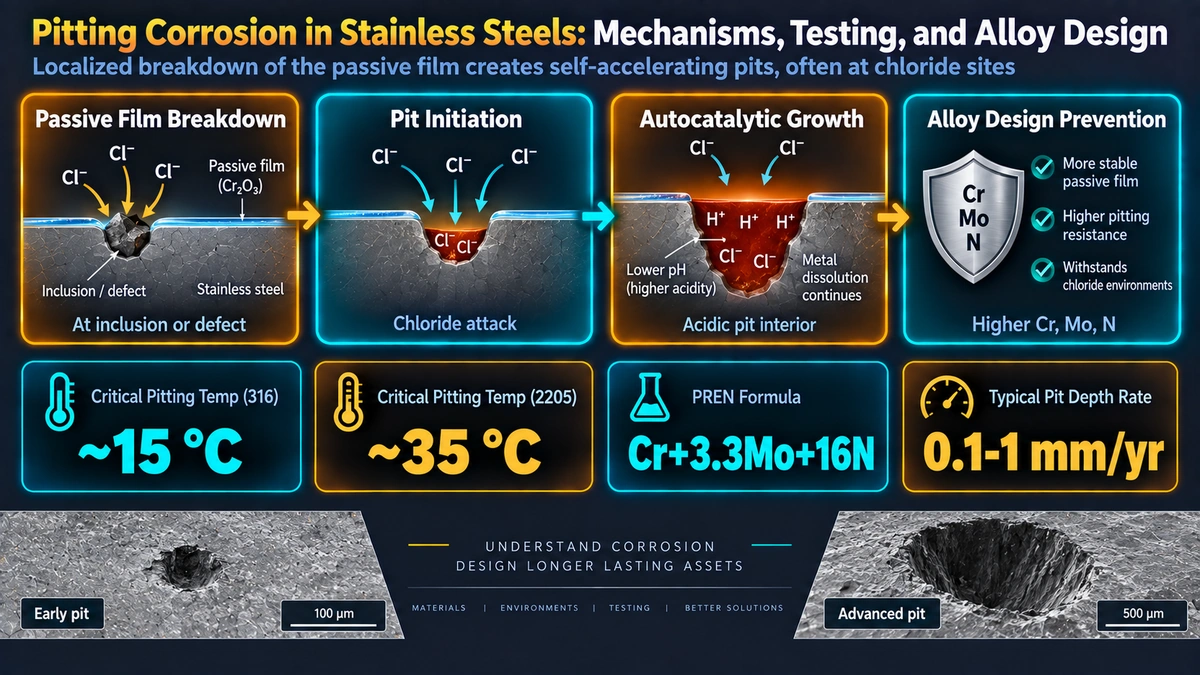
Once a stable pit nucleates and exceeds the critical nucleus size (typically 1–10 μm diameter), it becomes self-sustaining through an autocatalytic internal chemistry that makes passive film reformation thermodynamically impossible without external electrochemical intervention. The self-reinforcing sequence is:
- Active dissolution inside the pit: Fe → Fe2+ + 2e–; Cr → Cr3+ + 3e–; Ni → Ni2+ + 2e–. The cathodic reaction (oxygen reduction) occurs on the surrounding passive surface, not inside the pit.
- Metal cation hydrolysis and acidification: Mn+ + nH2O → M(OH)n + nH+. The pit interior pH can fall to 1–2, well below the passivity threshold for any stainless steel grade.
- Chloride enrichment for charge balance: As positively-charged metal cations accumulate in the pit, electroneutrality requires an equivalent influx of anions. Chloride, being highly mobile and present in the bulk electrolyte, migrates preferentially into the pit, reaching concentrations of 4–12 mol/L — 10–20 times the bulk concentration.
- Oxygen depletion: Diffusion of dissolved O2 into the pit interior is slower than O2 consumption by metal dissolution. The pit bottom becomes deaerated, eliminating any possibility of passive film reformation by the principal reaction pathway.
The resulting internal environment — pH 1–2, Cl– > 4 mol/L, zero dissolved O2 — is completely outside the passivity domain of any commercial stainless steel grade. The only way to stop propagation is electrochemical: externally polarising the structure below Eprot (cathodic protection), or physically removing the corrosive species from contact with the pit.
Pit Morphology and Depth Kinetics
Pit geometry evolves with time and controls local chemistry. Hemispherical pits growing on open surfaces maintain relatively good electrolyte exchange between the pit and the bulk solution; narrow, elongated pits developing beneath covers, oxide films, or in crevices accumulate the most aggressive internal chemistry and grow fastest. The empirical pit depth–time relationship for freely growing pits follows a power law:
Pit depth vs time (empirical power law):

  d = k × tⁿ

  Where:
    d = pit depth (mm or μm)
    t = exposure time (hours or days)
    k = rate constant (depends on alloy, environment, temperature)
    n = time exponent, typically 0.3–0.5 for freely growing pits

Interpretation:
  n < 0.5: diffusion-limited growth (pit chemistry dilutes over time)
  n = 0.5: pure diffusion control (Fickian)
  n > 0.5: accelerating growth (rare — indicates coalescence or crevice transition)

Note: pit depth is a stochastic variable; extreme-value statistics
(Gumbel or Weibull distribution) must be used for reliability assessment,
not mean pit depth.
Crevice Corrosion: Pitting Without a Surface Defect
Crevice corrosion is closely related to pitting but initiates through a distinct mechanism — oxygen depletion inside a confined geometry rather than passive film failure at a surface heterogeneity. Common crevice geometries in engineering practice include: flanged connections with gaskets, threaded fittings and fastener holes, tube-to-tubesheet interfaces, lap joints, and surfaces under biological films or fouling deposits.
The crevice corrosion mechanism in stainless steel proceeds in two phases: (1) initiation by oxygen depletion — O2 inside the crevice is consumed by the cathodic half-reaction and cannot be replenished by diffusion through the narrow gap; once O2 is exhausted, the passive film in the crevice is no longer thermodynamically stable, and active dissolution begins; (2) propagation by the same autocatalytic mechanism as pitting — exactly as described in the pit propagation section above.
The critical distinction between pitting and crevice corrosion is the initiation temperature. Because crevice corrosion bypasses the need for passive film breakdown at a surface defect, it initiates at lower temperatures and chloride concentrations. The Critical Crevice Temperature (CCT) is typically 15–25°C lower than the CPT for the same alloy under the same test conditions. This has direct engineering implications:
Crevice-free design principles: full-penetration welds rather than lap or fillet joints on external surfaces; PTFE spiral-wound gaskets rather than fibre gaskets (which absorb electrolyte); smooth-bore connections instead of threaded flanges; controlled drainage on horizontal stainless surfaces to prevent stagnant water pooling; and avoidance of contact with dissimilar metals that could establish galvanic couples. For the electrochemical basis of galvanic corrosion and metal selection criteria, see the MetallurgyZone corrosion mechanisms article.
Prevention Strategies: Alloy Selection, Surface Treatment, and Design
Alloy Upgrading Based on PREN and CPT
The primary engineering control for pitting is alloy selection matched to the service environment aggressiveness. The following guidelines apply to stainless steel selection in chloride-containing aqueous service:
- Indoor freshwater and food contact (<50 ppm Cl–): 304/304L (PREN ~19) is adequate. Ensure proper drainage and cleaning to prevent chloride concentration under deposits.
- Coastal atmospheric and dilute process chloride (50–1,000 ppm Cl–): 316L (PREN ~25) is the standard selection. Surface passivation per ASTM A967 is required after fabrication.
- Chemical processing and brackish water: 317L (PREN ~30) or 904L (PREN ~34) depending on temperature. Consider CPT test data for the specific chloride concentration and temperature.
- Seawater immersion at ambient temperature (<25°C): Minimum PREN 35 required. Duplex 2205 (PREN ~35) is the standard offshore structural material. Confirm weld metal PREN is also ≥ 35 using superduplex or 25Cr-10Ni-4Mo consumables.
- Hot seawater or concentrated brine (>25°C, >10,000 ppm Cl–): Minimum PREN 40. SAF 2507 superduplex (PREN ~41) or 254 SMO 6Mo austenitic (PREN ~43). For temperatures above 60°C in concentrated brine, Alloy 625 (PREN ~51) or titanium.
Surface Condition and Post-Fabrication Treatment
The surface condition of stainless steel has a large and frequently underestimated influence on pitting performance. The principal surface treatments are:
- Passivation (ASTM A967, ASTM A380): Immersion in 20–50% nitric acid or 5–10% citric acid solution removes free iron from the surface, dissolves near-surface MnS inclusions, and improves the Cr/Fe ratio in the passive film. Essential after machining and fabrication before chloride service. Citric acid is preferred for operator safety without performance penalty.
- Electropolishing: Anodic dissolution in phosphoric/sulphuric acid mixture removes surface peaks and valleys, reduces surface roughness to Ra < 0.5 μm, and creates a highly Cr-enriched surface passive film with 50–200 mV improvement in Epit relative to mechanically polished surfaces. Standard for pharmaceutical and high-purity food-grade stainless.
- Post-weld pickling and passivation: Weld heat tint (the oxide layer formed during welding) has a significantly lower Cr/Fe ratio than the base metal passive film, making it preferentially susceptible to pitting. Acid pickling using HF/HNO3 or citric acid followed by passivation must be performed on all welds in chloride service before hydrotest or commissioning. For the metallurgical effects of welding on stainless steel microstructure and corrosion resistance, see the MetallurgyZone guide on HAZ microstructure.
Cathodic Protection
Polarising the structure below the repassivation potential Eprot will arrest existing pits and prevent new ones from nucleating, regardless of chloride concentration or temperature. This approach is used for stainless steel heat exchangers with seawater cooling: aluminium or zinc sacrificial anodes, or impressed current systems, hold the tube sheet potential well below Eprot. Monitoring the potential is essential — over-protection (excessively negative potential) can cause hydrogen evolution and potentially hydrogen-assisted cracking in high-strength grades. See the MetallurgyZone article on hydrogen-induced cracking for the metallurgical context.
Pitting Failure in an MSF Desalination Evaporator Tube Sheet
A multi-stage flash (MSF) desalination plant in the Arabian Gulf experienced premature tube sheet failure after 18 months of service. The specified material was 316L stainless steel (PREN ≈ 25). Operating conditions: brine temperature 80–120°C, chloride concentration 45,000–65,000 ppm, pH 8.1–8.4.
Failure analysis: Pitting initiated at tube-to-tubesheet crevices (rolled expansion joints), where oxygen depletion and elevated temperature combined to produce the critical conditions for rapid crevice-initiated pit growth. The CPT of 316L at 65,000 ppm Cl– is approximately 20°C — far below the 80°C operating temperature. Pit depths of 4–12 mm were measured in a 20 mm thick tubesheet after 18 months of operation. MnS inclusions were confirmed as primary initiation sites on unfailed areas adjacent to crevices.
Root cause: Gross material misspecification. The PREN selection criterion for this brine temperature and concentration requires PREN ≥ 41. 316L at PREN ≈ 25 is not fit for purpose in this environment regardless of operating pH or inhibitor addition.
Corrective action: Replacement with SAF 2507 superduplex (PREN = 41, CPT > 55°C even in concentrated brine). Tube-to-tubesheet crevices were eliminated by converting from rolled expansion to full-penetration explosive welding. Post-weld passivation per ASTM A967 citric acid process was specified as a mandatory hold point. No further pitting failures were reported over the subsequent 12-year operating period, demonstrating the decisive effect of correct alloy selection combined with crevice-free design.
Frequently Asked Questions
Why does 304 stainless steel pit in swimming pools but 316L generally does not?
Does welding reduce pitting resistance in stainless steel?
What is the PREN formula and how is it used for material selection?
What is the difference between pitting corrosion and crevice corrosion?
What is the role of nitrogen in pitting resistance?
How is Critical Pitting Temperature (CPT) measured?
What surface treatments improve pitting resistance of stainless steel?
Why do MnS inclusions cause pitting preferentially compared to other inclusion types?
What is autocatalytic pit growth and why does it make pits self-sustaining?
Recommended Reference Books
Corrosion of Stainless Steels — A. J. Sedriks (2nd ed.)
The definitive reference covering all corrosion forms in stainless steels: pitting, crevice, SCC, intergranular. Essential for any corrosion engineer working with stainless.
View on AmazonCorrosion Engineering — Fontana & Greene (3rd ed.)
Classic foundational text covering all eight forms of corrosion including pitting and crevice, with electrochemical principles, materials selection, and prevention strategies.
View on AmazonOutokumpu Corrosion Handbook (10th ed.)
Comprehensive industry reference: PREN data, CPT values, corrosion rate tables, and material selection guidelines for every commercial stainless steel grade in aqueous environments.
View on AmazonCorrosion and Corrosion Control — Uhlig & Revie (4th ed.)
Comprehensive graduate-level corrosion science text: electrochemical theory, localised corrosion mechanisms, passivity, and practical corrosion prevention across all alloy systems.
View on AmazonDisclosure: MetallurgyZone participates in the Amazon Associates programme. If you purchase through these links, we may earn a small commission at no extra cost to you. This helps support free technical content on this site.
References
- Sedriks, A.J., Corrosion of Stainless Steels. 2nd ed. John Wiley & Sons, 1996.
- Frankel, G.S., “Pitting Corrosion of Metals: A Review of the Critical Factors.” Journal of the Electrochemical Society, 145(6), 2186–2198, 1998.
- ASTM G150: Standard Test Method for Electrochemical Critical Pitting Temperature Testing of Stainless Steels. ASTM International.
- ASTM G61: Standard Test Method for Conducting Cyclic Potentiodynamic Polarisation Measurements for Localised Corrosion Susceptibility of Iron-, Nickel-, or Cobalt-Based Alloys. ASTM International.
- ASTM A967: Standard Specification for Chemical Passivation Treatments for Stainless Steel Parts. ASTM International.
- Outokumpu Stainless, Corrosion Handbook. 10th ed. Outokumpu, 2015.
- Tronstad, R. and Drugli, J.M., “Pitting and crevice corrosion resistance of superduplex stainless steels.” Corrosion Science, 34(8), 1369–1382, 1993.
- Marcus, P. (ed.), Corrosion Mechanisms in Theory and Practice. 3rd ed. CRC Press, 2011.
Further Reading
Corrosion Mechanisms
Electrochemical cell fundamentals, Pourbaix diagrams, passivity, and corrosion thermodynamics.
Pitting Corrosion Overview
Broad guide to pitting in all alloy systems including carbon steel, aluminium, and nickel alloys.
HAZ Microstructure
Sensitisation, phase imbalance in duplex HAZ, and corrosion implications of weld thermal cycles.
Hydrogen-Induced Cracking
Mechanisms and susceptibility of high-strength and duplex stainless steels in sour service.
Grain Boundaries and Segregation
Cr depletion, sensitisation, and grain boundary segregation driving intergranular attack.
Charpy Impact Testing
Toughness evaluation of superduplex and austenitic grades for low-temperature chloride service.
Hardness Testing Methods
Vickers, Rockwell, and microhardness mapping for weld HAZ characterisation in stainless steel.
Metallurgy Calculators
Interactive calculators for PREN, corrosion rate, Charpy transition temperature, and more.
