Pressure Vessel Steel SA-516 Grade 70: A Complete Guide
SA-516 Grade 70 is the workhorse carbon steel plate specification behind a large share of the pressure vessels, storage tanks, and boiler components fabricated worldwide. This guide covers its chemistry, mechanical properties, normalizing and impact testing requirements, weldability, and how it compares with neighboring plate grades in the A516/SA-516 and A537 families.
Key Takeaways
- SA-516 Grade 70 is the ASME-adopted equivalent of ASTM A516 Grade 70, carrying the same chemistry and mechanical requirements plus ASME certification traceability.
- Minimum properties: 70 ksi (485 MPa) tensile strength, 38 ksi (260 MPa) yield strength, roughly 21% elongation in 2 in.
- Grade 70 is the highest-strength member of the A516/SA-516 family (55, 60, 65, 70), all sharing a similar carbon-manganese chemistry philosophy.
- Normalizing is required above certain thickness thresholds or for low-temperature service, refining grain structure for better toughness.
- Charpy impact testing applies only when MDMT, thickness, and stress ratio fall outside the ASME UCS-66 exemption curves — not universally required.
- Weldability is good with common low-hydrogen processes; preheat scales primarily with thickness and process hydrogen level.
1. What Is SA-516 Grade 70?
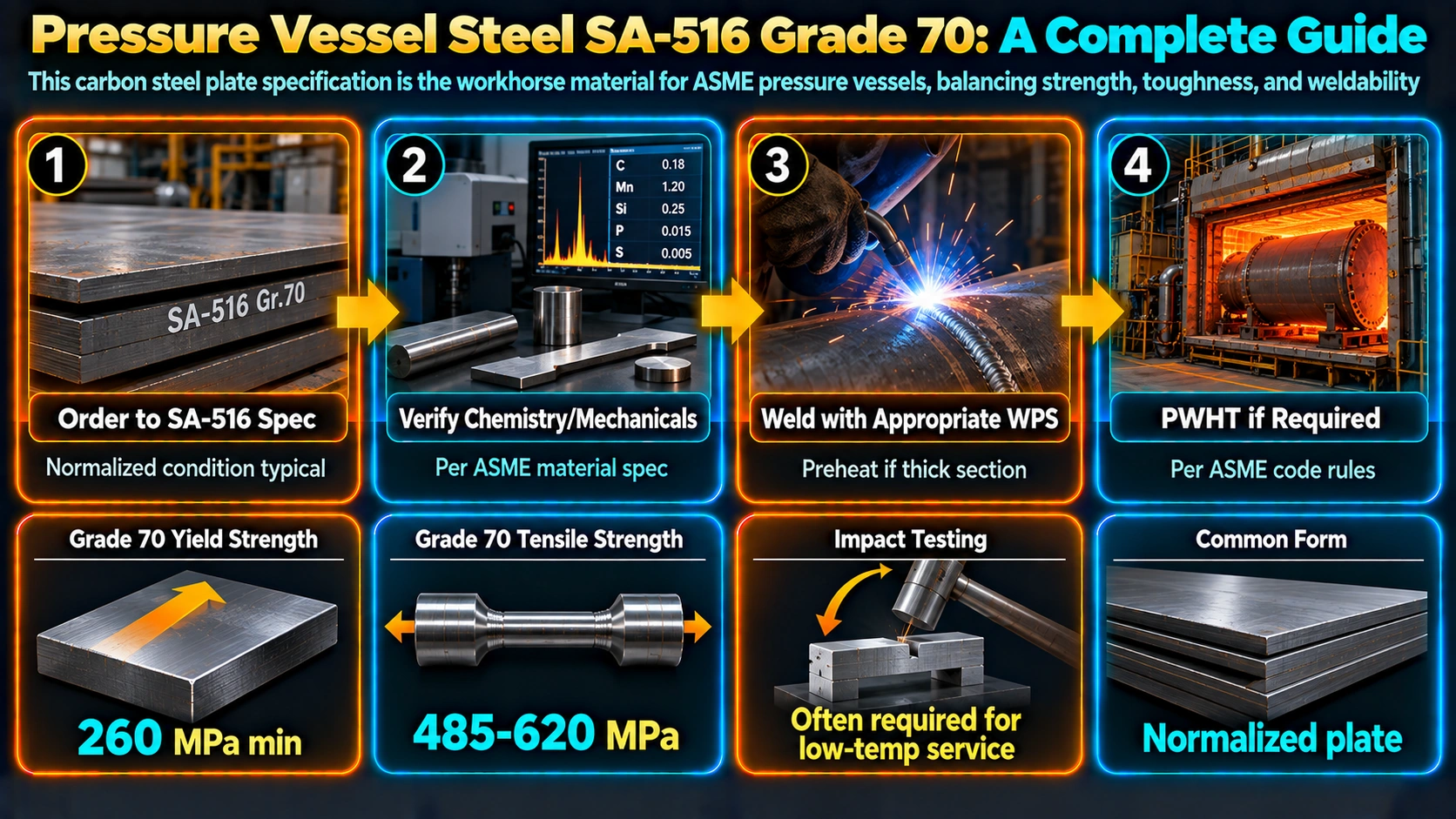
SA-516 Grade 70 is the ASME Boiler and Pressure Vessel Code Section II Part A adoption of ASTM A516 Grade 70, a normalizable carbon-manganese steel plate specification developed specifically for welded pressure vessels operating in moderate and lower temperature service. Within the A516/SA-516 family (Grades 55, 60, 65, 70), Grade 70 offers the highest strength while retaining the notch toughness behaviour the entire family was designed around.
1.1 SA-516 vs ASTM A516
SA-516 is chemically and mechanically essentially identical to ASTM A516, but sits under ASME Section II Part A, which layers on additional certification, material traceability, and quality documentation requirements needed for use in ASME Section VIII pressure vessel construction. In practice, a mill producing plate to SA-516 Grade 70 is producing to A516 Grade 70 requirements plus ASME-specific certification — most fabricators simply specify SA-516 directly when the end product is a code-stamped vessel.
2. Chemical Composition
| Element | Typical Max (wt%) | Role |
|---|---|---|
| Carbon | 0.27 – 0.31 (thickness dependent) | Primary strengthener; kept moderate to preserve weldability and toughness |
| Manganese | 0.85 – 1.20 | Solid-solution strengthening, grain refinement, deoxidation support |
| Phosphorus | 0.035 max | Controlled low — embrittlement and segregation risk |
| Sulfur | 0.035 max (often lower for HIC-resistant orders) | Controlled low — inclusion and hydrogen-induced cracking risk |
| Silicon | 0.13 – 0.45 | Deoxidation |
Carbon content varies slightly by plate thickness band within the specification, since thicker sections need a compensating chemistry adjustment to still hit the same minimum strength after slower cooling — a relationship rooted in the same iron-carbon phase diagram logic covered elsewhere on this site.
3. Mechanical Properties
| Property | Minimum Requirement |
|---|---|
| Tensile strength | 70,000 – 90,000 psi (485 – 620 MPa) |
| Yield strength | 38,000 psi (260 MPa) minimum |
| Elongation (2 in gauge) | ~21% minimum (thickness dependent) |
| Elongation (200 mm gauge) | ~19% minimum (thickness dependent) |
Properties are verified per ASTM A370 tension testing methodology (which itself references ASTM E8/E8M procedure), with test specimen orientation and location governed by the applicable product specification.
3. Normalizing and Grain Structure
SA-516 Grade 70 can be supplied as-rolled or normalized, and normalizing is mandated by ASME Section VIII design rules above certain plate thickness thresholds, or specified directly by the purchaser for low-temperature or critical service. Normalizing — austenitizing followed by air cooling — refines and homogenizes the ferrite-pearlite grain structure relative to the coarser, more variable as-rolled condition, which improves both the consistency of strength through the plate thickness and, critically, the notch toughness at reduced temperature.
Normalizing cycle (typical, illustrative):
    Austenitize: ~1650-1700 °F (900-925 °C)
    Hold: sufficient time for through-thickness
          temperature uniformity
    Cool: still air, to room temperature

Result: refined, more uniform ferrite-pearlite
        grain size compared to as-rolled condition
4. Impact Testing Requirements (ASME UCS-66)
Charpy V-notch impact testing of SA-516 Grade 70 is not universally required — whether it applies depends on the interaction of minimum design metal temperature (MDMT), plate thickness, and the applied stress ratio, evaluated against the exemption curves in ASME Section VIII Division 1 Part UCS-66. Many vessels operating at or near ambient temperature with moderate thickness fall within the exemption curve and require no impact testing at all; vessels intended for cold climates, refrigerated service, or start-up conditions at low temperature typically fall outside the exemption and require Charpy testing at a specified minimum test temperature, evaluated against minimum absorbed energy criteria discussed in more depth in the site’s Charpy impact testing article.
4.1 Why Toughness, Not Just Strength, Governs Selection
A plate can comfortably meet its minimum tensile and yield strength while still being unsuitable for a given MDMT if its ductile-to-brittle transition temperature sits too close to or above the vessel’s minimum operating temperature — the practical reason UCS-66 exists as a separate check layered on top of the basic strength specification.
5. Weldability and Preheat Considerations
SA-516 Grade 70 is considered a readily weldable carbon steel using common arc processes — SMAW, GMAW, FCAW, and SAW — with matching low-hydrogen consumables selected to approximate the base metal’s strength without significantly overmatching it. Preheat and interpass temperature requirements scale primarily with plate thickness and the diffusible hydrogen potential of the selected process, following the same hydrogen-cracking-avoidance logic covered in the site’s hydrogen cracking article — thicker sections restrain the weld more and cool the HAZ faster, both of which raise cracking risk without adequate preheat.
Post-weld heat treatment (PWHT) is frequently required by the governing construction code based on thickness and service conditions, both to relieve residual stress and to temper any hard HAZ constituents formed during welding, paralleling the same post-weld metallurgical control discussed in the quenching and tempering article applied here to a weld HAZ rather than a bulk heat treatment.
6. Comparison with Related Plate Grades
| Grade | Min. Tensile (ksi) | Min. Yield (ksi) | Typical Use Case |
|---|---|---|---|
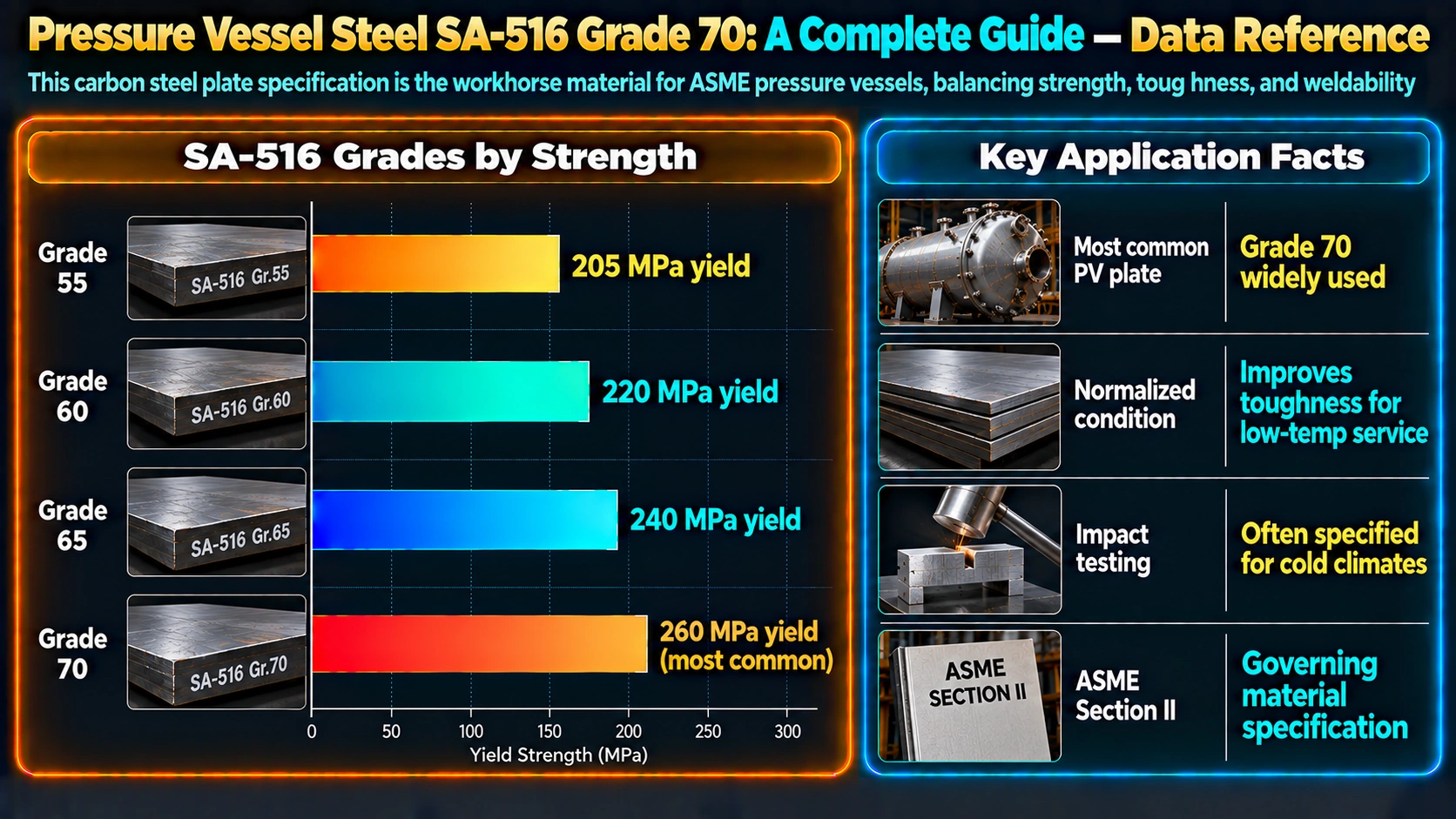
| SA-516 Gr. 55 | 55 | 30 | Lower-pressure vessels, lighter sections |
| SA-516 Gr. 60 | 60 | 32 | General-purpose vessels, moderate pressure |
| SA-516 Gr. 65 | 65 | 35 | Higher-pressure vessels within the same family chemistry |
| SA-516 Gr. 70 | 70 | 38 | Highest-strength option in the family; thick-section, higher-pressure vessels |
| SA-537 Class 1/2 | 70-100+ | 50-80+ | Where SA-516’s strength ceiling is insufficient |
Where a vessel’s design pressure and allowable thickness combination exceeds what even SA-516 Grade 70 can economically support, designers move to SA-537, a normalized or quenched-and-tempered carbon-manganese-silicon plate specification offering meaningfully higher strength at the cost of a more involved heat treatment route and typically higher plate cost.
7. Industrial Applications and Significance
SA-516 Grade 70 is the default plate specification for a huge fraction of ASME Section VIII pressure vessels, storage tanks, and boiler drums worldwide, precisely because it balances strength, weldability, availability, and toughness well enough to suit the majority of moderate-pressure, moderate-temperature applications without requiring exotic processing. Understanding when normalizing and Charpy testing actually apply — rather than assuming they are always required — is one of the more common points of confusion for engineers new to pressure vessel material specification, and getting that determination right has a direct, material impact on both project cost and delivery schedule.
8. Frequently Asked Questions
What is SA-516 Grade 70 steel?
What is the difference between ASTM A516 and ASME SA-516?
What is the chemical composition of SA-516 Grade 70?
What are the minimum mechanical properties of SA-516 Grade 70?
When is normalizing required for SA-516 Grade 70 plate?
Does SA-516 Grade 70 require Charpy impact testing?
Is SA-516 Grade 70 weldable and what preheat is typically needed?
How does SA-516 Grade 70 compare with SA-516 Grade 60 and SA-537?
Recommended Reference Materials
ASME Section VIII Pressure Vessel Design Handbook
Reference covering material selection, UCS-66 impact test exemption logic, and design rules.
View on AmazonASM Handbook — Properties and Selection of Carbon Steels
In-depth reference on carbon-manganese plate steel chemistry and heat treatment.
View on AmazonWelding Metallurgy Reference Text
Background on preheat, HAZ control, and PWHT for carbon steel plate.
View on AmazonMechanical Testing of Materials Handbook
Reference covering tensile and Charpy impact testing methodology.
View on AmazonDisclosure: MetallurgyZone participates in the Amazon Associates programme. If you purchase through these links, we may earn a small commission at no extra cost to you. This helps support free technical content on this site.
Further Reading
