Thermomechanical Controlled Processing (TMCP) of Steel
Thermomechanical controlled processing (TMCP) combines controlled hot rolling with accelerated cooling to refine ferrite grain size directly during plate or coil production, delivering a strength-toughness combination that conventional hot rolling plus normalizing cannot match at the same carbon and alloy content. This guide explains the reheating, controlled rolling, and accelerated cooling stages of TMCP, the microalloy precipitation chemistry that makes it work, and why it is the standard production route for modern linepipe and structural steel grades.
Key Takeaways
- TMCP refines ferrite grain size by controlling deformation temperature and cooling rate during rolling, rather than relying on a separate post-rolling normalizing treatment.
- Finish rolling below the no-recrystallization temperature (Tnr) leaves pancaked austenite with high internal deformation density, multiplying ferrite nucleation sites on cooling.
- Niobium microalloying is central to TMCP: Nb(C,N) precipitates raise Tnr and pin austenite grain boundaries, enabling the non-recrystallization rolling stage.
- Accelerated cooling (ACC) after rolling further refines grain size and adds precipitation strengthening beyond what controlled rolling alone achieves.
- Because strength comes from grain refinement and precipitation rather than carbon content, TMCP steels reach high strength grades at low carbon equivalent, improving field weldability.
- TMCP (and its direct-quench variant) is the standard route for API 5L X60-X100 linepipe, offshore structural plate, and shipbuilding steel.
What Is TMCP
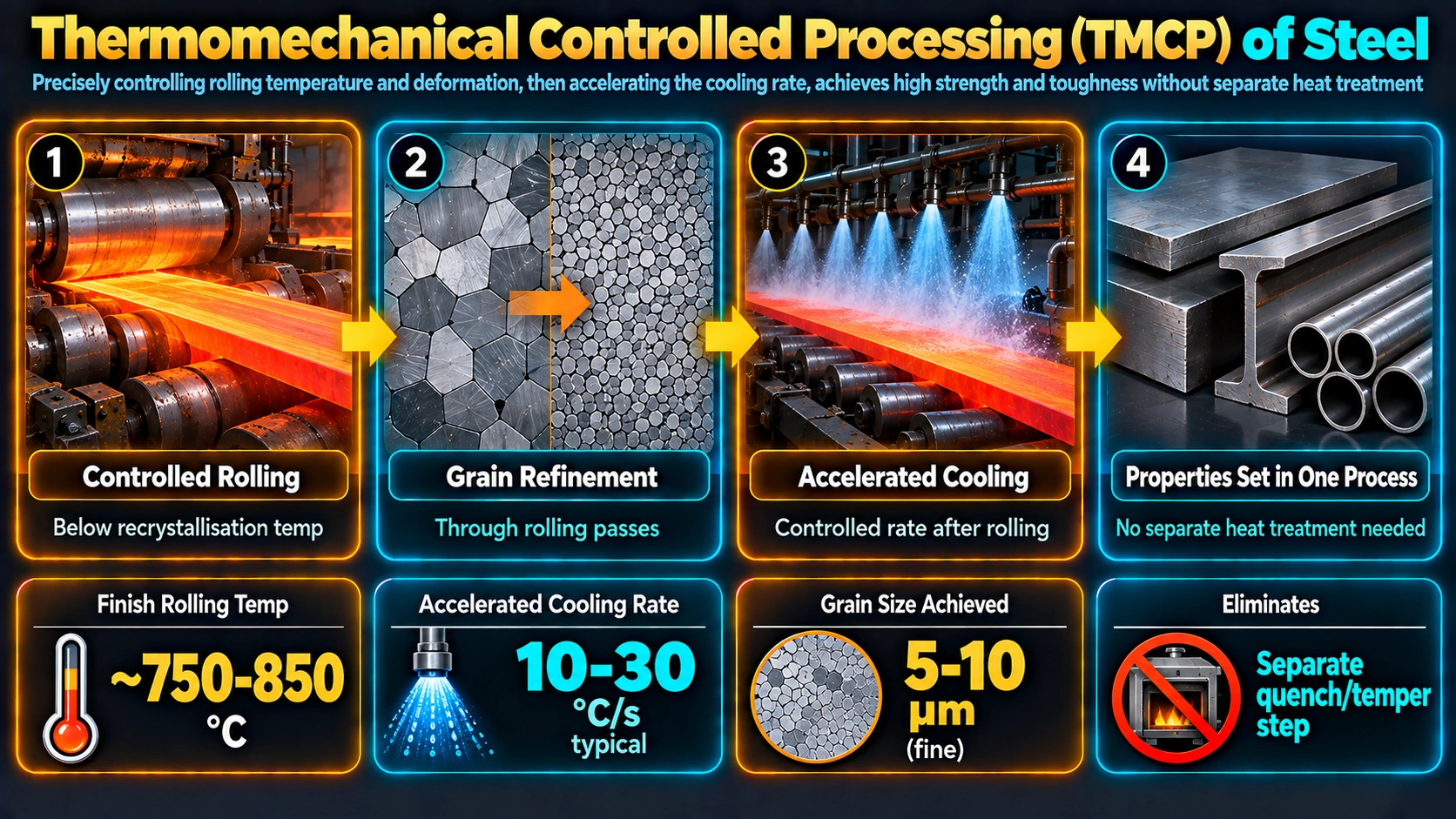
TMCP is a plate and coil production route that integrates hot deformation and cooling control into a single, tightly specified schedule so that the final microstructure, and therefore final mechanical properties, is set during rolling rather than through a subsequent standalone heat treatment. It was developed primarily to meet the combined demand for higher strength, better low-temperature toughness, and improved field weldability in linepipe and structural steel, a combination that is difficult to achieve simultaneously through carbon and alloy additions alone.
Stages of the TMCP Schedule
Reheating and Austenitizing
The slab is reheated to fully austenitize the microstructure and dissolve microalloy carbonitrides into solution, while fine, largely undissolved titanium nitride (TiN) particles are relied upon to pin austenite grain boundaries during reheating and limit initial grain coarsening, consistent with the boundary-pinning behaviour covered in the grain boundaries guide.
Rough Rolling in the Recrystallization Region
Above the no-recrystallization temperature (Tnr), each rolling pass deforms and then fully recrystallizes the austenite before the next pass, progressively refining austenite grain size through repeated recrystallization cycles.
Finish Rolling in the Non-Recrystallization Region
Once the strip or plate temperature drops below Tnr, recrystallization between passes becomes too slow to occur before the next pass, and the austenite instead accumulates deformation as pancaked (flattened, elongated) grains containing a high density of internal deformation bands. This pancaked, defect-rich austenite structure is central to the TMCP grain-refinement effect, since it presents far more nucleation sites (grain boundary area plus internal deformation bands) for ferrite formation on cooling than recrystallized, strain-free austenite would.
Accelerated Cooling (ACC)
Immediately after the final rolling pass, the plate is cooled at a controlled, faster-than-still-air rate, typically by water spray or laminar cooling banks, to a specified cooling stop temperature. Faster cooling suppresses ferrite grain growth after nucleation and can shift the transformed microstructure toward finer ferrite or, at higher cooling rates, bainite, while also promoting finer, more effective microalloy carbide precipitation than slow cooling allows.
Direct Quenching (Variant)
For ultra-high-strength plate grades, direct quenching applies rapid water quenching immediately after finish rolling rather than the moderate ACC rate, transforming the pancaked austenite directly to bainite or martensite. Direct-quenched TMCP grades are frequently tempered afterward to relieve internal stress and adjust toughness, similar in principle to conventional quenching and tempering, but starting from the deformation-refined austenite structure rather than a coarser reheated grain structure.
Microalloying Chemistry in TMCP Steel
| Element | Primary precipitate | Function in TMCP |
|---|---|---|
| Niobium (Nb) | Nb(C,N) | Retards recrystallization, raises Tnr, enables non-recrystallization rolling |
| Titanium (Ti) | TiN | Pins austenite grain boundaries during reheating, limits grain coarsening |
| Vanadium (V) | V(C,N) | Precipitation strengthening, primarily during and after cooling |
Because Nb(C,N) solubility and precipitation kinetics are strongly temperature-dependent, the reheating temperature, rough rolling schedule, and interpass times are all specified together with alloy composition rather than independently, since a schedule optimized for one microalloy design will not necessarily reproduce the same Tnr and grain-refinement response in a different composition.
Strengthening Mechanisms
TMCP steels derive strength predominantly from grain refinement, which is the only strengthening mechanism that simultaneously improves both strength and toughness, supplemented by microalloy precipitation strengthening and a smaller solid-solution contribution. The grain size dependence of yield strength follows the Hall-Petch relationship.
σy = σ0 + ky × d-1/2

σy = yield strength
σ0 = friction stress (lattice resistance to dislocation motion)
ky  = Hall-Petch strengthening coefficient
d    = mean ferrite grain diameter
Because grain refinement improves both strength and low-temperature toughness together, whereas carbon and most substitutional alloying additions raise strength at the expense of toughness, TMCP allows higher strength grades to be reached without the toughness penalty or the weldability penalty that a higher-carbon, higher-alloy conventional steel of the same strength would carry.
TMCP Compared with Alternative Production Routes
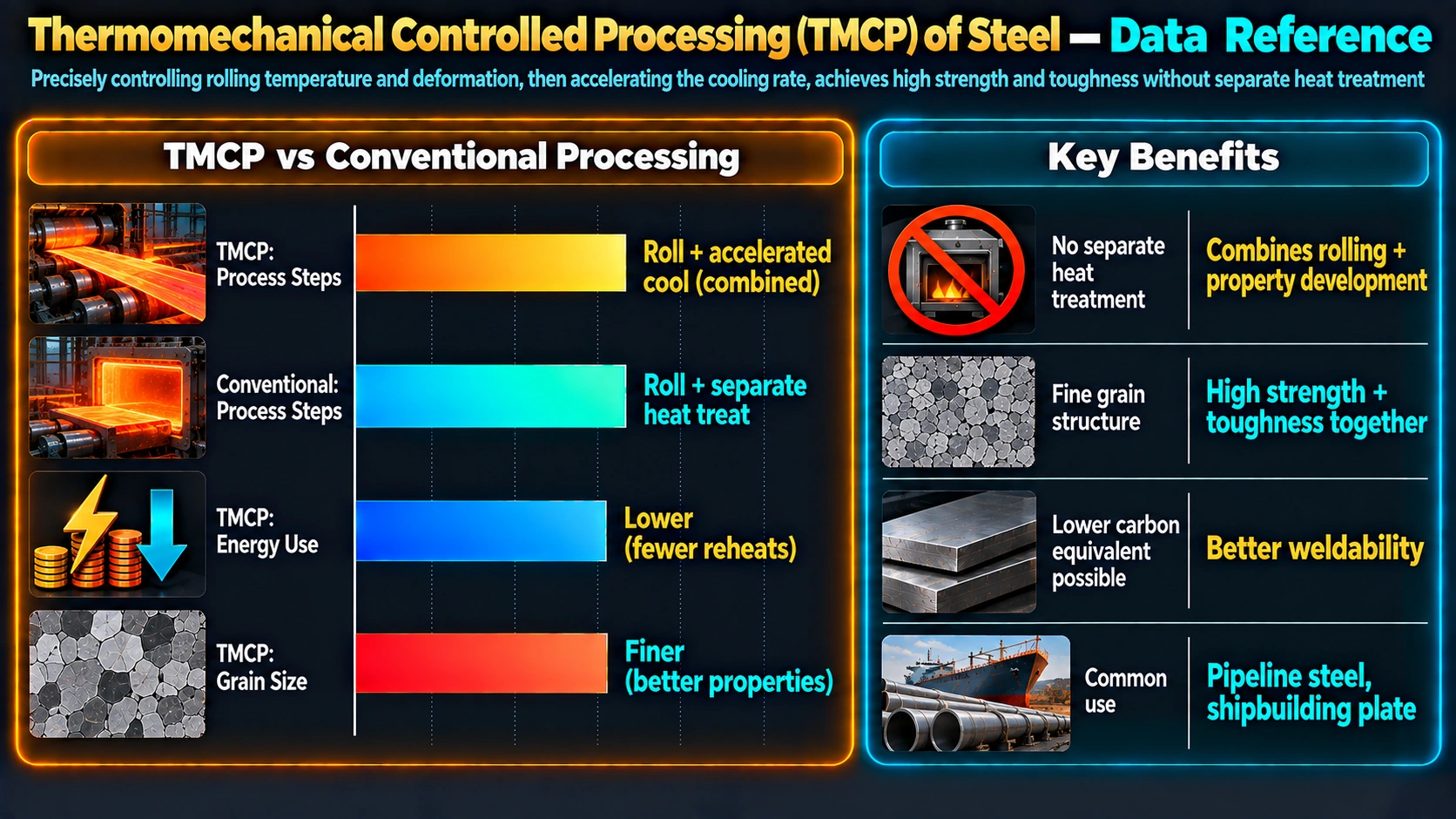
| Route | Grain refinement source | Post-rolling heat treatment | Typical carbon equivalent |
|---|---|---|---|
| Conventional hot rolling + normalizing | Normalizing heat treatment | Required (separate furnace cycle) | Moderate to high |
| TMCP (controlled rolling + ACC) | Controlled rolling + accelerated cooling | Generally not required | Low |
| TMCP with direct quenching (DQ) | Controlled rolling + rapid quench | Tempering typically applied | Low to moderate |
| Quenched and tempered plate (reheat route) | Reheat austenitizing + quench + temper | Required (separate furnace cycle) | Moderate to high |
Industrial Applications
TMCP is the standard production route for API 5L linepipe steel from grade X60 through X100, where the combination of high hoop strength, low-temperature Charpy toughness, and low carbon equivalent for field girth welding is a core specification requirement; low carbon equivalent directly reduces heat-affected zone hardness and the hydrogen cracking risk discussed in the NACE MR0175/ISO 15156 sour service guide. The same process route is used for offshore structural and shipbuilding plate, where toughness at low service temperature is a governing design requirement alongside strength.
Frequently Asked Questions
What is the difference between TMCP and conventional hot rolling followed by normalizing?
Why is finish rolling performed below the recrystallization temperature in TMCP?
What role does niobium play in TMCP steel?
What is accelerated cooling and why is it used after TMCP rolling?
Why does TMCP steel have better weldability than conventional high-strength steel?
What is direct quenching and how does it differ from standard TMCP?
What steel grades and products commonly use TMCP?
Does TMCP eliminate the need for any post-rolling heat treatment?
Recommended Reference Reading
Microalloyed Steels: Metallurgy and Applications
Core reference on Nb/Ti/V microalloying and controlled rolling metallurgy.
View on AmazonThermomechanical Processing of Steels
Focused process reference on controlled rolling and accelerated cooling schedules.
View on AmazonPipeline Steel Weldability Handbook
Reference connecting TMCP carbon equivalent design to field weldability performance.
View on AmazonPhysical Metallurgy of Steels
Foundational reference on Hall-Petch strengthening and phase transformation theory.
View on AmazonDisclosure: MetallurgyZone participates in the Amazon Associates programme. If you purchase through these links, we may earn a small commission at no extra cost to you. This helps support free technical content on this site.
Further Reading
