Superplastic Forming of Metals
Superplastic forming (SPF) uses fine-grained titanium and aluminium sheet at elevated temperature and low strain rate to achieve elongations of several hundred percent without necking, enabling complex, single-piece aerospace structures that would otherwise require multiple stamped and mechanically joined parts. This guide covers the grain-boundary sliding mechanism behind superplasticity, the process parameters that control it, the combined SPF/diffusion bonding route for sandwich structures, and where the technique fits against conventional sheet forming.
Key Takeaways
- Superplasticity requires a stable, fine equiaxed grain size (generally <10 μm), elevated temperature (~0.5 Tm), and a low, controlled strain rate.
- The dominant deformation mechanism is grain-boundary sliding accommodated by diffusion, which suppresses the local necking that limits conventional sheet forming ductility.
- A high strain rate sensitivity exponent (m ≥ 0.3, often 0.4-0.8 for aerospace grades) is the practical indicator of superplastic behaviour.
- Ti-6Al-4V is formed near 900-950°C; fine-grained 5083/7475 aluminium is formed near 450-520°C, both using gas pressure applied over minutes to hours.
- SPF/DB (superplastic forming combined with diffusion bonding) produces hollow, stiffened, or sandwich titanium structures in a single heated cycle, reducing part count and fastener weight.
- SPF is economically justified mainly for complex, weight-critical, low-to-medium volume parts due to long forming cycles and specialized tooling costs.
What Is Superplasticity
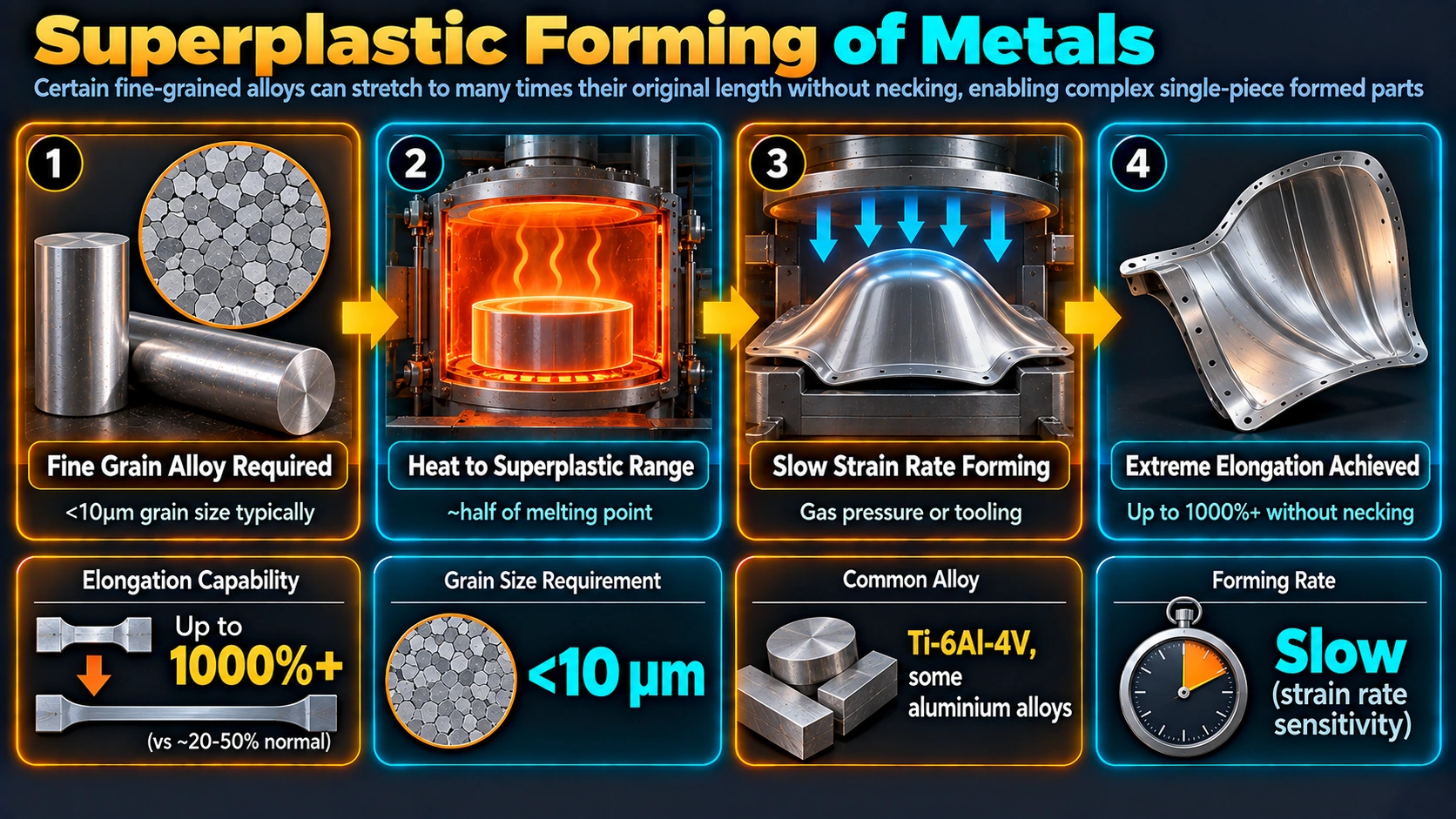
Superplasticity is the ability of certain fine-grained polycrystalline metals to sustain very large tensile elongations, commonly several hundred percent and in some alloys over 1000%, without the localized necking that terminates ductility in conventional sheet metal. This behaviour is only available within a specific window of grain size, temperature, and strain rate, which is why superplastic feedstock is a specially processed material rather than a property available in ordinary mill-annealed sheet.
The Grain-Boundary Sliding Mechanism
Superplastic flow is dominated by grain-boundary sliding, in which grains slide past one another along their boundaries while diffusion-controlled accommodation processes at triple points and boundary ledges prevent the void formation and stress concentration that would otherwise occur. Because sliding is distributed across a very fine grain structure rather than concentrated in a single shear band, deformation remains diffuse across the sheet, which is what suppresses local necking. This mechanism requires the grain structure to remain fine and equiaxed throughout the forming cycle, so alloys are specifically thermomechanically processed, often by controlled rolling and recrystallization or by microalloying with grain-refining phases, to produce and stabilize this structure. Compare with the general diffusion and boundary behaviour discussed in the grain boundaries guide.
Strain Rate Sensitivity
The practical indicator of superplastic capability is the strain rate sensitivity exponent, m, defined from the power-law relationship between flow stress and strain rate. A high m value means flow stress rises sharply if a local region strains faster than its surroundings, which redistributes further strain away from that region and suppresses necking, the same physical basis that gives chewing gum or hot glass their resistance to local thinning.
σ = K × ε̇m

σ = flow stress
K  = material constant
ε̇ = strain rate
m  = strain rate sensitivity exponent (m ≥ 0.3 for superplastic behaviour;
     0.4-0.8 typical for aerospace Ti and Al superplastic grades)
The flow stress-strain rate curve for a superplastic material passes through three regions: Region I (low strain rate, low m, grain-boundary-sliding-limited), Region II (the superplastic regime, high m), and Region III (high strain rate, low m, dislocation-glide-dominated), and commercial SPF processes are run within Region II.
Process Parameters by Material
| Material | Typical forming temperature | Typical strain rate | Typical grain size |
|---|---|---|---|
| Ti-6Al-4V (SPF grade) | 900-950°C | 10-4-10-3 s-1 | 2-6 μm |
| 5083 aluminium (fine-grain) | 450-520°C | 10-3-10-2 s-1 | 5-10 μm |
| 7475 aluminium (fine-grain) | 500-520°C | 10-4-10-3 s-1 | 5-10 μm |
| Ni-based superalloy PM sheet | ~950-1050°C | 10-4 s-1 | <10 μm |
SPF/DB: Superplastic Forming with Diffusion Bonding
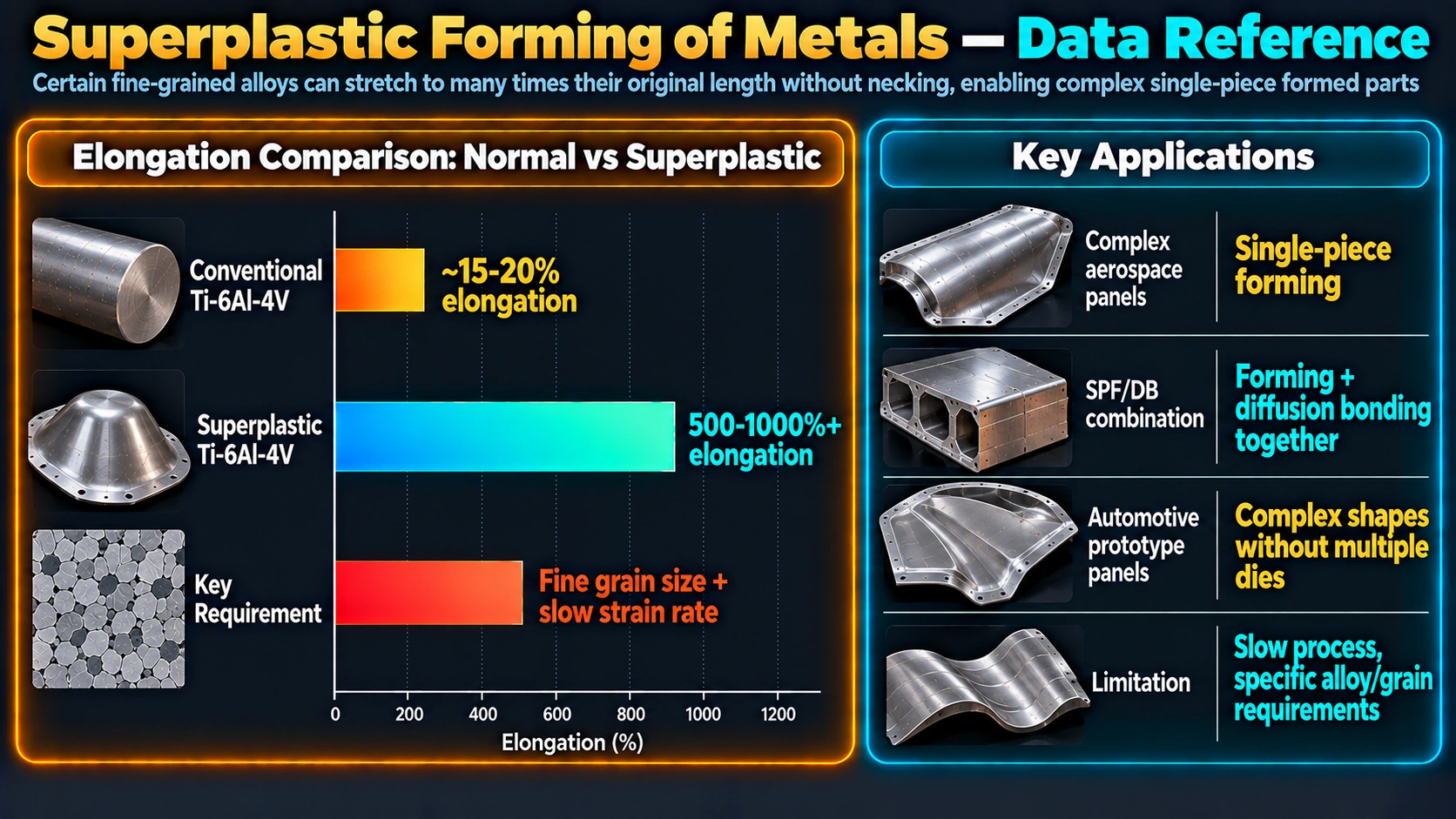
For titanium structures, superplastic forming is frequently combined with diffusion bonding (SPF/DB) in a single heated tool cycle. Two, three, or more titanium sheets are stacked with a selectively applied stop-off compound that prevents bonding at chosen locations, then the assembly is heated and pressed to diffusion-bond the unstopped areas. Gas pressure is then introduced between the bonded sheets to superplastically inflate the unbonded regions into a die cavity, producing hollow-core, corrugated-core, or truss-core stiffened panels in a single piece. This process, common in nacelle, fan blade, and access-door structures, eliminates the mechanical fasteners and adhesive joints that a built-up sheet-metal assembly would otherwise require, reducing both part count and structural weight. The diffusion mechanism involved is the same solid-state bonding phenomenon discussed in the hot isostatic pressing guide, applied here under uniaxial rather than isostatic pressure.
Cavitation and Its Control
Superplastic straining can nucleate microscopic voids (cavities) at grain boundaries and second-phase particles, particularly at higher strain rates or in alloys with a higher volume fraction of hard second-phase particles. Excessive cavitation coarsens under continued straining, reducing post-form ductility, fracture toughness, and fatigue performance if left uncontrolled. The standard mitigation is back-pressure forming, in which a superimposed hydrostatic gas pressure is applied on both sides of the sheet during forming, suppressing cavity growth by reducing the local tensile stress state without changing the net forming pressure differential.
SPF Compared with Conventional Sheet Forming
| Process | Typical strain rate | Achievable elongation | Typical part complexity |
|---|---|---|---|
| Superplastic forming | 10-4-10-2 s-1 | 200% to >1000% | Very high, single-piece, deep draws |
| Conventional stamping | ~1-102 s-1 | 20-50% | Moderate, multi-stage tooling |
| Deep drawing | ~10-1-10 s-1 | Limited by drawability ratio | Cylindrical / axisymmetric shapes |
| Hydroforming (room temp) | ~10-2-1 s-1 | Alloy-dependent, moderate | Complex but limited by base ductility |
Industrial Applications
SPF and SPF/DB titanium and aluminium parts are used extensively in commercial and military aircraft structures, including engine nacelle components, access panels, fan blade cores, and complex ducting, where the ability to form a single, deep, geometrically complex part in fine-grained titanium directly reduces both part count and structural weight relative to a riveted or welded built-up assembly. The niche remains predominantly aerospace because the combination of tooling cost, cycle time, and specialized fine-grain feedstock is difficult to justify economically outside high-value, weight-critical applications.
Frequently Asked Questions
What grain size is required for a metal to be superplastically formable?
What strain rate sensitivity value indicates superplastic behaviour?
What temperature is used to superplastically form Ti-6Al-4V?
What is SPF/DB and why is it used?
Why is superplastic forming cycle time so much longer than conventional stamping?
What is cavitation during superplastic forming?
Which aluminium alloys are commonly superplastically formed?
What are the main limitations of superplastic forming as a manufacturing process?
Recommended Reference Reading
Superplasticity in Metals and Ceramics
Foundational reference on grain-boundary sliding mechanics and superplastic alloy design.
View on AmazonTitanium and Titanium Alloys: Fundamentals and Applications
Covers Ti-6Al-4V processing routes including SPF and SPF/DB structures.
View on AmazonMetal Forming: Mechanics and Metallurgy
Broad forming-process reference covering strain rate sensitivity and forming limit theory.
View on AmazonAluminum and Aluminum Alloys (ASM Specialty Handbook)
Reference on fine-grain aluminium sheet processing for superplastic applications.
View on AmazonDisclosure: MetallurgyZone participates in the Amazon Associates programme. If you purchase through these links, we may earn a small commission at no extra cost to you. This helps support free technical content on this site.
Further Reading
