Hot Isostatic Pressing (HIP) Explained
Hot isostatic pressing (HIP) applies simultaneous elevated temperature and uniform gas pressure to close internal porosity and consolidate metal components to near-theoretical density. This guide explains the process mechanics, the densification mechanisms that operate during a HIP cycle, typical parameters by alloy class, and its central role in qualifying castings, powder metallurgy parts, and additively manufactured components for fatigue-critical service.
Key Takeaways
- HIP combines heat (0.5-0.8 Tm) and isostatic argon gas pressure (100-200 MPa, up to ~300 MPa) to densify parts through plastic yielding, creep, and diffusion bonding.
- HIP can only close porosity that is fully enclosed within the part; surface-connected porosity requires sealing (canning, cladding, or a dense as-built skin) before it can respond to isostatic pressure.
- The technique is standard post-processing for laser and electron beam powder bed fusion parts, closing gas porosity and some lack-of-fusion defects that otherwise initiate fatigue cracks.
- HIP is also used for powder metallurgy near-net-shape consolidation (canister HIP) and for closing shrinkage/gas porosity in aerospace superalloy and titanium castings.
- Densification proceeds through an early plastic-yielding stage followed by slower power-law creep and diffusional flow as porosity fraction and pore size decrease.
- Most precipitation-hardenable alloys still require a separate or combined solution treatment and aging cycle after HIP to develop final mechanical properties.
What Is Hot Isostatic Pressing
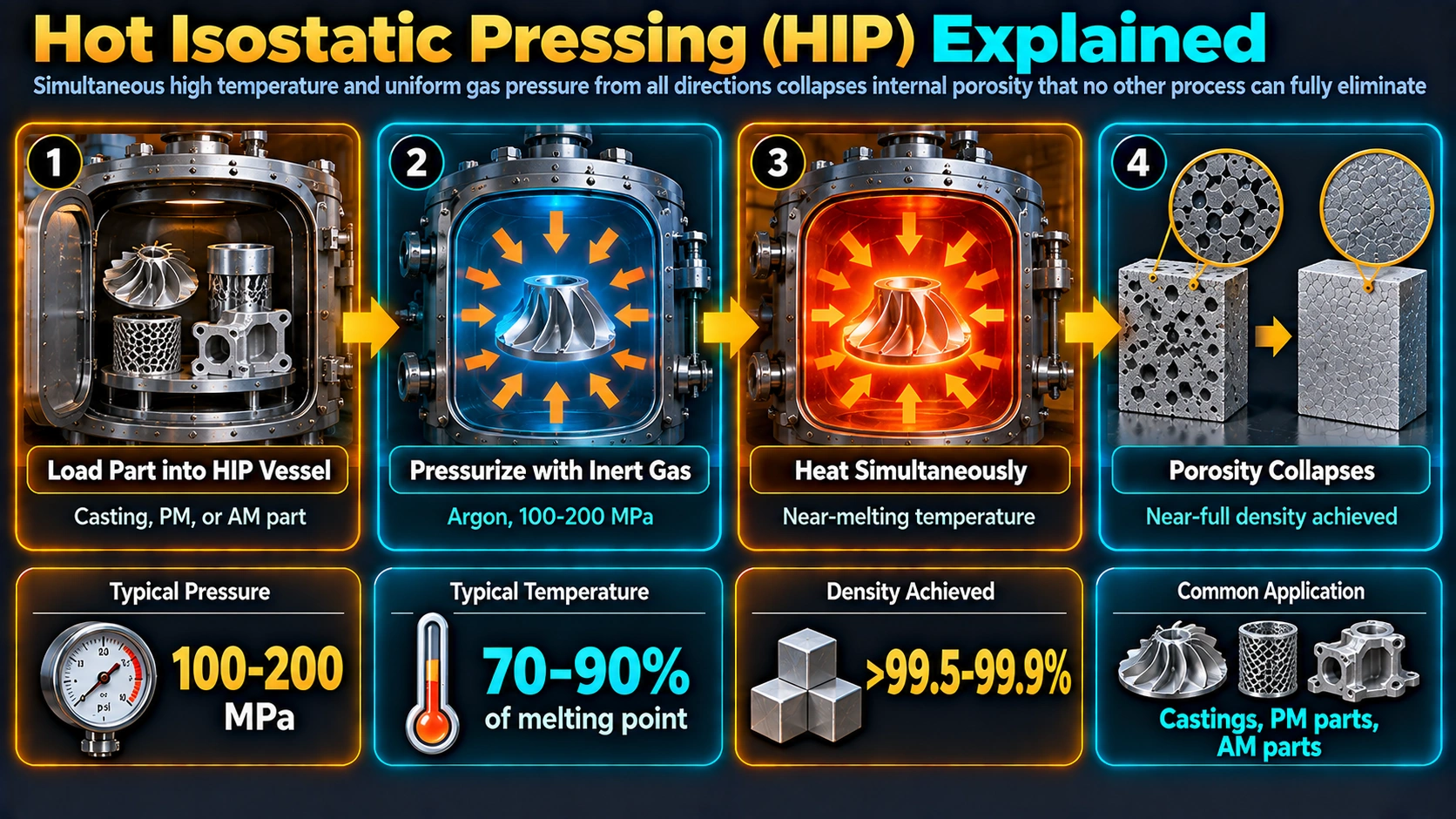
HIP is performed inside a pressure vessel (autoclave) in which the component is heated while high-pressure inert gas, almost always argon, applies uniform pressure from every direction. Because the pressure is isostatic (equal in all directions), the part densifies without the directional distortion associated with uniaxial hot pressing. The combination of elevated temperature, which lowers the material’s flow stress and activates diffusion, and sustained gas pressure drives internal pores to collapse and metallurgically bond shut, provided the pore is fully enclosed within the material and not open to the surface.
Densification Mechanisms
Pore closure during HIP proceeds through several concurrent mechanisms whose relative contribution shifts as densification progresses.
Plastic Yielding
At the start of a cycle, when local stress around a pore exceeds the material’s yield strength at temperature, the surrounding matrix deforms plastically and collapses the pore rapidly. This mechanism dominates early densification, particularly for larger pores and lower-strength alloys at temperature.
Power-Law Creep
As the pore shrinks and local stress concentration decreases below the yield condition, continued closure occurs by power-law (dislocation) creep, a time-dependent deformation mechanism sensitive to both stress and temperature.
Diffusional Flow
For the smallest residual porosity, closure is dominated by grain-boundary and volume diffusion of vacancies away from the pore surface, which is also the mechanism responsible for final metallurgical bonding across the collapsed pore interface once physical contact is achieved. This diffusion-bonding step, not just mechanical collapse, is what restores continuity across the former pore and allows it to carry load like the surrounding matrix. Compare with the diffusion concepts discussed in the grain boundaries guide.
Typical HIP Parameters by Application
| Alloy / material class | Typical temperature | Typical pressure | Typical hold time |
|---|---|---|---|
| Ti-6Al-4V (castings, PBF) | ~920-950°C | 100 MPa | 2 hours |
| Inconel 718 (castings, PBF) | ~1120-1185°C | 100-140 MPa | 2-4 hours |
| CoCr alloys (castings, PBF) | ~1150-1200°C | 100 MPa | 2-4 hours |
| Aluminum castings (A356/A357) | ~500-530°C | 100 MPa | 2-4 hours |
| PM tool steels / superalloy powder consolidation | ~1100-1200°C | 100-200 MPa | 2-4 hours |
These ranges are representative starting points; production HIP cycles are qualified against the specific alloy heat, prior processing route, and target specification, and should always be verified against the applicable process specification (e.g. AMS or OEM specifications) rather than used directly for production without qualification.
Applications
Casting Porosity Closure
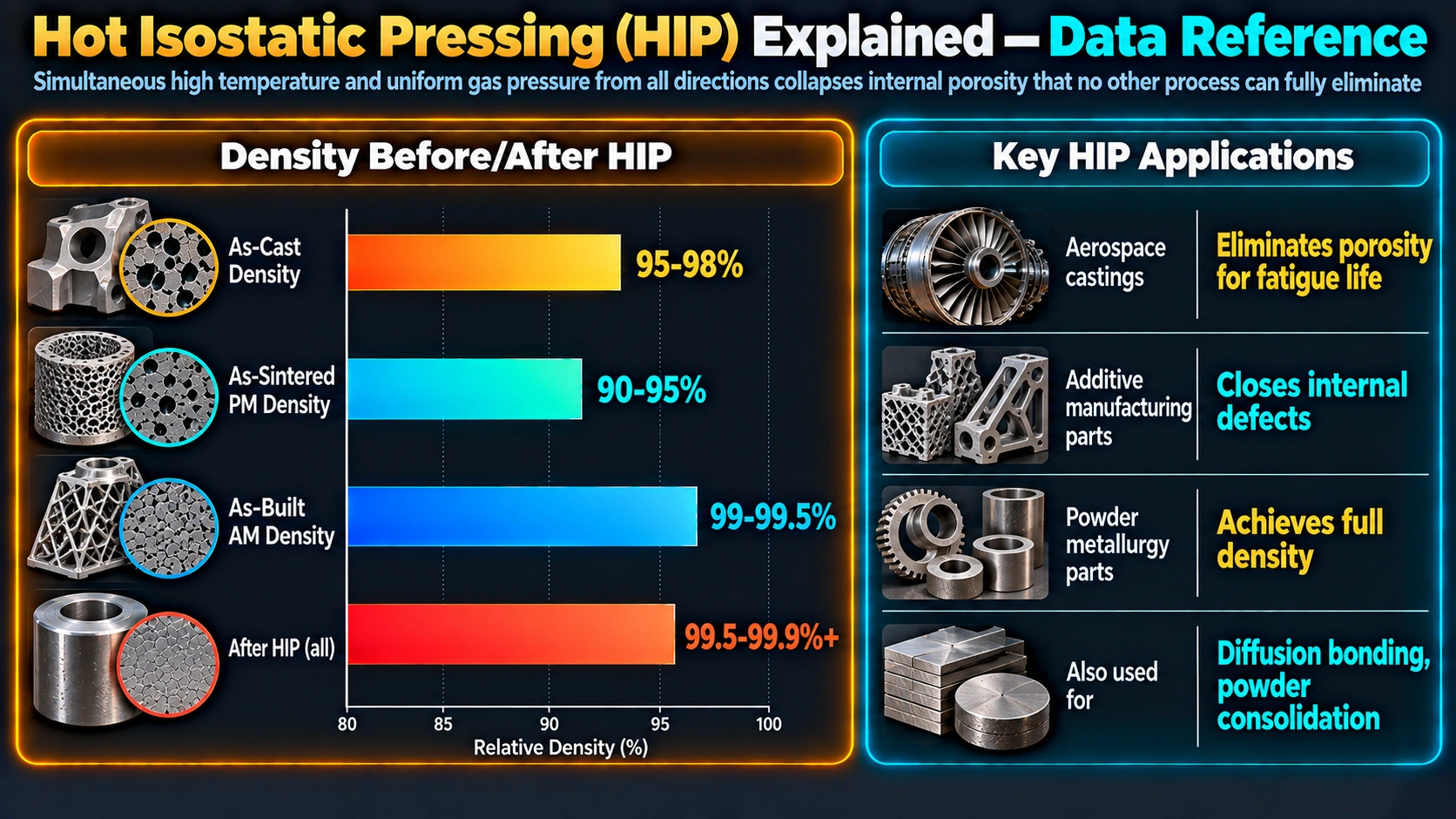
Investment and structural castings, particularly nickel-based superalloy and titanium aerospace castings, frequently contain internal shrinkage and gas porosity from solidification. HIP is specified as a mandatory processing step in many aerospace casting specifications, closing this porosity and reducing scatter in fatigue and fracture toughness data relative to the as-cast condition. Background on the solidification defects being closed is covered in the solidification and phase transformation discussion.
Additive Manufacturing Post-Processing
Laser and electron beam powder bed fusion parts commonly retain small spherical gas pores from atomized powder and, if process parameters are suboptimal, irregular lack-of-fusion voids. HIP is now a standard qualification step for fatigue-critical additively manufactured aerospace and medical components, closing enclosed porosity and substantially improving fatigue life and reducing property scatter compared to as-built material, though it cannot close porosity connected to the part’s external or internal channel surfaces.
Powder Metallurgy Consolidation
Canister (capsule) HIP consolidates metal powder directly to near-net shape by sealing powder inside an evacuated, gas-tight can before HIP, avoiding the porosity and oxidation risk of open-atmosphere sintering. This route is widely used for nickel-based superalloy turbine disks, titanium components, and tool steels where powder metallurgy processing controls segregation better than cast-and-wrought routes.
Diffusion Bonding and Cladding
The same combination of heat and isostatic pressure used for pore closure also drives solid-state diffusion bonding between mating surfaces, making HIP a production method for cladding dissimilar-alloy layers and for joining complex internal geometries that cannot be welded conventionally.
HIP Compared with Related Consolidation Processes
| Process | Pressure type | Typical density achieved | Key limitation |
|---|---|---|---|
| Hot isostatic pressing (HIP) | Isostatic gas, 100-200 MPa | Near 100% (enclosed porosity only) | Cannot close surface-connected porosity |
| Cold isostatic pressing (CIP) | Isostatic liquid, room temperature | Green/brown compact, ~60-90% | No metallurgical bonding, requires sintering |
| Pressureless sintering | None (thermal only) | Typically 90-98% | Residual porosity, grain growth risk |
| Hot pressing (uniaxial) | Uniaxial mechanical | Near 100% | Directional, limited to simple geometries |
| Weld repair | N/A (fusion) | Local, fusion-zone only | Introduces new HAZ, residual stress |
Post-HIP Heat Treatment
Because most structural HIP cycles run below or near the alloy’s full solutioning temperature and are optimized primarily for densification rather than final microstructure, precipitation-hardenable alloys typically still require a subsequent solution treatment and aging sequence to develop target strength, consistent with general heat treatment principles. Some production routes combine the HIP hold with the solution treatment step directly to reduce total thermal cycle time, provided the combined cycle still meets both densification and solutioning requirements.
Frequently Asked Questions
What temperature and pressure does hot isostatic pressing use?
Can HIP close porosity that is open to the surface?
Does HIP improve fatigue life in additively manufactured parts?
What is the difference between HIP and cold isostatic pressing?
What gas is used as the pressurizing medium in HIP?
Can HIP be used to repair castings?
Does HIP change the grain structure of a part?
Is a separate heat treatment needed after HIP?
Recommended Reference Reading
ASM Handbook Vol. 7: Powder Metal Technologies
Reference covering powder consolidation routes including HIP and canister processing.
View on AmazonHot Isostatic Pressing: Theory and Applications
Focused process reference on HIP densification mechanics and industrial practice.
View on AmazonAdditive Manufacturing Materials Science
Covers post-processing including HIP for laser and electron beam powder bed fusion parts.
View on AmazonReed’s Superalloys: Fundamentals and Applications
Superalloy processing reference covering HIP consolidation and casting porosity control.
View on AmazonDisclosure: MetallurgyZone participates in the Amazon Associates programme. If you purchase through these links, we may earn a small commission at no extra cost to you. This helps support free technical content on this site.
Further Reading
