Sacrificial Anode Materials: Zinc, Aluminium and Magnesium Compared
Zinc, aluminium, and magnesium are the three alloy families used almost universally for galvanic (sacrificial) cathodic protection, and each dominates a different application niche for reasons rooted directly in electrochemistry rather than convention. This guide compares their driving potential, capacity, and efficiency, explains why each is matched to a specific electrolyte environment, and sets out the selection logic and sizing approach used alongside impressed current systems on offshore and buried structures.
Key Takeaways
- All three anode materials work by being more electrochemically active than steel, corroding preferentially to supply protective current to the structure.
- Zinc anodes are effective and economical in seawater but are avoided above roughly 60-70°C due to passivation and possible polarity reversal.
- Aluminium alloy (Al-Zn-In) anodes offer roughly three times zinc’s capacity per unit weight and are now the dominant choice for offshore structures.
- Magnesium has the most negative potential of the three, giving it the driving voltage needed for high-resistivity environments like soil, but its lower efficiency makes it uneconomical and potentially harmful in low-resistivity seawater.
- Anode alloy purity is tightly controlled, since trace iron, copper, or lead can passivate the anode surface and sharply reduce effective output.
- Anode mass is sized from design current, service life, practical capacity, and a utilisation factor, following standards such as DNV-RP-B401.
How Galvanic Cathodic Protection Works
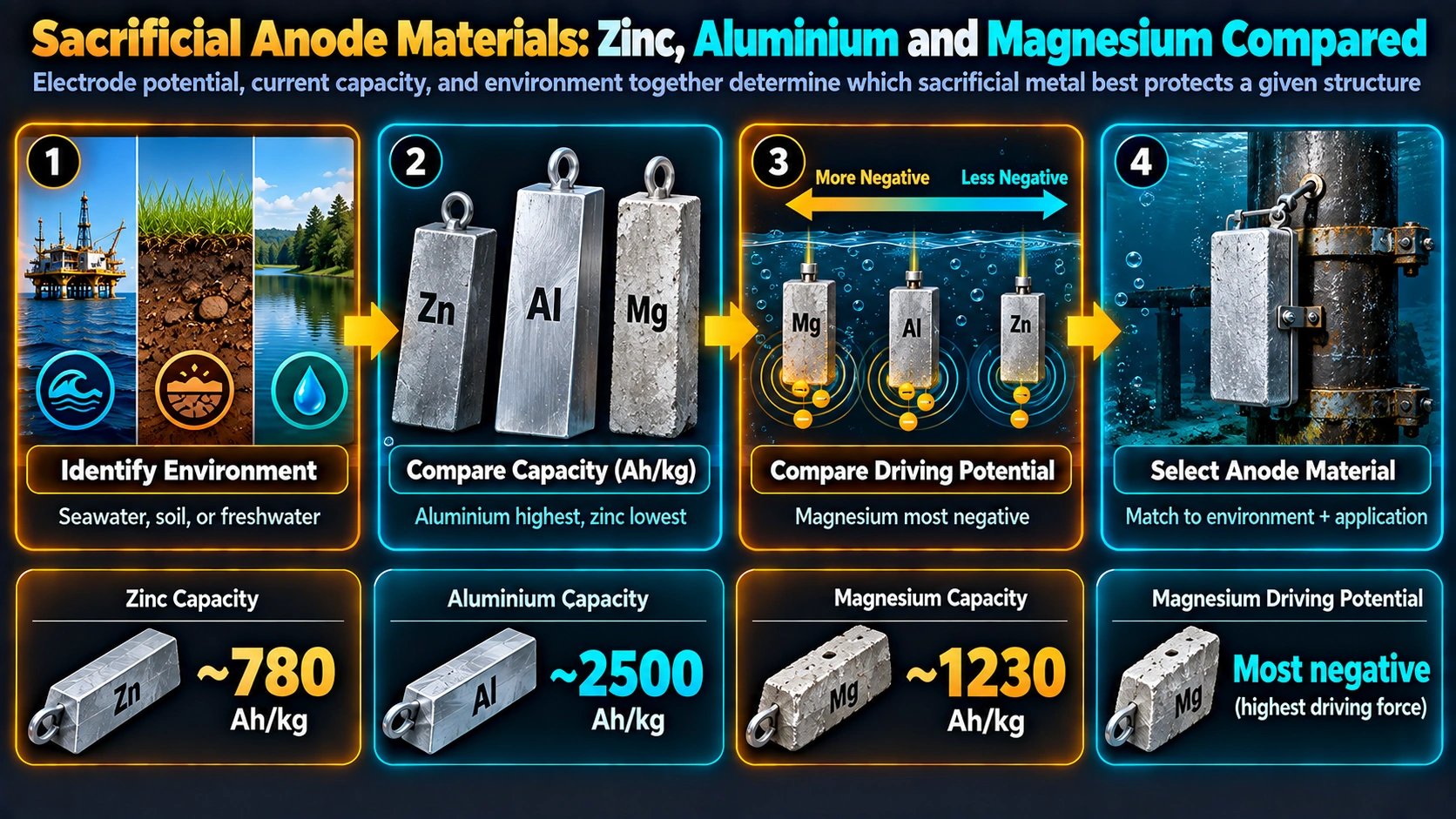
A sacrificial anode system exploits the same electrochemical driving force that causes ordinary galvanic corrosion, covered in corrosion mechanisms, and deliberately engineers it to protect the structure instead of damaging it. The anode is chosen to sit well below steel in the galvanic series, so when the two are electrically bonded and immersed in a shared electrolyte, the anode becomes the anode of the resulting cell and corrodes, while the structure becomes the cathode and is driven into a protected potential range where its own corrosion reaction is suppressed. This is a direct companion approach to cathodic protection of offshore structures, differing from impressed current systems only in where the driving voltage comes from — the anode’s own electrochemistry rather than an external power supply.
Head-to-Head Comparison
| Property | Zinc | Aluminium (Al-Zn-In) | Magnesium |
|---|---|---|---|
| Typical potential (vs Ag/AgCl seawater ref.) | ~ -1.05 V | ~ -1.05 to -1.10 V | ~ -1.5 to -1.7 V |
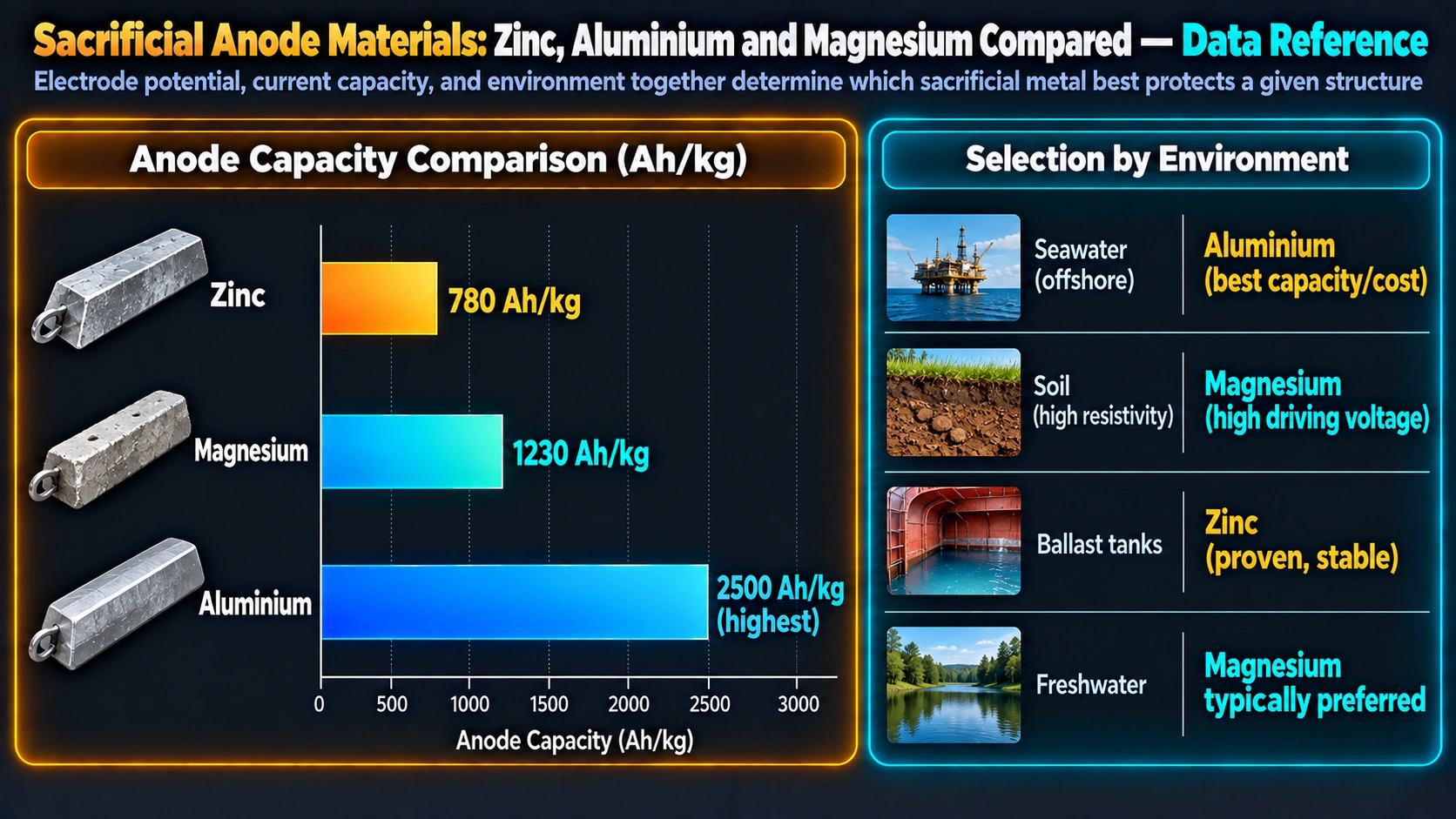
| Theoretical capacity | ~780 A-hr/kg | ~2000-2600 A-hr/kg | ~2200 A-hr/kg |
| Practical efficiency | ~90-95% | ~90% | ~50% |
| Best-suited electrolyte | Seawater (low-moderate resistivity) | Seawater (low-moderate resistivity) | Soil, freshwater (higher resistivity) |
| Temperature limitation | Avoid above ~60-70°C (passivation/polarity risk) | Wider effective range than zinc | Not typically temperature-limited in soil service |
| Weight per unit protection | Higher (lower capacity) | Lower (highest capacity of the three) | Moderate, but poor efficiency offsets capacity |
Zinc Anodes
Zinc was the original sacrificial anode material for marine structures and remains widely used, particularly where its lower cost and long track record are valued. Its main limitation is thermal: above roughly 60-70°C, zinc can form an intermetallic surface layer that passivates the anode, and in some documented cases can even reverse polarity relative to the steel it is meant to protect, actively accelerating corrosion rather than preventing it. This makes zinc unsuitable for hot service applications such as some subsea production risers or insulated hot pipelines. Alloy purity matters considerably: standards such as ASTM B418 tightly control iron, lead, and copper content, since even small amounts of these impurities promote passivation and reduce effective output. Modern specifications favour cadmium-free (Type II) zinc alloys over the older cadmium-containing formulations for environmental reasons.
Aluminium Anodes
Aluminium alloy anodes, activated with small additions of zinc and indium (replacing older mercury-activated formulations that raised environmental concerns), are now the dominant sacrificial anode material for offshore platforms, subsea structures, and pipelines. Pure aluminium passivates readily in seawater and would be ineffective as an anode on its own; the alloying additions disrupt this passive film formation, allowing the aluminium to dissolve steadily and deliver current. Aluminium’s key advantage is capacity: at roughly three times zinc’s theoretical capacity per unit weight, an aluminium anode system for the same design life and current demand weighs substantially less, directly reducing structural loading, installation cost, and the number of anode replacements over a structure’s service life — a significant factor in offshore economics where every tonne of topside or subsea weight has cost implications.
Magnesium Anodes
Magnesium has the most negative practical potential of the common anode materials, giving it by far the highest driving voltage. This is essential in high-resistivity electrolytes such as soil, where zinc or aluminium’s lower driving voltage cannot push sufficient protective current through the circuit resistance to adequately polarise a buried structure. Magnesium is therefore the standard choice for buried pipeline and underground tank cathodic protection, alongside impressed current systems for larger networks. Its lower practical efficiency, typically around 50% due to self-corrosion and hydrogen evolution losses, is a poor trade in low-resistivity seawater, where the excess driving voltage produces excessive current output, rapid anode consumption, and a real risk of overprotection — including coating disbondment and, in susceptible high-strength steels, a contribution to hydrogen embrittlement from excess cathodic hydrogen evolution at the protected structure.
Sizing a Sacrificial Anode System
Anode mass is calculated from the design current demand, intended service life, the alloy’s practical capacity, and a utilisation factor representing the fraction of anode material that remains electrically effective before the anode must be considered depleted (commonly around 0.85 for standard offshore stand-off anodes, per methods such as DNV-RP-B401):
W = (I × L × 8760) / (C × u)

W = required anode mass (kg)
I = design protective current (A)
L = design service life (years)
8760 = hours per year
C = anode practical capacity (A-hr/kg)
u = utilisation factor (fraction, typically ~0.85)
Because aluminium’s capacity C is roughly three times zinc’s, an aluminium anode system sized for the same current, life, and utilisation factor requires proportionally less mass, which is the quantitative basis for its dominance in offshore design where weight and installation cost scale directly with anode mass.
Selecting Between the Three Materials
| Application | Typical Choice | Reasoning |
|---|---|---|
| Offshore platforms, subsea pipelines, ship hulls | Aluminium (Al-Zn-In) | Highest capacity-to-weight ratio minimises anode mass and structural loading |
| Ballast tanks, harbour structures (moderate temperature) | Zinc | Proven performance, lower cost, adequate for ambient-temperature seawater |
| Hot service (risers, insulated pipelines >60-70°C) | Aluminium (avoid zinc) | Zinc’s passivation/polarity-reversal risk at elevated temperature rules it out |
| Buried pipelines, underground storage tanks | Magnesium | High driving voltage needed to overcome soil’s higher electrical resistivity |
| Freshwater structures (moderate-high resistivity) | Magnesium | Similar resistivity rationale as buried structures |
Frequently Asked Questions
What is a sacrificial anode and how does it protect steel?
Which sacrificial anode material is best for offshore structures?
Why can’t zinc anodes be used in hot environments?
Why is magnesium used for buried pipelines instead of zinc or aluminium?
Why is magnesium generally unsuitable for seawater cathodic protection?
What does anode efficiency mean and why does it vary between metals?
How is the required mass of a sacrificial anode calculated?
Are cadmium-containing zinc anodes still used?
Recommended Reference Reading
ASM Handbook, Volume 13: Corrosion
Comprehensive reference covering galvanic series, cathodic protection theory, and anode alloy metallurgy.
View on AmazonCathodic Protection: Theory and Practice
Applied reference on sacrificial and impressed current cathodic protection system design and sizing.
View on AmazonFontana’s Corrosion Engineering
Foundational text on galvanic series, electrochemical potential, and corrosion cell theory.
View on AmazonDNV-RP-B401 and Offshore CP Design Standards
Reference compilation covering offshore cathodic protection design and anode sizing standards.
View on AmazonDisclosure: MetallurgyZone participates in the Amazon Associates programme. If you purchase through these links, we may earn a small commission at no extra cost to you. This helps support free technical content on this site.
Further Reading
