Exfoliation Corrosion in Aluminium Alloys
Exfoliation corrosion is a subsurface form of intergranular attack that turns the elongated grain structure of rolled and extruded high-strength aluminium into a liability: corrosion tracks along grain boundaries running parallel to the surface, and the resulting layers of voluminous oxide wedge the metal apart into a delaminated, flaking structure. It is a longstanding concern in aerospace airframes built from 2xxx and 7xxx series alloys, and understanding its grain-structure and temper dependence is central to both alloy selection and inspection strategy. This guide covers the mechanism, the metallurgical factors that control susceptibility, standard test methods, and current prevention practice.
Key Takeaways
- Exfoliation corrosion is intergranular attack that propagates along grain boundaries parallel to the rolled or extruded surface, rather than into the material.
- It requires an elongated, “pancaked” grain structure; equiaxed-grain products generally do not exfoliate in the same layered fashion.
- 2xxx (Al-Cu) and 7xxx (Al-Zn-Mg-Cu) series alloys are most susceptible, due to anodic strengthening precipitates concentrated at grain boundaries.
- Voluminous corrosion products wedge attacked layers apart, producing the characteristic swelling, blistering, and flaking surface appearance.
- Peak-aged tempers (e.g. 7075-T6) are more susceptible than overaged tempers (e.g. 7075-T73), which trade some strength for substantially better resistance.
- ASTM G34 (the EXCO test) is the standard laboratory method for rating exfoliation susceptibility from N (none) to ED (severe).
What Is Exfoliation Corrosion?
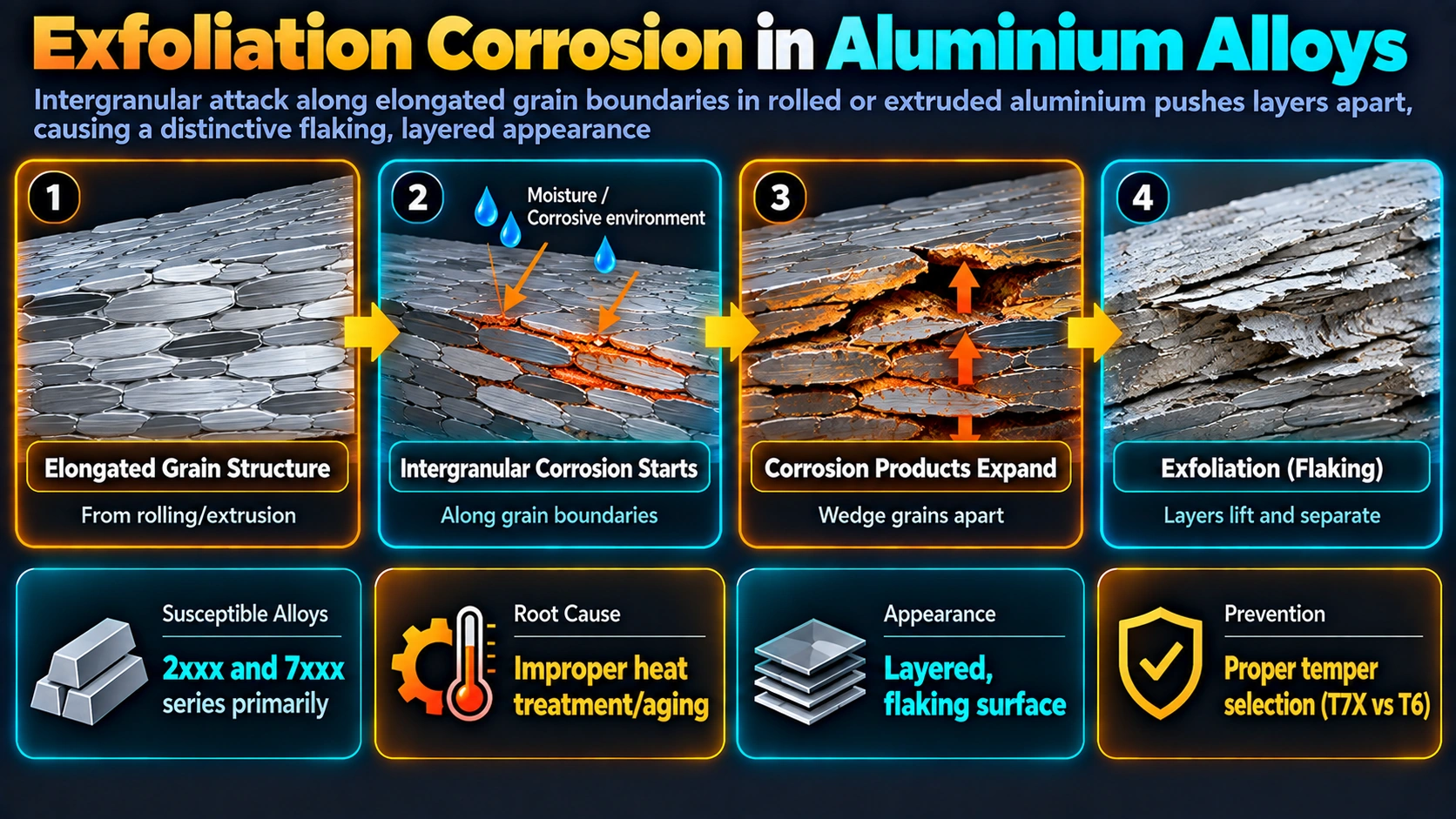
Exfoliation corrosion, also called layer or lamellar corrosion, is a specific geometric outcome of intergranular corrosion in wrought aluminium products. In products with equiaxed grains, intergranular attack tends to spread in multiple directions and does not produce large-scale delamination. In rolled plate, sheet, or extruded sections, however, the grain structure is elongated and flattened parallel to the working direction and surface. When the same anodic grain-boundary chemistry that drives ordinary intergranular attack is present, corrosion propagates preferentially along these parallel boundary planes rather than perpendicular into the material, undermining thin, largely intact layers of metal between the attacked planes.
Why Grain Structure Determines the Failure Mode
Rolling and extrusion elongate the original cast or recrystallised grains into thin, flattened “pancake” shapes aligned with the working direction, closely related to the deformation behaviour covered in grain boundary structure. This geometry means a large fraction of total grain boundary area runs parallel to the surface rather than at random orientations. Where those parallel boundaries also carry anodic precipitates, corrosion has an efficient, low-resistance path to follow laterally beneath the surface, rather than being forced to cut across grains to progress. The result is that exfoliation is fundamentally a geometry effect layered on top of an existing intergranular corrosion susceptibility, not a separate corrosion mechanism in its own right.
Alloy Susceptibility
Exfoliation corrosion susceptibility is concentrated in the high-strength, precipitation-hardened wrought alloy families most valued in aerospace structure for their strength-to-weight ratio:
| Alloy Series | Example Grades | Anodic Grain-Boundary Phase | Typical Aerospace Use |
|---|---|---|---|
| 2xxx (Al-Cu) | 2024, 2014 | Al2CuMg (S-phase) | Fuselage skin, lower wing surfaces (fatigue-critical, tension-dominated) |
| 7xxx (Al-Zn-Mg-Cu) | 7075, 7050 | MgZn2 (η phase) | Upper wing surfaces, spars, stringers (strength-critical, compression-dominated) |
Both families rely on fine precipitates for strength, following the same precipitation-hardening principles discussed for other systems in aluminium alloy series fundamentals. The relevant precipitates are less noble than the surrounding aluminium matrix, so they act as small anodes in a galvanic couple whenever a continuous or near-continuous film of them lines a grain boundary.
The Role of Corrosion Product Volume
The visible swelling and flaking that gives exfoliation corrosion its name comes from a straightforward volumetric effect: aluminium corrosion products (hydrated oxides and hydroxides) occupy substantially more volume than the metal consumed to produce them, generally several times greater. As attack advances along a buried grain-boundary plane, this expanding corrosion product has nowhere to go but to push the thin layer of metal above it upward and outward, producing the blistered, flaking surface characteristic of advanced exfoliation, often before any coating failure is visible from outside.
Volumetric wedging condition (qualitative)

V_product ≫ V_metal_consumed

V_product   = volume of hydrated Al oxide/hydroxide corrosion product
V_metal_consumed = volume of aluminium converted to that product

The larger this ratio, the greater the internal wedging stress
generated per unit length of attacked grain boundary.
Temper Dependence: T6 vs. Overaged Tempers
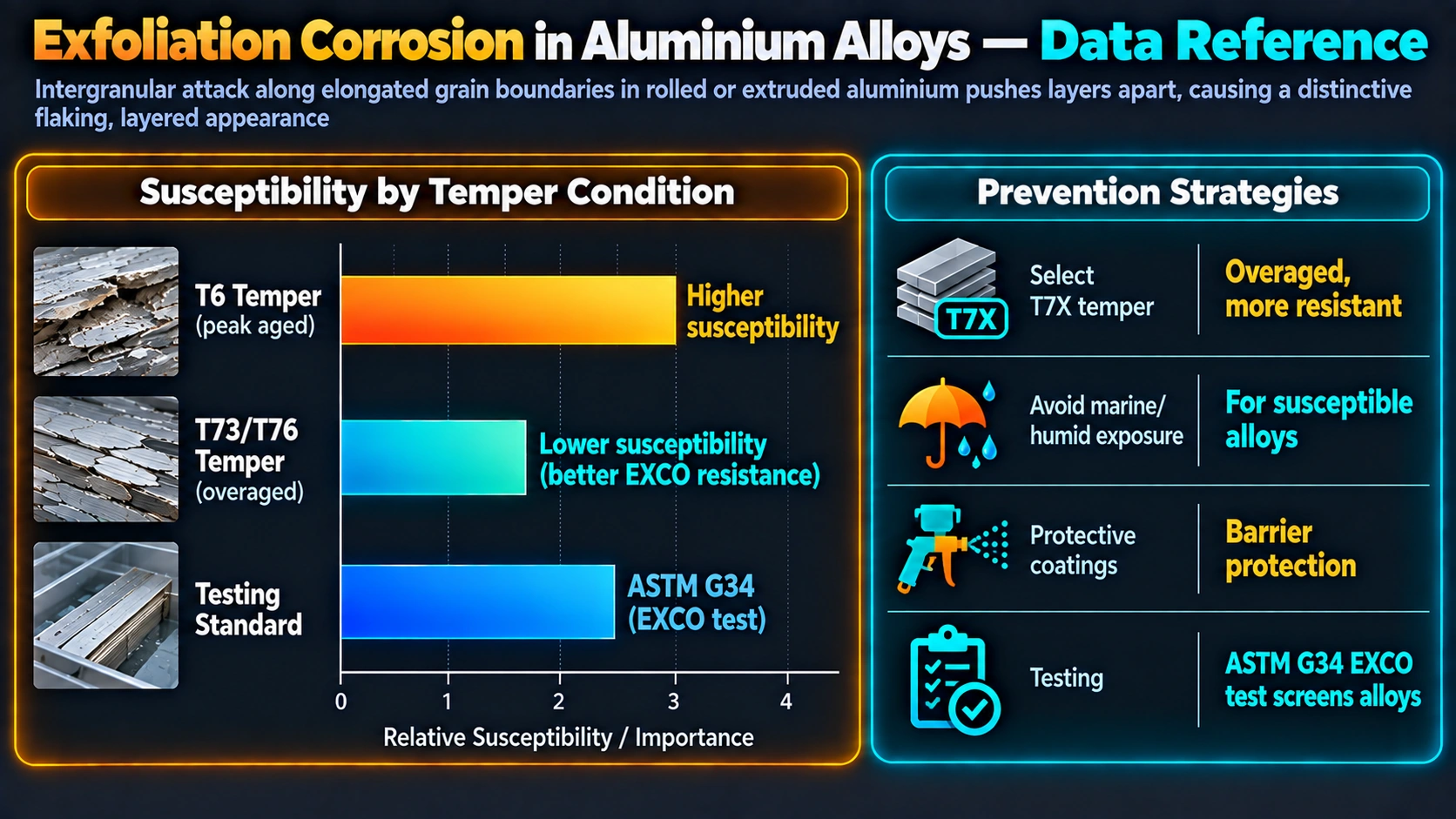
Heat treatment temper is the single most influential variable an engineer controls after alloy selection. In peak-aged tempers, strengthening precipitates form as a fine, closely spaced, near-continuous film along grain boundaries, alongside a narrow precipitate-free zone (PFZ) immediately adjacent to the boundary. This continuous anodic film sustains efficient galvanic attack along the boundary. Overageing coarsens and spaces out the grain-boundary precipitates, breaking their continuity, and widens the PFZ, both of which interrupt the low-resistance corrosion path and substantially improve resistance, at the cost of roughly 10-15% lower strength relative to the peak-aged condition.
| Temper (7075 example) | Grain-Boundary Precipitate Structure | Exfoliation Resistance | Relative Strength |
|---|---|---|---|
| T6 (peak aged) | Fine, near-continuous precipitate film, narrow PFZ | Lower | Highest |
| T73 (overaged) | Coarse, discontinuous precipitates, wide PFZ | High | ~10-15% below T6 |
| T76 (intermediate overage) | Intermediate precipitate spacing | Moderate-high | Between T6 and T73 |
Exfoliation Corrosion vs. Stress Corrosion Cracking
Exfoliation corrosion and stress corrosion cracking (SCC) share the same underlying grain-boundary chemistry and are influenced by the same tempers, which often leads to them being discussed together, but they are mechanically distinct failure modes:
| Aspect | Exfoliation Corrosion | Stress Corrosion Cracking |
|---|---|---|
| Requires applied/residual tensile stress | Not required, though residual stress can influence attack direction | Required — a threshold sustained tensile stress is necessary |
| Propagation pattern | Delamination parallel to surface, in layers | Crack propagation, often intergranular, can run into the section |
| Visual signature | Swelling, blistering, flaking | Often hidden until fracture or NDI detection |
The two modes are closely related enough that mitigation strategies overlap substantially, and susceptibility to one is frequently a warning sign for the other, echoing broader concerns covered in hydrogen-related cracking mechanisms in other alloy systems where environment and stress combine to accelerate what would otherwise be a slower corrosion process.
Testing: The EXCO Method
ASTM G34, universally referred to as the EXCO test, is the standard laboratory method for rating exfoliation susceptibility in 2xxx and 7xxx aluminium alloys. A bare, unpainted specimen is immersed in an acidified sodium chloride and hydrogen peroxide solution for a specified period, then visually rated against reference standards:
| Rating | Description |
|---|---|
| N | No attack |
| P | Surface pitting only, no exfoliation |
| EA | Slight exfoliation |
| EB | Moderate exfoliation |
| EC | Severe exfoliation |
| ED | Very severe exfoliation, significant material loss |
Related methods such as ASTM G85 Annex 2 (acidified synthetic seawater exposure) are also used, particularly where correlation with marine service environments is of interest, complementing the general atmospheric corrosion exposure classification used for outdoor structures more broadly.
Prevention in Aerospace Practice
- Temper selection: specifying overaged tempers (T73, T76, or equivalent) for structure in corrosion-prone locations, accepting the associated strength reduction where fatigue and static strength margins allow.
- Alclad cladding: a thin layer of high-purity, more anodic aluminium metallurgically bonded to the core alloy sheet provides sacrificial protection and a barrier against the core alloy’s exfoliation-susceptible grain boundaries reaching the surface.
- Anodizing and coating systems: chromic or sulfuric acid anodizing followed by primer and topcoat systems reduces moisture and chloride access to the metal surface.
- Structural detailing: avoiding faying surfaces and joints that trap moisture, and ensuring effective drainage paths, reduces the local time-of-wetness that drives both exfoliation and general pitting initiation.
- Inspection and maintenance: visual inspection for paint blistering, combined with ultrasonic or eddy-current non-destructive inspection, catches subsurface exfoliation before significant structural material loss, since surface coatings can remain largely intact well into the attack’s progression.
Frequently Asked Questions
What is exfoliation corrosion?
Why does exfoliation corrosion only affect certain aluminium products?
Which aluminium alloys are most susceptible to exfoliation corrosion?
How does heat treatment temper affect exfoliation corrosion resistance?
What causes the visible swelling and flaking in exfoliation corrosion?
How is exfoliation corrosion susceptibility tested?
How is exfoliation corrosion different from stress corrosion cracking in aluminium?
How is exfoliation corrosion prevented in aerospace aluminium structures?
Recommended Reference Reading
ASM Handbook, Volume 13: Corrosion
Comprehensive reference covering exfoliation, intergranular, and stress corrosion mechanisms in aluminium alloys.
View on AmazonAluminum: Properties and Physical Metallurgy
Reference on precipitation hardening, temper designations, and grain-boundary metallurgy in aerospace aluminium alloys.
View on AmazonFontana’s Corrosion Engineering
Foundational text on intergranular corrosion, galvanic coupling, and localised attack mechanisms.
View on AmazonASTM Standards for Aluminium Corrosion Testing
Reference compilation covering ASTM G34, G85, and related exfoliation and stress corrosion test methods.
View on AmazonDisclosure: MetallurgyZone participates in the Amazon Associates programme. If you purchase through these links, we may earn a small commission at no extra cost to you. This helps support free technical content on this site.
Further Reading
