Mild Steel vs Stainless Steel: Selection Guide
Mild steel and stainless steel solve different engineering problems, and the choice between them is rarely about which is “better” in absolute terms. Mild steel offers low cost, easy fabrication, and good strength for structural and general-purpose use, provided its corrosion is managed with a coating. Stainless steel builds corrosion resistance directly into the metal through a chromium-rich passive layer, at a materials and processing cost premium. This guide compares their composition, corrosion behaviour, mechanical properties, and fabrication requirements, and sets out clear criteria for choosing between them.
Key Takeaways
- Mild steel is a low-carbon steel (typically 0.05-0.25% C) with no inherent corrosion resistance; its rust layer is porous and non-protective.
- Stainless steel contains a minimum of about 10.5% chromium, which forms a thin, self-healing chromium oxide passive layer that gives it inherent corrosion resistance.
- Common structural mild steel and annealed austenitic stainless steel have broadly comparable yield strength; the real differentiators are corrosion behaviour, cost, and fabrication requirements.
- Stainless steel typically costs several times more than mild steel per unit weight, driven mainly by chromium and nickel content.
- Welding stainless steel requires matching filler metal, tighter heat input control, and often post-weld cleanup to avoid sensitization and restore the passive layer.
- The right choice depends on exposure environment, hygiene requirements, budget, maintenance tolerance, and fabrication capability — not on stainless steel being universally superior.
What Is Mild Steel?
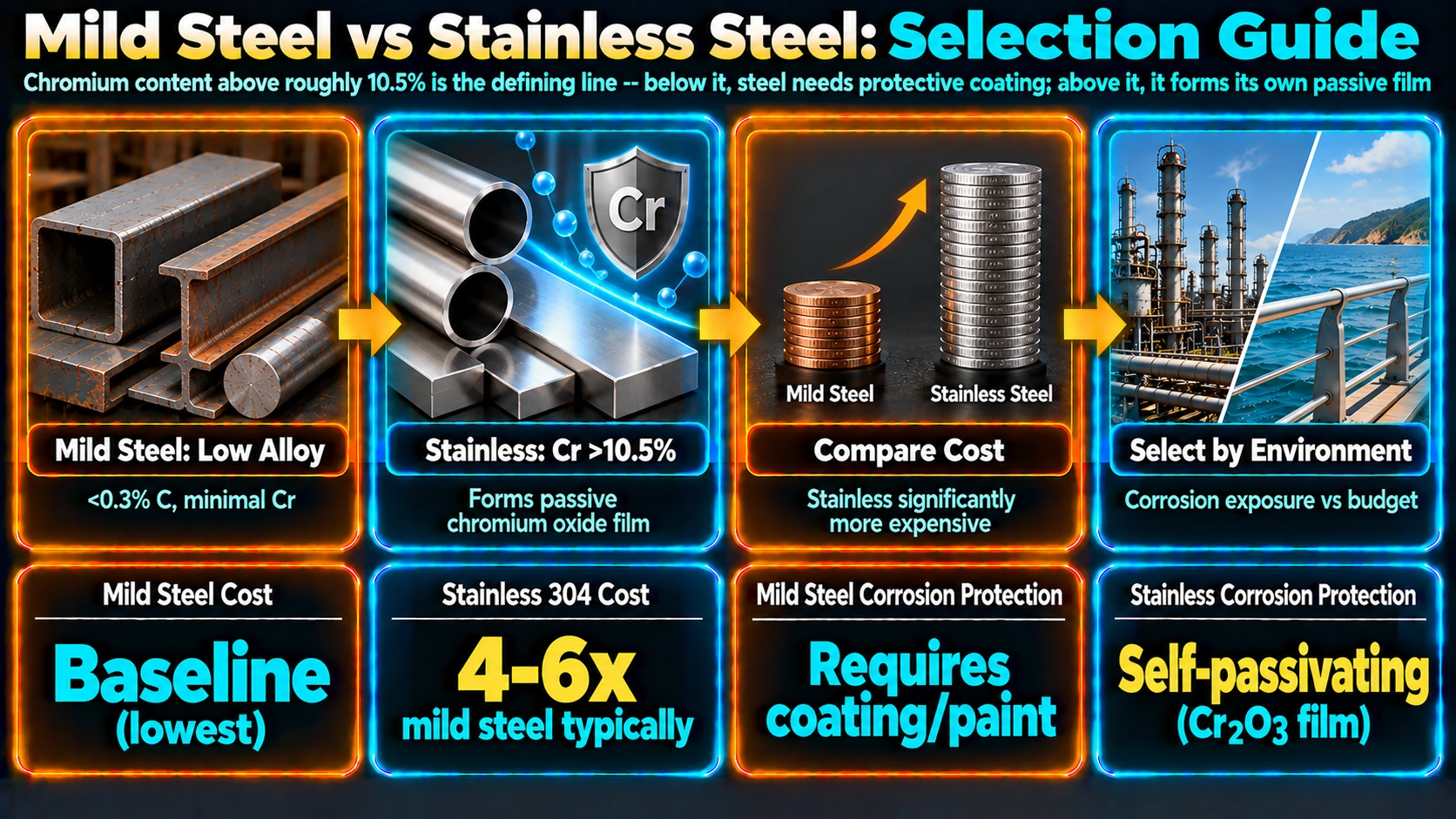
Mild steel (also called low-carbon steel) contains roughly 0.05-0.25% carbon with no significant alloying additions, giving a microstructure of soft ferrite with dispersed pearlite colonies, closely following the low-carbon end of the iron-carbon phase diagram. It is strongly ferromagnetic, readily weldable and machinable, and available in a wide range of structural sections, plate, and sheet at low cost. Its main limitation is corrosion resistance: without chromium or another passivating element, mild steel’s oxide layer is porous and continues to flake and expose fresh metal, so it must be protected with paint, galvanizing, or another coating system for anything beyond dry, indoor, low-corrosivity service.
What Is Stainless Steel?
Stainless steel is defined by a minimum chromium content of approximately 10.5%, the threshold at which the alloy reliably forms a continuous, self-healing chromium oxide (Cr2O3) passive film only a few nanometres thick. Unlike weathering steel’s much thicker, cyclically-built atmospheric patina, the stainless passive layer forms almost instantly on exposure to oxygen and regenerates itself if mechanically damaged, provided the surface remains exposed to an oxidising environment. Stainless steel is produced in several distinct metallurgical families:
| Family | Typical Grades | Microstructure | Magnetic? | Key Traits |
|---|---|---|---|---|
| Austenitic | 304, 316 | Face-centred cubic austenite | Generally no | Best general corrosion resistance and weldability; most widely used family |
| Ferritic | 430 | Body-centred cubic ferrite | Yes | Lower nickel content, lower cost, moderate corrosion resistance |
| Martensitic | 410, 420 | Martensite (heat-treatable) | Yes | Highest hardness and wear resistance; lower corrosion resistance than austenitic |
| Duplex | 2205 | Mixed austenite + ferrite | Yes | High strength and superior resistance to chloride stress-corrosion cracking |
Head-to-Head Comparison
| Property | Mild Steel | Stainless Steel (304 baseline) |
|---|---|---|
| Typical yield strength | ~250 MPa | ~215 MPa (annealed), higher after cold work |
| Typical tensile strength | ~400-550 MPa | ~505-620 MPa |
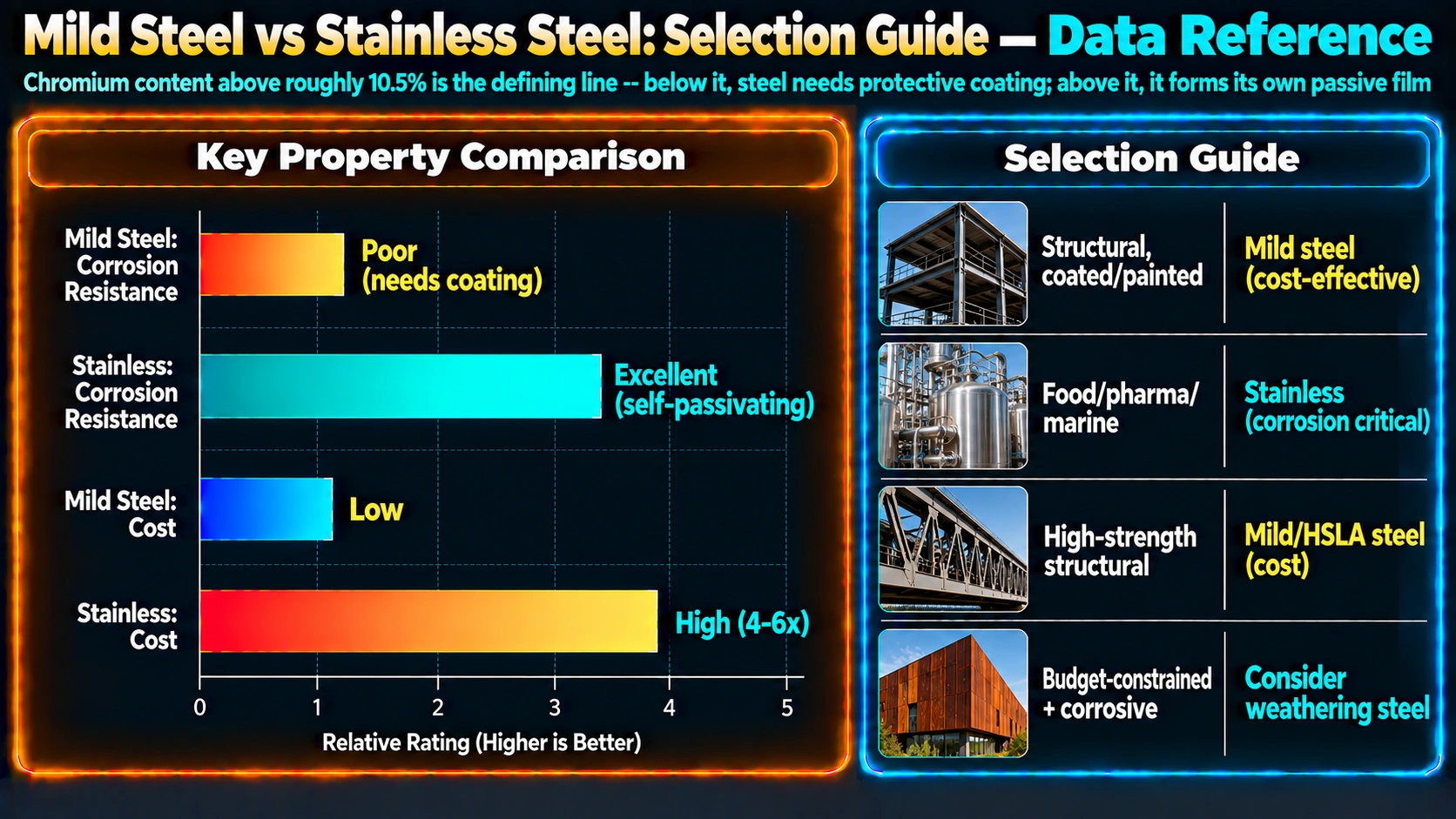
| Corrosion resistance | Poor uncoated; requires paint/galvanizing | Good to excellent, inherent to the alloy |
| Relative material cost | Baseline (lowest) | Roughly 3-5x mild steel, market dependent |
| Weldability | Excellent, forgiving process window | Good, but requires matching filler and heat control |
| Machinability | Excellent | Moderate; work-hardens, needs sharp tooling |
| Magnetic response | Strongly magnetic | Generally non-magnetic (austenitic) |
| Maintenance | Ongoing coating upkeep | Low; periodic cleaning only |
| Typical service life uncoated outdoors | Short; active corrosion | Long; passive layer is stable |
Corrosion Resistance Mechanism
The corrosion behaviour difference is fundamentally electrochemical, following the same principles covered in corrosion mechanisms. In mild steel, iron oxidises to form hydrated iron oxides that are porous and poorly adherent, allowing continuous access of oxygen and moisture to fresh metal beneath. In stainless steel, chromium preferentially oxidises at the surface to form a dense, thin, tightly bonded Cr2O3 film that acts as a diffusion barrier, and because it is only a few atomic layers thick, any local damage exposes fresh chromium that reoxidises almost immediately given adequate oxygen supply.
Design Allowance Comparison
Because mild steel corrodes progressively even under a coating system’s eventual breakdown, structural designs commonly add a sacrificial corrosion allowance to the required section thickness, an allowance rarely needed for stainless steel in the same service:
t_design = t_required + CA

t_design = specified design thickness
t_required = thickness needed for load/strength alone
CA = corrosion allowance (service-life and environment dependent)
Welding and Fabrication Differences
Mild steel welds with a wide process window and few special precautions beyond standard hydrogen-cracking control on thicker sections. Stainless steel welding, by contrast, requires closer attention:
- Matching filler metal: filler composition must match the base grade family to preserve corrosion resistance and mechanical properties at the joint.
- Heat input control: excess heat input increases distortion (stainless steel has roughly 50% higher thermal expansion and lower thermal conductivity than mild steel) and time spent in the sensitizing temperature range.
- Sensitization avoidance: prolonged exposure between roughly 425-870°C allows chromium carbides to precipitate at grain boundaries, locally depleting chromium and increasing susceptibility to intergranular attack; low-carbon (L-grade) or stabilised fillers reduce this risk.
- Shielding and backing purge: root-side inert gas purging on stainless pipe and vessel welds prevents oxidation (sugaring) of the weld underside.
- Post-weld cleanup: pickling or passivation treatment removes heat tint and free iron contamination, restoring a uniform passive layer across the weld zone.
Choosing Between Mild Steel and Stainless Steel
Mild steel generally makes sense when:
- The environment is dry, indoor, or low-corrosivity, or an effective coating/maintenance programme is already in place
- Budget and material cost are primary constraints
- Heavy structural sections or high-volume fabrication favour lower material and machining cost
- Appearance and hygiene are not critical requirements
Stainless steel generally makes sense when:
- The component is exposed to moisture, chemicals, or outdoor weathering without practical recoating access
- Food contact, pharmaceutical, or other hygienic standards apply
- Long service life with minimal maintenance outweighs the higher initial material cost
- Aesthetic appearance of bare metal is part of the design intent
Common Applications
| Application Area | Typical Choice | Reasoning |
|---|---|---|
| Structural building frames | Mild steel | Lower cost at high tonnage; corrosion managed via coating and enclosure |
| Food processing equipment | Stainless steel (304/316) | Hygiene, cleanability, chemical resistance to cleaning agents |
| General fabrication, brackets, frames | Mild steel | Machinability and weld-friendliness reduce fabrication cost |
| Marine hardware, chemical processing | Stainless steel (316 or duplex) | Chloride and chemical exposure demands inherent corrosion resistance |
| Automotive exhaust systems | Stainless steel (ferritic) | Heat and corrosion resistance at moderate cost |
| Pipelines, tanks (non-corrosive service) | Mild steel | Cost-effective for large-volume, low-corrosivity fluid handling |
Frequently Asked Questions
What is the main difference between mild steel and stainless steel?
Is stainless steel stronger than mild steel?
Why is stainless steel more expensive than mild steel?
Is mild steel magnetic and is stainless steel magnetic?
Can mild steel be used outdoors without a coating?
Why is welding stainless steel different from welding mild steel?
Which is better for food-grade or hygienic applications?
What is sensitization in stainless steel and why does it matter for selection?
Is stainless steel always the safer choice over mild steel?
Recommended Reference Reading
ASM Specialty Handbook: Stainless Steels
Reference covering stainless steel metallurgy, grade families, and corrosion behaviour in depth.
View on AmazonFontana’s Corrosion Engineering
Foundational text on passivation, pitting, and intergranular corrosion mechanisms relevant to stainless steel selection.
View on AmazonCallister’s Materials Science and Engineering
Core materials science text covering ferrous alloy classification, phase diagrams, and mechanical behaviour.
View on AmazonWelding Metallurgy by Sindo Kou
Reference on filler metal selection, heat input control, and welding metallurgy for both carbon and stainless steels.
View on AmazonDisclosure: MetallurgyZone participates in the Amazon Associates programme. If you purchase through these links, we may earn a small commission at no extra cost to you. This helps support free technical content on this site.
Further Reading
