Dual Phase (DP) Steel Guide: Microstructure, Processing, and Automotive Applications
Dual Phase (DP) steel is the highest-volume grade family within the Advanced High-Strength Steel (AHSS) category, built on a simple idea: disperse hard martensite islands inside a soft, continuous ferrite matrix through intercritical annealing. The result is a steel that combines high strength with good formability and no yield-point elongation, making it the workhorse AHSS for automotive body structures. This guide covers the phase transformations behind DP microstructure, the standard grades, mechanical behaviour, welding considerations, and how DP steel fits alongside TRIP and TWIP steels in the broader AHSS family.
Key Takeaways
- DP steel consists of a soft, continuous ferrite matrix with 10-40% dispersed hard martensite islands, produced by intercritical annealing followed by rapid cooling.
- Unlike conventional HSLA steel, DP steel yields continuously with no Luders plateau, giving it a lower yield-to-tensile ratio and a higher initial work-hardening rate.
- Grade designation (DP 590, DP 780, DP 980, DP 1180) refers to minimum tensile strength in MPa; martensite volume fraction increases with grade level.
- Manganese stabilises austenite and provides hardenability; silicon or aluminium suppress carbide formation so the second phase transforms to martensite rather than bainite or pearlite.
- DP steel trades some total elongation and hole-expansion capability for processing simplicity compared with TRIP and TWIP AHSS grades.
- Resistance spot welding requires a narrower parameter window than mild steel because of intercritical HAZ softening.
Microstructure and Strengthening Mechanism
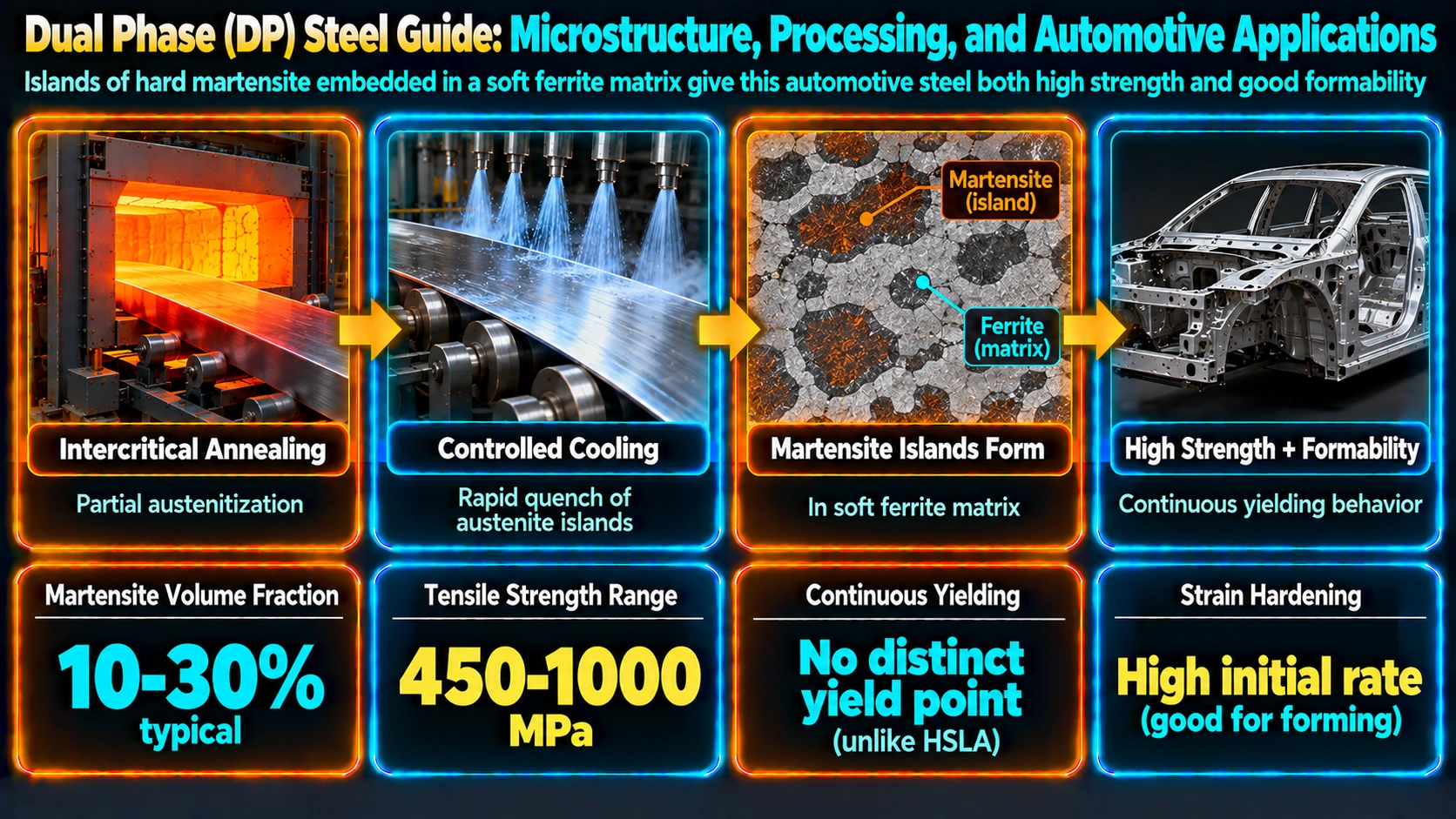
DP steel’s mechanical behaviour follows directly from its two-phase microstructure. The continuous ferrite matrix, largely unchanged from the intercritical anneal, provides ductility and enables dislocations to move relatively freely at low stress. The dispersed martensite islands, typically 10-40% by volume depending on grade, act as hard, high-strength obstacles that generate a high density of geometrically necessary dislocations in the surrounding ferrite as deformation begins. This composite-like load-sharing behaviour is what gives DP steel its characteristic continuous, rounded stress-strain curve rather than the sharp yield point and grain-boundary-pinned Luders-band behaviour typical of conventional HSLA steel.
Why DP Steel Yields Continuously
Conventional low-carbon or HSLA steels often show a distinct upper and lower yield point followed by a Luders strain plateau, caused by dislocations breaking away from interstitial (carbon/nitrogen) pinning atmospheres. In DP steel, the martensite islands themselves generate a high density of mobile dislocations in the adjacent ferrite during cooling from the intercritical anneal, due to the volume expansion accompanying the diffusionless austenite-to-martensite transformation. These pre-existing dislocations mean there is no discrete yield-point event; the material yields smoothly and work-hardens rapidly from the onset of plastic strain.
Processing Route
DP steel is produced on continuous annealing lines (CAL) or continuous galvanizing lines (CGL), following a defined thermal cycle:
- Heating into the intercritical region: the cold-rolled strip is heated to a temperature within the α+γ two-phase field, typically 750-850°C, where the phase fraction of austenite formed is controlled by both temperature and starting composition.
- Intercritical soak: holding at temperature allows carbon to partition preferentially into the forming austenite, enriching it well above the bulk carbon content.
- Rapid cooling: cooling rates fast enough to bypass the pearlite and bainite noses of the strip’s continuous-cooling-transformation diagram convert the carbon-enriched austenite directly to martensite, while the ferrite is largely unaffected.
- Optional overageing/galvanizing pass: on CGL lines, a brief hold near the zinc pot temperature can occur without significantly tempering the freshly formed martensite in most DP grade designs.
Alloy Design
| Element | Typical Range (wt%) | Metallurgical Role |
|---|---|---|
| Carbon (C) | 0.06–0.15 | Controls martensite hardness and, with intercritical fraction, martensite volume fraction |
| Manganese (Mn) | 1.0–2.5 | Austenite stabiliser; increases hardenability so austenite transforms to martensite, not bainite/pearlite |
| Silicon (Si) | 0.1–0.5 | Suppresses carbide precipitation during cooling, promoting clean martensite formation |
| Aluminium (Al) | 0.02–0.06 (up to ~1.0 in some grades) | Alternative carbide suppressant to silicon, particularly in galvanized grades |
| Chromium / Molybdenum | 0–0.5 (grade dependent) | Added in higher grades (DP 980/1180) to boost hardenability at practical cooling rates |
| Niobium / Titanium | 0–0.03 | Microalloy additions for grain refinement of the ferrite matrix |
Standard DP Grades
| Grade | Min. Tensile Strength | Typical Yield Strength | Typical Elongation |
|---|---|---|---|
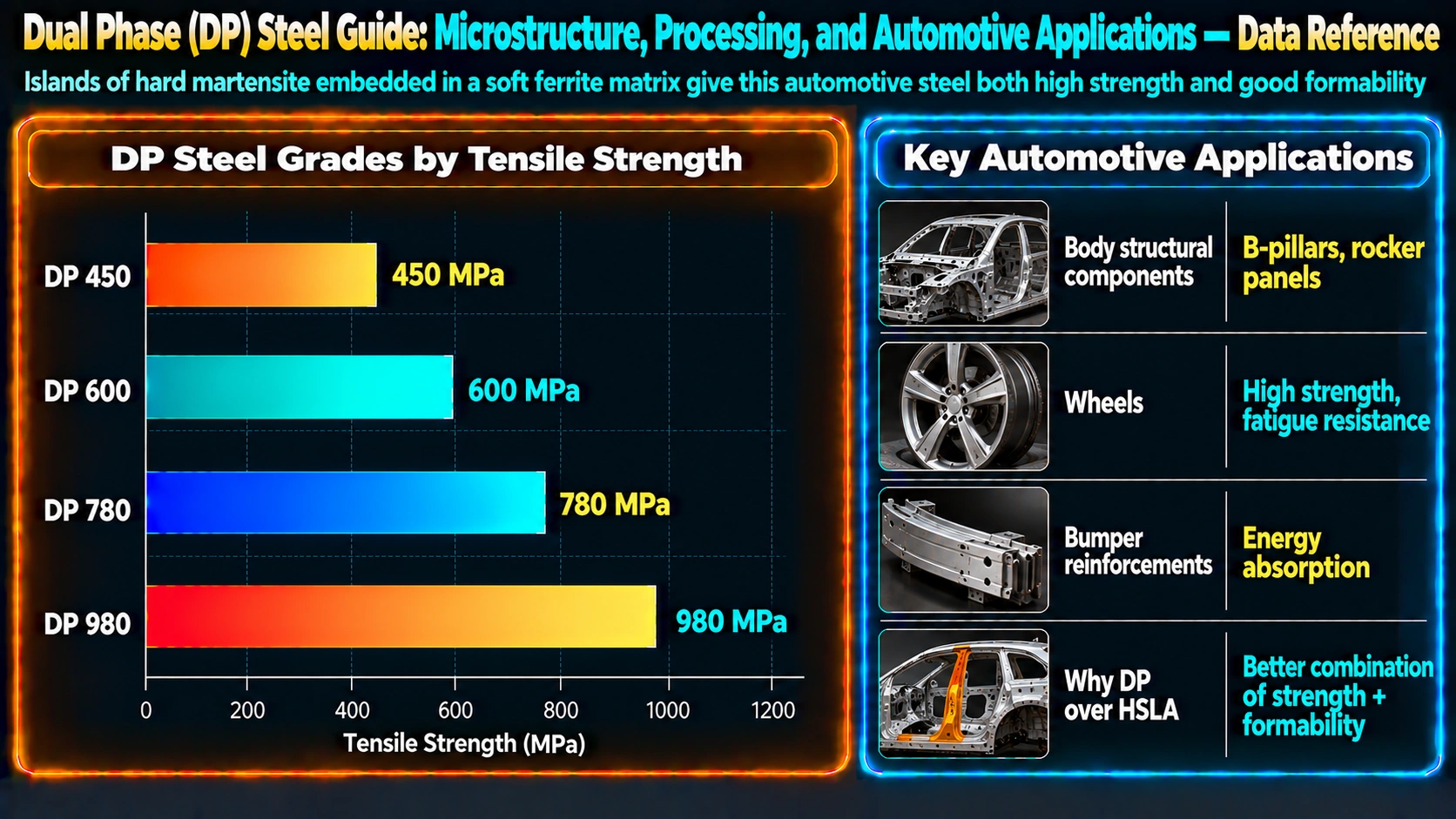
| DP 590 | 590 MPa | 340–420 MPa | 24–30% |
| DP 780 | 780 MPa | 420–500 MPa | 18–24% |
| DP 980 | 980 MPa | 550–650 MPa | 12–17% |
| DP 1180 | 1180 MPa | 800–950 MPa | 7–12% |
Grades are commonly specified to SAE J2745, VDA 239-100, or ASTM A1088, with the numeric designation referring to minimum ultimate tensile strength in MPa. Higher grades achieve their strength primarily through increased martensite volume fraction and, at DP 980 and above, additional hardenability alloying to ensure complete martensitic transformation through the strip thickness at production line cooling rates.
Mechanical Behaviour Compared with Other Sheet Steels
Estimating Composite Flow Strength
A simplified rule-of-mixtures approach is often used as a first-order estimate of DP steel flow strength, treating the ferrite and martensite as a two-phase composite:
σ_DP ≈ fᶟ × σᶟ + f_M × σ_M

fᶟ, f_M = volume fractions of ferrite and martensite (fᶟ + f_M = 1)
σᶟ = flow stress of the ferrite matrix
σ_M = flow stress of the martensite islands
This model captures the general trend that increasing martensite volume fraction raises strength, but it under-predicts real behaviour at low strains because it does not account for the extra dislocation density generated in the ferrite by the transformation strain around each martensite island; the martensite volume fraction itself is set by where the intercritical annealing temperature falls relative to the iron-carbon phase diagram and can be approximated with the lever rule at the intercritical temperature.
DP Steel in the AHSS Family: DP vs. TRIP vs. TWIP
DP steel sits at the simpler end of the AHSS processing spectrum. Building on the mechanisms covered in MetallurgyZone’s TRIP and TWIP steel guide, the three grade families can be compared directly:
| Grade Family | Governing Mechanism | Relative Ductility | Processing Complexity |
|---|---|---|---|
| Dual Phase (DP) | Fixed ferrite-martensite composite structure | Moderate | Lower — single intercritical anneal + rapid cool |
| TRIP | Strain-induced transformation of retained austenite to martensite during forming | High | Higher — requires a bainitic hold step to stabilise retained austenite |
| TWIP | Deformation twinning in high-manganese austenitic matrix | Very high | Highest — fully austenitic, high-Mn alloy design and processing |
In practice, DP steel is specified where cost-effective strength and adequate formability are the priority, while TRIP and TWIP grades are reserved for components demanding higher energy absorption or more severe forming, where their added processing cost is justified.
Formability Considerations
DP steel’s high initial work-hardening rate (n-value) supports good stretch formability in the early stages of forming, which is favourable for components with broad, shallow contours. However, the hardness mismatch at ferrite-martensite interfaces promotes void nucleation under stretch-flange conditions, giving DP steel a comparatively low hole-expansion ratio relative to single-phase or bainitic AHSS grades of similar strength. Component and die design for DP steel parts must account for this trade-off, particularly around trimmed edges and pierced holes.
Welding DP Steel
Resistance spot welding is the dominant joining process for DP steel in automotive body assembly. The main metallurgical concern is heat-affected zone softening: material in the intercritical HAZ can re-austenitise briefly during welding and, depending on local cooling rate and dilution, transform to softer constituents than the base metal’s engineered ferrite-martensite structure. This produces a local minimum in hardness and strength adjacent to the weld nugget, which must be accounted for in joint design and weld schedule qualification. Compared with mild steel, DP steel spot welding requires tighter control of current, electrode force, and hold time to maintain nugget size while limiting expulsion, and low-hydrogen practice remains relevant wherever arc welding processes are used on higher-carbon-equivalent DP grades, following the same principles outlined in hydrogen-induced cracking prevention.
Automotive Applications
DP steel’s balance of strength, ductility, and relatively low processing cost has made it the default AHSS choice for a wide range of body-in-white components: B-pillar reinforcements, rocker panels, bumper beams and reinforcements, wheel discs, and other structural members that must absorb crash energy while remaining formable enough for conventional stamping lines. Lower grades (DP 590/780) are favoured where formability dominates the design, while DP 980 and DP 1180 are reserved for the most safety-critical, highest-strength structural applications where reduced elongation is an acceptable trade-off.
Frequently Asked Questions
What makes Dual Phase (DP) steel different from conventional HSLA steel?
What is intercritical annealing?
What does the number in DP 780 or DP 980 mean?
How does DP steel compare with TRIP steel?
Why is DP steel harder to spot weld than mild steel?
What is bake hardening in DP steel?
Why does DP steel have a low hole-expansion ratio?
What alloying elements are essential in DP steel?
What automotive parts commonly use DP steel?
Recommended Reference Reading
ASM Handbook, Volume 4D: Heat Treating of Irons and Steels
Covers intercritical annealing, continuous annealing line practice, and phase transformation control in sheet steel.
View on AmazonAdvanced High-Strength Steels: Metallurgy and Applications
Focused reference on DP, TRIP, TWIP, and martensitic AHSS grades for automotive body engineering.
View on AmazonCallister’s Materials Science and Engineering
Core materials science text covering phase diagrams, martensitic transformation, and composite strengthening theory.
View on AmazonWelding Metallurgy by Sindo Kou
Reference on resistance spot welding metallurgy and heat-affected zone behaviour in high-strength sheet steels.
View on AmazonDisclosure: MetallurgyZone participates in the Amazon Associates programme. If you purchase through these links, we may earn a small commission at no extra cost to you. This helps support free technical content on this site.
Further Reading
