Weathering Steel (Corten) Guide: Composition, Patina Chemistry, and Design Practice
Weathering steel is a family of low-alloy steels engineered to form a dense, adherent rust layer that slows further corrosion instead of flaking away. Marketed originally as Corten, it is now standardised under ASTM A242, A588, A606-4, and equivalent specifications, and is used bare in bridges, industrial structures, and architectural cladding. This guide covers the alloying chemistry behind patina formation, the standard grades, where the material performs and where it fails, and the detailing and welding practices that keep it working as intended.
Key Takeaways
- Weathering steel resists atmospheric corrosion through small additions of copper, chromium, phosphorus, nickel, and silicon that promote a dense, fine-grained goethite (α-FeOOH) patina rather than a loose, flaking oxide.
- The protective mechanism depends on cyclic wetting and drying; it does not work in continuously wet, buried, submerged, or marine/chloride-rich environments.
- A stable patina typically matures over 18 months to 3 years, during which an initial “bleeding” period can stain adjacent concrete and masonry.
- ASTM A588 and A242 cover structural plate and shapes; A606-4 covers sheet product; A847 covers structural tubing.
- Welded joints require matching low-alloy filler metal so the weld metal and HAZ patinate at the same rate as the base plate.
- Corrosion loss follows a decreasing-rate power law over time in suitable atmospheres, unlike the roughly linear loss seen in plain carbon steel.
What Is Weathering Steel?
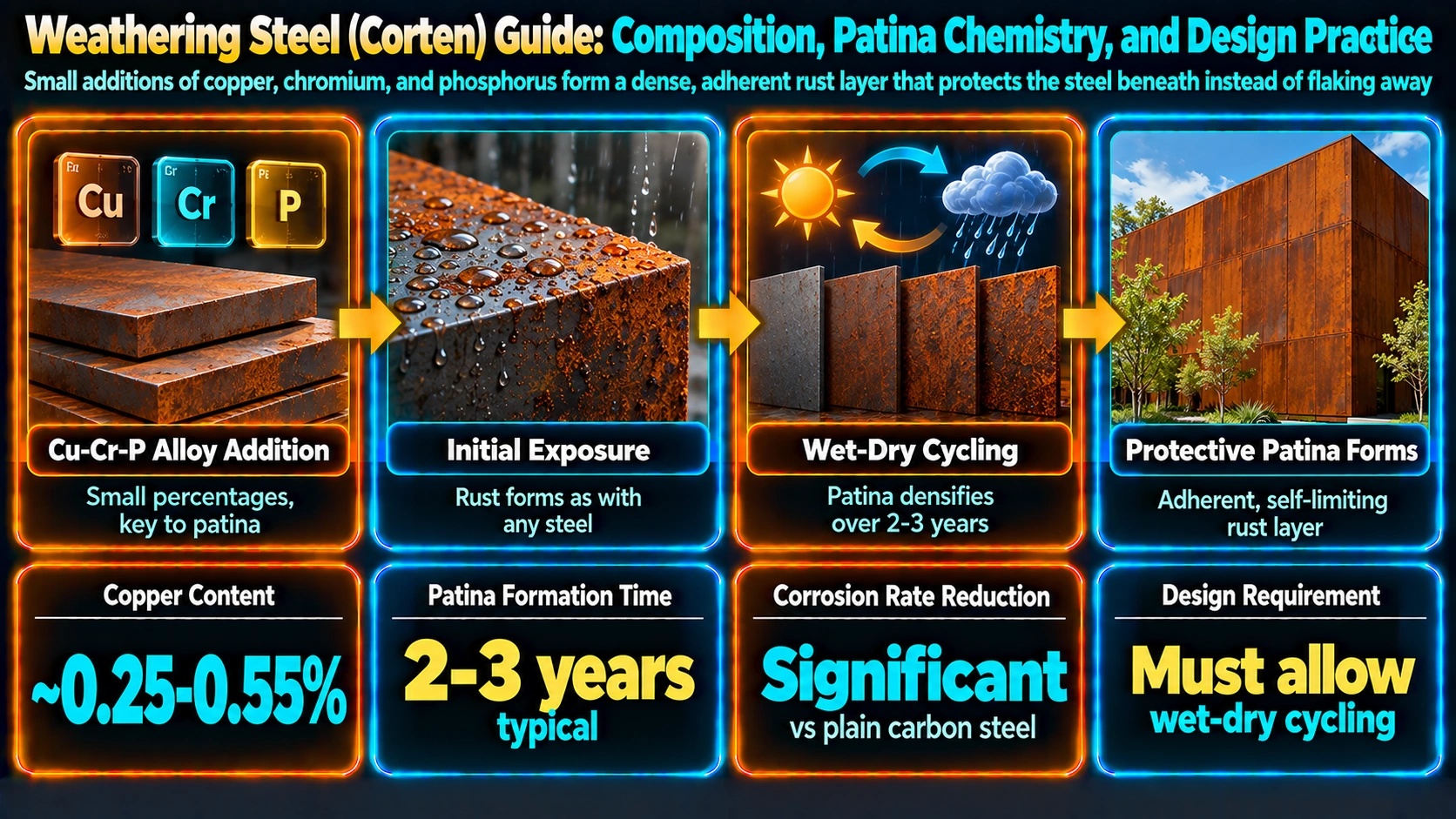
Weathering steel is a low-carbon, low-alloy structural steel formulated so its own corrosion product becomes the corrosion barrier. Where plain carbon steel forms a porous, poorly adherent oxide that continually spalls and exposes fresh metal, weathering steel develops a fine-grained, tightly bonded oxide layer — the patina — that slows the diffusion of oxygen, moisture, and pollutants to the underlying iron-carbon matrix. The corrosion rate falls sharply after the first few wet-dry cycles and continues to decrease as the patina matures.
Composition and Alloying Elements
Weathering steels are compositionally close to conventional low-carbon structural steel, with small, deliberate additions that alter the electrochemistry and crystallography of the rust layer rather than the bulk mechanical structure.
| Element | Typical Range (wt%) | Metallurgical Role |
|---|---|---|
| Carbon (C) | 0.12 max | Kept low for weldability and toughness; not a corrosion-resistance factor |
| Copper (Cu) | 0.25–0.55 | Primary patina stabiliser; segregates to the metal/oxide interface and promotes adherent goethite |
| Phosphorus (P) | 0.06–0.15 | Refines rust crystal structure to a finer, denser layer; higher than normal structural-steel limits |
| Chromium (Cr) | 0.30–1.25 | Increases general atmospheric corrosion resistance and strength |
| Nickel (Ni) | 0.25–0.65 | Improves toughness and works synergistically with Cu in some grades |
| Silicon (Si) | 0.15–0.65 | Deoxidiser; contributes modestly to corrosion resistance |
Patina Formation Mechanism
The transformation from bare steel to protective patina is an electrochemical process governed by the availability of moisture and the alloy’s ability to trap and stabilise corrosion products at the metal surface, closely related in principle to the mechanisms discussed in corrosion mechanisms.
Wet-Dry Cycling
During wetting, dissolved oxygen and moisture support anodic dissolution of iron and cathodic oxygen reduction, producing hydrated iron oxides. During drying, these oxides dehydrate and recrystallise. Repeated cycling progressively converts the initially loose, orange lepidocrocite (γ-FeOOH) outer layer into a denser, darker goethite (α-FeOOH) inner layer that is far less permeable to further ionic transport.
Role of Copper and Phosphorus
Copper is the single most influential alloying addition. It concentrates at the metal/oxide interface as the patina forms, lowering local pH conditions in a way that favours goethite nucleation over the looser akaganeite and lepidocrocite phases seen in unalloyed steel. Phosphorus refines the crystallite size of the rust product, reducing porosity and improving adhesion. Chromium contributes a broader general improvement in corrosion resistance and is particularly important in industrial or higher-pollutant atmospheres.
Patina Maturation Timeline
A newly erected weathering-steel structure passes through three broad stages: an active bleeding phase (roughly the first 1–18 months) with visible orange-brown runoff as loose oxide is washed away; a transitional phase where the patina darkens and adhesion improves; and a stabilised phase, typically reached between 18 months and 3 years, where the corrosion rate has dropped to a low, slowly decreasing steady state.
Standard Weathering Steel Grades
| Specification | Product Form | Typical Yield Strength | Notes |
|---|---|---|---|
| ASTM A242 | Plate, bar, shapes | 290–345 MPa | Original high-strength low-alloy weathering grade; narrower thickness range than A588 |
| ASTM A588 | Plate, bar, shapes | 290–345 MPa | Most widely specified structural weathering steel; multiple grades (A–K) with slightly different chemistry |
| ASTM A606 Type 4 | Hot- and cold-rolled sheet | 310–345 MPa | Thinner-gauge product for cladding, ductwork, and light fabrication |
| ASTM A847 | Structural tubing (HSS) | 317 MPa | Weathering-grade equivalent of A500 tubing for exposed structural members |
Where Weathering Steel Works — and Where It Doesn’t
| Environment | Suitability | Reason |
|---|---|---|
| Rural / general atmospheric | Excellent | Regular wet-dry cycling with low chloride and sulfur loading matures the patina cleanly |
| Industrial atmosphere | Good | Higher SO₂ can accelerate early corrosion but Cr and Cu still deliver a net benefit over plain steel |
| Marine / coastal (chloride-rich) | Poor | Chlorides disrupt goethite formation and keep the corrosion rate near that of unalloyed steel |
| Continuously wet, buried, or submerged | Poor | No drying cycle means the loose, non-protective oxide phase never converts to adherent patina |
| Sheltered from rain but humid | Poor | Condensation without washing/drying cycles leaves deposits and salts on the surface, promoting pitting |
Structural and Architectural Applications
Weathering steel is specified where its life-cycle maintenance advantage over painted or galvanized structural steel is highest: highway and pedestrian bridge girders, transmission towers, industrial support structures, and exposed building frames. In architecture it is used as a deliberate, uncoated facade or cladding material, prized for the warm, evolving colour of its patina; well-known examples include large-scale sculptural and pavilion structures where the material’s ageing is treated as part of the design intent rather than a defect to hide.
Design Detailing for Runoff Staining
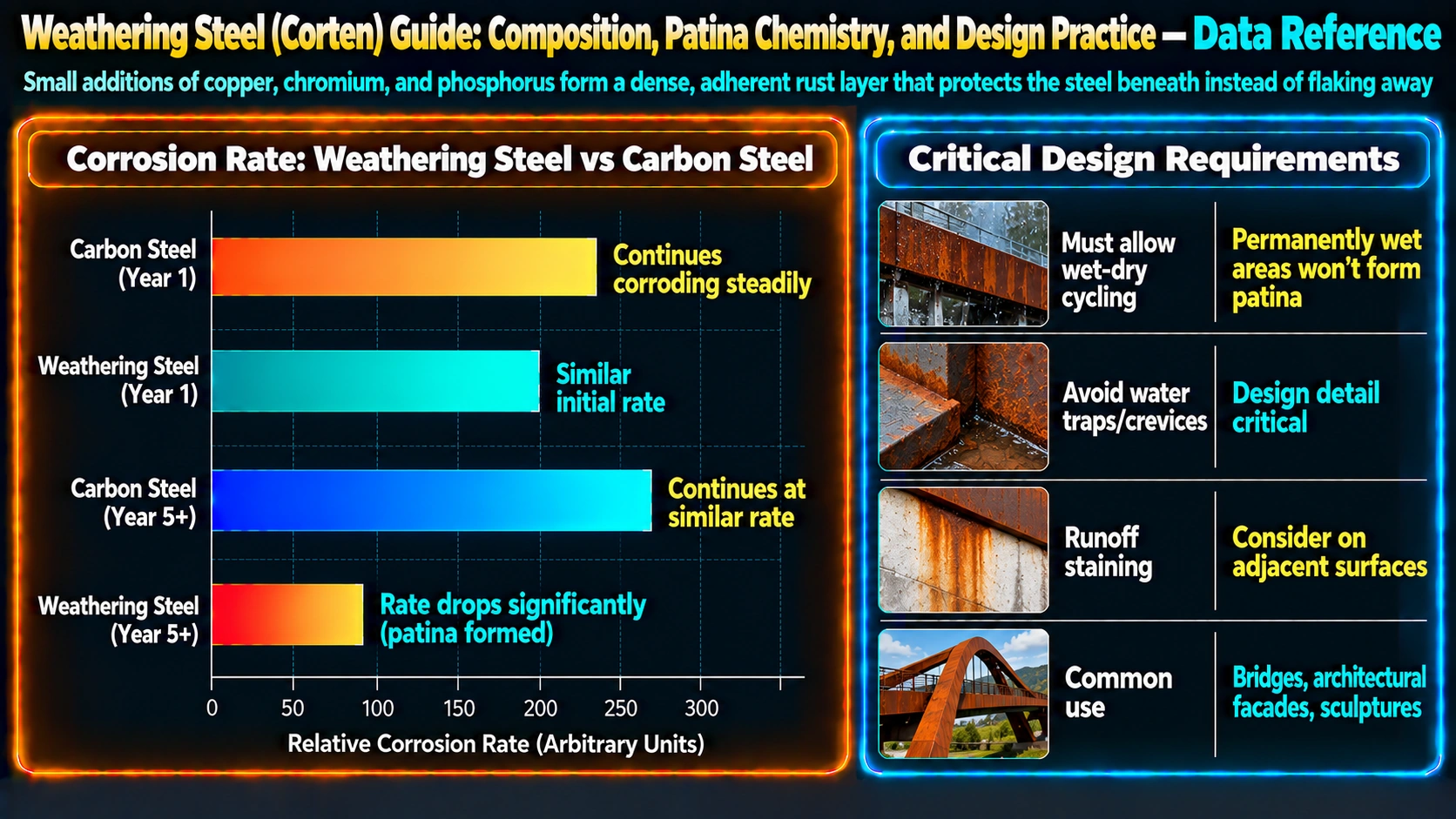
Because the bleeding phase sheds loose oxide, weathering steel must be detailed to protect adjacent finishes:
- Provide drip edges, kerfs, or sacrificial flashing to direct runoff away from concrete, stone, and light-coloured cladding.
- Isolate the base of columns and structural members from concrete with a physical break or sealant joint, since staining is largely cosmetic but can be difficult to remove once absorbed into porous substrates.
- Avoid crevices and horizontal ledges that trap standing water, which locally prevents the dry cycle needed for patina stabilisation and can initiate pitting.
- Where staining risk is unacceptable, consider a pre-weathering process off-site, or an alternative material for the specific detail rather than coating the weathering steel itself.
Welding Weathering Steel
Weathering steel is readily weldable with conventional arc processes, but corrosion performance at the joint depends on more than mechanical soundness. If ordinary carbon-steel filler metal is used, the weld deposit and immediately adjacent heat-affected zone can corrode at a different rate than the surrounding patinated plate, producing a visually and functionally inconsistent joint.
Filler Metal Selection
Matching low-alloy consumables containing comparable copper, chromium, and nickel additions to the base plate are specified so the deposited weld metal patinates at the same rate as the parent material. This mirrors the logic used in selecting consumables for other low-alloy applications discussed in the guide to hydrogen-induced cracking prevention, where low-hydrogen practice is equally important.
Preheat and Hydrogen Control
Preheat requirements follow standard carbon-equivalent-based practice for the section thickness involved; weathering steel’s alloy content raises its carbon equivalent modestly relative to plain structural steel, so preheat and low-hydrogen electrode practice should not be relaxed simply because the base metal looks similar to mild steel.
Corrosion Kinetics: The Power-Law Model
Atmospheric corrosion loss for both weathering and plain carbon steels is commonly modelled with a power-law expression relating metal loss to exposure time:
W = A × tⁿ

W = metal loss or depth of attack (μm)
t = exposure time (years)
A = material/environment constant (loss after 1 year)
n = corrosion-rate exponent (dimensionless)
For plain carbon steel in most atmospheres, n typically approaches 0.8–1.0, indicating an ongoing, near-linear loss rate as the non-protective oxide continually spalls. For weathering steel with a maturing patina, n is characteristically lower, often in the 0.4–0.6 range, reflecting a corrosion rate that decreases significantly once the protective layer stabilises. This distinction, not a difference in initial corrosion rate, is the real basis of weathering steel’s life-cycle advantage.
Weathering Steel vs. Alternative Corrosion-Protection Strategies
| Approach | Maintenance | Initial Cost | Best Suited To |
|---|---|---|---|
| Weathering steel (bare) | Very low after patina matures | Moderate | Rural/industrial atmospheres with wet-dry cycling, long design life |
| Hot-dip galvanized steel | Low, recoat only if damaged | Moderate | Smaller members, high-humidity or marine exposure where weathering steel underperforms |
| Painted/coated carbon steel | High, periodic recoating required | Low initial, high lifecycle | Applications needing a specific colour or where any staining is unacceptable |
| Stainless steel | Very low | High | Marine, chemical, or aesthetic-critical applications where weathering steel and galvanizing are unsuitable |
Industrial Significance and the Economic Case
The primary driver for specifying weathering steel is life-cycle cost: eliminating repeat painting cycles on large structures such as bridges removes a major recurring maintenance expense and the associated traffic or operational disruption. The trade-off is a narrower environmental window of suitability and the need for correct detailing at the design stage, since retrofitting drainage or isolation details after staining has occurred is far more difficult than specifying them up front.
Frequently Asked Questions
Is Corten the same as weathering steel?
Does weathering steel need painting?
How long does it take for weathering steel to form a patina?
Can weathering steel be used near the coast?
Why does weathering steel stain concrete and stonework?
What filler metal is used to weld weathering steel?
What is the difference between ASTM A588 and A242?
Can weathering steel be used underground or fully submerged?
Does weathering steel lose section thickness over time?
Recommended Reference Reading
ASM Handbook, Volume 13: Corrosion
Comprehensive reference on atmospheric and electrochemical corrosion mechanisms, including low-alloy steel patina formation.
View on AmazonFontana’s Corrosion Engineering
Foundational text on corrosion theory, kinetics, and engineering control methods used throughout structural metallurgy.
View on AmazonASTM Standards for Structural Steel
Reference compilation covering A588, A242, A606, and related structural and weathering steel specifications.
View on AmazonCallister’s Materials Science and Engineering
Core materials science text covering alloy design, electrochemical corrosion, and structural steel metallurgy fundamentals.
View on AmazonDisclosure: MetallurgyZone participates in the Amazon Associates programme. If you purchase through these links, we may earn a small commission at no extra cost to you. This helps support free technical content on this site.
Further Reading
