Filiform Corrosion Explained
Filiform corrosion is a distinctive form of under-film attack that spreads as narrow, thread-like filaments beneath an organic coating, most often on painted aluminium and steel. It rarely threatens structural integrity on its own, but it is a persistent coatings-industry problem because it appears well before other visible failure and undermines both appearance and coating adhesion. This guide covers the differential aeration mechanism that drives filament growth, the humidity and coating-permeability window it needs, how it is tested, and how it is prevented in practice.
Key Takeaways
- Filiform corrosion is under-film corrosion that grows as narrow, branching threads from a coating defect, rather than spreading uniformly like blistering.
- Each thread has an actively corroding, acidic head at the leading edge and a desiccated, oxide-filled tail behind it, driven by a differential aeration cell.
- It requires three conditions together: a coating with intermediate water vapour permeability, ambient relative humidity typically in the 65-95% range, and an initiation defect exposing bare metal.
- Head acidity is self-sustaining: hydrolysis of dissolved metal cations continuously regenerates the acid that keeps the head actively corroding.
- Standard tests such as ASTM D2803 (aluminium) and ASTM D4711 (steel) use a scribed, acid-initiated panel held at controlled high humidity to quantify filament growth.
- Prevention relies on pretreatment, coating system selection, edge sealing, and humidity control rather than any single fix.
What Is Filiform Corrosion?
Filiform corrosion is a localised, under-film corrosion mode that produces narrow (typically 0.1-0.5 mm wide), branching, worm-like tracks a few millimetres to several centimetres long, spreading out from a single initiation point beneath an intact-looking coating. It is mechanistically related to the general under-film and localised corrosion processes covered in corrosion mechanisms and shares its differential-aeration driving force with pitting corrosion, but the coating film confines and directs the attack into a distinct thread pattern rather than a localised pit.
The Head-and-Tail Mechanism
Each filiform thread is a self-propagating electrochemical cell with two functionally distinct zones:
The Active Head
At the leading edge, a small pocket of concentrated, acidic electrolyte sits in direct contact with bare or thinly oxidised metal. Oxygen access here is limited because the head sits under the thickest part of the advancing moisture pocket, so the head behaves anodically: metal dissolves, and the dissolved cations hydrolyse in water to regenerate acid, sustaining low pH at the head without any external acid source after initiation.
The Desiccated Tail
Behind the head, the electrolyte dries out as the thread advances, leaving a track of solid corrosion product. This region has much better access to atmospheric oxygen diffusing through the thinner trailing film and acts as the cathode, consuming oxygen and generating hydroxide ions. The oxygen concentration difference between the oxygen-starved head and the oxygen-rich tail is the differential aeration cell that pulls the thread forward, always toward fresher coating and higher local humidity.
Anodic reaction at the head (example: aluminium substrate)
  Al → Al³⁺ + 3e-

Hydrolysis of the dissolved cation (regenerates acidity)
  Al³⁺ + 3H2O → Al(OH)3 + 3H⁺

Cathodic reaction in the oxygen-rich tail
  O2 + 2H2O + 4e- → 4OH-
The Humidity and Permeability Window
Filiform corrosion only propagates within a specific combination of conditions, which is why it is often described as a “window” rather than a simple threshold:
| Condition | Effect if Too Low | Effect if Too High |
|---|---|---|
| Relative humidity | Below roughly 65% RH, the film dries out and the cell cannot sustain itself; filaments stall | Above roughly 95% RH, moisture ingress becomes broad and uniform, favouring blistering over confined thread growth |
| Coating water vapour permeability | A highly impermeable barrier coating limits moisture ingress except at defects, which can suppress or slow filament initiation | An overly permeable coating allows moisture to spread broadly under the film, again favouring blistering rather than a confined thread |
Distinguishing Filiform Corrosion from Related Failures
| Failure Mode | Pattern | Primary Driver |
|---|---|---|
| Filiform corrosion | Narrow, branching threads from a defect | Differential aeration cell with a directional head/tail structure |
| Osmotic blistering | Broad, rounded lifted areas | Osmotic pressure from soluble salts trapped at the coating-metal interface |
| General under-film corrosion | Diffuse loss of adhesion over a wide area | Widespread moisture and ionic ingress, no single dominant defect |
| Pitting corrosion (uncoated) | Isolated, roughly circular pits | Local passive-film breakdown, typically by chloride attack |
Testing and Measurement
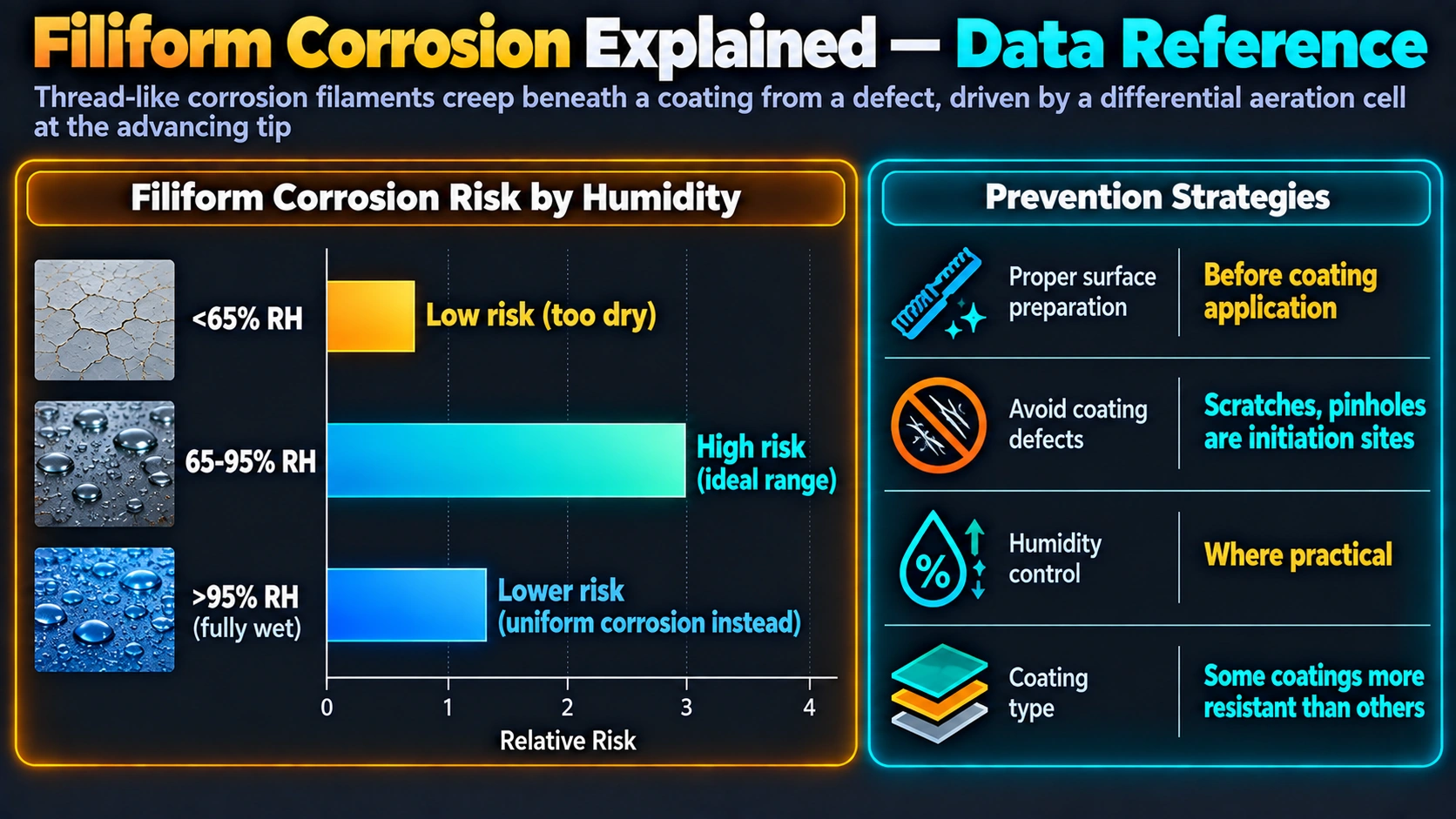
Because filiform corrosion depends on a specific humidity and initiation combination, it is evaluated with dedicated accelerated tests rather than general salt-fog exposure alone. ASTM D2803 (for aluminium) and ASTM D4711 (for steel) are the standard methods: a coated test panel is deliberately scribed to bare metal, the scribe is initiated with an acid or salt treatment (commonly hydrochloric acid fumes or an acidified salt solution), and the panel is then held in a controlled chamber at a fixed high humidity, typically around 82-85% RH, for a specified exposure period. Filament length, density, and any undercutting are measured and compared against acceptance criteria for the coating system under evaluation. This differs from the immersion or fog-based exposure used in general atmospheric corrosion testing precisely because the humidity window, not spray or immersion, is what controls filiform propagation.
Where Filiform Corrosion Is a Practical Problem
Coated aluminium is the substrate most associated with filiform corrosion, particularly in aircraft skins and fasteners, architectural aluminium extrusions, and coated beverage cans, since aluminium’s naturally protective oxide film can still be locally disrupted at cut edges and mechanical damage. Coated automotive steel body panels, tin-plated steel food packaging, and coated magnesium die-castings are also commonly affected. In all of these cases, the coating itself is functioning largely as intended over most of the surface; the failure is concentrated at defects, edges, and fastener holes where the coating’s continuity is compromised.
Prevention Strategy
No single measure reliably prevents filiform corrosion; it is managed through a combination of surface preparation, coating system design, and detailing:
- Surface pretreatment: chromate or chromate-free conversion coatings, or anodising for aluminium, improve adhesion and provide a corrosion-resistant interface beneath the organic coating.
- Coating system selection: choosing a primer/topcoat system with balanced permeability and strong adhesion, informed by accelerated filiform testing rather than general salt-spray results alone.
- Edge and hole sealing: cut edges, rivet and fastener holes, and other high-risk initiation sites benefit from sealant or edge coating to eliminate the exposed-metal defect filiform corrosion needs to start.
- Damage avoidance and inspection: handling and installation practices that limit scratches and impact damage reduce the number of potential initiation sites over a component’s service life.
- Environmental control where feasible: for indoor or enclosed applications, keeping ambient relative humidity outside the 65-95% propagation window removes one of the three conditions filiform corrosion needs.
Frequently Asked Questions
What is filiform corrosion?
What causes filiform corrosion to start?
Why does the corroding head of a filiform thread stay acidic?
Why does filiform corrosion need a specific humidity range?
How is filiform corrosion different from blistering under a coating?
Which metals and industries are most affected by filiform corrosion?
How is filiform corrosion tested and measured?
How can filiform corrosion be prevented?
Recommended Reference Reading
ASM Handbook, Volume 13: Corrosion
Comprehensive reference including under-film and coating-related localised corrosion mechanisms.
View on AmazonFontana’s Corrosion Engineering
Foundational text on electrochemical corrosion theory, including differential aeration cell behaviour.
View on AmazonOrganic Coatings: Science and Technology
Reference on coating permeability, adhesion, and failure modes including filiform and blister corrosion.
View on AmazonASTM Standards for Coating Corrosion Testing
Reference compilation covering ASTM D2803, D4711, and related accelerated coating corrosion test methods.
View on AmazonDisclosure: MetallurgyZone participates in the Amazon Associates programme. If you purchase through these links, we may earn a small commission at no extra cost to you. This helps support free technical content on this site.
Further Reading
