Diffusion Bonding and Transient Liquid Phase Bonding for Aerospace Assemblies
Diffusion bonding (DB) and transient liquid phase (TLP) bonding are solid-state and near-solid-state joining processes that produce metallurgical joints approaching parent-metal properties without a persistent liquid phase, a fusion zone, or a heat-affected zone of the kind created by arc welding. Both processes are foundational to aerospace manufacturing: diffusion bonding enables the integral fabrication of complex titanium structures by SPF/DB, while TLP bonding provides the only practical route to repairing single-crystal and directionally solidified nickel superalloy turbine blades without re-melting the base material. This article provides a thorough technical treatment of process physics, interlayer design, kinetics, process parameters, quality assurance, and aerospace applications for both methods.
Key Takeaways
- Diffusion bonding is a three-stage solid-state process: asperity deformation, creep-driven void closure, and grain boundary migration that consumes the original faying surface.
- Ti-6Al-4V is bonded at 900–950°C under 2–10 MPa in vacuum better than 10−⁴ mbar; bonding below the beta transus (~995°C) preserves the bimodal microstructure and ductility.
- TLP bonding uses a thin interlayer (25–75 μm) with boron, silicon, or phosphorus as a melting-point depressant; the interlayer melts transiently, then re-solidifies isothermally as the depressant diffuses into the base metal.
- AWS BNi-2 (Ni–7Cr–4.5Si–3.1B) is the dominant interlayer for nickel superalloy TLP bonding, achieving near-parent-metal creep strength after full isothermal solidification at 1065–1120°C over 4–10 hours.
- SPF/DB combines superplastic forming and diffusion bonding in Ti-6Al-4V to produce lightweight, integrally-stiffened hollow panels, reducing part count by 60–80% versus riveted assemblies.
- Bond quality is assessed by phased-array ultrasonic C-scan (detect residual voids), metallographic cross-section (bond-line porosity), and tensile coupon testing (joint efficiency > 95% of parent UTS for well-bonded interfaces).
Diffusion Bonding: Process Physics and Fundamentals
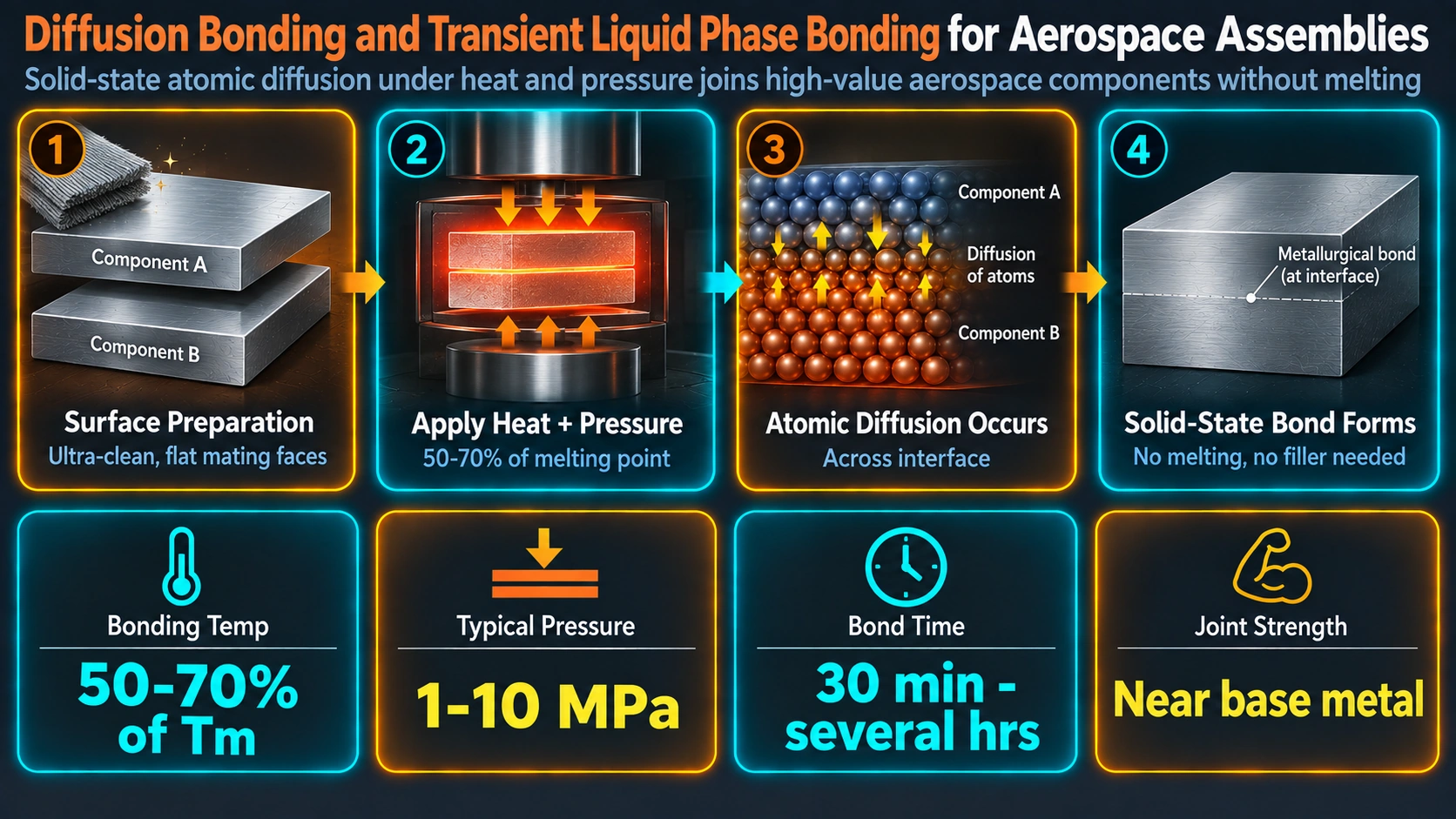
Diffusion bonding achieves joining entirely in the solid state by three sequential mechanisms that occur at temperatures of 0.5–0.9 Tm (where Tm is the absolute melting temperature of the lower-melting component) under uniaxial or isostatic pressure in vacuum or inert atmosphere. The absence of a liquid phase means no solidification shrinkage, no dendritic segregation, no hot cracking, and no metallurgical dilution of the parent composition. The joint line can be rendered practically invisible in metallographic section after a complete bond cycle.
Stage 1 — Surface Deformation and Asperity Contact
On any engineering surface — even after fine grinding or polishing to Ra < 0.4 μm — the real contact area when two surfaces are brought into contact under modest pressure is only 1–3% of the apparent contact area, determined by the height distribution of surface asperities (Greenwood–Williamson contact model). Stage 1 applies pressure sufficient to cause local plastic deformation of these asperities, collapsing them and increasing the real contact fraction to >90% of the apparent area. The deformation is governed by the yield criterion:
Contact hardness of asperity: H ≈ 3 × σ_y(T)

Applied pressure for asperity collapse: P ≥ H × (A_real / A_apparent)

For 90% contact at P = 10 MPa:  σ_y(T) ≤ 3.7 MPa
This is satisfied at T ≥ ~0.6 Tₘ for most metals (creep-softened σ_y)
Stage 2 — Creep and Void Closure
After Stage 1, isolated pores remain at the interface where asperities did not make contact, and at triple junctions between grain boundaries and the faying surface. These voids close by a combination of:
- Power-law creep: Sustained stress at elevated temperature drives dislocation creep, transporting material from void walls into the bulk. Creep rate ἐ̇ = Aσnexp(−Qc/RT), where n = 3–5 for metals and Qc ≈ Qself-diffusion.
- Volume diffusion: Vacancy flux driven by the chemical potential gradient between the stressed void surface and the surrounding matrix. Dominant at high temperatures and for fine voids.
- Grain boundary diffusion: Faster than volume diffusion (activation energy Qgb ≈ 0.6 Qv) and dominant at lower temperatures and for voids adjacent to grain boundaries. The effective diffusivity is Deff = Dv + (πδDgb/d), where δ is the grain boundary width (~0.5 nm) and d is the grain diameter.
The void shrinkage kinetics can be approximated by the Hull–Rimmer model for spherical voids under applied stress σ:
Void shrinkage rate (volume diffusion dominated):
dV/dt = −2πΩD_vσ / (kT · ln(L/r))

Where:  Ω = atomic volume (m³)
        D_v = volume self-diffusivity (m²/s)
        σ  = applied normal stress at void surface (Pa)
        L  = half-spacing between voids (m)
        r  = void radius (m)
        k  = Boltzmann constant, T = absolute temp. (K)
Stage 3 — Grain Boundary Migration
Once voids are closed, the original faying surface boundary is a special grain boundary with a high density of dislocations from the Stage 1 deformation. The driving force for grain boundary migration (reduction of grain boundary energy) causes this boundary to migrate away from the interface plane into the adjacent grains, consuming the evidence of the original joint and creating new grains that span across what was the bond plane. This stage transforms the joint from a metallurgically distinct layer into a microstructure indistinguishable from the parent material, provided PAGS, texture, and phase fractions are uniform across the joint. Stage 3 is the rate-limiting step for achieving high joint efficiency and requires sufficient time at temperature, typically 1–4 hours depending on material and temperature.
Process Parameter Window
| Material | Tm (°C) | Bond Temp. (°C) | T/Tm | Pressure (MPa) | Time (h) | Atmosphere | Notes |
|---|---|---|---|---|---|---|---|
| Ti-6Al-4V | ~1660 | 900–950 | 0.60–0.63 | 2–10 | 1–4 | Vacuum <10−⁴ mbar | Below β-transus (~995°C) |
| Inconel 718 | ~1336 | 1050–1100 | 0.73–0.77 | 15–30 | 1–3 | Vacuum / Ar | Below δ-solvus (1010°C); grain growth risk above |
| 316L Stainless | ~1400 | 1100–1150 | 0.73–0.76 | 20–50 | 1–4 | Vacuum | Sensitisation risk in 450–850°C range on cooling |
| Al 6061-T6 | ~660 | 530–560 | 0.78–0.82 | 5–20 | 0.5–2 | Vacuum | Al₂O₃ disruption; interlayer often used |
| Cu-DHP (copper) | ~1085 | 800–900 | 0.70–0.77 | 5–15 | 1–3 | H₂/N₂ or vacuum | High Dv; clean bonding in reducing atmosphere |
| Ni single-crystal (SX) | ~1340 | 1150–1200 | 0.79–0.82 | 10–25 | 2–6 | Vacuum <10−⁵ mbar | TLP preferred for SX; DB disturbs crystal orientation |
Surface Preparation Requirements
Surface preparation is the single most important determinant of bond quality aside from temperature and pressure. The requirements cascade from the mechanism:
- Roughness: Ra < 0.4 μm (fine grinding or lapping). Higher roughness increases void size, requiring longer Stage 2 dwell. Extremely low roughness (Ra < 0.05 μm, mirror-polished) can paradoxically reduce bond quality by creating van der Waals adhesion that prevents intimate metallic contact during initial heating.
- Flatness: < 0.025 mm per 100 mm. Warped faying surfaces leave un-contacted regions that require excessive pressure or temperature to close, risking dimensional distortion of the assembly.
- Cleanliness: Hydrocarbon films < 1 monolayer. Solvent degrease then vacuum bake at 200–250°C for 2 h before loading into the bonding press. Hydrocarbons dissociate at bonding temperatures and leave carbon films at the interface.
- Oxide state: TiO₂ (titanium) and Al₂O₃ (aluminium) are the most problematic. TiO₂ dissolves into the titanium matrix above ~750°C in vacuum and does not impede bonding; Al₂O₃ is stable to the melting point and must be mechanically disrupted or chemically dissolved via interlayer.
Transient Liquid Phase Bonding: Principles and Interlayer Design
TLP bonding — also termed activated diffusion bonding (ADB) or diffusion brazing — was developed specifically to address a fundamental limitation of solid-state diffusion bonding: the requirement for very high applied pressures to achieve intimate contact across macroscopic gaps or rough surfaces. TLP bonding inserts a thin interlayer (25–150 μm) whose composition is chosen to melt at the bonding temperature, forming a transient liquid that fills the gap by capillary action. The liquid then re-solidifies isothermally as the melting-point depressant (MPD) — typically boron, silicon, or phosphorus — diffuses out of the joint into the base metal, raising the local liquidus temperature above the bonding temperature.
Four Stages of TLP Bonding
Isothermal Solidification Kinetics
The rate-limiting step for TLP bond completion is the diffusion of the MPD through the solid base metal during Stage 3. The time for complete isothermal solidification (tIS) follows from the parabolic diffusion law:
Isothermal solidification time (for symmetric joint):
t_IS = W² / (8 D_MPD × k_p²)

Where:  W     = initial interlayer half-thickness (m)
        D_MPD = diffusivity of MPD (B, Si, P) in base metal (m²/s)
        k_p   = partition coefficient = C_S / C_L at bonding temp.

For BNi-2 on Inconel 718 (W = 37.5 μm, D_B ≈ 2×10⁻¹² m²/s at 1100°C):
t_IS ≈ (37.5×10⁻⁶)² / (8 × 2×10⁻¹² × 0.04²)
     ≈ 5.5 h at 1100°C

Increasing temperature by 50°C approximately halves t_IS (Arrhenius dependence).
If the bonding time is insufficient for complete isothermal solidification, the residual liquid at the joint centreline solidifies on cooling by a eutectic reaction, producing a layer of brittle boride and silicide phases (Ni₃B, Ni₃Si) at the bond centreline. These phases dramatically reduce ductility and fatigue life — appearing as a bright white line in metallographic section. This “centreline eutectic” is the dominant failure mode of incompletely processed TLP bonds in superalloys.
Interlayer Systems for Aerospace Alloys
| Base Metal | Interlayer (AWS/common) | MPD Element(s) | Tₘₑₗₖ (°C) | Bond Temp. (°C) | t_IS (h) | Joint Strength vs. Parent |
|---|---|---|---|---|---|---|
| Ni superalloy (poly) | BNi-2 (Ni–7Cr–4.5Si–3.1B) | B, Si | 970–1000 | 1065–1120 | 4–10 | 95–100% UTS; ~80% creep |
| Ni superalloy (SX/DS) | BNi-9 / Amdry DF-3 | B only (low Si) | 1055–1080 | 1150–1200 | 8–20 | ~100% creep (orientation-matched) |
| Co-base superalloy | BCo-1 (Co–19Cr–17Ni–8Si–4W–0.8B) | B, Si | 1110 | 1160–1200 | 6–12 | 90–95% UTS |
| Ti-6Al-4V | Cu foil / Cu-Ti eutectic | Cu (eutectic-forming) | 960 (Cu-Ti ▲) | 850–900 | 1–3 | 85–95% UTS |
| Aluminium 6061 | Al–Si brazing sheet (AA4045) | Si | 577 (Al-Si eutectic) | 575–600 | 0.3–1 | 70–85% UTS (after age) |
| ODS ferritic steel | Ni–20Cr–10P foil | P | 875 | 900–950 | 2–4 | 80–90% UTS |
Superplastic Forming and Diffusion Bonding (SPF/DB) in Titanium
SPF/DB is the most commercially significant application of diffusion bonding in aerospace manufacturing. It exploits two exceptional properties of Ti-6Al-4V in the temperature range 875–950°C: superplasticity (the ability to sustain large uniform elongations of 500–1000% at low strain rates under gas pressure) and the ability to diffusion bond at the same temperature. By integrating both operations into a single thermal cycle, complex hollow, integrally-stiffened structures are fabricated from flat sheet without intermediate assembly or fastening.
Process Sequence
- Sheet preparation: Two, three, or four Ti-6Al-4V sheets are degreased, pickled (HF/HNO₃ or KOH electropolish), and dried. Stop-off compound (yttria or boron nitride slurry) is silk-screened onto the faying surfaces in a pre-designed pattern that defines which areas will bond and which will remain separate (to be inflated later).
- Stack assembly and sealing: The sheets are stacked, a stainless steel or Ti alloy picture frame is electron-beam welded around the perimeter to seal the stack, and argon purge / vacuum connections are attached.
- Diffusion bonding: The sealed pack is placed in a hot press, heated to 900–925°C under 2–5 MPa pressure for 2–3 hours. The areas not covered by stop-off compound bond metallurgically. Areas with stop-off compound remain unbonded.
- Superplastic inflation (forming): While still at temperature (or after a brief transfer to a matched die), argon gas pressure (0.5–3 MPa) is admitted through the purge connection into the unbonded channels. The Ti-6Al-4V is superplastic at 900°C and inflates into the die cavity at strain rates of 10−⁴–10−³ s−¹, forming the three-dimensional integral structure. Inflating different internal channels sequentially allows complex geometry control.
- Cooling and inspection: The formed assembly is cooled to room temperature, the picture frame is machined off, and the component is ultrasonically C-scanned to verify bond integrity.
Microstructural Consequences of SPF/DB
Ti-6Al-4V processed by SPF/DB has a distinctly different microstructure from wrought or forged material. The SPF step introduces a fine-grained equiaxed α+β microstructure (grain size 2–8 μm) with uniform crystallographic texture — ideal for superplastic flow — but with lower fatigue strength than conventionally processed bimodal or lamellar Ti-6Al-4V. The diffusion bond interface, when correctly processed, shows no distinct bond line in metallographic section; however, a diffuse band of slightly coarser grains (from grain boundary migration during Stage 3) may be visible at high magnification. Tensile properties across a well-formed SPF/DB interface should meet AMS 4928 parent material minimums: UTS ≥ 896 MPa, Rp0.2 ≥ 827 MPa, elongation ≥ 10%.
Aerospace Applications of SPF/DB
| Structure | Aircraft / Programme | Configuration | Advantage vs. Alternative |
|---|---|---|---|
| Engine nacelle panels | Boeing 747-400, Airbus A340 | 3-sheet sandwich with stiffening webs | 60% fewer parts vs. riveted aluminium; 20% weight saving |
| Wing access panels | Eurofighter Typhoon | 2-sheet SPF/DB with integral ribs | Eliminates 180 fasteners per panel; improved fatigue life |
| Fuselage frames | F-22 Raptor | 4-sheet multi-bay hollow frame | Integral structure with internal stiffening; no bond-line weakness |
| Leading edges | Various commercial jets | 2-sheet with stiffening ribs | Smooth aerodynamic surface; no rivet heads or thermal expansion mismatch |
| Thrust reversers | CFM56 variants | 3-sheet cascade assembly | Complex internal geometry unachievable by conventional forming |
TLP Bonding for Turbine Blade Repair
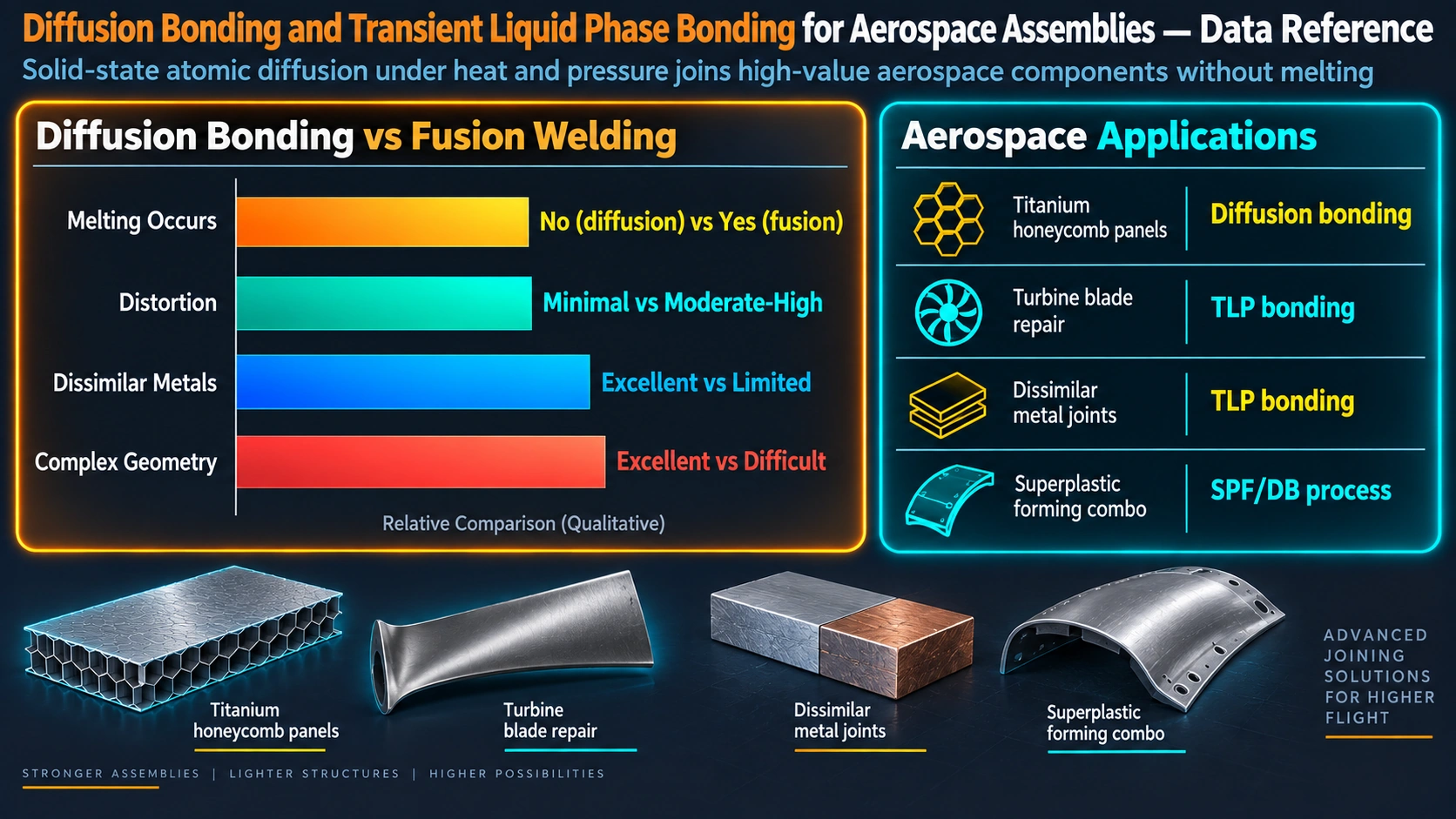
Gas turbine blades experience the most severe operating conditions of any metallic engineering component: surface temperatures approaching 1100°C, centrifugal stresses of 100–180 MPa, aggressive oxidation and hot corrosion, and thermal fatigue cycling. The thin-walled, film-cooled single-crystal (SX) and directionally solidified (DS) Ni superalloy blades used in commercial turbofan high-pressure turbines represent engineering and production investments of thousands of dollars per blade, creating powerful economic incentives for repair rather than replacement — provided the repair restores aeromechanical properties.
Why Fusion Welding Cannot Repair SX/DS Blades
The columnar or single-crystal grain structure of DS and SX turbine blades is destroyed by conventional fusion welding because: (1) the weld pool re-solidifies with a random polycrystalline or cellular microstructure that lacks the creep resistance of the original; (2) the HAZ experiences temperatures above the γ′ solvus, dissolving the strengthening precipitate and producing over-ageing on cooling; and (3) the thermal gradient from the weld heat source induces large residual tensile stresses in a material with near-zero ductility at room temperature, causing cracking in the HAZ or weld metal. Laser cladding of single-crystal superalloy filler is under development, but TLP bonding remains the industrially validated repair standard.
TLP Blade Repair Process
- Damage assessment and preparation: The blade is inspected by FPI and UT to characterise the extent of tip erosion, leading-edge damage, or crack network. Damaged material is removed by precision grinding (EDM or electrochemical machining for film-cooling holes) to a clean base for the repair.
- Pre-weld cleaning: Fluoride ion cleaning (FIC) is applied if oxidised γ′-depleted zones or oxide-filled cracks are present. The FIC atmosphere (HF + H₂) volatilises Al₂O₃ and Cr₂O₃ from crack surfaces, enabling subsequent TLP interlayer contact with clean base metal.
- Interlayer application: BNi-2, BNi-9, or a proprietary superalloy brazing powder is applied as a slurry or foil to the prepared surface. Slurry formulations (powder + organic binder) allow application to complex geometries including crack interiors.
- Bonding cycle: The blade is fixtured and processed in a vacuum furnace (10−⁵–10−⁶ mbar) at 1065–1200°C for 4–24 hours depending on the interlayer and extent of repair. For SX blades, a specifically matched single-crystal or polycrystalline filler may be pre-placed as a pre-sintered preform (PSP), and the TLP cycle fuses and homogenises the interface without disrupting the substrate crystal.
- Post-bond restoration heat treatment: The blade is solution heat-treated (≥ γ′ solvus, typically 1280–1320°C for René N5 / CMSX-4) and aged (two-step: ~1080°C/4h + 870°C/24h) to restore the bimodal γ′ precipitate distribution and creep strength.
- Inspection: FPI (for surface-connected cracks), UT (for subsurface voids in the bond), and coordinate measuring machine (CMM) dimensional check against original blade drawing.
Quality Assurance and Inspection of Diffusion Bonds
The most common discontinuity in diffusion-bonded joints is residual porosity: isolated spherical or planar voids remaining at the bond plane where insufficient creep or diffusion occurred. In TLP bonds, centreline eutectic is the additional critical defect. Both are detected and characterised by the methods below.
Phased-Array Ultrasonic Testing (PAUT)
Immersion or contact PAUT with 5–25 MHz focused transducers is the primary volume inspection method. A void of diameter d ≥ λ/2 (where λ = wavelength of ultrasound in the material) reflects a detectable echo. For titanium at 10 MHz, λ = 0.6 mm — thus voids > 0.3 mm are reliably detected. C-scan display maps unbonded area fraction across the joint plane. AMS 2769 (titanium DB) specifies maximum allowable unbonded area and void dimensions for flight-critical structures. See also non-destructive testing methods for general NDT technique reference.
Metallographic Assessment
Cross-section metallography remains the reference standard for bond quality characterisation. Specimens are sectioned perpendicular and parallel to the bond plane, mounted in resin, ground to 1 μm diamond, and etched with Kroll’s reagent (titanium) or marble’s reagent (nickel alloys). A fully bonded interface shows:
- No distinguishable bond line at 100× optical magnification
- Grain boundaries crossing the original faying surface plane
- Residual porosity area fraction < 0.5% of bond plane area
- No continuous oxide film (visible as a dark line in back-scatter SEM)
- For TLP bonds: no centreline eutectic phase (confirmed by EDS mapping for B, Si, P enrichment)
Mechanical Testing Protocols
| Test | Specimen Type | Standard | Pass Criterion (Ti-6Al-4V DB) |
|---|---|---|---|
| Transverse tensile | Bond plane perpendicular to load axis | ASTM E8 | UTS ≥ 896 MPa; A ≥ 10% |
| Shear strength | Single lap shear or butt-shear | ASTM D1002 | τ ≥ 500 MPa |
| Fatigue (axial) | Bond plane in gauge section | ASTM E466 | Endurance limit ≥ 80% parent |
| Creep rupture (TLP) | Cylindrical, bond transverse | ASTM E139 | Rupture life ≥ 85% parent at given σ/T |
| Peel test (SPF/DB) | T-peel on web section | ASTM D1876 | Failure in parent, not bond |
Comparison: Diffusion Bonding vs. TLP Bonding vs. Electron Beam Welding
| Criterion | Diffusion Bonding (DB) | TLP Bonding | Electron Beam Welding (EBW) |
|---|---|---|---|
| Liquid phase | None (solid state) | Transient only | Persistent weld pool |
| Joint gap tolerance | < 0.025 mm (flatness critical) | Up to 0.3–0.5 mm (liquid fills) | Up to 0.5 mm (pre-weld machining) |
| HAZ / microstructure disruption | None to minimal | None (below melting of base) | Significant HAZ; solidification structure in weld |
| Applicable to SX superalloys | Limited (pressure disturbs orientation) | Yes (standard repair route) | No (destroys SX structure) |
| Complex geometry capability | Excellent (HIP extends to 3D) | Good (liquid fills complex gaps) | Limited to line-of-sight |
| Joint efficiency (% parent UTS) | 95–100% | 90–100% (after homogenise) | 85–100% (depends on PWHT) |
| Cycle time | 1–6 h | 4–24 h (IS solidification) | Minutes (high throughput) |
| Vacuum requirement | Essential (<10−⁴ mbar) | Essential (<10−⁵ mbar) | Essential (<10−³ mbar) |
| Applicable standards | AMS 2769, AWS C3.2 | AMS 2675, AMS B-1 (repair) | AWS D17.1, MIL-STD-2219 |
For a comprehensive understanding of the HAZ microstructure that EBW and laser welding produce in nickel superalloys, see also the HAZ microstructure and hydrogen cracking articles covering the solid-state welding approaches to crack avoidance in high-strength alloys. The broader context of investment casting of superalloys is relevant background for understanding the single-crystal structures that TLP bonding is used to repair.
Frequently Asked Questions
Why is surface preparation so critical for diffusion bonding?
What is the difference between diffusion bonding and diffusion brazing?
What interlayer is used for TLP bonding of nickel superalloys?
What bonding conditions are used for Ti-6Al-4V diffusion bonding?
What is SPF/DB and where is it used in aerospace?
How is bond quality assessed in diffusion-bonded joints?
Can aluminium alloys be diffusion bonded?
What are the main defect types in diffusion-bonded and TLP-bonded joints?
Recommended Reference Books
Further Reading
