Hydrogen Storage Materials: Metal Hydrides, Carbon Storage, and Safety Metallurgy
The viability of a hydrogen economy depends as much on materials science as on electrochemistry. Whether hydrogen is stored as a compressed gas at 70 MPa, as a liquid at 20 K, or absorbed in a solid-state metal hydride, the materials of the storage system must simultaneously satisfy thermodynamic, mechanical, and safety requirements that are not easily reconciled. This article provides a graduate-engineer-level treatment of the principal solid-state and physical storage routes, the metallurgy of structural materials for high-pressure and cryogenic hydrogen containment, hydrogen embrittlement mechanisms and material selection criteria, and the emerging carbon-based and complex hydride storage systems.
Key Takeaways
- Hydrogen can be stored as compressed gas (up to 70 MPa in Type IV composite cylinders), as liquid hydrogen (LH2) at 20 K, or in solid-state metal hydrides, each with distinct materials challenges.
- The US DOE 2025 onboard vehicle system target is 5.5 wt% gravimetric capacity and 40 g H2/L volumetric capacity; current compressed-gas Type IV cylinders approach but do not comfortably exceed the gravimetric target.
- AB5 intermetallics (LaNi5H6) operate at near-ambient temperature with excellent cycle life but low gravimetric capacity (1.4 wt%); MgH2 offers 7.6 wt% but requires temperatures above 300°C for desorption.
- BCC ferritic steels are completely unsuitable for liquid hydrogen service due to the ductile-to-brittle transition; austenitic stainless steels (304L, 316L) and aluminium alloys (2219, 5083) are the standard cryogenic materials.
- For high-pressure gaseous hydrogen service, maximum steel hardness is limited to 22 HRC (248 HV) to prevent hydrogen-assisted cracking; the hydrogen fugacity at 70 MPa is approximately 100–130 MPa.
- NaAlH4 and LiBH4 are complex hydrides with theoretical capacities of 7.4 and 18.5 wt% respectively, but practical reversibility requires catalysts and nanostructuring.
Fundamentals: Why Hydrogen Storage is a Materials Problem
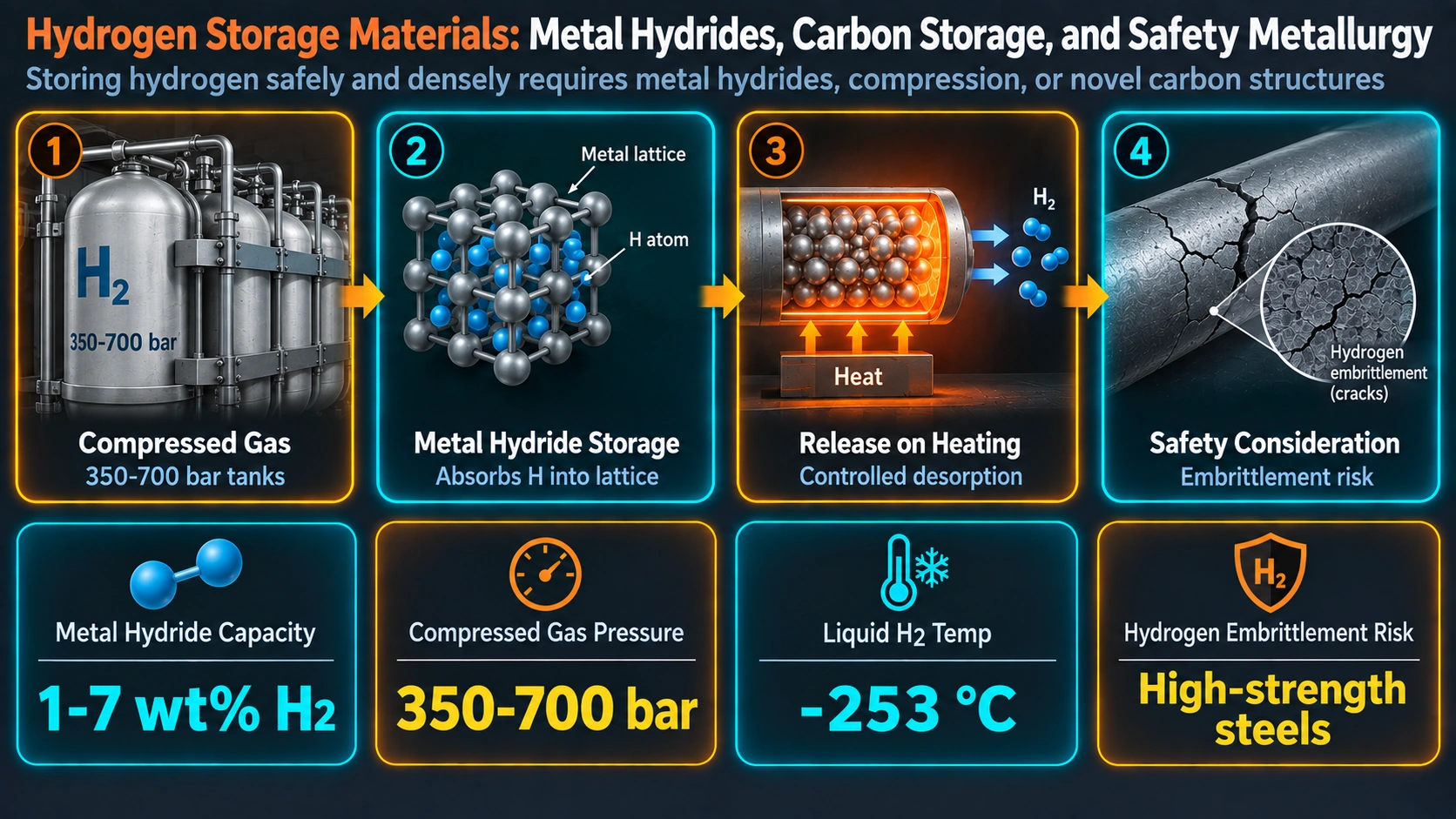
Hydrogen has the highest mass-specific energy density of any fuel (120 MJ/kg LHV, versus 44 MJ/kg for gasoline), but its volumetric energy density under ambient conditions is negligibly small: at 1 bar and 20°C, hydrogen gas contains only 0.09 kg/m³. A 5 kg hydrogen load — the nominal onboard capacity of a fuel cell vehicle — occupies 56 m³ at ambient conditions. Practical storage therefore requires densification either by physical means (compression, liquefaction) or by chemical absorption into a solid-state medium.
No single storage technology simultaneously satisfies all the engineering requirements. The evaluation criteria for hydrogen storage materials are defined by the US Department of Energy Hydrogen and Fuel Cell Technologies Office, and include gravimetric capacity (wt% H2), volumetric capacity (g H2/L), operating temperature and pressure, charging and discharging kinetics, cycle life, cost, toxicity, and safety. Understanding which material best meets a given subset of these criteria requires a detailed understanding of the underlying solid-state chemistry and physical metallurgy.
Compressed Gaseous Hydrogen (CGH2): Cylinder Metallurgy
Pressure Vessel Types and Materials
Compressed gaseous hydrogen is the dominant storage technology in commercial fuel cell vehicles (Toyota Mirai, Hyundai Nexo) and is widely used in industrial hydrogen handling. Cylinders are classified by structural design into four types under ISO 11119 and SAE J2579:
| Type | Construction | Typical Material | Gravimetric Efficiency | Typical Pressure (MPa) |
|---|---|---|---|---|
| Type I | All-metal, no overwrap | Carbon steel or aluminium alloy (6061-T6) | ~1 wt% | 20–30 |
| Type II | Metal liner with partial glass/carbon fibre hoop wrap | Steel or Al liner + GFRP hoop | ~1.5–2 wt% | 20–30 |
| Type III | Metal liner with full composite overwrap | Aluminium liner + CFRP full wrap | ~3–4 wt% | 35–70 |
| Type IV | Polymer liner with full CFRP overwrap | HDPE/nylon liner + CFRP | ~5–7 wt% | 70 |
| Source: ISO 11119, SAE J2579. Gravimetric efficiency = H2 mass / (H2 mass + tank system mass). | ||||
Steel Selection for High-Pressure Hydrogen Service
Where metallic pressure-bearing components contact hydrogen gas at elevated pressure, materials selection must address hydrogen embrittlement (HE) susceptibility. The governing documents are ASME PVHO-1, ISO 11114-4 (cylinder materials compatibility), and NACE TM0177 / NACE TM0284 for material screening. The primary acceptance criterion is a maximum hardness of 22 HRC (248 HV10). This threshold exists because:
- High-strength martensitic microstructures with hardness above ~250 HV have crack-tip hydrogen concentrations sufficient to trigger hydrogen-enhanced decohesion (HEDE) at stress intensities below KIC
- Tempered martensite and normalised/tempered bainite in the 200–300 HV range are significantly less susceptible
- Austenitic microstructures, with their FCC structure and low hydrogen diffusivity (~10³ times lower than BCC), are the least susceptible
For carbon steel cylinders (Type I, Type II), SA-372 Grade J (quenched and tempered, hardness-controlled) is the standard. For aluminium alloy liners (Type III), 6061-T6 is most common, though high-strength 7xxx alloys are avoided due to SCC susceptibility in moist hydrogen environments.
Carbon Fibre Reinforced Polymer (CFRP) in Type IV Cylinders
The structural shell of Type IV cylinders is wound CFRP, with carbon fibres (T700 or T1000 grade Toray, typical tensile strength 4.9–7.0 GPa) embedded in an epoxy matrix. The liner is non-structural and serves only as a hydrogen permeation barrier. Liner permeability to hydrogen (which has a kinetic diameter of 0.289 nm) is a critical design parameter: HDPE liners have permeability approximately 10 times greater than nylon (PA6 or PA66) liners at ambient temperature. For 70 MPa service, both materials must meet the maximum permeation rate of 6 Ncm³/(h/L) specified in SAE J2579.
fH2 = p × exp[ (p − p0) × b / (RT) ]

Where:
  fH2  = hydrogen fugacity (thermodynamic pressure), MPa
  p      = actual gas pressure, MPa
  b      = van der Waals excluded volume constant for H2 ≈ 2.67 × 10⁻⁵ m³/mol
  R      = 8.314 J/(mol·K)
  T      = absolute temperature, K

Example: p = 70 MPa, T = 298 K
  fH2 ≈ 70 × exp(70 × 2.67×10−5 / (8.314×10−6 × 298)) ≈ 100–130 MPa

Consequence: hydrogen chemical activity at 70 MPa storage pressure is
             equivalent to ~100–130 MPa ideal gas pressure.
Why 70 MPa rather than higher? Above approximately 70 MPa, the trade-off between additional compression energy (which scales roughly as ln(P2/P1)) and incremental hydrogen density diminishes rapidly because hydrogen is increasingly non-ideal. The density of compressed hydrogen at 70 MPa and 15°C is approximately 40 kg/m³ — only 57% of liquid hydrogen density (70.8 kg/m³) at 1.5× the cost in pressure vessel mass and compression energy.
Metal Hydride Storage: Thermodynamics and Material Classes
Pressure-Composition-Temperature (PCT) Thermodynamics
When a metal or intermetallic alloy is exposed to hydrogen gas, absorption proceeds in three stages: physisorption of H2 on the surface, dissociative chemisorption and surface diffusion of atomic H, and bulk diffusion of H atoms into the metal lattice. At low hydrogen content, hydrogen occupies interstitial sites as a solid solution (α phase). Beyond a critical concentration, a phase transition occurs to a distinct metal hydride phase (β phase). During this two-phase coexistence, the equilibrium hydrogen pressure remains approximately constant with changing composition — this is the plateau pressure. The plateau width defines the usable storage capacity.
The Van’t Hoff equation relates plateau pressure to temperature through the enthalpy and entropy of hydrogenation:
ln(peq/p0) = ΔH/(RT) − ΔS/R

Where:
  peq  = equilibrium (plateau) hydrogen pressure, Pa
  p0   = reference pressure (1 bar = 105 Pa)
  ΔH   = enthalpy of hydrogenation, J/mol H2  (negative for exothermic absorption)
  ΔS   = entropy of hydrogenation, J/(mol H2·K)  (typically −130 J/mol K)
  R    = 8.314 J/(mol·K)
  T    = absolute temperature, K

Practical desorption condition: peq ≥ 1 bar requires T ≥ ΔH / (ΔS + R·ln(p0/p0))
                                             simplifies to: Tdes ≈ ΔH / ΔS

For near-ambient operation (ΔS ≈ −130 J/mol K, T = 298 K):
  Target ΔH range ≈ −15 to −40 kJ/mol H2
This thermodynamic window is the central design constraint for metal hydrides intended for near-ambient temperature operation. Hydrides with |ΔH| much greater than ~40 kJ/mol (e.g., MgH2 at ~75 kJ/mol) require elevated temperatures for desorption. Hydrides with |ΔH| below ~15 kJ/mol desorb too readily, requiring high pressures for charging.
AB5 Intermetallics: LaNi5 and Substituted Variants
LaNi5 was the first practically useful metal hydride identified for reversible hydrogen storage, reported by Philips Research Laboratories in 1970. It crystallises in the hexagonal CaCu5-type structure (space group P6/mmm). Hydrogen occupies three types of tetrahedral interstices (4h, 2c, 3g Wyckoff sites) in the fully saturated LaNi5H6 composition. Key properties include:
| Hydride | Structure | H2 wt% | ΔH (kJ/mol H2) | Tdes at 1 bar | Plateau Pressure (25°C) |
|---|---|---|---|---|---|
| LaNi5H6 | AB5, hexagonal | 1.38 | −30.1 | ~25°C | ~0.17 MPa |
| MmNi5 (mischmetal) | AB5, hexagonal | ~1.2 | −21 to −27 | Below ambient | 0.2–1.0 MPa |
| LaNi4.7Al0.3 | AB5, substituted | 1.1 | −36 | ~50°C | ~0.05 MPa |
| TiFeH2 | AB, CsCl-type | 1.89 | −28.1 | ~30°C | 0.5–1.0 MPa |
| TiMn1.5 | AB2, Laves C14 | ~1.9 | −28 | ~25°C | 0.8 MPa |
| ZrV2H5.5 | AB2, Laves C15 | 3.0 | −75 | >250°C | <0.001 MPa |
| Sources: Sandrock (1999) J Alloys Compd 293; Schlapbach & Züttel (2001) Nature 414. Tdes = desorption temperature for plateau pressure = 1 bar. | |||||
The primary limitation of AB5 hydrides is their low gravimetric capacity, a consequence of the large molar mass of La (138.9 g/mol). Substitution on the A-site (e.g., Ce, Pr, Nd, or mischmetal) and on the B-site (Al, Mn, Co, Cu) enables fine-tuning of the equilibrium pressure and kinetics. Partial Al substitution on the Ni site (LaNi4.7Al0.3) stabilises the hydride against decrepitation (pulverisation during cycling) by reducing the unit cell volume change on hydrogenation from ~25% in LaNi5 to ~15–18%, significantly extending cycle life.
Decrepitation and Cycle Life
The volume expansion on hydriding (ΔV/V ≈ 25% for LaNi5) generates internal stresses that exceed the fracture toughness of the intermetallic. After the first few hydrogenation cycles, the alloy pulverises to a fine powder (5–50 μm particle size). This is not necessarily detrimental — the increased surface area improves kinetics — but it does raise the risk of particle attrition generating pyrophoric fine dust if the tank is breached. Industrial applications (e.g., NiMH battery electrodes, submarine fuel storage) use slurry-bed or packed-bed tank designs with sintered stainless steel filters to contain the powder.
MgH2: High-Capacity Light Metal Hydride
Magnesium hydride (MgH2) has a gravimetric capacity of 7.6 wt% and a volumetric capacity of ~109 kg H2/m³ — making it among the most attractive solid-state storage media on paper. However, its practical application is severely limited by:
- High desorption temperature: The Mg-H bond enthalpy is ~75 kJ/mol H2, requiring temperatures above 300°C for desorption at 1 bar. Automotive waste heat (PEM fuel cell exhaust at ~80°C) is wholly insufficient.
- Slow kinetics: MgO surface oxide acts as a diffusion barrier for hydrogen. Activation (removal of this barrier) requires either prolonged exposure to high-pressure H2 at elevated temperature, or mechanical milling.
- Low thermal conductivity: Bulk MgH2 powder has thermal conductivity of ~1 W/(m·K), making heat management during charging and discharging (which is highly exothermic/endothermic at ~75 kJ/mol) challenging.
Research strategies to overcome these barriers include nanostructuring by high-energy ball milling, nanoconfinement in porous carbon scaffolds (preventing agglomeration and reducing diffusion path lengths), and catalytic doping with transition metal oxides (TiO2, Nb2O5, V2O5) that accelerate H2 dissociation and recombination on the surface.
Complex Hydrides: NaAlH4, LiBH4, and Amides
Complex hydrides contain complex anions ([AlH4]−, [BH4]−, [NH2]−) in which hydrogen is covalently bonded to a central light element. Their theoretical gravimetric capacities are significantly higher than intermetallic hydrides:
| Compound | Theoretical wt% | Desorption Reaction | Tdes (°C) | Reversible? |
|---|---|---|---|---|
| NaAlH4 | 7.4 | 3 NaAlH4 → Na3AlH6 + 2 Al + 3 H2 (3.7 wt%); then Na3AlH6 → 3 NaH + Al + 1.5 H2 (1.9 wt%) | 100–150 (step 1); 150–200 (step 2) | Yes, with Ti catalyst |
| LiBH4 | 18.5 | LiBH4 → LiH + B + 3/2 H2 | 380–480 (without catalyst) | Partially (requires 350 bar H2 to rehydride) |
| LiNH2 + LiH (amide system) | 6.5 | LiNH2 + LiH → Li2NH + H2 | 150–250 | Yes |
| Ca(BH4)2 | 11.6 | Ca(BH4)2 → CaH2 + 2B + 3H2 | 320–500 | Partially |
| Source: Zuttel et al. (2010) ChemPhysChem; DOE Hydrogen Storage Materials Database (2024). | ||||
The breakthrough for NaAlH4 came when Bogdanovic and Schwickardi (1997) demonstrated that catalytic doping with Ti compounds (TiCl3, TiO2) reduces the desorption temperature to 100–200°C and makes the system reversibly cyclable. The Ti catalyst nanoparticles facilitate Al-H bond breaking at the surface. Practical NaAlH4 systems deliver approximately 4–5 wt% reversible capacity after accounting for catalyst mass and incomplete cycling.
Cryogenic Liquid Hydrogen (LH2): Materials Requirements
Liquid hydrogen at atmospheric pressure has a boiling point of −253°C (20.3 K) and a density of 70.8 kg/m³ — the highest volumetric storage density of any hydrogen storage method. Its main engineering challenges are the extreme temperature requirement, boil-off loss (typically 0.1–0.3% per day in large tanks), and the severe constraints on structural material selection imposed by cryogenic temperature.
Ductile-to-Brittle Transition and Material Selection
The ductile-to-brittle transition temperature (DBTT) is a defining characteristic of BCC metals. Below this temperature, dislocation glide is restricted and fracture proceeds by brittle cleavage with little plastic deformation. For structural carbon steels, the DBTT is typically −20 to −60°C; for alloy steels it may be −60 to −100°C — far above the 20 K operating temperature of LH2 storage. Any ferritic or martensitic steel is therefore completely unsuitable for components contacting or containing liquid hydrogen. For detailed background on this phenomenon and its implications, see the MetallurgyZone article on low-temperature steels for cryogenic service.
FCC metals and alloys have no DBTT: their close-packed crystal structure allows continued dislocation movement even at 4 K. The primary structural materials for LH2 tanks are:
- Austenitic stainless steels (AISI 304L, 316L): Excellent toughness to 20 K, Charpy impact energy remaining above 100 J at cryogenic temperature. Used for piping, inner vessels, and structural elements. Low carbon grades (304L, 316L) preferred to minimise sensitisation risk in welded joints.
- Aluminium alloys (2219-T87, 5083-O, 6061-T6): FCC structure, no DBTT, excellent cryogenic toughness. 2219-T87 (Al-Cu-Mn) is the historical choice for aerospace cryogenic tanks (NASA Saturn V, Space Shuttle External Tank). 5083-O (Al-Mg) is widely used for LNG and LH2 industrial tanks due to its combination of toughness, weldability, and moderate strength.
- 9% Nickel steel: A ferritic-based steel that, through its fine martensitic structure and high nickel content, retains CVN toughness above 27 J (code minimum) at −196°C. Primarily used for LNG storage; occasional use for sub-ambient hydrogen service above −196°C.
- Invar (Fe-36Ni): Nearly zero coefficient of thermal expansion from ambient to cryogenic temperature. Used for precision cryogenic structures where dimensional stability is critical rather than structural load-bearing capacity.
| Material | Crystal Structure | DBTT | Typical CVN at −196°C (J) | LH2 / LNG Suitability |
|---|---|---|---|---|
| Structural carbon steel A36 | BCC (ferrite) | −10 to −30°C | <5 J (brittle) | Not suitable |
| 9% Nickel steel (ASTM A553) | Tempered martensite + austenite | Below −196°C | >34 J | LNG service (−162°C); not for LH2 |
| AISI 304L / 316L stainless | FCC (austenite) | None | >100 J | Excellent (to 20 K) |
| Aluminium 5083-O | FCC | None | >40 J | Excellent (to 20 K) |
| Aluminium 2219-T87 | FCC | None | >40 J | Excellent; NASA aerospace standard |
| Invar (Fe-36Ni) | FCC | None | ~100 J | Structural (not pressure-bearing) |
| CVN data from NIST Cryogenics Materials Database and ASM Handbook Vol. 2. Values are indicative; actual design shall use mill-test certified data. | ||||
Hydrogen Embrittlement Mechanisms and Prevention
Hydrogen embrittlement in metallic materials is not a single mechanism but a family of related phenomena that reduce ductility, fracture toughness (KIH), and fatigue crack growth resistance in hydrogen-containing environments. The three most widely accepted mechanisms are:
Hydrogen-Enhanced Decohesion (HEDE)
Hydrogen segregates to regions of high hydrostatic tensile stress, particularly at grain boundaries, inclusion/matrix interfaces, and crack tips. At these locations, the accumulation of dissolved hydrogen reduces the cohesive strength of atomic bonds, allowing fracture to occur at applied stress intensity factors well below KIC. HEDE is the dominant mechanism in high-strength martensitic steels. The threshold stress intensity for hydrogen-assisted cracking (KIH) can fall to 20–40% of KIC in these steels at hydrogen pressures above 1 MPa. For a detailed treatment of hydrogen cracking in weldments, see the MetallurgyZone article on hydrogen-induced cold cracking.
Hydrogen-Enhanced Localised Plasticity (HELP)
In lower-strength steels and austenitic stainless steels, the dominant mechanism is HELP: dissolved hydrogen reduces the barrier to dislocation motion (reduces the Peierls–Nabarro stress), causing intense localised slip at crack tips. This localised deformation results in apparent macroscopic embrittlement even though the underlying mechanism is enhanced plasticity, not decohesion. HELP is generally less severe than HEDE but can still cause significant loss of uniform elongation and notch toughness.
Hydride-Induced Embrittlement (HIE)
In metals that form thermodynamically stable hydrides — principally titanium, vanadium, niobium, zirconium, and their alloys — dissolved hydrogen precipitates as a brittle hydride phase at the crack tip. Crack advance occurs by successive cleavage of the brittle hydride, a process called hydride-shielded cracking. Iron and nickel do not form stable hydrides under practical conditions, so HIE is not relevant to steels; it is, however, critical in titanium alloy pipelines and pressure vessels for hydrogen service.
Prevention Strategies
- Material selection below the hardness threshold: Maintain all carbon and low-alloy steel components below 22 HRC (248 HV) through appropriate heat treatment. This is the most reliable and code-specified preventive measure.
- Use of austenitic or FCC alloys: 304L, 316L stainless steels and aluminium alloys are substantially less susceptible to HEDE due to low hydrogen diffusivity in FCC lattices and the absence of a DBTT.
- Avoid high-strength cold-worked microstructures: Strain-induced martensite in cold-drawn austenitic stainless can significantly elevate HE risk. Annealed or lightly cold-worked grades are preferred.
- Fracture mechanics qualification testing: ASTM G129 (slow strain rate test in hydrogen environment) and ASTM E1681 (KIH determination by constant-load testing) provide quantitative HE susceptibility data for material approval.
Carbon-Based and Porous Materials for Hydrogen Storage
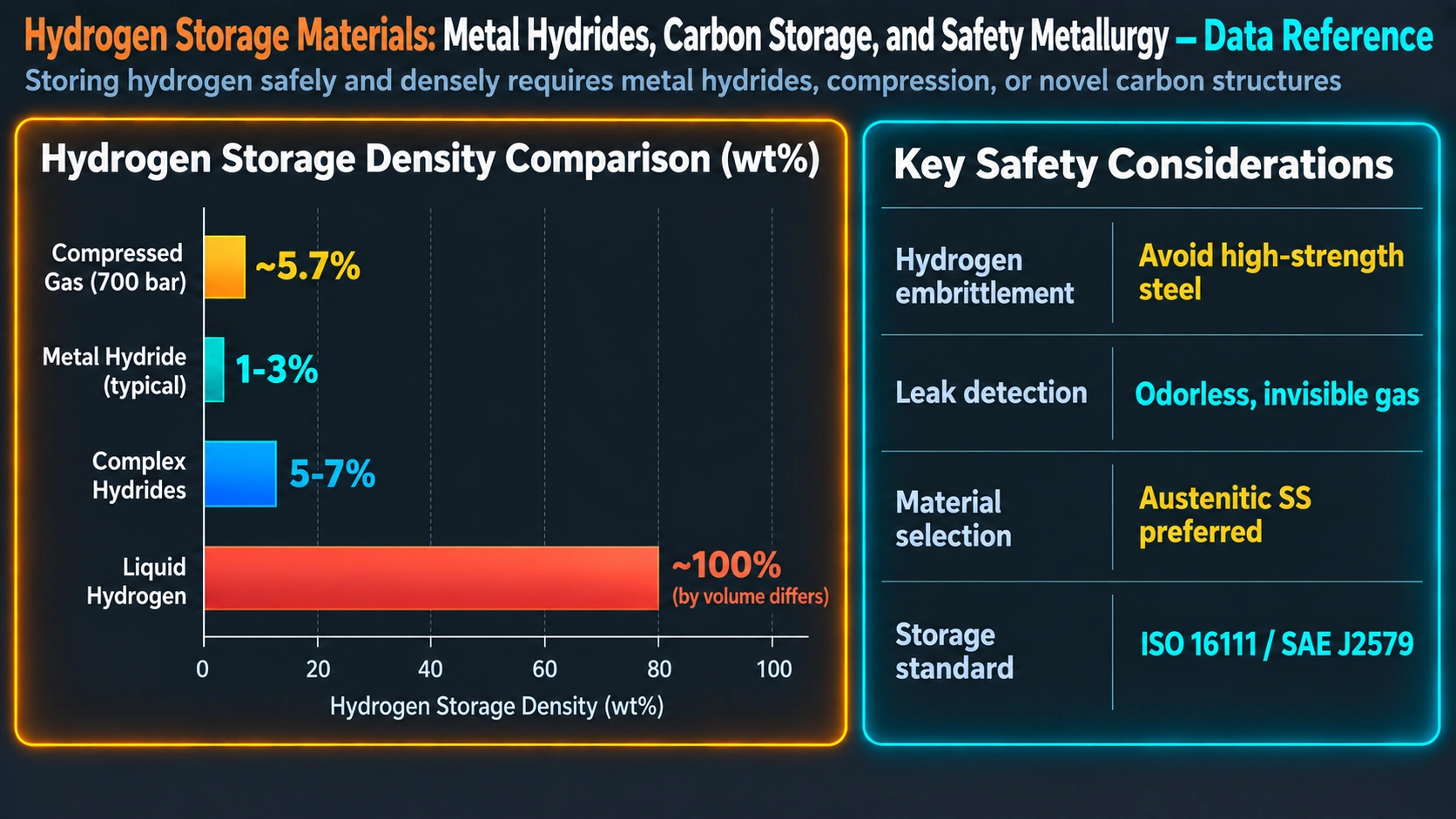
Physisorption on high-surface-area materials offers an alternative route to solid-state hydrogen storage. Unlike metal hydrides, physisorption involves only weak van der Waals interactions between H2 molecules and the adsorbent surface; the enthalpy of adsorption is only 4–10 kJ/mol H2, compared to 30–80 kJ/mol for chemisorption in metal hydrides. The low binding energy means near-ambient physisorption capacities are low at practical pressures; cryogenic temperatures (77 K) are required to achieve useful adsorption densities.
Activated Carbon and Carbon Nanotubes
Activated carbon with surface areas of 1000–3000 m²/g can adsorb 5–7 wt% H2 at 77 K and 4 MPa, dropping to below 0.5 wt% at room temperature and 10 MPa. Carbon nanotubes (single-walled, SWCNT) attracted intense interest following initial reports of 5–10 wt% H2 at room temperature; however, careful reproducible experiments consistently show room-temperature physisorption below 0.5 wt% in defect-free SWCNTs. Enhanced storage claims were attributed to measurement artefacts (water contamination, outgassing from sample holders) and have not been independently reproduced. The theoretical maximum physisorption capacity of a material with 100% carbon atoms at monolayer coverage is approximately 3.3 wt%, which establishes an upper thermodynamic bound for all carbon adsorbents at ambient temperature.
Metal-Organic Frameworks (MOFs)
MOFs — crystalline porous coordination polymers — have surface areas up to 7000 m²/g and tunable pore geometries. MOF-5 (Zn4O(BDC)3, surface area ~3800 m²/g) and IRMOF series achieve 4–7 wt% H2 at 77 K. At room temperature, even the best MOFs (UiO-66, MIL-53) store below 1 wt% at 10 MPa. The challenge is increasing the isosteric heat of adsorption above ~15 kJ/mol at room temperature — achievable in principle by unsaturated metal coordination sites or by spillover from incorporated metal nanoparticles. Moisture sensitivity (hydrolysis of the metal–ligand bond) and low mechanical strength remain barriers to practical application.
Safety Metallurgy: Compatibility Testing and Standards
Materials selection for hydrogen service requires compliance with a framework of international standards. The principal documents are:
- ISO 11114-4: Test methods for the compatibility of cylinder and valve materials with gas contents — specifically for hydrogen, covering sustained-load cracking tests (SLC), notch tensile, and slow strain rate tests.
- SAE J2579: Technical information report on fuel systems in fuel cell and other hydrogen vehicles; specifies Type IV cylinder qualification, burst testing at 2.25× nominal working pressure, and cycle life of 11,250 fill cycles.
- ASME PVHO-1: Safety standard for pressure vessels for human occupancy; Section 6 covers hydrogen compatibility requirements applicable to pressure vessels in hydrogen service.
- NACE MR0175 / ISO 15156: Primarily for sour oil and gas service, but the 22 HRC hardness limit and material qualification methodology are widely adopted for gaseous hydrogen infrastructure including pipelines and compressors.
- ASTM G129: Standard practice for slow strain rate testing to evaluate susceptibility of metallic materials to environmentally assisted cracking. The index of hydrogen embrittlement (IHE) is defined as the ratio of fracture strain in hydrogen to fracture strain in argon or vacuum; IHE < 1 indicates embrittlement.
IHE = εf,H2 / εf,ref

Where:
  εf,H2  = fracture strain in hydrogen gas environment
  εf,ref = fracture strain in reference inert environment (argon, vacuum)

IHE = 1.0  →  no embrittlement
IHE < 0.8  →  moderate embrittlement (caution)
IHE < 0.5  →  severe embrittlement (not suitable for hydrogen service)
Emerging Storage Technologies
Several materials systems are under active development and may become commercially relevant in the coming decade. Liquid organic hydrogen carriers (LOHCs — e.g., dibenzyltoluene/perhydrodibenzyltoluene, toluene/methylcyclohexane systems) store hydrogen through reversible catalytic hydrogenation and dehydrogenation reactions and are compatible with existing liquid fuel logistics infrastructure. They require no pressure vessel above ambient and achieve approximately 6 wt% theoretical capacity. Ammonia (NH3) as a hydrogen carrier stores 17.7 wt% hydrogen and can be cracked over Ru catalysts at 400°C to release H2, though incomplete cracking leaves NH3 contamination that poisons PEM fuel cells below 0.1 ppm. Glass microspheres and hollow glass fibres have been explored for microencapsulated compressed hydrogen at moderate pressures (10–40 MPa), with the advantage that the glass is inherently hydrogen-compatible and non-metallic. The grain boundary engineering of nanoscale metal hydride particles remains an active research area, as boundary segregation and oxide passivation control both kinetics and cycle life in these systems.
Frequently Asked Questions
What is the US DOE gravimetric capacity target for hydrogen storage systems?
Why is MgH2 not used commercially despite its high hydrogen content?
What is the difference between AB5 and AB2 hydrides?
How does cryogenic temperature affect steel toughness and why is this relevant to liquid hydrogen tanks?
Why does hydrogen embrittlement increase with hydrogen gas pressure?
What are the hardness limits for steels in high-pressure hydrogen gas service?
What is a Type IV hydrogen cylinder and why is it used in fuel cell vehicles?
Can austenitic stainless steel experience hydrogen embrittlement?
What is the Van’t Hoff equation and how is it used for metal hydrides?
Recommended Reference Books
Disclosure: MetallurgyZone participates in the Amazon Associates programme. If you purchase through these links, we may earn a small commission at no extra cost to you. This helps support free technical content on this site.
