Copper and Copper Alloys: Brass, Bronze, Cupronickel, and Beryllium Copper — Complete Guide
Copper is one of the most versatile structural and functional metals in engineering: its unmatched combination of electrical conductivity (100% IACS for pure ETP copper), thermal conductivity (385 W/m·K), inherent corrosion resistance in atmospheric and marine environments, and excellent fabricability makes it indispensable across electrical, marine, aerospace, and chemical process industries. Alloying copper with zinc, tin, nickel, aluminium, silicon, or beryllium produces a family of alloys — brasses, bronzes, cupronickels, and precipitation-hardened grades — with properties tailored from soft, highly formable decorative alloys to spring-hard electrical conductors exceeding 1,200 MPa tensile strength. This article covers the phase diagram basis, alloy classification, mechanical properties, corrosion behaviour, and industrial applications of the principal copper alloy families, together with the critical failure modes of dezincification and season cracking and how to prevent them.
Key Takeaways
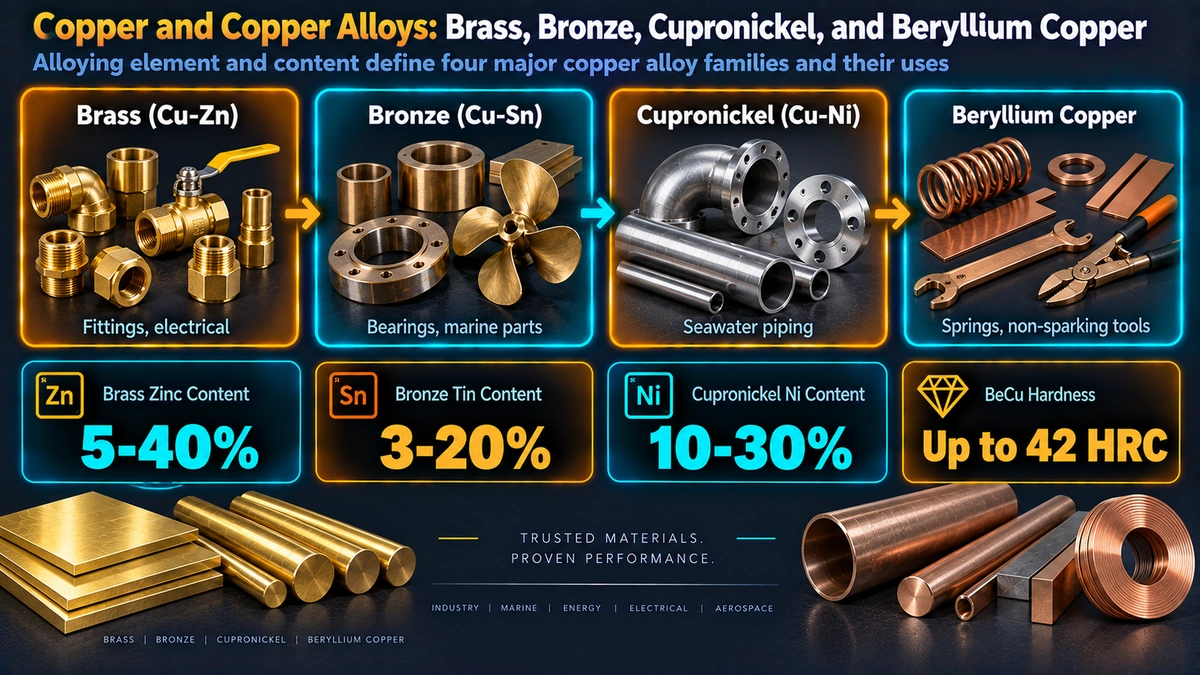
- Copper alloys are classified by their principal alloying element: zinc (brasses, C2xxxx), tin (bronzes, C5xxxx), nickel (cupronickels, C7xxxx), and beryllium (C17xxx); each group has a distinct phase diagram, microstructure, and property profile.
- Alpha brasses (<37% Zn, FCC single phase) are highly ductile and cold-formable; alpha-beta brasses (37–46% Zn) are stronger and hot-workable but less ductile; the beta phase is the preferentially attacked phase in dezincification.
- Dezincification of brasses with >15% Zn in chloride-containing water is prevented by adding 0.02–0.06% arsenic to produce dezincification-resistant (DZR) brass grades.
- Season cracking (stress corrosion cracking of alpha brass in ammonia environments) is prevented by stress relief annealing at 250–350°C after cold forming operations.
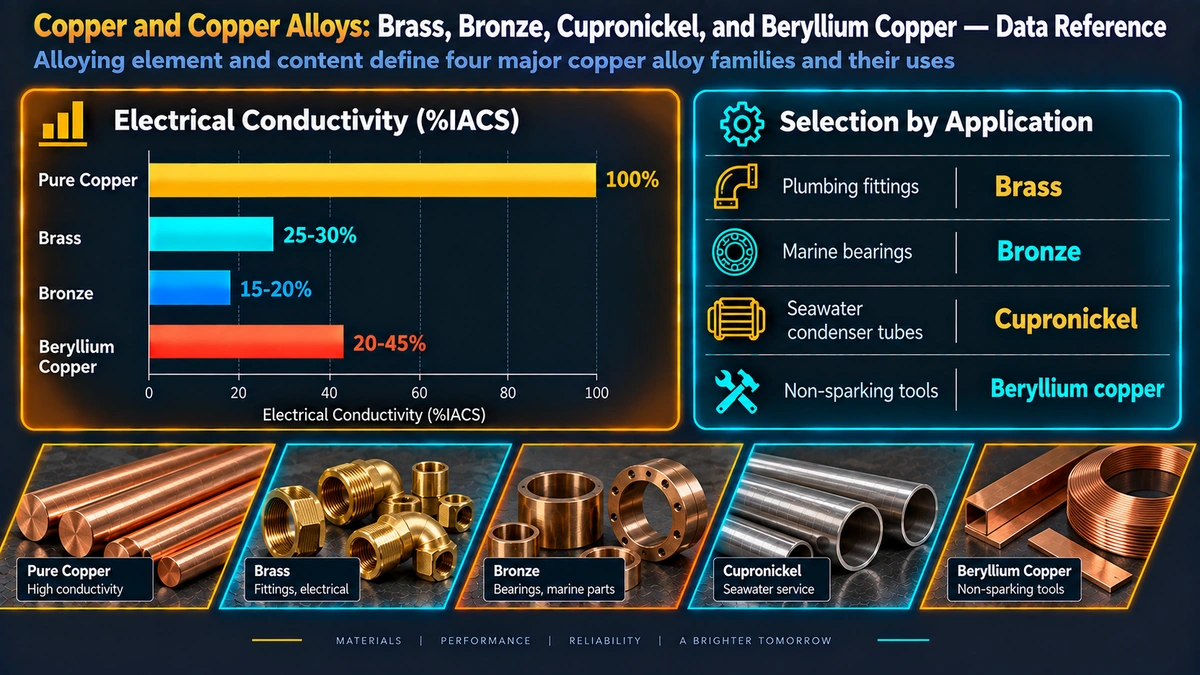
- Beryllium copper (C17200, 1.8% Be) achieves 1,200–1,400 MPa UTS after solution treatment and age hardening — the highest strength of any commercial copper alloy — while retaining 15–35% IACS electrical conductivity.
- 90/10 and 70/30 cupronickels are the materials of choice for seawater heat exchanger tubing: their protective Cu-Ni oxide film resists pitting, crevice corrosion, biofouling, and impingement attack at practical flow velocities.
Brass Dezincification Susceptibility Checker
Enter the nominal alloy composition to assess dezincification susceptibility and DZR arsenic requirement per ISO 6509 / BS EN 12165 criteria.
Copper: Crystal Structure, Conductivity, and Alloy Systems
Copper (Cu, atomic number 29) crystallises in the face-centred cubic (FCC) structure with a lattice parameter of 0.3615 nm. The FCC structure has no close-packed direction change with temperature (no allotropic transformation), meaning copper does not undergo the phase changes that make iron and steel heat-treatable through martensite formation. Instead, copper alloys derive their strength through solid solution hardening, work hardening, or — in select alloy systems — precipitation hardening. The high electron density of copper and its single conduction electron per atom give pure copper its exceptional electrical conductivity (58 MS/m, defined as 100% IACS) and thermal conductivity (385 W/m·K).
Alloying elements substitute for copper atoms in the FCC lattice (substitutional solid solution) or, in the case of very small atoms, occupy interstitial sites. Zinc, tin, and aluminium are the principal hardening solutes in commercial copper alloys; each causes lattice distortion that impedes dislocation motion, increasing strength at the cost of some conductivity. The UNS designation system (C10000–C99999) classifies wrought copper alloys by principal solute: C1xxxx coppers, C2xxxx brasses (Cu-Zn), C5xxxx phosphor bronzes (Cu-Sn-P), C6xxxx aluminium and silicon bronzes, C7xxxx cupronickels (Cu-Ni), and C8xxxx/C9xxxx cast alloys.
Brass: The Cu-Zn Alloy System
Brass is the generic name for copper-zinc alloys spanning 5–45% Zn. The Cu-Zn phase diagram (see SVG above) is the governing reference: below approximately 37% Zn, the alloy is fully alpha phase (FCC, single-phase solid solution); between 37% and 46% Zn, the duplex alpha+beta microstructure forms; above 46% Zn the alloy is predominantly beta. This phase structure boundary is the most important metallurgical variable in brass engineering because it determines formability, machinability, and dezincification susceptibility.
Alpha Brasses (<37% Zn)
Alpha brasses are completely single-phase FCC alloys. The absence of a second phase means they are highly ductile, capable of extreme cold reduction (up to 90% in drawing operations) without intermediate annealing, and have excellent resistance to dezincification. Hardness and strength increase progressively with zinc content; ductility remains excellent throughout the alpha field. Representative alpha brasses:
- Gilding metal (C21000, 5% Zn): Red-gold colour; used for coins, medals, architectural hardware. Essentially no dezincification risk.
- Red brass (C23000, 15% Zn): Plumbing tube and fittings in soft water; immune to dezincification at this Zn level.
- Cartridge brass (C26000, 30% Zn): The most widely used cold-working brass. Used for cartridge cases (hence the name), radiator cores, lamp sockets, and deep-drawn components. Excellent cold formability. Susceptible to season cracking from residual stress in ammonia environments; requires stress relief after forming. Dezincification susceptible in stagnant water without arsenic addition.
- Yellow brass (C27000, 35% Zn): Near the alpha/alpha-beta boundary; slightly higher strength, still alpha phase. Used for hardware, locks, and musical instruments.
Alpha-Beta (Duplex) Brasses (37–46% Zn)
The presence of beta phase (ordered BCC, CsCl-type structure) profoundly changes the alloy’s behaviour. The beta phase is harder but more brittle than alpha at room temperature, making extensive cold working difficult. However, at 700–800°C the beta phase disorders (beta to beta’ transition), becoming soft and ductile — making alpha-beta brasses excellent for hot forging, hot extrusion, and hot screw-machine operations. The beta phase also has a significantly higher zinc activity than alpha, making it preferentially attacked in dezincification.
- Muntz metal (C28000, 40% Zn): Hot-rolled plate and sheet for marine applications. Strong, economical. High dezincification risk unless DZR treatment applied.
- Free-cutting brass (C36000 / CW614N, 35.5% Zn, 3% Pb): The most widely machined copper alloy. Lead particles at grain boundaries act as chip-breakers, enabling extremely high machining speeds. Used for screw machine parts, fittings, and valve bodies. Lead content prevents welding. Dezincification susceptible — not suitable for potable water in many countries without DZR designation.
- Naval brass (C46400 / CW712R, 39% Zn, 0.75–1.0% Sn): Tin addition improves corrosion resistance in seawater; used for marine hardware, condenser plates, and desalination plant fittings.
- DZR brass (CW602N / CW724R, EN grades): Dezincification-resistant brass with 0.02–0.06% As addition. Arsenic inhibits the selective zinc dissolution mechanism by adsorbing on beta phase surfaces and blocking active dissolution sites. Mandated for potable water fittings in the UK (BS 6920 / WRAS approval) and most EU countries for applications above 15% Zn. The As content must be within a narrow window: too little provides no inhibition; too much can cause hydrogen embrittlement and impair hot formability.
Bronze: Phosphor, Aluminium, and Silicon Bronze
Phosphor Bronze (Cu-Sn-P)
Phosphor bronze alloys (C51000–C52400, 3.5–10% Sn, 0.03–0.35% P) exploit the excellent solid solution hardening effect of tin in copper. The Cu-Sn phase diagram shows a narrow alpha (FCC) phase field extending to approximately 15.8% Sn at the eutectoid temperature (586°C). Commercial alloys contain 3.5–10% Sn, well within the alpha field for good fabricability. Tin provides 2–3 times more solid solution strengthening per atom than zinc, giving phosphor bronze significantly higher strength and fatigue resistance than equivalent-zinc brasses.
Phosphorus additions (0.03–0.35%) serve primarily as a deoxidant during melting; residual P in solid solution further strengthens the alloy. In the cast condition, Sn segregates heavily during solidification, producing cored dendrites; homogenisation annealing at 600–700°C is required before working. Wrought spring temper phosphor bronze (C51000, 5% Sn) achieves 550–700 MPa UTS with excellent fatigue strength and low stress relaxation, making it the preferred material for precision electrical connector springs, waveguide flanges, and snap-action switches.
Aluminium Bronze (Cu-Al)
Aluminium bronzes (C60000–C64210, 5–11% Al with Fe, Ni, Mn additions) have the highest strength of the non-precipitation-hardenable copper alloys — up to 700–850 MPa UTS in the 9–11% Al grades — combined with excellent corrosion resistance in seawater, acids, and oxidising environments. The protective film is a dense Al2O3-rich oxide that re-passivates rapidly after mechanical damage. Nickel additions (4–5% Ni in C63000 “nickel-aluminium bronze”) create a more complex microstructure with retained beta phase and kappa precipitates that further improve corrosion resistance and cavitation resistance.
Nickel-aluminium bronze (NAB, C63000 / AB2) is the standard material for ship propellers, pump impellers, valve seats, and piping in seawater service. Its corrosion resistance in flowing seawater at velocities up to 8–10 m/s exceeds that of cupronickel, and its higher strength reduces weight. The key failure mode is selective phase attack of the beta phase in stagnant seawater, analogous to dezincification — prevented by PWHT (post-weld heat treatment) at 675°C for at least 6 hours to stabilise the microstructure.
Silicon Bronze (Cu-Si)
Silicon bronzes (C65100–C65500, 1.5–3.1% Si) combine good strength (350–500 MPa UTS), excellent weldability, and superior resistance to corrosion in fresh water, dilute acids, and organic compounds. Unlike brasses and aluminium bronzes, silicon bronze is readily weldable by GTAW without pre- or post-heat. It is used for marine hardware, chemical process vessels, and architectural applications requiring a combination of corrosion resistance and weldability. Its low dezincification risk (no zinc) and good appearance make it a preferred architectural hardware material.
Cupronickel: Marine and Heat Exchanger Alloys
Cupronickel alloys (C70600, Cu-10Ni; C71500, Cu-30Ni) are completely miscible across the entire Cu-Ni composition range — a continuous solid solution phase diagram with no miscibility gap — meaning both alloys are single-phase FCC microstructures with no second phases to selectively attack. This, combined with the synergistic corrosion resistance of both copper and nickel, produces exceptional behaviour in seawater environments.
Iron additions (0.5–1.5% Fe, mandatory in both 90/10 and 70/30 grades) are critical: iron refines the grain structure and, more importantly, concentrates in the protective oxide film at the metal surface, dramatically improving the film’s stability and adhesion. Alloys without adequate iron (below ~0.4% Fe) show significantly inferior seawater corrosion resistance. Manganese (0.5–1.0%) deoxidises the melt and improves hot workability.
| Alloy | UNS / EN | UTS (MPa) | Max Flow Velocity (m/s) | Pitting Resistance | Typical Application |
|---|---|---|---|---|---|
| 90/10 Cupronickel | C70600 / CW352H | 280–380 | 3.0 | Excellent | Naval HX tubes, seawater piping, desalination |
| 70/30 Cupronickel | C71500 / CW354H | 350–480 | 4.5 | Superior | Offshore HX, high-velocity service, naval vessels |
| Cu-30Ni-2Fe-2Mn (716) | C71640 | 380–520 | 5.0 | Superior | Titanium-replacement in aggressive seawater |
Beryllium Copper: Precipitation Hardening to 1,400 MPa
Beryllium copper alloys (C17200 / CW101C, 1.8–2.0% Be; C17500, 0.4–0.7% Be / 2.4–2.7% Co) are the highest-strength commercial copper alloys, achieving mechanical properties that overlap with high-strength steel while retaining 15–35% IACS electrical conductivity. This unique combination is possible because precipitation hardening operates through a different mechanism from solid solution hardening: the coherency strains and obstacle density from nanoscale beryllide precipitates can provide very large strength increments without proportionally reducing conductivity.
Heat Treatment and Precipitation Hardening Mechanism
BeCu heat treatment sequence (C17200 / CW101C):

Step 1 — Solution treatment (ST):
  Temperature: 760–800°C (below solidus, above Be solvus)
  Atmosphere:  Nitrogen or vacuum (prevent surface oxidation)
  Time:        15–45 min (section-dependent)
  Quench:      Water quench (rapid) to retain Be in solid solution
  Result:      Supersaturated FCC solid solution, soft (~200 HV)

Step 2 — Age hardening (precipitation hardening):
  Temperature: 310–330°C (peak age for C17200)
              260–280°C (peak age for high-conductivity C17500)
  Time:        2–3 hours (peak)
  Result:      Coherent γ" (Cu₂Be) precipitates form at {100} planes
              Dislocation pinning by coherency strain + obstacle density
              Peak: ~400 HV, UTS 1,200–1,400 MPa, 15–20% IACS

Over-aging (above 360°C or extended time):
  γ" transforms to incoherent equilibrium CuBe phase
  Hardness and strength decrease; conductivity increases slightly
  Avoid for structural applications; used for high-conductivity grades
The beryllium solvus line in the Cu-Be binary diagram passes from approximately 2% Be at 866°C to <0.2% Be at 300°C, providing a large driving force for precipitation over the practical ageing temperature range. The precipitation sequence on ageing follows: supersaturated solid solution → GP zones (coherent Be clusters on {100} planes) → metastable γ″ (coherent, maximum hardening) → incoherent CuBe equilibrium phase (over-aged, declining hardness).
Copper Alloy Family Quick-Reference
Corrosion of Copper Alloys: Dezincification, Season Cracking, and Impingement Attack
Dezincification
Dezincification is the dominant corrosion failure mode for alpha-beta brasses in water service. The porous copper sponge left by dezincification retains the original fitting dimensions and appearance — making it invisible without NDT — but has essentially zero structural integrity. A 22 mm compression fitting that looks intact can be perforated or crushed by hand if dezincification has converted the full wall thickness. The ISO 6509 accelerated test and the field assessment methods described in BS EN 12165/12164 are mandatory quality checks for fittings in potable water applications. For the electrochemical fundamentals governing dezincification as selective phase corrosion, see the corrosion mechanisms and pitting corrosion articles.
Season Cracking (Stress Corrosion Cracking)
Season cracking — the stress corrosion cracking of alpha brass in ammonia or amine-containing environments — remains a significant failure risk for cold-formed components in industrial, agricultural, and refrigeration environments where ammonia is present. The critical variables are zinc content (above 15% Zn significantly increases susceptibility), residual stress level (typically from cold drawing, deep drawing, or cold heading), and ammonia concentration. Even trace ammonia from cleaning agents, refrigerant leaks, or biological decomposition can initiate cracking in highly stressed components. Prevention by stress-relief annealing (250–350°C, 30–60 minutes) is effective and inexpensive; it is good practice to specify stress relief for all cold-formed brass components going into service in potentially ammonia-containing environments. This is analogous to the hydrogen-assisted cold cracking risk in high-CE steels discussed in the MetallurgyZone article on hydrogen-induced cracking.
Impingement Attack and Erosion-Corrosion
The protective film on copper alloys is soft and has limited resistance to mechanical disruption by high-velocity turbulent flow, entrained air, or abrasive particles. Once the film is disrupted faster than it can reform, bare metal is continuously exposed and corrosion accelerates dramatically. Maximum flow velocities for heat exchanger tube materials: admiralty brass ~1.5 m/s; 90/10 cupronickel ~3.0 m/s; 70/30 cupronickel ~4.5 m/s; nickel-aluminium bronze ~8 m/s; titanium — essentially immune. For the broader principles of erosion-corrosion in engineering systems, see the MetallurgyZone article on corrosion mechanisms.
Mechanical Properties Reference Table
| Alloy | UNS | Condition | UTS (MPa) | 0.2% YS (MPa) | Elong. (%) | Hardness | Conductivity (% IACS) |
|---|---|---|---|---|---|---|---|
| ETP Copper | C11000 | Annealed | 220 | 70 | 45 | 40 HRF | 101 |
| ETP Copper | C11000 | Hard drawn | 340 | 310 | 4 | 90 HRF | 98 |
| Cartridge Brass | C26000 | Annealed | 330 | 110 | 68 | 53 HRB | 28 |
| Cartridge Brass | C26000 | H (hard) | 615 | 530 | 8 | 80 HRB | 26 |
| Muntz Metal | C28000 | Annealed | 380 | 140 | 45 | 55 HRB | 27 |
| Free-cutting Brass | C36000 | H (half-hard) | 470 | 380 | 18 | 70 HRB | 26 |
| Phosphor Bronze | C51000 | Annealed | 345 | 130 | 64 | 57 HRB | 15 |
| Phosphor Bronze | C51000 | H (hard) | 700 | 640 | 5 | 97 HRB | 13 |
| Al Bronze (Ni-Al) | C63000 | As extruded | 655 | 310 | 20 | 88 HRB | 7 |
| 90/10 Cupronickel | C70600 | Annealed | 300 | 110 | 36 | 60 HRF | 9 |
| 70/30 Cupronickel | C71500 | Annealed | 380 | 140 | 36 | 75 HRF | 5 |
| Beryllium Copper | C17200 | ST (solution treated) | 500 | 200 | 35 | 65 HRB | 22 |
| Beryllium Copper | C17200 | AT (peak aged) | 1,350 | 1,140 | 2 | 40 HRC | 22 |
Dezincification Failure in a Potable Water Distribution System
A UK water authority received reports of discoloured water (brown, copperish tint) and pin-hole leaks in a residential estate fitted with 22 mm and 15 mm compression fittings installed five years previously. Investigation revealed the fittings were manufactured from free-cutting brass (CW614N, Cu-37Zn-3Pb) — a standard specification for the era but not conforming to current WRAS approval requirements for dezincification resistance.
Failure analysis: Cross-sections cut from failed fittings showed uniform dezincification penetrating to full wall thickness (3.5–4.0 mm) in approximately 60% of fittings examined. The porous copper zone had compressive strength near zero; hand pressure could crumble the dezincified layer. The supply water had chloride content of 85–120 mg/L and pH 7.1–7.5 at 55–65°C (hot water circuit) — conditions well established as aggressive for non-DZR brasses. ISO 6509 test of retained stock confirmed dezincification depth >800 μm, far exceeding the 200 μm maximum for DZR compliance.
Remediation: Full replacement of approximately 3,400 fittings with CW602N DZR brass (0.04% As, ISO 6509 compliant, WRAS approved). Residual impact: legal liability for property damage, reputational cost to the installer, and material/labour cost approximately 12× the original fitting material cost. Lesson: the marginal additional cost of DZR brass (<5–8% over standard brass) is negligible compared to the failure cost. Always specify WRAS-approved DZR for any potable water application above 15% Zn.
Industrial Applications by Sector
Electrical and Electronics
ETP copper (C11000) and oxygen-free copper (OFHC, C10200) dominate electrical conductors, bus bars, and transformer windings where conductivity is the primary design criterion. Beryllium copper (C17200) is specified for high-performance spring contacts, edge card connectors, and precision relay blades where the combination of high spring force, low creep, and 15–22% IACS conductivity cannot be matched by any other copper alloy or by spring steel (which has near-zero conductivity). Phosphor bronze (C51000) is the standard for lower-force connectors where full BeCu strength is unnecessary.
Marine and Offshore
90/10 cupronickel (C70600) is the material of choice for seawater condenser and heat exchanger tubing in naval vessels, offshore platforms, and desalination plants. Its combination of good corrosion resistance, excellent biofouling resistance (copper ion release inhibits barnacle and mussel attachment), and adequate flow velocity tolerance up to 3 m/s makes it operationally superior to most alternatives for long-term unmaintained service. Nickel-aluminium bronze (C63000) is used for propeller blades, sea valves, and pump impellers where the higher strength and cavitation resistance of NAB are required. For seawater system design, see the MetallurgyZone articles on pitting corrosion and cathodic protection.
Plumbing and Potable Water
DZR brass (CW602N/CW724R) is mandated for all brass fittings >15% Zn in potable water systems in the UK (WRAS approval), across EU member states (EN 12164/12165 DZR grade requirement), and in most other jurisdictions with modern plumbing codes. Red brass (C23000, 15% Zn) and silicon bronze are used where dezincification immunity is required without arsenic additions. Cast gunmetal (Cu-Sn-Zn, CC491K) is the traditional material for gate valves and globe valves in water distribution.
Frequently Asked Questions
What is dezincification and which brasses are susceptible?
What is season cracking in brass?
What is the difference between alpha brass and beta brass?
How is beryllium copper hardened and what are its key properties?
Why are 90/10 and 70/30 cupronickel used for seawater heat exchangers?
What is phosphor bronze and what makes it suitable for springs?
What is the UNS designation system for copper alloys?
What is impingement attack in copper alloys and how is it prevented?
Recommended Reference Books
ASM Specialty Handbook: Copper and Copper Alloys
The definitive ASM reference for all copper alloy families: compositions, microstructures, properties, corrosion data, fabrication, and applications. Essential for any materials engineer working with copper alloys.
View on AmazonCopper and Copper Alloys (Copper Development Association)
CDA publication covering the full family of copper alloys: brasses, bronzes, cupronickels, BeCu — compositions, properties, corrosion, and selection guidelines for engineering applications.
View on AmazonPhysical Metallurgy — Cahn & Haasen (4th ed.)
Graduate-level physical metallurgy covering non-ferrous phase diagrams including Cu-Zn, Cu-Sn, Cu-Be, precipitation hardening theory, and deformation mechanisms across all alloy systems.
View on AmazonCorrosion Engineering — Fontana & Greene (3rd ed.)
Classic corrosion engineering text covering dezincification, season cracking, impingement attack, and galvanic corrosion of copper alloys in service environments. Fundamental reference for corrosion engineers.
View on AmazonDisclosure: MetallurgyZone participates in the Amazon Associates programme. If you purchase through these links, we may earn a small commission at no extra cost to you. This helps support free technical content on this site.
References
- ASM Specialty Handbook: Copper and Copper Alloys. ASM International, 2001.
- ISO 6509-1:2019: Corrosion of Metals and Alloys — Determination of Dezincification Resistance of Copper Alloys with Zinc. ISO.
- BS EN 12165:2016: Copper and Copper Alloys — Wrought and Unwrought Forging Stock. BSI.
- ASTM B111: Standard Specification for Copper and Copper-Alloy Seamless Condenser Tubes and Ferrule Stock. ASTM International.
- ASTM B171: Standard Specification for Copper-Alloy Plate and Sheet for Pressure Vessels, Condensers, and Heat Exchangers. ASTM International.
- Copper Development Association (CDA), Copper Alloys for Marine Environments. Publication TN 41. CDA, 2000.
- Campbell, F.C. (ed.), Elements of Metallurgy and Engineering Alloys. ASM International, 2008.
- WRAS: Water Regulations Advisory Scheme, Approval Requirements for Plumbing Products. WRAS, 2019.
Further Reading
Corrosion Mechanisms
Electrochemical cells, galvanic series, Pourbaix diagrams, and the thermodynamic basis of dezincification and SCC.
Pitting Corrosion
Passive film breakdown and localised corrosion — mechanism parallels relevant to brass and cupronickel in chloride service.
Cathodic Protection Offshore
Galvanic coupling of copper alloys to steel structures and CP design for mixed-material marine systems.
Hydrogen-Induced Cracking
Stress corrosion cracking mechanisms analogous to brass season cracking — susceptibility, prevention, and testing.
Grain Boundaries and Segregation
Grain boundary segregation effects relevant to dezincification initiation and SCC crack path selection.
Hardness Testing Methods
Vickers, Rockwell F/B/C, and Brinell hardness scales used across the full copper alloy hardness range.
Charpy Impact Testing
Impact toughness characterisation of BeCu, aluminium bronze, and other high-strength copper alloys.
Materials Calculators
Metal weight, galvanic corrosion risk, and other calculators for copper alloy engineering applications.
