Nickel Alloys: Inconel, Hastelloy, Monel, and Superalloy Selection Guide
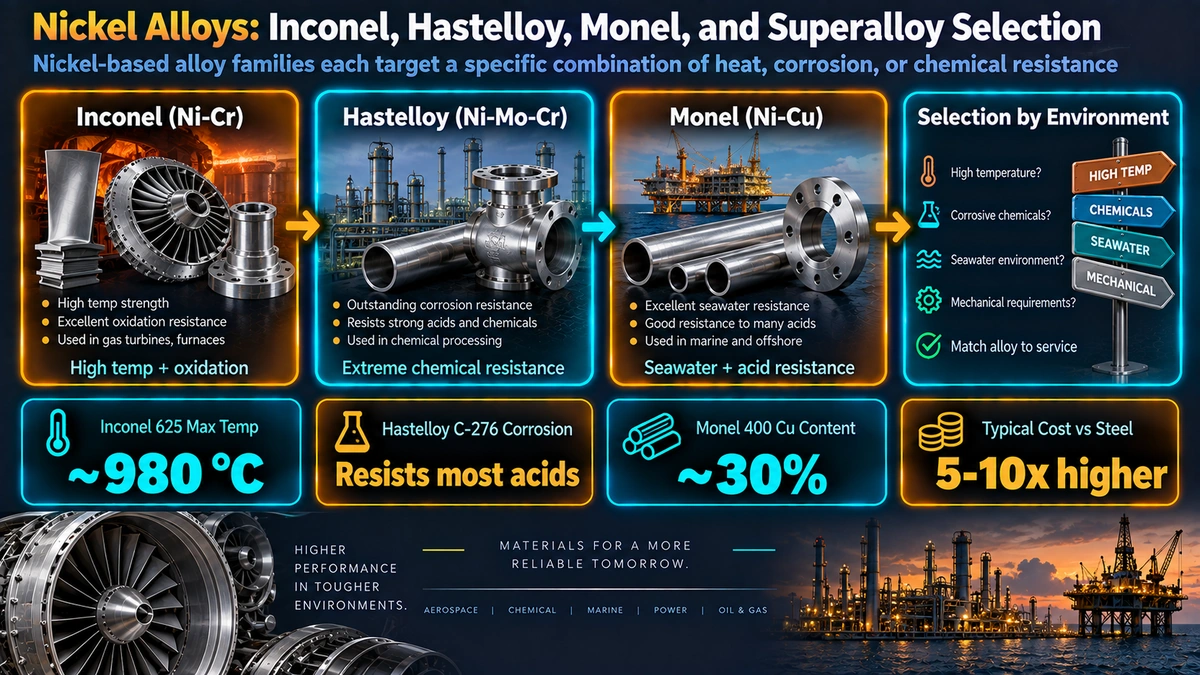
Nickel and its alloys occupy the apex of the engineering materials hierarchy — deployed where no other metallic system can simultaneously deliver oxidation resistance above 900°C, immunity to chloride-induced stress corrosion cracking, resistance to reducing mineral acids, and the mechanical strength to carry structural loads. From gas turbine discs sustaining 1,000 MPa centrifugal stress at 700°C to subsea flexible risers resisting seawater corrosion at 3,000 m depth, the breadth of nickel alloy applications reflects a metallurgical versatility unmatched by any other elemental base. This article provides a rigorous technical guide to all major nickel alloy families: their compositions, strengthening mechanisms, corrosion behaviour, welding metallurgy, and engineering selection logic.
Key Takeaways
- Nickel’s stable FCC crystal structure (no allotropic transformation), wide solid solubility for alloying elements, and natural corrosion resistance make it uniquely suited as a base for both high-temperature and corrosion-resistant engineering alloys.
- The six principal alloy families are: solid-solution CRAs (Hastelloy, Alloy 625), Monel (Ni-Cu), Incoloy (Ni-Fe-Cr), precipitation-hardened alloys (Inconel 718, 725, Waspaloy), directionally solidified and single-crystal superalloys, and oxide-dispersion-strengthened (ODS) alloys.
- Chromium provides oxidation resistance via Cr2O3; molybdenum provides resistance to reducing acids and pitting; aluminium + titanium form the γ′ (Ni3Al,Ti) precipitate that gives superalloys their exceptional high-temperature strength.
- Inconel 625 (solid-solution, excellent weldability) and Inconel 718 (precipitation-hardened, highest strength) are not interchangeable — they serve fundamentally different design requirements.
- NACE MR0175/ISO 15156 governs the selection and condition of nickel alloys for sour (H2S-containing) oil and gas service; hardness limits are strictly enforced to prevent sulphide stress cracking.
- Welding of precipitation-hardened nickel alloys requires careful control of heat input and PWHT heating rate to avoid strain-age cracking (SAC) in the HAZ.
Why Nickel? Fundamental Metallurgy
Nickel (Ni, atomic number 28) crystallises in the face-centred cubic (FCC) structure, which is thermodynamically stable from absolute zero to its melting point at 1,455°C. This single fact is of profound engineering significance: unlike iron, which undergoes the BCC-to-FCC (α-to-γ) transformation at 912°C and back on cooling, nickel experiences no allotropic transition. The FCC structure has 12 equivalent {111}<110> slip systems, giving excellent room-temperature ductility and, critically, maintaining toughness at cryogenic temperatures without the ductile-to-brittle transition that afflicts BCC ferritic steels.
The FCC lattice also accommodates large quantities of substitutional alloying elements without phase instability. Chromium (atomic radius 1.28 Å), molybdenum (1.39 Å), cobalt (1.25 Å), tungsten (1.40 Å), and iron (1.26 Å) all dissolve extensively in the nickel matrix (1.25 Å), enabling the vast compositional range of commercial alloys. Aluminium (1.43 Å) and titanium (1.47 Å) are less soluble and partition preferentially to the ordered γ′ precipitate, providing the primary strengthening phase in superalloys.
Nickel’s corrosion resistance derives from its position in the electrochemical series (E° = −0.25 V vs SHE) — more noble than iron (−0.44 V) — combined with the powerful protective effect of the chromium oxide (Cr2O3) passive film formed when Cr ≥ 10–12% is present. This film is stable across a wide potential range and regenerates after mechanical damage, providing the foundation for corrosion resistance in both oxidising and neutral environments.
Alloy Family 1: Solid-Solution Nickel-Chromium-Molybdenum Alloys
The Ni-Cr-Mo family — commercially known as Hastelloy (Haynes International), Inconel 625 (Special Metals), and Alloy 22 (Haynes) — derives its properties entirely from solid-solution strengthening and the chemistry of its passive film. There is no precipitation reaction and no phase transformation exploited for hardening; these alloys are used in the annealed condition throughout their service life.
Alloy 625 (UNS N06625 / Inconel 625)
Alloy 625 is the workhorse of the offshore, subsea, and chemical process industries. Its nominal composition is 58% Ni min, 20–23% Cr, 8–10% Mo, 3.15–4.15% Nb+Ta, ≤5% Fe, ≤0.10% C. Chromium provides oxidation resistance and general corrosion resistance; molybdenum provides pitting resistance and resistance to reducing acids; niobium provides solid-solution strengthening (atomic misfit with the Ni matrix creates lattice strain fields that impede dislocation motion) and stabilises the microstructure against sensitisation.
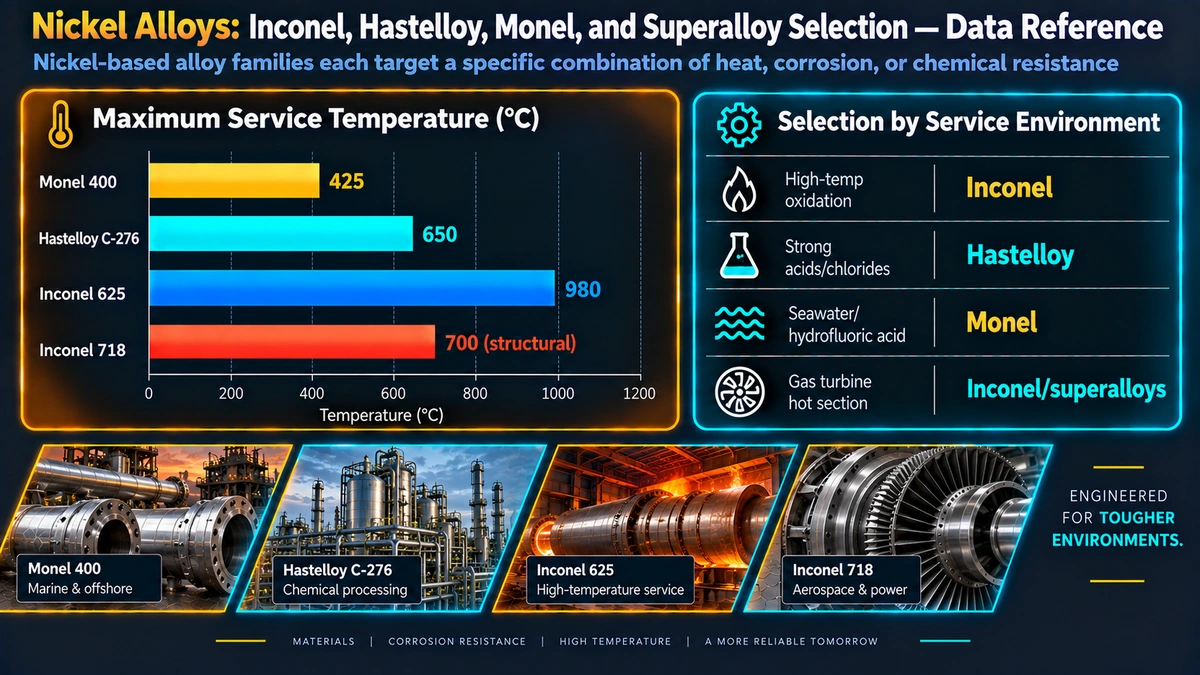
The pitting resistance equivalent number (PREN = Cr + 3.3Mo + 16N) for Alloy 625 is approximately 50–55, far above the 40 PREN threshold for use in seawater. The alloy is immune to chloride-induced stress corrosion cracking (SCC) — a critical failure mode for austenitic stainless steels in hot, concentrated chloride environments. It resists attack by phosphoric acid (all concentrations), dilute sulphuric acid, dilute hydrochloric acid, and mixed acid systems. Its primary limitations are in concentrated reducing acids (where Alloy C-276 or B-3 outperforms it) and in oxidising mineral acids above moderate concentrations.
Weldability is excellent: Alloy 625 is not susceptible to HAZ liquation cracking or strain-age cracking because there is no precipitation strengthening phase. AWS ERNiCrMo-3 filler metal is specified for welding. The alloy is also the most widely used weld overlay cladding material for carbon steel pressure vessels in aggressive chemical service and subsea applications.
Hastelloy C-276 (UNS N10276)
C-276 represents the pinnacle of solid-solution corrosion resistance in the Ni-Cr-Mo system, achieved by pushing Mo to its maximum practical solubility: 15–17% Cr, 15–17% Mo, 3–4.5% W, ≤0.01% C, ≤0.08% Si. The combination of 16% Mo (nominal) and 4% W gives PREN >70 and essentially universal corrosion resistance in both oxidising and reducing environments. The ultra-low carbon and silicon contents eliminate sensitisation at weld HAZs without requiring post-weld solution annealing, a significant advantage over earlier C-family alloys (C and C-4). C-276 is resistant to wet chlorine, hydrochloric acid, sulphuric acid (most concentrations), phosphoric acid, acetic acid, and concentrated mixed acid streams encountered in chemical processing, FGD (flue gas desulphurisation) scrubbers, and pharmaceutical manufacture.
Hastelloy C-22 (UNS N06022) and C-2000 (UNS N06200)
C-22 contains 20–22.5% Cr (higher than C-276), 12.5–14.5% Mo, and 2.5–3.5% W, providing a better balance between oxidising and reducing corrosion resistance. The higher chromium level improves performance in oxidising acids (nitric acid, mixtures of nitric + hydrochloric) where C-276 is less optimal. C-2000 adds 1.3–1.9% Cu to its composition, specifically to improve resistance to sulphuric acid across all concentrations — a niche that is otherwise challenging to fill with a single alloy. These alloys are used in mixed-service chemical plant and pharmaceutical equipment where the process stream composition varies.
Hastelloy B-3 (UNS N10675)
Hastelloy B-3 is a nickel-molybdenum (no chromium) alloy: 65% Ni, 28.5% Mo, 1.5% Cr, with tight control on Fe, Co, Mn, and Si. The absence of chromium means B-3 has no passive film to protect it in oxidising environments — it must not be exposed to oxidising media including dissolved oxygen, ferric or cupric ions, or nitric acid. However, in pure reducing environments, particularly hydrochloric acid at all concentrations and temperatures including boiling, B-3 is the most resistant engineering alloy available. B-3 replaced the earlier B-2 alloy by improving stability against thermal decomposition in the 900–1,100°F (480–595°C) range, which had caused premature embrittlement in B-2 during fabrication heat treatments.
| Alloy (UNS) | Ni% | Cr% | Mo% | Other | PREN (approx) | Key service environments |
|---|---|---|---|---|---|---|
| Alloy 625 (N06625) | ≥58 | 20–23 | 8–10 | 3.15–4.15 Nb | ≈ 52 | Seawater, chlorides, subsea, weld overlay |
| C-276 (N10276) | bal. | 14.5–16.5 | 15–17 | 3–4.5 W | ≈ 73 | HCl, H2SO4, wet Cl2, FGD |
| C-22 (N06022) | bal. | 20–22.5 | 12.5–14.5 | 2.5–3.5 W | ≈ 67 | Mixed oxidising-reducing; HNO3+HCl |
| C-2000 (N06200) | bal. | 22–24 | 15–17 | 1.3–1.9 Cu | ≈ 75 | H2SO4 all concentrations |
| B-3 (N10675) | ≥65 | 1–3 | 27–32 | Low Fe, Co, Mn | N/A (no passive film) | Pure HCl (all conc.), acetic acid |
| G-30 (N06030) | bal. | 28–31.5 | 4–6 | 1.5–4 W, 1.5–4 Cu | ≈ 43 | Phosphoric acid, fertiliser plant |
Alloy Family 2: Monel (Nickel-Copper Alloys)
Monel alloys are nickel-copper solid solutions, commercially introduced by the International Nickel Company (INCO) and named after INCO president Ambrose Monell. The Ni-Cu binary system is fully miscible across all compositions, and commercial Monel compositions cluster around 63–70% Ni, 28–34% Cu, with small additions of Fe, Mn, Si, and Al.
Monel 400 (UNS N04400)
Monel 400 is the baseline alloy: 63–70% Ni, 28–34% Cu, ≤2.5% Fe, ≤2.0% Mn. Its corrosion resistance is exceptional in seawater (particularly in flowing seawater where the protective film is maintained — stagnant conditions promote crevice corrosion), hydrofluoric acid (all concentrations up to boiling, a unique property among structural alloys), alkaline solutions, and neutral reducing salts. The alloy was historically essential for HF alkylation units in petroleum refining, where carbon steel corrodes rapidly and most other alloys are unsatisfactory. Monel 400 is NOT resistant to oxidising acids (nitric, chromic acid), ammonia with moisture (which causes SCC), or moist, aerated chlorine gas above ambient temperature.
Monel K-500 (UNS N05500)
K-500 adds 2.30–3.15% Al and 0.35–0.85% Ti to Monel 400, enabling precipitation hardening by the γ′ phase (Ni3(Al,Ti)) in the same manner as nickel superalloys. After age hardening at 525–593°C, K-500 achieves yield strength of 690–760 MPa compared with 170–310 MPa for annealed Monel 400. The alloy is non-magnetic (important for minesweeper shafting) and has excellent resistance to HF acid. It is the standard material for pump shafts, valve stems, and propeller shafts in marine and offshore service requiring both corrosion resistance and high strength. It is, however, susceptible to SCC in moist, aerated chloride environments under high stress, particularly if surface tensile residual stresses from machining are not addressed by controlled surface treatment.
Alloy Family 3: Incoloy (Nickel-Iron-Chromium Alloys)
Incoloy alloys are nickel-iron-chromium alloys occupying the composition space between austenitic stainless steels (low Ni, high Fe) and solid-solution nickel alloys (high Ni, low Fe). The higher iron content reduces cost relative to the pure Ni-Cr-Mo alloys while still providing substantially better corrosion resistance than the 300-series stainless steels, particularly against chloride SCC.
Incoloy 825 (UNS N08825)
Alloy 825 (38–46% Ni, 19.5–23.5% Cr, 2.5–3.5% Mo, 1.5–3.0% Cu, 0.6–1.2% Ti, balance Fe) is one of the most widely specified alloys in the NACE MR0175 approved materials list for sour oil and gas service. It resists both sulphide stress cracking (SSC) and stress corrosion cracking in H2S-containing environments through its combination of high nickel content (which suppresses hydrogen absorption and SSC susceptibility) and its passive film chemistry. The titanium addition stabilises the alloy against sensitisation in the HAZ during welding. Alloy 825 is extensively used for downhole tubing, wellhead fittings, heat exchanger tubing in refinery service, and chemical plant handling phosphoric and sulphuric acids.
Incoloy 800H and 800HT (UNS N08810, N08811)
The 800-series alloys (32–38% Ni, 19–23% Cr, balance Fe, with controlled C and Al+Ti additions) are designed for elevated-temperature oxidation and carburisation resistance, not primarily for aqueous corrosion resistance. Alloy 800H/HT is used extensively in steam reforming furnace tubes, ethylene cracking coils, and petrochemical heater radiant section tubes operating at 750–1,000°C. The controlled carbon content (0.06–0.10% for 800H) ensures adequate creep strength through stable M23C6 carbide precipitation at grain boundaries, while avoiding excessive grain boundary embrittlement. The controlled Al+Ti (Al+Ti = 0.85–1.20% for 800HT) provides some solid-solution strengthening and minor γ′ contribution. These alloys bridge the gap between stainless steels and the fully austenitic nickel alloys for elevated-temperature service.
Incoloy 925 (UNS N09925)
Alloy 925 (38–46% Ni, 19.5–23.5% Cr, 2.5–3.5% Mo, 1.5–3.0% Cu, 2.0–2.8% Ti, 0.1–0.5% Al, balance Fe) is the precipitation-hardened counterpart to Alloy 825. By raising Ti to 2.0–2.8% and adding Al, it enables γ′ age hardening that doubles the yield strength to 690–793 MPa relative to annealed Alloy 825 (≈310 MPa). It is approved in NACE MR0175/ISO 15156 Part 3 for sour service and is used for high-strength corrosion-resistant downhole completion hardware, wellhead components, and surface safety valves.
Alloy Family 4: Precipitation-Hardened Nickel Alloys
Precipitation hardening in nickel alloys exploits the formation of coherent ordered precipitates within the FCC matrix. Three distinct precipitate phases are exploited commercially:
γ′ (gamma prime): Ni₃(Al,Ti)  — Ordered L1₂ structure (ordered FCC)
   Coherent with γ matrix; {100} cube faces
   Mismatch δ = (a_γ′ - a_γ) / a_γ = typically −0.1 to +0.5%
   Anomalous strength increase with temperature (to ≈750°C)
   Found in: Waspaloy, René 41, Udimet 700/720, single-crystal alloys

γ′′ (gamma double-prime): Ni₃Nb  — Ordered D0₂ₐ structure (BCT, disc-shaped)
   Precipitates on {001} planes of γ matrix
   Metastable; converts to δ (orthorhombic Ni₃Nb) above ≈650°C
   Primary strengthener in: Inconel 718, Inconel 706
   Provides high strength at intermediate temperatures (≤650°C)

η (eta): Ni₃Ti  — D0₂₄ structure (HCP-derived)
   Forms needles/Widmanstätten morphology on overaging
   Generally detrimental to ductility; controlled to avoid

δ (delta): Ni₃Nb  — Orthorhombic (stable form of γ′′ above 650°C)
   Used deliberately in 718 to pin grain boundaries
   Fine δ at grain boundaries improves creep rupture strength
Inconel 718 (UNS N07718)
Inconel 718 is the most widely produced nickel superalloy by tonnage, accounting for approximately 30–35% of all superalloy production. Its nominal composition: 50–55% Ni, 17–21% Cr, 4.75–5.50% Nb+Ta, 2.80–3.30% Mo, 0.65–1.15% Ti, 0.20–0.80% Al, 17–21% Fe. The primary strengthening comes from γ′′ (Ni3Nb), with a secondary contribution from γ′ (Ni3Al,Ti). After a standard two-step ageing treatment (720°C/8 h + 621°C/8 h), typical properties are:
| Property | Typical Value (bar/forging, aged) | Standard |
|---|---|---|
| 0.2% Proof strength (Rp0.2) | 1,035–1,100 MPa | AMS 5662 / ASTM B637 |
| Ultimate tensile strength | 1,240–1,310 MPa | AMS 5662 |
| Elongation | 12–18% | |
| Reduction of area | 15–20% | |
| Hardness | 36–42 HRC | |
| Stress rupture (650°C / 621 MPa) | ≥23 h (min) | AMS 5662 |
| Charpy impact (room temp) | 35–70 J |
The critical limitation of Inconel 718 is the thermal instability of γ′′ above approximately 650°C. On long-term exposure, γ′′ transforms to the equilibrium δ phase (Ni3Nb, orthorhombic), which has minimal coherency with the matrix and does not contribute to strengthening. This limits 718 to applications below approximately 650°C for long-term structural service. The Laves phase — (Ni,Cr,Fe)2(Nb,Mo,Ti) — segregates to interdendritic regions during solidification and must be dissolved by homogenisation heat treatment (1,065–1,093°C) before forging and ageing. Laves phase remnants reduce ductility and impact toughness and provide preferential crack initiation sites.
Inconel 725 (UNS N07725)
Alloy 725 is a modified 825 composition with increased Ti (1.0–1.7%) and Nb (2.75–4.0%) to enable γ′′ precipitation hardening while maintaining the excellent aqueous corrosion resistance of 825. After ageing, it achieves yield strength of 793–896 MPa — lower than 718 but with better corrosion resistance in sour service. NACE MR0175 Part 3 approves Alloy 725 for downhole completion equipment. It is the preferred choice when both high strength and sour service corrosion resistance are required, and where 718 lacks the required NACE approval at the hardness level needed.
Waspaloy (UNS N07001) and René 41 (UNS N07041)
Waspaloy (57% Ni, 19.5% Cr, 13.5% Co, 4.3% Mo, 3.0% Ti, 1.4% Al) and René 41 (55% Ni, 19% Cr, 11% Co, 10% Mo, 3.1% Ti, 1.5% Al) are polycrystalline wrought superalloys used for gas turbine discs, casings, and rings operating above 700°C. Both are γ′-strengthened and contain cobalt, which reduces the stacking fault energy of the matrix (impeding cross-slip and improving creep resistance) and increases the γ′ solvus temperature. These alloys are significantly more susceptible to strain-age cracking than Inconel 718 due to their higher Al+Ti content and faster γ′ precipitation kinetics. Welding procedures for Waspaloy require solution annealing before PWHT, carefully controlled heating rates through the precipitation range, and pre-heating to reduce weld residual stresses.
Alloy Family 5: Directionally Solidified and Single-Crystal Superalloys
Conventional investment-cast polycrystalline turbine blades contain grain boundaries that are the weakest link at high temperature: voids nucleate at grain boundaries under creep loading; oxidising gases penetrate preferentially along them; and any boundary not perpendicular to the principal stress direction contributes a grain-boundary sliding component to creep strain. Directional solidification (DS) aligns all grain boundaries parallel to the blade axis (the principal stress direction), eliminating transverse boundaries. Single-crystal (SX) casting eliminates grain boundaries entirely.
SX alloys achieve this by removing the grain-boundary strengtheners (carbon, boron, zirconium, hafnium) that would cause grain-boundary liquid films and interfere with crystal growth, and by increasing the refractory element content (W, Re, Ru) for solid-solution creep resistance. Rhenium additions (3% in second-generation, 6% in third-generation alloys) are particularly powerful: Re segregates to the γ matrix channels between γ′ precipitates, reduces the rate of γ′ coarsening (rafting) under creep loading, and substantially extends creep rupture life.
Generation  Alloy      Ni    Cr   Co   Mo   W    Re   Al   Ti   Ta   Hf
1st         PWA 1480   bal.  10   5    —    4    —    5    1.5  12   —
1st         René N4    bal.  9    8    2    6    —    3.7  4.2  4    —
2nd         CMSX-4     bal.  6.5  9    0.6  6    3    5.6  1    6.5  0.1
2nd         René N5    bal.  7    8    2    5    3    6.2  —    7    0.15
3rd         CMSX-10    bal.  2    3    0.4  5    6    5.7  0.2  8    0.03
3rd         René N6    bal.  4.2  12.5 1.4  5.8  5.4  5.75 —    7.2  0.15

Re-free:    TMS-82+    bal.  5    10   2    8.7  —    5.3  0.5  6    0.1
            (4th gen. equivalent, uses Ru instead)
The operating temperature advantage of SX over equiaxed castings is approximately 100–150°C for the same creep life — allowing the engine designer to increase turbine entry temperature (TET) and thereby improve thermal efficiency. Combined with internal cooling channels and thermal barrier coatings (TBCs) of 7% yttria-stabilised zirconia (7YSZ), modern SX blades sustain metal temperatures of 1,050–1,150°C in service.
Welding Metallurgy of Nickel Alloys
Welding of nickel alloys is significantly more demanding than welding austenitic stainless steels, primarily because of their sensitivity to two distinct cracking modes: hot cracking during solidification and HAZ heating, and strain-age cracking (SAC) during PWHT of precipitation-hardenable grades.
Solidification Cracking
Solidification cracking (also called centreline cracking or hot cracking) occurs when tensile stresses applied during weld pool solidification exceed the strength of the semi-solid material. Nickel alloys are susceptible because their wide solidification temperature range and tendency toward microsegregation of alloying elements to interdendritic regions create persistent liquid films at grain boundaries late in solidification. Sulphur and phosphorus are particularly damaging even at concentrations below 10 ppm: they are strongly rejected from the solidifying nickel and form low-melting-point Ni3S2 eutectic (melting point 645°C) and Ni3P eutectics that remain liquid long after the dendrite network has solidified. The remedies are:
- Specify ultra-low S + P in both base metal and filler (S ≤ 0.005%, P ≤ 0.010%).
- Use filler metals with carbon addition (e.g., ERNiCrMo-3 contains 0.05% C), which scavenges sulphur.
- Maintain a convex weld pool shape (crater-crack prevention) and avoid abrupt arc extinction.
- Use stringer beads rather than weave beads to reduce restraint and columnar grain boundaries in the weld centreline.
HAZ Liquation Cracking
In the HAZ immediately adjacent to the fusion boundary, local regions heated above the grain-boundary liquation temperature (>1,200°C for most alloys) form thin liquid films at boundaries, even though the bulk HAZ remains below the solidus. On cooling, these films solidify under tensile stress and crack. Susceptibility is increased by large grain size (less boundary area to share the film), high restraint, and the presence of low-melting grain-boundary phases (carbides, MC-type: NbC in Alloy 718, TiC in other alloys, all of which have constitutional liquation reactions with the matrix). Controlling heat input, maintaining fine grain size, and using low-restraint joint designs reduce HAZ liquation cracking.
Strain-Age Cracking (SAC)
SAC is specific to precipitation-hardenable alloys (Waspaloy, René 41, Inconel 718 to a lesser degree). During PWHT, if the heating rate through the γ′ precipitation range (approximately 650–850°C) is too slow, precipitation occurs before stress relaxation by creep can dissipate the welding residual stresses. The resulting combination of high residual stress and rapid strength increase causes intergranular HAZ cracking. Mitigation:
- Solution anneal after welding and before ageing to dissolve γ′ and allow stress relaxation.
- Heat rapidly through the critical precipitation temperature range to minimise time at temperature during PWHT.
- Use filler metals with lower Al+Ti content than the base metal to reduce precipitation rate in the weld metal (e.g., Inconel 625 filler for Waspaloy base where strength is not critical).
- Design weld joints for minimum restraint and use pre-weld stress relief where feasible.
Heat Input and Shielding Gas
Nickel alloys have lower thermal conductivity than carbon steel (approximately 10–15 W/m·K vs 50 W/m·K) and higher coefficient of thermal expansion. Combined, these properties mean heat dissipates slowly and distortion per unit heat input is larger. The practical consequence is that lower heat inputs than comparable steel welds are used: GTAW (TIG) and PAW are preferred for root passes and thin material; GMAW and SAW are used for production cladding. Pure argon shielding gas is used for GTAW; argon + 0–5% hydrogen for improved arc stability in GTAW of some alloys; helium additions for deeper penetration. Oxygen-containing gases (CO2, air) cause oxidation of the weld metal and must be avoided.
Materials Selection Guide
The selection logic for nickel alloys follows from four questions: (1) What is the primary service threat — corrosion, high temperature, or both? (2) What is the operating temperature? (3) What mechanical properties are required? (4) What fabrication method will be used, and does it impose weldability constraints? The matrix below provides a structured first-pass selection guide.
| Service requirement | Primary alloy choice | Alternative | Standard / specification | Notes |
|---|---|---|---|---|
| Seawater, subsea, offshore risers | Alloy 625 (N06625) | Duplex 2507 (lower cost but lower resistance) | ASTM B443, DNV-OS-F101 | Weld overlay for C-steel; solid for tubing |
| HCl acid, all concentrations | Hastelloy B-3 (N10675) | C-276 if trace oxidants present | ASTM B333 | Exclude all oxidising species from service |
| Mixed acid / FGD scrubbers | Hastelloy C-276 (N10276) | C-22, Alloy 625 | ASTM B575 | Verify chloride level; assess crevice risk |
| Sour oil and gas (≤mild H2S) | Incoloy 825 (N08825) | Alloy 625, C-276 | NACE MR0175 Part 3 | Verify temp / pH / H2S pp against limits |
| Sour service + high strength (≤35 HRC) | Inconel 718 (N07718) | Alloy 725 (N07725) | NACE MR0175 Part 3 | 718 HRC limit strictly enforced; 725 preferred for severely sour |
| HF alkylation, seawater pumps | Monel 400 (N04400) | Monel K-500 for strength | ASTM B164 | K-500 for shafts; 400 for vessels |
| Steam reforming tubes (800–1,000°C) | Incoloy 800HT (N08811) | Alloy 602CA (HP-Nb) | ASTM B407 | Centrifugally cast for tubulars; control C, Al+Ti |
| Gas turbine discs (500–700°C) | Inconel 718 (N07718) | Waspaloy (>650°C) | AMS 5662 / AMS 5665 | 718 limited to 650°C long-term; Waspaloy to 760°C |
| Gas turbine blades (>900°C) | DS / SX alloys (CMSX-4, R-N5) | Waspaloy (lower TET) | Engine OEM specification | Investment cast; TBC mandatory above 1,050°C |
| Phosphoric acid (fertiliser plant) | Hastelloy G-30 (N06030) | Alloy 625 | ASTM B582 | Fluoride contamination in process stream critical |
| Cryogenic (−196°C LNG) | Inconel 625 or Alloy 800 | 9Ni steel (lower cost) | ASTM B443 | FCC structure; no DBTT; impact not limiting |
| Weld overlay cladding on C-steel | Alloy 625 (ERNiCrMo-3 wire) | C-276 (ERNiCrMo-4) | AWS A5.14; ASME SFA-5.14 | 2-layer technique; verify final layer chemistry by PMI |
Oxide-Dispersion-Strengthened (ODS) Alloys
ODS alloys represent the highest-temperature capability of any wrought nickel-base material. They are produced by mechanical alloying: nickel alloy powder and yttria (Y2O3) powder (typically 0.5–1.5 wt%) are co-milled in a high-energy ball mill until the oxide particles are uniformly distributed at the nanoscale (5–20 nm diameter). The mechanically alloyed powder is then hot-pressed or hot-extruded and zone-annealed to develop a highly elongated grain structure with the oxide dispersoids distributed uniformly on grain boundaries and within grains. The Y2O3 dispersoids are thermodynamically stable at temperatures approaching the alloy melting point, unlike γ′ precipitates which dissolve at the γ′ solvus (≈1,100–1,200°C), and impede dislocation and boundary motion by the Orowan mechanism even at 1,100–1,150°C. MA754 (Ni-20Cr-0.3Al-0.5Ti-0.6Y2O3) and MA6000 (Ni-15Cr-4.5Al-2.5Ti-4W-2Mo-1Y2O3) are the principal commercial ODS alloys, used in gas turbine combustor hardware, turbine vanes, and experimental blade applications where even SX alloys approach their temperature limit.
Frequently Asked Questions
What makes nickel a superior base metal for high-temperature and corrosion-resistant alloys?
What is gamma prime (γ′) and why is it so important in nickel superalloys?
What is the difference between Inconel 625 and Inconel 718, and when should each be chosen?
Why does Hastelloy C-276 outperform other stainless steels and nickel alloys in reducing acid environments?
What is strain-age cracking and which nickel alloys are susceptible?
Can Inconel 625 be used as a weld overlay cladding on carbon steel pressure vessels?
What is the role of niobium in Inconel 625 and Inconel 718?
What nickel alloys are approved under NACE MR0175/ISO 15156 for sour service?
How does oxidation resistance differ between wrought nickel alloys and investment-cast single-crystal superalloys?
Recommended References
Superalloys: A Technical Guide — Donachie (2nd Ed.)
The authoritative single-volume reference on nickel, cobalt, and iron superalloys: compositions, processing, microstructure, mechanical properties, coatings, and repair. Essential for turbine engineers.
View on AmazonMaterials Science & Engineering: An Introduction — Callister (10th Ed.)
Comprehensive undergraduate text covering crystal structures, phase diagrams, and corrosion fundamentals applicable to understanding nickel alloy metallurgy at the atomic scale.
View on AmazonSuperalloys II — Sims, Stoloff & Hagel
The classic multi-author reference on nickel superalloy metallurgy, strengthening mechanisms, oxidation, and processing. The standard reference for gas turbine materials engineers.
View on AmazonCorrosion of Austenitic Stainless Steels & Nickel Alloys — Sedriks
Covers pitting, crevice corrosion, SCC, and sensitisation in stainless steels and nickel CRAs with data for Hastelloy, Incoloy, and Inconel grades in industrial environments.
View on AmazonDisclosure: MetallurgyZone participates in the Amazon Associates programme. If you purchase through these links, we may earn a small commission at no extra cost to you. This helps support free technical content on this site.
Further Reading
Investment Casting of Superalloys
Ceramic shells, directional solidification, single-crystal growth, and casting defects in turbine blade production.
Galvanic Corrosion Prevention
Why nickel alloys accelerate corrosion of coupled carbon steel; area ratio effects and protection strategies.
Pitting Corrosion
PREN calculation, chloride threshold, passive film breakdown — the key mechanism driving selection of high-Mo nickel alloys.
Explosive Welding and Roll Bonding
How Alloy 625 and Hastelloy clad plates are produced as solid-state composites on carbon steel substrates.
Thermal Barrier Coatings and HVOF
NiCrAlY bond coats, 7YSZ TBC systems, and HVOF Hastelloy coatings for wear and oxidation protection.
Corrosion Mechanisms
Electrochemical foundations of corrosion — understanding why Cr, Mo, and Cu additions shift the passive range of nickel alloys.
Hydrogen-Induced Cracking
Sulphide stress cracking (SSC) in sour service — why high-hardness nickel alloys must meet NACE MR0175 hardness limits.
Preheat and Interpass Temperature
Carbon equivalent methods and hydrogen cracking prevention — the context for nickel alloy weld overlay on carbon steel substrates.
