Roll Bonding and Explosive Welding: Solid-State Clad Plate Production
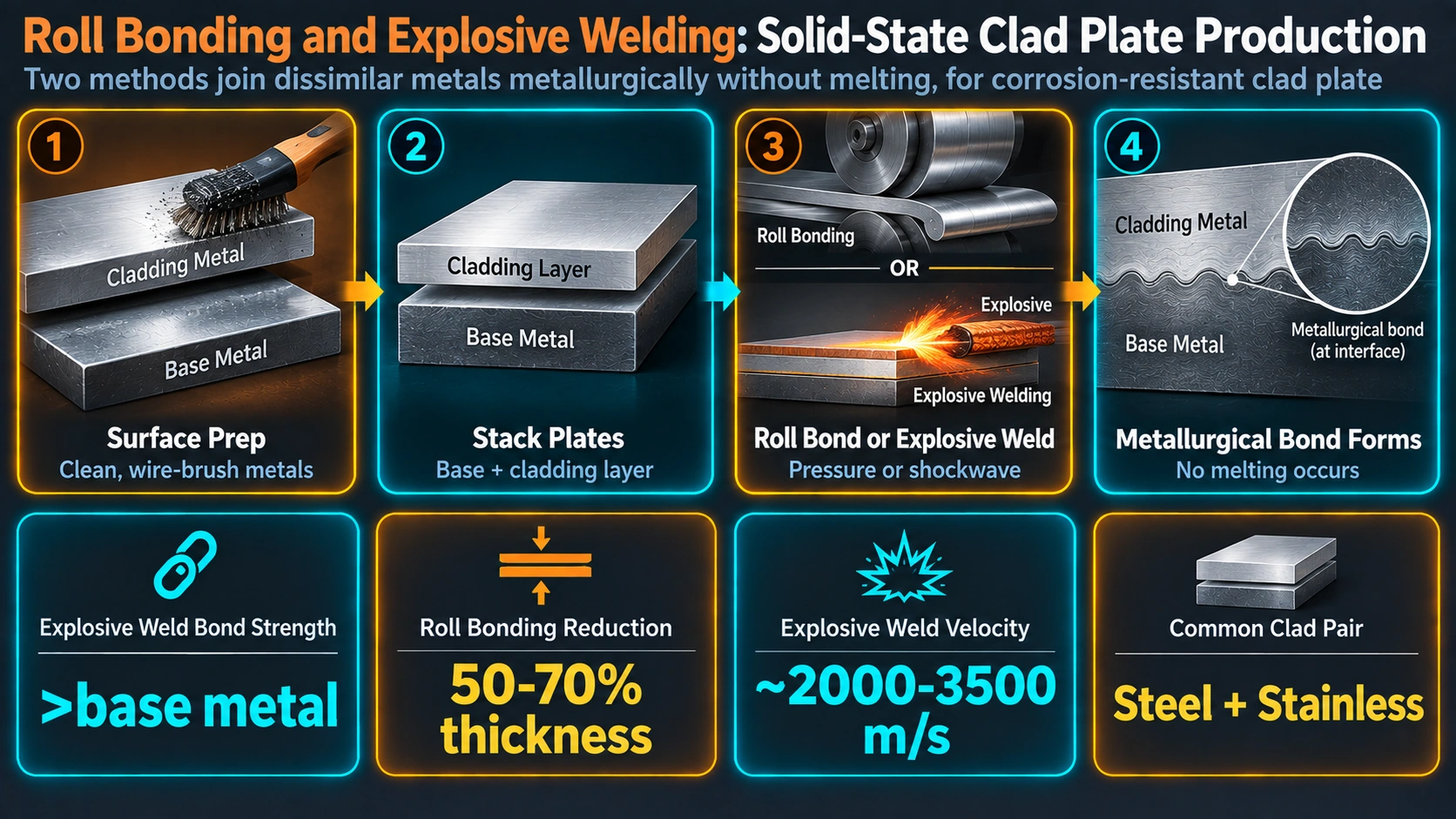
Roll bonding and explosive welding (EXW) produce metal-clad composite plates and dissimilar-metal transition joints without melting either component. These solid-state processes achieve metallurgical bonding through severe plastic deformation (roll bonding) or high-velocity oblique impact (EXW), thereby avoiding the dilution, segregation, heat-affected zone cracking, and intermetallic layer growth that make fusion welding impractical for many dissimilar-metal combinations. They are indispensable for producing stainless-clad pressure vessel plate, aluminium-copper electrical transition joints, titanium-steel marine fittings, and multi-layer thermostat bimetals — components that span the full range of process plant, offshore, aerospace, and power engineering.
Key Takeaways
- Bonding in both processes occurs in the solid state: no bulk melting, no weld pool, no dilution zone. Interfacial temperatures may briefly reach the melting point locally, but the bulk material remains solid.
- Explosive welding operates through a high-pressure jetting mechanism that expels surface oxides and contaminants, exposing pristine metal surfaces that bond under 5–50 GPa transient pressure.
- The wavy interface in EXW is produced by Kelvin-Helmholtz instability and is the macroscopic fingerprint of successful jetting; its wavelength and amplitude must be controlled to minimise intermetallic melt pocket volume.
- Roll bonding requires surface preparation (wire brushing or chemical etching) to disrupt and disperse oxide films, and typically achieves bonding at reductions of 40–70% per bonding pass, often with intermediate anneals.
- Area ratio and combination-specific intermetallic phase diagrams determine whether a direct EXW bond is acceptable or an interlayer material (Cu, Ni, Ag) is needed.
- Clad plate acceptance testing per ASTM A578 (UT), A264/A265 (shear strength ≥140 MPa for SS clad), and A264 (bend test) is mandatory for pressure vessel service.
Explosive Welding: Physics and Process Mechanics
The Jetting Mechanism
The bonding mechanism in explosive welding is fundamentally different from all fusion welding processes. When the detonation front propagates across the explosive layer, it accelerates the flyer plate downward at high velocity. Because the plate is inclined at a small dynamic angle β relative to the base plate, the collision does not occur simultaneously across the entire area but rather travels as a moving point — the collision front — at the detonation velocity Vd.
At the collision point, the extreme pressure (5–50 GPa) causes both metals to behave transiently as hydrodynamic fluids. This produces a high-velocity jet — a thin stream of material ejected forward of the collision point, carrying with it the surface oxide films, adsorbed contaminants, and a thin layer of each metal surface. The jet velocity can reach 2–4 km/s. By physically removing the oxide barrier, the jet exposes atomically clean metal surfaces that are immediately brought into contact under extreme pressure, forming metallic bonds across the interface. This is why surface cleanliness, while important, is less critical in EXW than in diffusion bonding: the jetting action provides self-cleaning at the moment of bonding.
Collision Velocity and the Bonding Window
For successful bonding, the collision velocity Vc (the velocity of the flyer plate normal to the base plate at the collision point) must fall within a defined bonding window:
Lower limit (V_c,min):
  V_c > V_min ≈ C_1 × HV_f / ρ_f
  (Must exceed threshold to produce jetting; HV_f = Vickers hardness of flyer, ρ_f = flyer density)

Upper limit (V_c,max):
  V_c < V_max ≈ C_2 × c_s
  (Must remain below sonic velocity of flyer to suppress excessive bulk melting; c_s = sound velocity)

Typical ranges:
  V_c: 150–600 m/s (flyer plate velocity)
  V_d: 1,800–4,500 m/s (detonation velocity)

Relationship: V_c = V_d × sin(β)   for small angles β

Dynamic angle β: optimised in range 5–20°
Collision pressure P_c: 5–50 GPa (function of ρ, V_c, and bulk sound speed)
The bonding window is a two-dimensional region on a Vc–β plot, first described by Wittman et al. and widely used to parameterise EXW processes. The window is narrower for metals with high acoustic impedance mismatch and wider for compatible metal pairs. For metal combinations that form brittle intermetallics, the upper boundary of the window is further constrained by the need to limit melt pocket volume at wave crests.
The Wavy Interface: Kelvin-Helmholtz Instability
The characteristic wavy morphology at the EXW bond interface arises from Kelvin-Helmholtz (K-H) instability — the same hydrodynamic phenomenon responsible for ocean waves and atmospheric billows at shear flow boundaries. At the collision front, the metal jet creates a velocity shear between the two metal surfaces flowing relative to each other. When the shear velocity exceeds a critical threshold (governed by surface tension and density of the metal in its transiently fluid state), the interface becomes unstable and oscillates periodically, producing sinusoidal waves that are frozen in place as the material solidifies.
The wavelength λ and amplitude A of the interface waves are controlled by explosive loading parameters:
- Higher explosive mass ratio (explosive mass / flyer plate mass) increases collision velocity and generally produces larger amplitude waves.
- Increasing standoff distance h increases the time of flight for the flyer and modifies the angular impact geometry, affecting λ and A.
- Harder metals (higher dynamic yield strength) tend to produce smaller amplitude waves for the same explosive loading.
The engineering significance of wave morphology is threefold. A wavy interface with amplitude A > 0 and wavelength λ of 1–10 mm is the macroscopic confirmation that jetting occurred and bonding is genuine. The interlocking wave profile provides mechanical keying that increases apparent shear strength above what chemical bonding alone would give. However, at the crest of each wave, a small volume of mixed-composition metal solidifies from the molten state and may contain intermetallic compounds. These melt pockets are brittle, and their volume must be minimised by selecting process parameters in the lower-to-mid range of the bonding window. Very large waves (from excessive explosive loading) produce excessive melt pocket volume and reduce bond toughness. A flat interface (from insufficient loading) indicates inadequate jetting and poor bonding.
Explosive Materials and Operational Logistics
Industrial EXW uses low to medium detonation velocity explosives to keep collision velocities within the bonding window. Common choices include:
- ANFO (ammonium nitrate / fuel oil): Vd ≈ 3,000–4,500 m/s (confined). Low cost, widely available. Used for large-area plates with thick flyers.
- Diluted PETN (pentaerythritol tetranitrate) mixed with inert filler: Vd adjusted from 1,800 to 4,000 m/s by dilution ratio. Preferred for thin flyers or sensitive metal combinations requiring precise velocity control.
- Detasheet / flexible sheet explosive: Uniform thickness, suitable for complex-geometry shots. Vd ≈ 6,900 m/s (high — used diluted for most EXW).
All EXW operations require remote sites or hardened bunkers due to the blast overpressure, ground vibration, and noise of detonation. Regulatory permits under national explosives legislation (BATFE in the USA; HSE Explosives Regulations in the UK; PESO in India) are mandatory. This logistical overhead and the regulatory compliance cost are among the primary factors that make EXW more expensive per square metre of clad plate than roll bonding for compatible metal systems.
Roll Bonding: Mechanism and Process Parameters
Bonding Mechanism in Roll Bonding
Roll bonding achieves solid-state metallurgical bonding by rolling two or more metal layers together at sufficient reduction to disrupt surface oxide films and bring fresh metal surfaces into intimate contact. The bonding mechanism involves two stages. First, the applied compressive stress disrupts and fragments the surface oxide films on each metal (which are harder and more brittle than the metal substrate and fracture at much lower strains). Second, the material beneath the fractured oxide extrudes through the cracks under the rolling pressure, contacting the equivalent fresh metal surface on the opposing sheet. These areas of clean metal-to-metal contact form metallic bonds — initially across discrete islands, then progressively across a larger fraction of the interface as reduction increases.
A minimum threshold reduction (Rmin) must be exceeded in the bonding pass to achieve adequate contact:
R = (t_0 - t_f) / t_0 × 100%    (per-pass thickness reduction)

Typical R_min for bonding:
  Al-Al:          35–50%  (annealed, wire brushed surfaces)
  Cu-Al:          50–65%  (requires aggressive surface preparation)
  Al-steel:       60–75%  (often requires intermediate anneal and multiple passes)
  Cu-Cu:          40–55%
  Ni-steel:       50–65%

Surface preparation (critical):
  Wire brushing: removes bulk oxide, roughens surface to increase contact area
  Chemical etching: removes oxide chemically; used where wire brushing damages thin foil
  Vacuum roll bonding: avoids oxide re-formation; used for reactive metals (Ti, Be)
Hot vs Cold Roll Bonding
Roll bonding is performed either at elevated temperature (hot roll bonding) or at ambient temperature (cold roll bonding). The choice depends on the metal combination, required bond strength, and subsequent forming operations.
Cold Roll Bonding
- Performed at ambient temperature; no furnace required
- Higher rolling forces needed (metals are work-hardened)
- Bond strength develops progressively with reduction
- Annealing after bonding relieves work hardening and improves ductility
- Suitable for: Al-Al, Cu-Al, Cu-steel strip/sheet
- Better surface finish; less oxide scale than hot bonding
- Tighter thickness tolerance achievable
- Risk: work-hardening limits achievable reduction per pass
Hot Roll Bonding
- Performed at elevated temperature (400–1,200°C depending on metal)
- Lower flow stress reduces required rolling force
- Bonding occurs at lower reductions (35–55%) than cold
- Diffusion across interface enhanced — stronger bond
- Suitable for: steel-steel, Ni-steel, large clad plate formats
- Risk: intermetallic growth at elevated temperature (Ti-steel, Al-steel)
- Must control time at temperature to limit intermetallic layer thickness
- Surface oxidation requires controlled atmosphere or scale removal
Multi-Pass Roll Bonding and Annealing
For metal combinations with large mismatches in flow stress or where the required total reduction exceeds the ductility of one component, roll bonding is performed in multiple passes with intermediate annealing. The annealing step:
- Restores ductility of work-hardened layers, allowing further reduction without cracking.
- Promotes diffusion across the bond interface, strengthening the metallurgical bond.
- Must be controlled in temperature and time to avoid unacceptable intermetallic layer growth where the binary system has a high intermetallic formation tendency (Al-Cu: CuAl2, Cu9Al4; Al-Fe: FeAl3, Fe2Al5).
The intermetallic layer thickness follows a parabolic growth law controlled by diffusivity:
x² = 2 k t

where:
  x = intermetallic layer thickness (μm)
  k = growth rate constant = k_0 × exp(−Q / RT)
  t = time at temperature (s)
  Q = activation energy for growth (J/mol)
  R = 8.314 J/(mol·K)
  T = absolute temperature (K)

Example: Al-Fe system, FeAl₃ growth at 500°C:
  k ≈ 4 × 10⁻¹³ m²/s
  In 1 hour: x = sqrt(2 × 4e-13 × 3600) ≈ 1.7 μm
  In 10 hours: x ≈ 5.4 μm  (limit: ≤3–5 μm for good bond ductility)
Intermetallic Formation and Interlayer Strategy
The most critical metallurgical challenge in both EXW and roll bonding of dissimilar metals is control of intermetallic compound (IMC) formation at the bond interface. IMCs are ordered phases of fixed stoichiometry that form when two metals with negative mixing enthalpy are brought into contact at sufficient temperature. They are generally brittle (low fracture toughness), have different thermal expansion coefficients from the parent metals, and can significantly degrade bond mechanical properties.
Critical Dissimilar Metal Systems
| Metal Combination | Critical IMC(s) | Formation onset (°C) | Max tolerable layer | Interlayer required? |
|---|---|---|---|---|
| Titanium – Steel | FeTi, Fe2Ti, TiC | ≈ 500°C | ≤1–2 μm | For PWHT; Cu or Ni foil |
| Aluminium – Steel | FeAl3, Fe2Al5 | ≈ 450°C | ≤3–5 μm | Usually no (EXW thin bond); Cu foil optional |
| Aluminium – Copper | CuAl2, Cu9Al4, CuAl | ≈ 250°C | ≤5 μm | No; control annealing time/temp |
| Titanium – Aluminium | TiAl, Ti3Al, TiAl3 | ≈ 600°C | ≤1 μm | Yes — Cu or Ni interlayer |
| Nickel – Titanium | NiTi, Ni3Ti, NiTi2 | ≈ 700°C | ≤1 μm | Yes — Cu or Ag interlayer |
| Stainless – Carbon steel | None significant | N/A | N/A | No |
| Copper – Steel | None significant | N/A | N/A | No |
When an interlayer is required, the foil must itself be compatible (form no brittle IMC) with both parent metals, or at least form only thin, compliant reaction layers. Copper is the most widely used interlayer in EXW: it is ductile, has good acoustic impedance for the bonding process, and forms manageable reaction layers with most metals. For the Ti-Al system, a copper foil between 0.5 and 2 mm thick is sufficient to prevent direct Ti-Al contact while maintaining overall joint quality.
Industrial Applications of Clad Plate
Pressure Vessel Cladding (EXW)
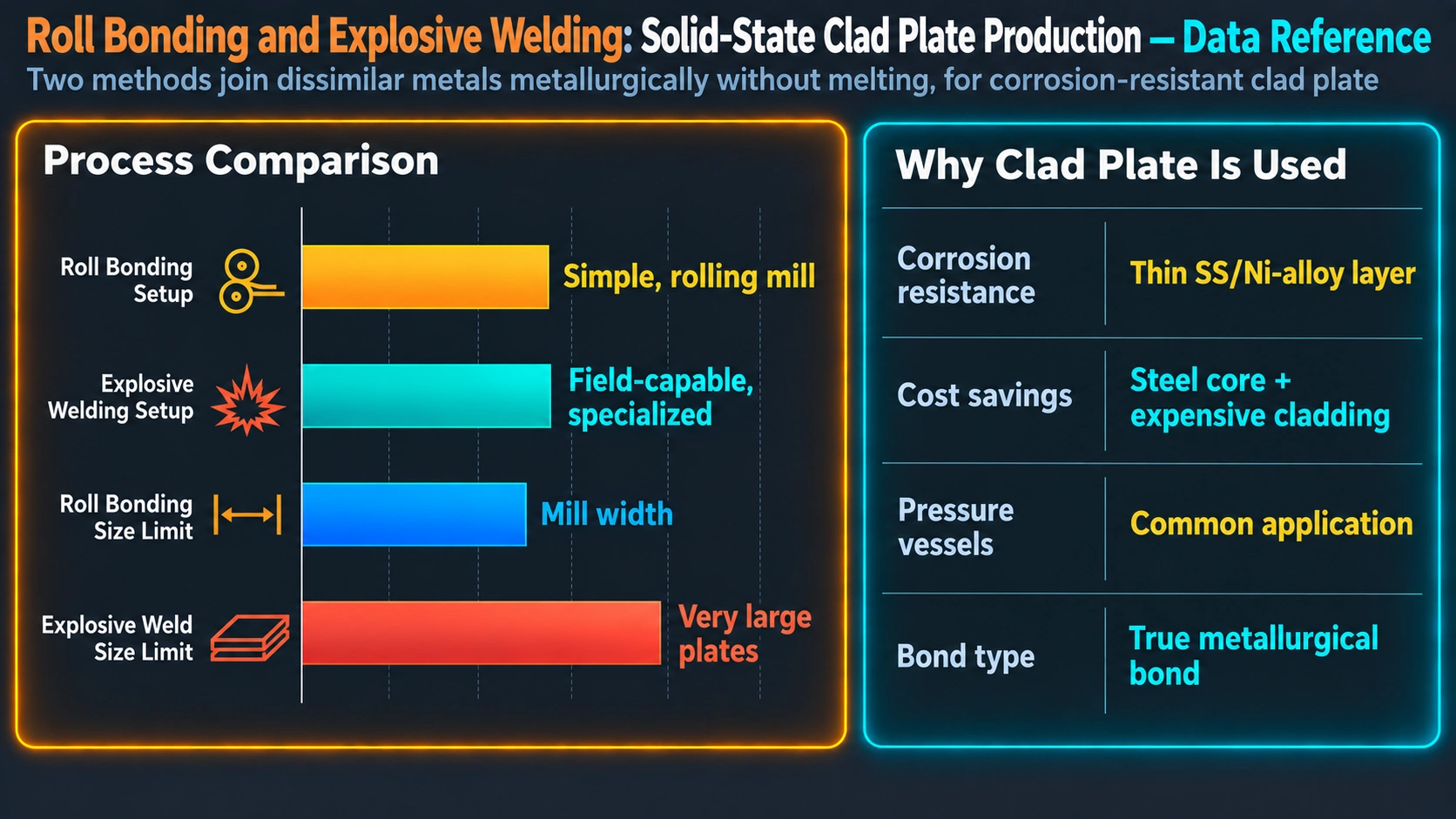
The largest commercial application of explosive welding is the manufacture of corrosion-resistant clad plate for chemical process and petrochemical pressure vessels. A structural carbon steel substrate (typically SA516 Gr70 or SA387 Gr11 for creep service) provides the required mechanical properties and wall thickness for pressure containment at minimum material cost. A corrosion-resistant cladding layer of 2–6 mm thickness is applied by EXW, selected to match the process chemistry:
- 316L or 317L stainless steel: Dilute sulphuric acid, phosphoric acid, general chemical service.
- 904L stainless steel: Concentrated sulphuric acid, seawater desalination.
- 2205 duplex stainless steel: Chloride environments, urea plants, seawater service.
- Alloy 625 (Inconel 625): Highly aggressive acids, FGD scrubbers, hydrochloric acid service.
- Hastelloy C-276: Mixed acid service, chlorinated solvents, wet chlorine.
- Titanium Grade 2 or Grade 12: Nitric acid, chloride-rich service, seawater condensers.
- Zirconium 702: Hydrochloric acid, acetic acid, nuclear fuel reprocessing.
The cost saving against a solid noble alloy vessel is 40–80%, driven by the fact that only the process-wetted surface (typically 2–4 mm) needs to be the expensive corrosion-resistant alloy. ASME VIII Div. 1 Part UB governs the use of clad plate in pressure vessel construction, including requirements for the base plate material, cladding bond strength, and NDE requirements. The cladding is not credited with structural contribution in pressure calculations (it is treated as a corrosion allowance), though in some codes a partial credit is permitted.
Aluminium-Copper Electrical Transition Joints (EXW)
Direct bolted or welded connections between aluminium bus conductors and copper components cause galvanic corrosion (as detailed in the galvanic corrosion prevention guide), increased contact resistance at the Al-Cu interface, and potential creep of the aluminium under bolt clamping loads at elevated service temperature. EXW-produced Al-Cu transition pieces solve all three problems: the aluminium end is welded to the aluminium busbar using standard MIG/TIG processes; the copper end is bolted or welded to the copper component. The EXW bond interface carries the current with low resistance and no corrosion risk, because the dissimilar metal junction is internal to a sealed solid-state bond rather than exposed to the atmosphere.
Titanium-Steel Marine and Offshore Transitions (EXW)
Titanium Grade 2 offers exceptional corrosion resistance in seawater, making it the material of choice for seawater cooling system piping on naval vessels and offshore platforms. However, the ship’s structural system and most piping connections are carbon or low-alloy steel. Titanium cannot be fusion welded to steel (the Fe-Ti binary system produces FeTi and Fe2Ti intermetallics that render the fusion weld zone brittle). EXW-produced Ti-Cu-steel transition rings and spools allow Ti pipe to be welded conventionally to the Ti side of the transition fitting, and the steel side to be welded to the structural steel system, with the solid-state EXW bond carrying the load across the dissimilar metal interface.
Roll-Bonded Applications
Roll bonding is preferred over EXW for high-volume sheet and strip production where the metal combination is compatible. Key commercial applications include:
- Aluminium brazing sheet: AA3003 core clad with AA4045 or AA4343 filler alloy on one or both faces. Produced by cold roll bonding; the filler melts during furnace brazing to form joints in automotive heat exchangers and HVAC coils. The cold roll bond is disrupted and replaced by a brazed joint, but initial roll bonding maintains intimate filler-core contact necessary for controlled brazing flow.
- Copper-clad aluminium (CCA) wire and strip: Combines the electrical conductivity of copper at the surface (where high-frequency current flows, due to the skin effect) with the weight and cost advantage of aluminium core. Used in RF cables, antenna feeders, and signal cables.
- Brass-Invar-brass thermostatic bimetal: Invar (Fe-36Ni) has near-zero coefficient of thermal expansion; brass has high CTE. The composite strip deflects predictably with temperature, actuating thermostats, circuit breakers, and bimetallic temperature switches. Multi-layer roll bonding with precise thickness control is essential for consistent actuation temperature.
- Clad coins (circulating coinage): Many modern circulating coins are roll-bonded composites: copper-clad steel (UK 1p, 2p; many EU cents), cupro-nickel clad copper (US quarter, dime). Provides the appearance and electromagnetic signature of solid alloy coins at substantially lower material cost.
Quality Testing and Acceptance Criteria
Acceptance testing for EXW and roll-bonded clad plate is specified by ASTM standards and the applicable construction code. The test sequence for pressure vessel clad plate typically covers the full suite shown below.
| Test Method | Standard | What it detects | Acceptance criterion |
|---|---|---|---|
| Ultrasonic testing (UT) — 100% area scan | ASTM A578 | Unbonded regions (delaminations, lack of bond) | No single indication ≥25 mm diam.; no linear indication ≥ 50 mm length; unbonded area < specified % of total |
| Shear strength test (lap shear) | ASTM A264 (SS clad) / A265 (Ni alloy clad) | Bond shear strength (quantitative) | ≥ 140 MPa (20,300 psi) for stainless and Ni-alloy clad; ≥ 69 MPa for some softer clad systems |
| Bend test (root and face) | ASTM A264 | Delamination under bending; ductility of bond interface | No separation of cladding from base metal; no crack in cladding ≥ 3 mm |
| Tensile test (composite) | ASTM A370 | Tensile strength of composite system | Per base plate specification (cladding not counted) |
| Metallographic cross-section | ASTM E3 | Interface morphology, intermetallic layer, melt pockets (EXW) | Wavy interface (EXW), no continuous IMC layer > 5 μm, no gross melt zones |
| Corrosion test (cladding) | ASTM A262 (Pr. E for SS); ASTM G28 (Ni alloys) | Sensitisation, intergranular corrosion resistance | Per cladding specification; no intergranular attack |
| Radiographic testing (RT) | ASTM E94 | Large subsurface anomalies (supplementary to UT) | No indications exceeding Level II of ASTM E186 |
Ultrasonic Testing of Clad Plate
ASTM A578 Supplementary Requirement S1, S2, or S3 specifies three levels of UT stringency for clad plate, with S3 being the most demanding (used for nuclear and critical pressure vessel service). The UT scan is performed from the base plate side using straight-beam (compression wave) transducers. The cladding-to-base interface produces a strong reflection; unbonded areas produce a back-wall echo from the cladding-to-air interface, giving a characteristic pattern of indications on the C-scan. Automated UT scanning with data recording is standard practice for production plate. For titanium-clad plates, the acoustic impedance mismatch between Ti and steel is very high, making UT interpretation more complex and requiring calibrated reference standards of the specific metal combination.
Comparison of EXW and Roll Bonding
| Parameter | Explosive Welding (EXW) | Roll Bonding |
|---|---|---|
| Bonding mechanism | High-velocity impact jetting | Severe plastic deformation, oxide disruption |
| Dissimilar metal capability | Very high — virtually any combination | Moderate — limited by flow stress mismatch and formability |
| Plate size | Up to ~4 × 10 m; any thickness | Limited by mill width; continuous coil for sheet/strip |
| Minimum cladding thickness | ≈ 1.5 mm (practical lower limit) | < 0.1 mm possible for thin foil composites |
| Surface preparation | Degreasing; oxide self-cleaned by jet | Critical: wire brush, etch, or vacuum required |
| Process environment | Outdoor site or bunker; explosive permit required | Industrial rolling mill; no special licensing |
| Production rate | Batch (one shot per plate setup) | Continuous (coil-to-coil for strip) |
| Cost (per m²) | Higher (logistical, regulatory overhead) | Lower for compatible systems in volume |
| Post-bond forming | Limited (large plates, hard to re-form) | Good (strip can be stamped, drawn, bent) |
| Bond strength (shear) | 140–400 MPa depending on system | 50–200 MPa depending on system and reduction |
| Primary standards | ASTM A578, A264, A265, B898, ASME VIII UB | ASTM B548, relevant material specifications |
Frequently Asked Questions
What is the fundamental bonding mechanism in explosive welding?
What is the difference between roll bonding and explosive welding?
What causes the wavy interface in explosive welding and why does it matter?
What metal combinations can be joined by explosive welding?
What post-weld heat treatment is required for explosive-welded clad plates?
How is clad plate bond quality tested and what are the acceptance criteria?
What explosive materials and loading geometries are used in explosive welding?
Can roll bonding be used for three or more layer composites?
What are the dimensional limits and tolerances achievable in explosive welding?
Recommended References and Tools
AWS Welding Handbook Vol. 1 — Welding Science & Technology (10th Ed.)
The definitive reference covering the physics and metallurgy of all welding processes including explosive welding. Essential for understanding solid-state bonding fundamentals.
View on AmazonBridge Cam Weld Gauge — AWS/EN Weld Inspection
Multi-function weld inspection gauge for measuring weld leg length, reinforcement, bevel angle, and gap. Used by CWI/CSWIP inspectors for structural and pressure vessel weld inspection.
View on AmazonTempilstik Temperature Indicating Sticks — Welding Preheat
Temperature-indicating crayons for on-site preheat and interpass temperature verification. Rated to specific temperatures; smear changes from solid to liquid at the rated point.
View on AmazonLincoln Electric VIKING 3350 Auto-Darkening Welding Helmet
High-performance auto-darkening helmet with 4C lens technology for SMAW, GTAW, GMAW, and FCAW processes in structural and clad plate fabrication environments.
View on AmazonDisclosure: MetallurgyZone participates in the Amazon Associates programme. If you purchase through these links, we may earn a small commission at no extra cost to you. This helps support free technical content on this site.
Further Reading
Diffusion Bonding and TLP
Solid-state bonding by solid-state diffusion and transient liquid phase — mechanism, parameters, and aerospace applications.
HAZ Microstructure in Steel Welds
Thermal zones, grain coarsening, CGHAZ martensite, and toughness implications in fusion welding — the problem that solid-state processes avoid.
Galvanic Corrosion Prevention
Why Al-Cu and Ti-steel direct joints corrode, and how EXW transition pieces solve the dissimilar metal connection problem.
Thermal Spray Coatings: HVOF, Plasma, Cold Spray
Alternative surface cladding technologies — coating thickness limits, bond strength, and comparison with roll bonding.
Nickel Alloys: Inconel, Hastelloy, Monel
Alloy selection for corrosion-resistant cladding — 625, C-276, 825 compositions, properties, and application environments.
Arc Spraying and Wire Flame Spraying
Thermal spraying as a complement to EXW cladding for corrosion and wear protection on complex geometries.
Metal Extrusion: Hot and Cold Processes
Co-extrusion as another solid-state composite forming route for bimetallic rod and tube products.
Investment Casting of Superalloys
Directional solidification and single-crystal casting — the alternative when solid-state bonding is not applicable for complex geometry.
