Magnesium Alloys: Lightweight Structural and Die Casting Grades
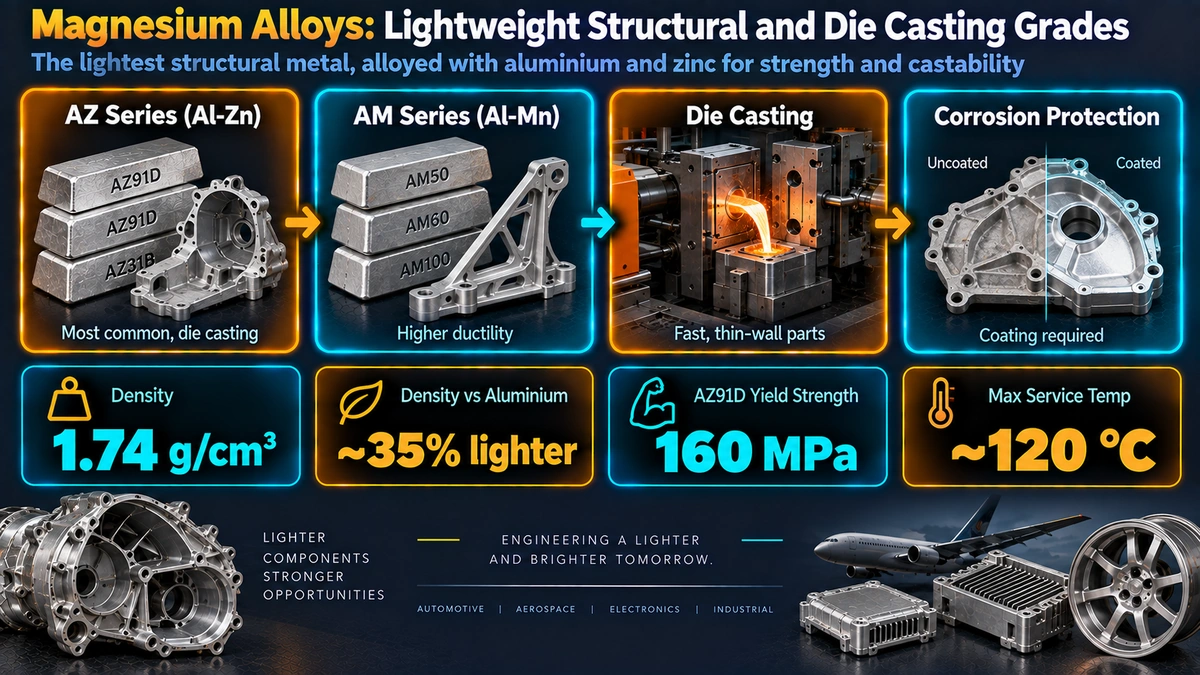
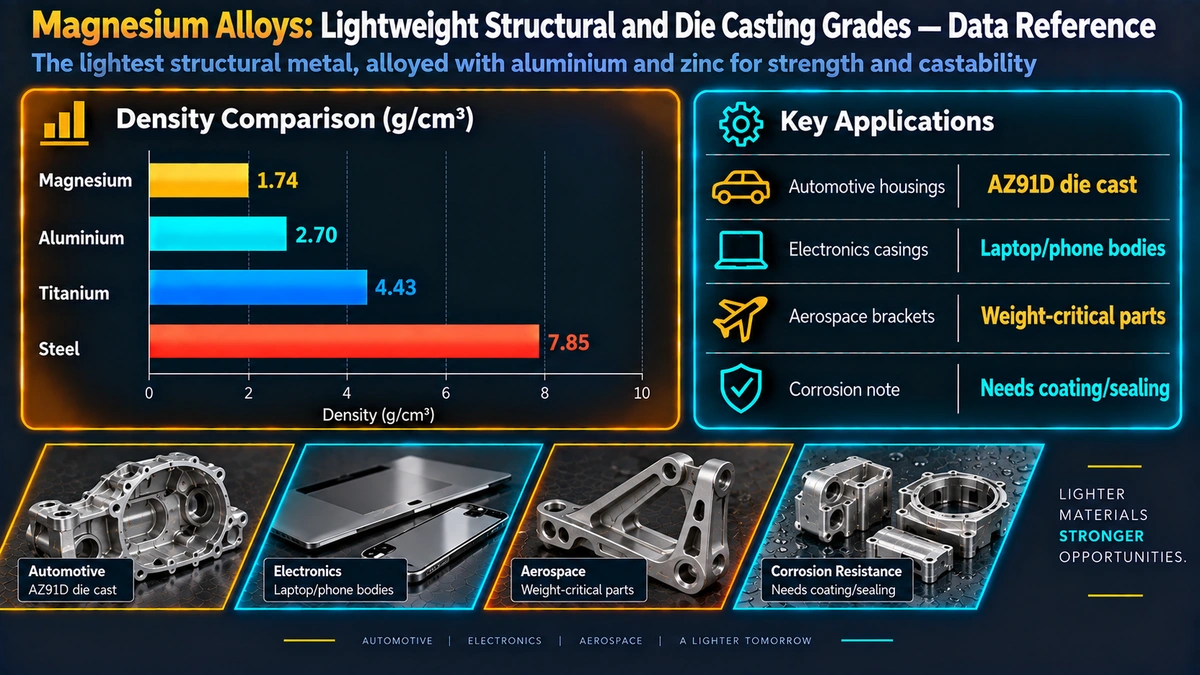
Magnesium is the lightest structural metal in engineering use, with a density of 1.74 g/cm³ — 35% lower than aluminium and 77% lower than structural steel. Magnesium alloys exploit this density advantage through a combination of solid-solution strengthening, precipitation hardening, and dispersion of intermetallic phases, achieving specific strengths competitive with aluminium alloys across a broad range of alloy families and processing routes. This article provides a graduate-level treatment of magnesium alloy metallurgy: designation systems, crystal structure and deformation physics, wrought and casting alloy families, heat treatment, corrosion mechanisms and protection, and industrial applications in automotive, aerospace, and electronics.
Key Takeaways
- Magnesium (density 1.74 g/cm³) is the lightest common structural metal; its HCP crystal structure limits room-temperature ductility by restricting active slip systems to basal (0001)⟨11̅20⟩.
- The ASTM designation system encodes alloying elements and nominal compositions: AZ91D contains ~9 wt% Al and ~1 wt% Zn; the letter suffix denotes purity class.
- Aluminium is the most important alloying element, strengthening through solid solution and Mg₁₇Al₁₂ (β-phase) precipitation at grain boundaries and within grains.
- Zirconium refines grain size in Zr-containing alloys (ZK, WE series) by providing potent HCP nucleation sites during solidification; it cannot be used with Al or Mn alloys.
- Galvanic corrosion is the dominant practical concern: Mg has the most negative standard electrode potential (−2.37 V vs SHE) of common structural metals, making electrical isolation essential in mixed-metal assemblies.
- AZ91D dominates high-pressure die casting; AZ31B is the workhorse wrought sheet/extrusion alloy; WE43 and Elektron 21 serve elevated-temperature aerospace applications up to 250°C.
Magnesium Crystal Structure and Deformation Physics
Magnesium crystallises in the hexagonal close-packed (HCP) structure with lattice parameters a = 0.3209 nm and c = 0.5211 nm, giving a c/a ratio of 1.624 — slightly below the ideal close-packed value of 1.633. This close-packed geometry means that the basal plane (0001) is the most densely populated and the lowest-energy slip plane. The Burgers vector for basal slip is ⟨11̅20⟩ (i.e., the <a> direction), with a magnitude of a = 0.3209 nm.
Why Room-Temperature Ductility is Limited
At room temperature, the critically resolved shear stress (CRSS) for basal slip in pure magnesium is approximately 0.5 MPa. Non-basal prismatic {10̅10}⟨11̅20⟩ slip requires a CRSS of roughly 39 MPa, and pyramidal <c+a> slip on {10̅11} planes requires over 45 MPa. This enormous disparity means that only basal slip is practically active at room temperature. Because the basal plane provides only two independent slip systems, the von Mises criterion (minimum five independent systems for arbitrary plastic deformation) cannot be met by basal slip alone.
Tensile twinning on {10̅12}⟨10̅11⟩ systems supplements basal slip and is particularly important during compression applied along the c-axis (the [0001] direction). However, twinning is polar — it accommodates extension along <c> during tension perpendicular to the c-axis, but compressive twinning on {10̅11} systems requires a much higher CRSS. The anisotropy between tension twin-prone and compression twin-prone orientations is the underlying reason for the strong tension-compression yield asymmetry observed in extruded and rolled magnesium.
Effect of Temperature on Ductility
Above approximately 200°C, prismatic and pyramidal slip systems become thermally activated and the CRSS anisotropy decreases sharply. This explains why magnesium alloys are readily formable by hot extrusion, rolling, and forging at 300–450°C, but exhibit limited cold workability. Dynamic recrystallisation (DRX) occurs readily during hot deformation, providing an additional grain-refinement mechanism that enhances post-deformation ductility.
Alloy Designation System
The ASTM/SAE designation system for magnesium alloys uses a logical alpha-numeric code. The first two letters identify the principal alloying elements in descending order of nominal concentration, using the abbreviations: A = aluminium, Z = zinc, M = manganese, K = zirconium, W = yttrium, E = rare earths (Ce, Nd, La, Pr), H = thorium, S = silicon, T = tin. The two numbers following indicate the approximate nominal wt% of the first and second elements respectively, rounded to whole numbers. A final letter (A, B, C, D, E) denotes the revision or purity class of the alloy.
AZ91D  →  A = aluminium (~9 wt%)
            Z = zinc (~1 wt%)
            D = fourth revision / high-purity variant

ZK60A  →  Z = zinc (~6 wt%)
            K = zirconium (~0 wt%, actually 0.45 wt%)
            A = first designated alloy variant
The temper designation follows the alloy code after a hyphen, using conventions analogous to aluminium alloy tempers: F (as-fabricated), O (annealed), H (strain-hardened), T4 (solution treated), T5 (artificially aged after casting), T6 (solution treated and artificially aged).
Role of Alloying Elements
Aluminium (A)
Aluminium is the most commercially important alloying element in magnesium. It is the primary solid-solution strengthener, with a maximum solubility of 12.7 wt% at the eutectic temperature of 437°C, decreasing to approximately 2 wt% at room temperature according to the Mg-Al binary phase diagram. This large solubility change provides scope for age hardening through precipitation of the Mg₁₇Al₁₂ intermetallic phase (β-phase, body-centred cubic, prototype: Mg₁₇Al₁₂). In rapidly solidified die castings, β-phase forms a continuous or semi-continuous grain boundary network that limits corrosion penetration and provides modest creep resistance. However, the β-phase has a low melting point (459°C) and dissolves above approximately 120–130°C, removing its strengthening contribution and permitting grain boundary sliding — the fundamental creep weakness of AZ alloys.
Zinc (Z)
Zinc is the second most common solute, present in amounts up to 6 wt% in wrought alloys (ZK60) and at ~1 wt% in AZ die casting alloys. Zinc contributes to solid-solution strengthening and, in Zr-containing alloys (ZK series), promotes GP zone and MgZn precipitate formation during age hardening. Zinc also reduces the melting range, improving fluidity and castability. However, Zn content above approximately 1 wt% in Al-containing alloys can promote hot cracking (hot shortness) during solidification by expanding the brittle solid+liquid two-phase region.
Manganese (M)
Manganese is added primarily to improve corrosion resistance by scavenging iron from the melt through formation of Al-Mn and Fe-Mn intermetallics that settle during melt holding. Iron is the most damaging impurity in magnesium alloys: at concentrations above the tolerance limit of approximately 50 ppm (wt), Fe forms micro-galvanic cathodes that dramatically accelerate generalised corrosion. Mn additions of 0.1–0.5 wt% reduce effective Fe activity to below the tolerance threshold. Mn alone contributes modest solid-solution strengthening.
Zirconium (K)
Zirconium is a uniquely effective grain refiner for magnesium alloys that are free of aluminium and manganese. Zr has an HCP crystal structure with a = 0.3231 nm — only 0.7% larger than magnesium (a = 0.3209 nm) — providing an almost perfect epitaxial nucleation substrate for α-Mg during solidification. Typical additions of 0.4–0.7 wt% Zr refine grain size from several millimetres to 30–80 µm. Zr reacts with aluminium and manganese to form stable intermetallics (Al₂Zr₃, MnZr), removing it from solution and negating its grain-refinement effect; hence Zr is incompatible with A-series and M-series alloying.
Rare Earths and Yttrium (E, W)
Rare earth (RE) additions — principally neodymium, cerium, and lanthanum — are the basis of high-temperature magnesium alloys. RE elements have low solid solubility in Mg and form thermally stable intermetallic compounds (e.g., Mg₃Nd, Mg₁₂Nd, Mg₅Gd) that resist coarsening at elevated temperatures. These phases pin grain boundaries and maintain dislocation networks at 150–250°C, enabling creep resistance well beyond the capability of AZ alloys. Yttrium (up to 4 wt% in WE43) reduces stacking fault energy on non-basal planes, activating additional slip modes and significantly improving ductility and texture randomisation in wrought products.
Alloying strategy summary: For room-temperature structural service, AZ series (Al+Zn) and AM series (Al+Mn) offer the best cost-performance balance. For elevated-temperature applications above 150°C, WE43 or Elektron 21 (Nd+Gd+Zr) are the engineering-grade choices. For wrought products requiring grain refinement without Al, ZK60 (Zn+Zr) provides excellent strength-ductility balance.
Wrought Magnesium Alloys
AZ31B — The Wrought Workhorse
AZ31B (Mg-3Al-1Zn-0.2Mn) is the most widely produced wrought magnesium alloy, available as sheet, plate, extrusion, and tube. In the annealed condition (O-temper), tensile yield strength is typically 150–165 MPa with elongation of 12–21%. Hot-rolled and H24-tempered sheet achieves 220–240 MPa YS with reduced ductility (10–15%). AZ31B is routinely processed by extrusion at 300–400°C and by rolling at 350–450°C with incremental passes and inter-pass reheating to maintain temperature above the brittle-to-ductile transition.
A significant characteristic of AZ31B sheet is its crystallographic texture: hot rolling produces a strong basal texture with the <0001> direction aligned perpendicular to the sheet surface. This texture makes in-plane tensile properties high but sheet formability (particularly in-plane compression and deep drawing) poor, because basal slip is poorly oriented for <c>-direction strains. Elevated-temperature forming (100–250°C) activates non-basal slip and twinning, improving limiting drawing ratio from about 1.5 at room temperature to 2.5 at 200°C.
AZ61 and AZ80
Increasing aluminium content to 6 wt% (AZ61) and 8 wt% (AZ80) raises yield strength through enhanced solid-solution strengthening and greater volume fraction of Mg₁₇Al₁₂ precipitate, but at the cost of reduced ductility. AZ61 is used primarily as extrusion billets and welding filler wire; its weldability is better than AZ80 due to a narrower solidification range. AZ80 in T5 temper (artificially aged after extrusion) achieves YS of 250–280 MPa, the highest among standard wrought AZ alloys.
ZK60 — Age-Hardenable Wrought Alloy
ZK60 (Mg-6Zn-0.5Zr) is the principal age-hardenable wrought magnesium alloy. The Zr addition refines as-cast grain size to 30–50 µm, and subsequent T5 ageing at 150–175°C for 24 hours produces MgZn precipitates (β₁ and β₂ phase GP zones) that give peak hardness and yield strengths of 270–305 MPa — among the highest for commercial magnesium wrought products. ZK60 is used in aerospace and sporting goods (bicycle frames, racket handles) where minimum weight is paramount and elevated temperature is not a concern.
WE43 — High-Temperature Wrought Alloy
WE43 (Mg-4Y-3RE-0.5Zr, where RE = Nd + heavy rare earths) is the principal aerospace-grade magnesium alloy for elevated-temperature service. Solution treatment at 525°C dissolves coarse as-cast intermetallics; ageing at 250°C for 16 hours precipitates fine Mg₅(Y,Nd) and β₁-Mg₃Nd phases. At 250°C, WE43-T6 retains a 0.2% proof stress of approximately 160 MPa — more than double that of AZ31 at the same temperature. Creep rate at 250°C/70 MPa is two to three orders of magnitude lower than AZ91D, making WE43 suitable for helicopter gearbox housings, aerospace structural castings, and high-performance engine components.
| Alloy / Temper | Al | Zn | Mn | Zr | Y / RE | YS (MPa) | UTS (MPa) | Elong. (%) |
|---|---|---|---|---|---|---|---|---|
| AZ31B-O | 3.0 | 1.0 | 0.2 | — | — | 160 | 250 | 18 |
| AZ31B-H24 | 3.0 | 1.0 | 0.2 | — | — | 220 | 290 | 13 |
| AZ61A-F | 6.1 | 1.0 | 0.15 | — | — | 200 | 295 | 16 |
| AZ80A-T5 | 8.0 | 0.5 | 0.12 | — | — | 275 | 345 | 7 |
| ZK60A-T5 | — | 6.0 | — | 0.5 | — | 305 | 365 | 11 |
| WE43-T6 | — | — | — | 0.5 | 4Y / 3RE | 195 | 250 | 7 |
Magnesium Casting Alloys
Casting accounts for approximately 90% of all magnesium alloy components produced, with high-pressure die casting (HPDC) dominating at over 80% of cast volume. Sand casting, permanent mould casting, and thixocasting account for the remainder. The stringent requirements of HPDC — rapid cavity filling at injection speeds of 30–100 m/s, pressure intensification to 70–140 MPa, and cycle times of 15–45 seconds — impose specific metallurgical demands on alloy composition.
AZ91D — The Die Casting Standard
AZ91D (Mg-9Al-1Zn-0.3Mn) is by far the most widely used magnesium die casting alloy, accounting for approximately 60% of all magnesium casting production globally. The relatively high aluminium content (9 wt%) achieves several objectives simultaneously: it lowers the liquidus temperature (from 650°C for pure Mg to approximately 598°C for AZ91D), improves melt fluidity, reduces shrinkage porosity by narrowing the solidification range, and maximises the volume fraction of grain-boundary Mg₁₇Al₁₂ (β-phase) that enhances room-temperature yield strength to approximately 150 MPa and UTS of 230 MPa in T4 temper.
The “D” suffix designates the high-purity variant of AZ91, with tight limits on Fe (<0.005 wt%), Ni (<0.002 wt%), and Cu (<0.030 wt%). These three elements are highly damaging in trace amounts because they form noble intermetallic micro-cathodes (FeAl, Ni₃Al, CuMg₂) embedded in the Mg matrix. At concentrations above their tolerance thresholds, these particles drive localised galvanic attack that increases salt spray corrosion rates by one to two orders of magnitude versus high-purity material.
AM Series — High Ductility Die Casting
AM50A (Mg-5Al-0.4Mn) and AM60B (Mg-6Al-0.4Mn) sacrifice some yield strength versus AZ91D in favour of substantially higher energy absorption and ductility, making them the alloys of choice for automotive safety-critical castings (steering wheels, instrument panel beams, door frames, seat structures) where crashworthiness is paramount. AM60B achieves elongation of 8–13% versus 3–5% for AZ91D, with UTS of approximately 220 MPa. The lower Al content (5–6 vs 9 wt%) reduces the brittle grain-boundary β-phase network, enabling crack propagation to be arrested by ductile α-Mg dendrites rather than fracturing along a continuous intermetallic network.
AE44 — Elevated-Temperature Die Casting
AE44 (Mg-4Al-4RE, where RE is a mixed rare-earth addition of Ce, La, Pr) was developed specifically for automotive powertrain die castings (engine cradles, oil pans, transmission housings) that must retain properties at 150–175°C. The RE elements react preferentially with Al to form Al₁₁RE₃ intermetallics at grain boundaries, consuming Al that would otherwise form the low-melting Mg₁₇Al₁₂ phase. The Al₁₁RE₃ phase is thermally stable to above 350°C, providing creep resistance through grain boundary pinning and precipitation hardening. AE44 is the primary Mg die casting alloy for BMW, Daimler, and Volkswagen powertrain applications.
| Alloy / Temper | Process | Al (wt%) | Special Additions | YS (MPa) | UTS (MPa) | Elong. (%) | Key Use |
|---|---|---|---|---|---|---|---|
| AZ91D-T4 | HPDC | 9 | Zn 1%, Mn 0.3% | 150 | 230 | 3 | General structural |
| AM50A-F | HPDC | 5 | Mn 0.4% | 125 | 210 | 10 | Automotive interior |
| AM60B-F | HPDC | 6 | Mn 0.4% | 130 | 220 | 8 | Steering, seat frames |
| AE44-F | HPDC | 4 | 4% mixed RE | 145 | 230 | 10 | Powertrain >150°C |
| AS41B-F | HPDC | 4 | Si 1%, Mn 0.35% | 140 | 215 | 6 | Engine blocks (Mg₂Si dispersion) |
| EZ33A-T5 | Sand/PM | — | 3%RE, 2.5%Zn, 0.6%Zr | 110 | 160 | 3 | Elevated-temp castings |
| WE43-T6 | Sand/PM | — | 4Y, 3RE, 0.5Zr | 190 | 250 | 4 | Aerospace, defence |
Corrosion Behaviour and Protection
Magnesium has the most negative standard electrode potential of any common structural metal: E° = −2.37 V versus the standard hydrogen electrode (SHE). In comparison, aluminium is at −1.66 V and iron at −0.44 V. In the presence of an electrolyte, magnesium will act as the anode in virtually any galvanic couple with another engineering metal, dissolving preferentially. Despite this thermodynamic instability, magnesium forms a thin surface oxide layer (MgO) in dry air that provides limited passivation, but this film is less protective than the aluminium oxide layer on Al alloys or the chromium oxide on stainless steels. The MgO film is disrupted by chloride ions and breaks down rapidly in NaCl solutions above approximately 0.1 mol/L.
The Negative Difference Effect (NDE)
A counterintuitive behaviour unique to magnesium is the negative difference effect (NDE): hydrogen evolution (the cathodic reaction rate) paradoxically increases when magnesium is anodically polarised. This anomalous behaviour, attributed to dissolution of partially oxidised Mg⁺ ions (Mg⁺ species) that subsequently reduce water chemically rather than electrochemically, means that corrosion currents measured from polarisation curves underestimate actual corrosion rates. The NDE complicates application of standard electrochemical corrosion measurement techniques (Tafel extrapolation, linear polarisation resistance) and requires correction methods such as hydrogen gas collection or gravimetric weight loss to obtain accurate corrosion rates.
Impurity Tolerance Thresholds
The correlation between impurity level and corrosion rate in Mg alloys follows a threshold behaviour: below a critical concentration, impurities have minimal effect on corrosion; above it, corrosion rate increases sharply. The tolerance limits (approximate) are: Fe < 50 ppm, Ni < 20 ppm, Cu < 300 ppm. At typical Mn additions of 0.2–0.5 wt%, the Mn/Fe ratio exceeds the critical ratio of approximately 7.5, below which Fe is effectively rendered inactive as a cathode by formation of harmless Fe-Mn intermetallics. This is why AZ91D with controlled impurity levels (the “D” designation) has salt spray corrosion resistance approximately 10–100 times better than AZ91A or AZ91B with relaxed impurity limits.
Galvanic coupling caution: Never allow direct metal-to-metal contact between magnesium components and steel, copper, or nickel alloy fasteners, fittings, or brackets in environments where condensation or salt water ingress is possible. Insulating gaskets, sleeves, and bushings (PTFE, neoprene, or aluminium-coated nylon) are mandatory for structural joints. Paint and conversion coating integrity at joints must be maintained throughout service life.
Surface Protection Systems
Because bare magnesium alloys cannot resist aggressive environments without surface treatment, a multi-layer protection strategy is standard in industrial practice:
- Chemical conversion coating: Chrome-free manganese-phosphate or permanganate coatings (replacing the now-restricted hexavalent chromate) provide a porous but adherent base for paint adhesion. Coating thickness is typically 0.5–2 µm. ASTM D1732 and MIL-M-45202 specify conversion coating requirements.
- Micro-arc oxidation (MAO / PEO): Plasma electrolytic oxidation grows a dense MgO-MgAl₂O ; ceramic layer 10–40 µm thick directly on the alloy surface using pulsed high-voltage DC in alkaline electrolyte. The resulting ceramic layer has hardness of 300–600 HV (versus 50–80 HV for the alloy), excellent corrosion resistance, and good tribological properties. MAO is increasingly used for aerospace and defence components.
- Electroless nickel plating: A duplex electroless Ni-P + Ni system provides hermetic barrier protection and good wear resistance. Post-plate hydrogen embrittlement bake at 190°C for 1 hour is required per ASTM B656.
- Organic coatings: Two-component epoxy primer + polyurethane topcoat is the standard automotive and aerospace finishing system. Primer adhesion depends critically on the quality and integrity of the underlying conversion coating.
Heat Treatment of Magnesium Alloys
Magnesium alloys respond to heat treatment analogously to aluminium alloys, through solution treatment and subsequent age hardening, but the lower diffusion rates in the HCP lattice and the lower melting point of Mg require careful temperature control. The main heat treatment designations are T4 (solution treat + quench + natural age), T5 (artificially age directly from fabrication, without solution treat), and T6 (solution treat + artificial age).
Solution Treatment
Solution treatment dissolves coarse intermetallic phases formed during casting or forging, creating a supersaturated solid solution. For AZ91D, solution treatment at 413–418°C for 16–24 hours dissolves the Mg₁₇Al₁₂ β-phase into the α-Mg matrix. Temperature control within ±3°C is critical: exceeding the eutectic temperature of 437°C will cause incipient melting at grain boundaries (burning), producing shrinkage porosity and permanent mechanical property degradation. WE43 solution treatment at 525°C is closer to the incipient melting temperature and requires tighter furnace uniformity.
Artificial Ageing
Artificial ageing of solution-treated magnesium alloys follows a nucleation-growth-coarsening sequence analogous to aluminium age hardening. For AZ91D-T6, ageing at 168°C for 16 hours produces a fine dispersion of Mg₁₇Al₁₂ precipitates within α-Mg grains (not solely at grain boundaries as in the T4 condition), increasing 0.2% proof stress from approximately 95 MPa (T4) to 145 MPa (T6). Overageing at higher temperatures or prolonged times coarsens precipitates, reducing strengthening.
Peak hardness age hardening sequence (AZ series):
  SSSS → GP zones → coherent β″ (Mg₃Al hexagonal) → semi-coherent β′ → incoherent β (Mg₁₇Al₁₂, BCC)

  Hall-Petch relation (grain size strengthening):
  σ_y = σ_0 + k_y × d^(-½)
  k_y (Mg)  ≈ 180–280 MPa·µm^(½) — significantly higher than Al (k_y ≈ 68 MPa·µm^(½))
  Grain refinement is therefore highly effective in Mg alloys
Magnesium in Automotive and Aerospace Applications
The primary driver for magnesium alloy adoption is mass reduction. Every kilogram saved in a vehicle body or powertrain reduces fuel consumption by approximately 0.015 L/100 km and CO₂ emissions by 35 g/km over the vehicle life, based on rolling resistance and powertrain efficiency analysis. In battery electric vehicles (BEVs), mass reduction has an amplified benefit: lighter structure reduces battery size requirement, with a “mass snowball” effect of approximately 1.3 kg saved for every 1 kg directly lightweighted.
Automotive Applications
The largest single use of magnesium die castings is instrument panel beams (cross-car beams), where AM60B or AZ91D replace steel at weight savings of 2–4 kg per vehicle. Steering wheels, door inner panels, seat frames, and trunk lid structures are produced from AM60B and AM50A. Engine blocks in magnesium (AZ91D, AM-HP series) have been produced by BMW for the Inline-6 engines in the 3-series, achieving a 24% weight reduction versus an all-aluminium block. Volkswagen Group uses AZ91D HPDC for gearbox housings in the DSG dual-clutch transmissions. Ford, GM, and Chrysler have used AZ91D for transfer case housings, valve covers, and intake manifolds.
Aerospace and Defence Applications
Aerospace magnesium applications are dominated by sand and investment castings where the higher unit cost of WE43 and Elektron 21 is justified by extreme weight requirements. Helicopter gearbox housings (Sikorsky CH-53, AgustaWestland AW139) use WE43-T6 sand castings to save 10–15 kg versus equivalent aluminium castings. Aerospace grade AZ91E and EV31A (Mg-3Nd-1.5Gd-0.4Zr) are used for avionics housings, missile fin structures, and UAV fuselage frames. Wrought ZK60A plate and AZ31B extrusions are used in military aircraft flooring panels (F-16, C-130 variants) where replacement of aluminium panels achieves 10–20% structural mass reduction.
Electronics and Consumer Applications
Thixomoulded (semi-solid processed) AZ91D and AM60B have largely displaced die cast aluminium for laptop housings, tablet frames, and professional camera bodies, providing a 25–35% weight reduction with comparable stiffness. The excellent specific stiffness (E/ρ) of magnesium (E = 45 GPa, ρ = 1.74 g/cm³, giving specific modulus of 25.9 GPa·cm³/g versus 26.0 for Al — essentially identical) means that section thickness must remain similar to aluminium for stiffness-governed designs, but mass is saved through the density reduction alone.
Machining and Manufacturing Considerations
Magnesium is one of the most machinable of all structural metals. Its low shear strength, low tool-chip friction coefficient, and good chip-breaking characteristics allow cutting speeds 5–10 times higher than steel and 2–3 times higher than aluminium, with excellent surface finish. Standard carbide or high-speed steel tooling is appropriate. Fire safety: dry cutting is preferred; if a coolant is required, mineral oil (not water-based emulsions) should be used, as water reacts with magnesium chips to evolve hydrogen in a burning swarf fire. Machining areas must be kept clear of accumulated chips, which are the primary fire risk. Class D fire extinguishers (dry graphite or dry sand) must be accessible.
Sustainability and Recycling
Magnesium is the eighth most abundant element in the earth’s crust (2.35 wt%) and the third most abundant dissolved element in seawater (1,300 ppm). Primary production from magnesite (MgCO₃) or from seawater Mg(OH)₂ is energy-intensive (approximately 45 kWh/kg for electrolytic production), but secondary (recycled) magnesium requires only 5% of that energy. End-of-life automotive magnesium die castings are readily sorted by XRF and remelted. The primary challenges for recycling are flux contamination (MgCl₂-based fluxes used in some primary smelting) and oxide inclusion removal. Closed-loop recycling within the automotive supply chain (whereby OEM scrap is returned to the Tier 1 die caster and remelted) is now common practice among European automotive manufacturers, achieving effective recycling rates above 85%.
Frequently Asked Questions
What do the letters in magnesium alloy designations mean?
The ASTM designation system uses letter codes for alloying elements: A = aluminium, Z = zinc, M = manganese, K = zirconium, W = yttrium, E = rare earths. The first two letters denote the two principal alloying elements in descending order of nominal content. Numbers following indicate approximate wt% of each element. The final letter (A, B, C, D) indicates purity class or revision: D typically denotes the high-purity controlled-impurity variant. AZ91D therefore means approximately 9 wt% Al, 1 wt% Zn, fourth (D) purity class.
Why is AZ91D the most widely used magnesium die casting alloy?
AZ91D (9 wt% Al, 1 wt% Zn) offers the best combination of castability, strength, and corrosion resistance among Mg die casting alloys. High aluminium content promotes the Mg₁₇Al₁₂ (β-phase) intermetallic, which improves room-temperature strength. Low melting range and good melt fluidity ensure complete cavity fill in complex thin-wall die castings. The ‘D’ purity designation restricts Fe (<50 ppm), Ni (<20 ppm), and Cu (<300 ppm) to levels below the corrosion tolerance thresholds, giving salt spray performance 10–100 times better than lower-purity AZ91A or B.
Why does magnesium have poor room-temperature ductility?
Magnesium has an HCP crystal structure. At room temperature, only basal slip (0001)⟨11̅20⟩ is easily activated (CRSS ≈ 0.5 MPa); non-basal prismatic and pyramidal systems have CRSS values 50–100 times higher. With only two independent basal slip systems, the von Mises criterion (minimum five independent systems for general plastic deformation) cannot be met. Mechanical twinning supplements basal slip but is polar and directional. The result is limited elongation typically of 2–10% in wrought products. Above 200°C, prismatic and pyramidal systems activate thermally, dramatically improving formability.
What is the role of zirconium in magnesium alloys?
Zirconium is a potent grain refiner in magnesium alloys free of aluminium or manganese. Zr has an HCP structure with only ~0.7% lattice parameter mismatch with Mg, providing highly effective heterogeneous nucleation sites during solidification. Typical additions of 0.4–0.7 wt% refine grain size from several millimetres to 30–80 µm. Zr cannot be used with Al or Mn alloys because it forms stable intermetallics (Al₂Zr₃, MnZr) with these elements, removing both Zr and the companion element from solid solution and negating grain refinement.
How does magnesium compare in density to aluminium and steel?
Magnesium has a density of 1.74 g/cm³, making it the lightest structural metal in common engineering use. This is 35% lighter than aluminium (2.70 g/cm³) and 78% lighter than steel (7.85 g/cm³). On a specific strength basis (UTS/density), the best magnesium wrought alloys are competitive with high-strength aluminium alloys and substantially better than structural steels.
What surface treatments protect magnesium alloys from corrosion?
Several treatment strategies are used. Chrome-free chemical conversion coatings (permanganate or phosphate-based) provide paint adhesion base. Micro-arc oxidation (MAO/PEO) grows a dense MgO ceramic layer 10–40 µm thick with hardness of 300–600 HV. Electroless nickel provides hermetic barrier protection. Organic topcoats (epoxy primer + polyurethane) complete the system for automotive and aerospace service. All treatments require thorough degreasing and cleaning; any surface contamination compromises adhesion and protective performance.
What is the galvanic corrosion risk when magnesium contacts other metals?
Magnesium has an electrochemical potential of approximately −2.37 V vs SHE, making it strongly anodic to virtually all engineering metals. In an electrolyte, galvanic coupling with aluminium, steel, or copper causes rapid dissolution of the Mg anode. Galvanic corrosion rate scales with cathode/anode area ratio — small Mg anode areas adjacent to large steel cathodes are especially vulnerable. Mitigation requires electrical isolation (insulating gaskets, bushings, sleeves), protective coatings on both metals, sealants at joints, and design minimisation of exposed Mg surface adjacent to cathodic metals. See the corrosion mechanisms guide for the electrochemical principles.
Are magnesium alloys flammable in machined chip or powder form?
Bulk magnesium ignites only above approximately 650°C (near its melting point) and presents minimal fire risk in solid component form under normal service. However, finely divided chips and powder are genuinely flammable and can sustain combustion. Machining swarf should be collected dry and kept away from water (which reacts with burning Mg to release flammable hydrogen) and oil-based coolants. Class D fire extinguishers (dry sand or graphite powder) must be available. Water and CO₂ extinguishers must never be used on burning magnesium.
What is the creep behaviour of magnesium alloys at elevated temperature?
Standard AZ series alloys (AZ31, AZ91D) creep significantly above 120°C due to softening and dissolution of the Mg₁₇Al₁₂ β-phase grain boundary network, enabling grain boundary sliding. AM50 and AM60B (lower Al content) perform better to about 150°C. For service above 175°C, WE43 (Mg-4Y-3RE-0.5Zr) or Elektron 21 (Mg-2.8Nd-1Gd-0.4Zr) are used, relying on thermally stable rare-earth intermetallic precipitates that resist coarsening and maintain dislocation pinning to 250°C and above.
Can magnesium alloys be welded?
Yes. TIG (GTAW) with AZ61 or AZ92A filler is the most common fusion welding process for wrought and cast magnesium alloys. The oxide film must be mechanically or chemically removed immediately before welding. Post-weld stress relief at 260°C for 1 hour reduces residual stresses. Friction stir welding (FSW) is increasingly applied to AZ series sheet, as it avoids fusion zone porosity and hot cracking. Resistance spot welding is used for automotive sheet assemblies. Dissimilar metal welding to aluminium or steel requires special precautions to manage galvanic couples at the joint interface. See the HAZ microstructure guide for weld metallurgy principles.
