HSLA Steels: Microalloying Principles and Thermomechanical Processing
High-strength low-alloy (HSLA) steels represent one of the most significant advances in physical metallurgy of the twentieth century, delivering yield strengths of 275–690 MPa at carbon equivalents low enough for routine welding — a combination unachievable by carbon content alone. This article examines the metallurgical mechanisms by which trace additions of niobium, vanadium, and titanium interact with thermomechanical controlled processing (TMCP) to produce these properties, with quantitative treatment of grain refinement, precipitation strengthening, and weldability.
Key Takeaways
- HSLA steels derive strength from four additive mechanisms: ferrite base, solid solution, Hall-Petch grain refinement, and precipitation hardening by Nb/V/Ti carbides and nitrides.
- Niobium is the dominant grain-refining element; it raises the non-recrystallisation temperature (Tnr) to 920–980 °C, enabling controlled rolling to pancake austenite before transformation.
- Vanadium contributes primarily through interphase precipitation of V(C,N) during the austenite-to-ferrite transformation, delivering 50–150 MPa of precipitation strengthening.
- Titanium fixes free nitrogen as TiN above 1400 °C, preventing austenite grain coarsening during slab reheating and protecting HAZ toughness in welds.
- TMCP (controlled rolling + accelerated cooling) refines the final ferrite grain size to 2–8 µm, improving both yield strength and Charpy impact energy simultaneously.
- Carbon equivalent (CEIIW < 0.43 or Pcm < 0.20) governs cold cracking susceptibility; HSLA grades are specifically designed within these limits for structural welding without mandatory preheat.
What Are HSLA Steels?
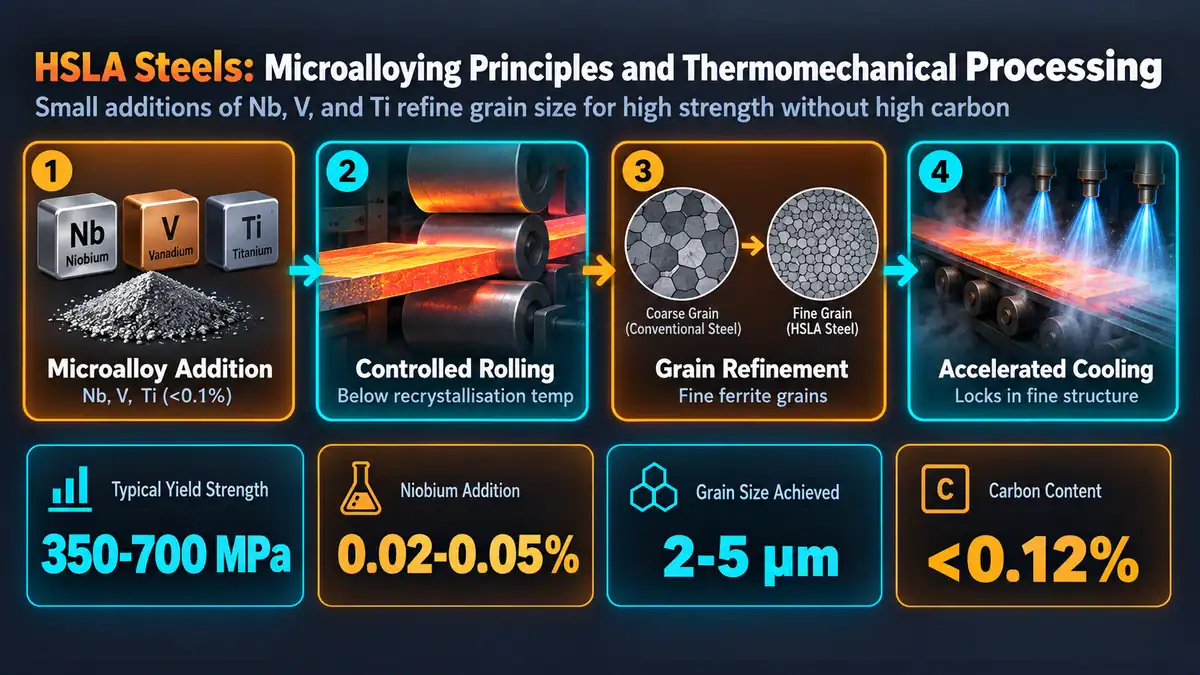
High-strength low-alloy (HSLA) steels are a family of low-carbon structural steels that achieve yield strengths significantly above plain carbon steel through the addition of small quantities of microalloying elements — principally niobium (Nb), vanadium (V), and titanium (Ti) — in combination with controlled thermomechanical processing. Total alloy addition is typically less than 0.10 wt% for each element, often less than 0.05 wt%, yet the microstructural effects are profound.
The defining characteristic of HSLA steels is the simultaneous achievement of three properties that are normally in conflict: high strength, good notch toughness, and low-carbon-equivalent weldability. Plain carbon steel can be made strong by increasing carbon content, but this reduces toughness and weldability. HSLA steels circumvent this by keeping carbon below 0.12 wt% and using microalloying to deliver strength through grain refinement and precipitation hardening instead.
Classification and Grades
HSLA steels are broadly classified by their primary strengthening mechanism and intended application:
| Category | Typical Grade / Standard | YS Range (MPa) | Primary Microalloying | Typical Application |
|---|---|---|---|---|
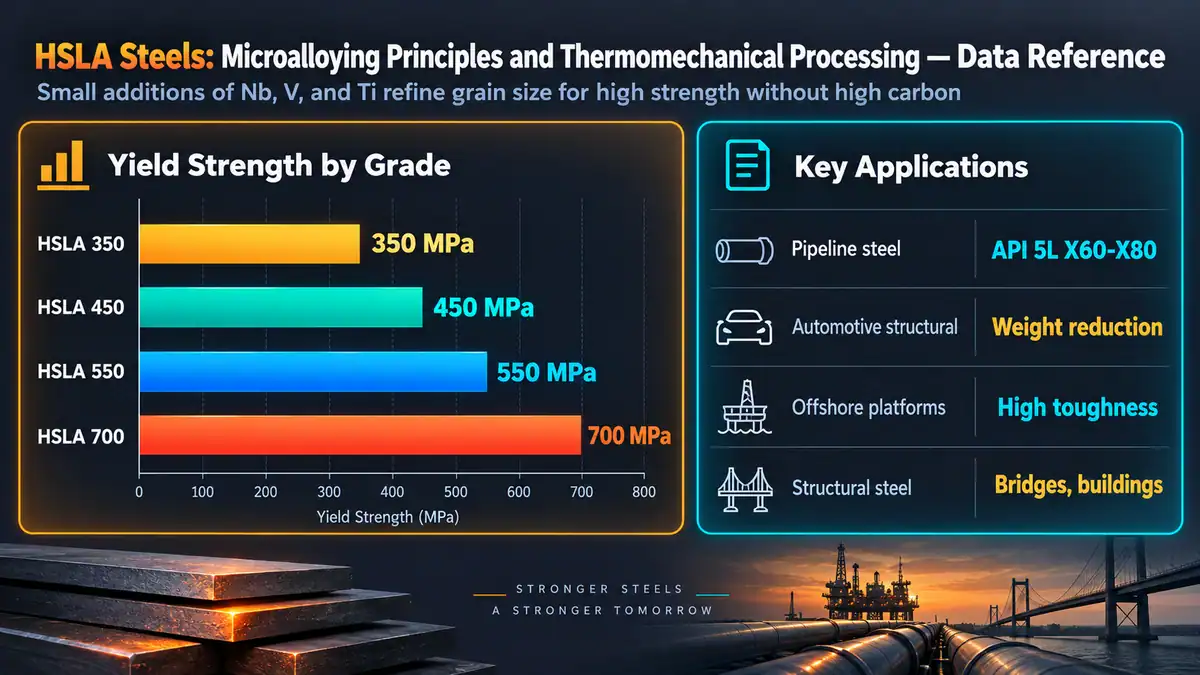
| Structural HSLA | ASTM A572 Gr. 50; EN 10025-4 S355M | 345–415 | Nb, V | Buildings, bridges, offshore platforms |
| Linepipe HSLA | API 5L X65, X70, X80 | 450–620 | Nb, V, Ti, Mo | Oil & gas pipelines, sour service |
| Automotive HSLA | ASTM A656 Gr. 80; DP600–DP780 | 480–620 | Nb, V, Ti | Chassis, frame, structural stampings |
| Weathering HSLA | ASTM A588; EN 10025-5 S355J2W | 345–415 | Cu, Cr, Ni, Nb | Bridges, architectural exposed structures |
| Fine-grain normalised | EN 10025-3 S275N/S355N/S460N | 275–460 | Al, Nb, V | Pressure vessels, shipbuilding |
| High-strength TMCP | API 5L X100, X120; EN 10225 S500Q | 690–830 | Nb, Mo, B | Ultra-high-pressure linepipe, arctic structures |
The Four Strengthening Mechanisms
The yield strength of a ferritic HSLA steel is the sum of four additive contributions. Understanding each independently allows the metallurgist to design compositions and processes that hit a target yield strength while satisfying toughness and weldability constraints.
1. Ferrite Base Strength (σ0)
The Peierls–Nabarro stress for dislocation motion in pure body-centred cubic (BCC) iron is approximately 50–70 MPa. This lattice friction stress forms the irreducible lower bound of yield strength and is minimally influenced by composition or processing within the ranges used for HSLA steels.
2. Solid Solution Strengthening
Interstitial and substitutional solutes distort the iron lattice, creating stress fields that impede dislocation glide. Manganese (typically 1.0–1.8 wt%) provides the largest solid solution contribution, approximately 30–45 MPa for each weight percent. Silicon (0.1–0.5 wt%) contributes ~80 MPa/wt%. Molybdenum and copper provide smaller but still significant contributions. The solid solution increment typically totals 50–90 MPa in standard structural grades.
A critical point: carbon and nitrogen are both powerful solid solution strengtheners in ferrite (~5000 MPa/wt%), but free interstitials also cause yield-point elongation (Luders band formation), strain ageing, and reduced toughness. Microalloying elements are added specifically to tie up carbon and nitrogen as precipitates, leaving ferrite substantially free of interstitials. This is why low-carbon HSLA steels show continuous yielding behaviour superior to plain carbon grades.
3. Grain Refinement — Hall-Petch Strengthening
Grain boundaries are barriers to dislocation transmission. The Hall-Petch relationship quantifies the increase in yield strength with decreasing grain size:
σ_y = σ_0 + k_y × d^(-1/2)

Where:
  σ_y  = yield strength (MPa)
  σ_0  = lattice friction stress ≈ 70 MPa (ferrite)
  k_y   = Hall-Petch slope ≈ 0.60 MPa·m^(1/2) (ferritic steels)
  d     = mean ferrite grain diameter (m)

Example: d = 5 µm (2.24 × 10^-3 m^(-1/2) ):
  σ_HP = 0.60 × (5×10^-6)^(-1/2) = 0.60 × 447 = 268 MPa

  d = 20 µm (conventional hot-rolled):
  σ_HP = 0.60 × (20×10^-6)^(-1/2) = 0.60 × 224 = 134 MPa

  Δσ for TMCP refining 20→5 µm = 134 MPa additional strength
Crucially, grain refinement is the only strengthening mechanism that simultaneously improves toughness. Every other mechanism (solid solution, precipitation, dislocation hardening) reduces the ductile-to-brittle transition temperature (DBTT). Refining ferrite from 20 to 5 µm shifts DBTT by approximately −50 to −80 °C, which is why TMCP HSLA plate can meet −40 °C or −60 °C Charpy requirements that are impossible for normalised plate of equivalent strength.
4. Precipitation Strengthening
Nanoscale carbide and nitride precipitates (NbC, VC, V4C3, TiC, and mixed carbonitrides) nucleate on dislocations and sub-grain boundaries during and after the austenite-to-ferrite transformation. The Orowan-Ashby equation describes the strengthening increment from a dispersion of fine precipitates:
Δσ_ppt = 0.538 × Gb × f^(1/2) / r × ln(r / b)

Where:
  G   = shear modulus of ferrite ≈ 80,000 MPa
  b   = Burgers vector ≈ 0.248 nm (BCC Fe)
  f   = volume fraction of precipitates
  r   = mean precipitate radius (nm)

Key result: maximum strengthening occurs at minimum r.
  For NbC at r ≈ 2 nm, f ≈ 0.001: Δσ ≈ 80-120 MPa
  For VC at r ≈ 4 nm, f ≈ 0.002: Δσ ≈ 50-100 MPa
Precipitation hardening is maximised when precipitates form at the highest possible nucleation density, which requires transformation at relatively low temperatures (promoting supersaturation) and sufficient microalloying element content. Interphase precipitation, where rows of carbide sheets nucleate on the migrating austenite/ferrite interface, is particularly effective for V(C,N) in steels with elevated nitrogen content.
Roles of Individual Microalloying Elements
Niobium (Nb) — The Grain Refiner
Niobium is the most widely used and, gram-for-gram, the most metallurgically potent microalloying element for grain refinement. Its effects operate through three distinct mechanisms:
Solute Drag on Austenite Grain Boundaries
Nb in solution has a low diffusivity in austenite and a strong segregation tendency to grain boundaries (binding energy ~150 kJ/mol). This solute drag effect retards austenite grain boundary migration after recrystallisation, suppressing grain coarsening above the solubility limit temperature. More importantly, Nb in solution dramatically raises the temperature below which austenite cannot recrystallise after deformation — the non-recrystallisation temperature Tnr.
Austenite Recrystallisation Retardation
During hot rolling, each pass plastically deforms the austenite. Above Tnr, austenite recrystallises between passes (static recrystallisation, SRX), refining the grain size. Below Tnr, Nb in solution and fine Nb(C,N) precipitates impede SRX, causing deformation to accumulate in flattened (pancaked) austenite grains with high dislocation density and extensive deformation bands. These deformation bands act as additional ferrite nucleation sites during subsequent cooling, multiplying the number of ferrite grains formed per unit volume austenite.
T_nr (°C) = 887 + 464C + (6445Nb - 644√Nb)
              + (732V - 230√V) + 890Ti + 363Al - 357Si

Example: 0.07%C, 0.040%Nb, 0.020%V, 0.015%Ti, 0.030%Al, 0.25%Si
  = 887 + 32.5 + (257.8 - 128.8) + (14.6 - 32.6) + 13.4 + 10.9 - 89.5
  = 965 °C

Controlled rolling below this temperature pancakes austenite.
Precipitation in Ferrite
After transformation, residual Nb in solution precipitates as NbC and Nb(C,N) in ferrite, providing an additional 40–80 MPa of precipitation strengthening. Nb(C,N) precipitates that formed in austenite during rolling (strain-induced precipitation) are typically coarser and contribute less to ferrite strengthening.
Typical Nb addition: 0.020–0.060 wt%. Above ~0.06 wt%, the incremental benefit per unit cost diminishes and solubility in austenite at standard reheating temperatures (1150–1250 °C) becomes a concern.
log[Nb][C] = 3.11 − 7900/T (T in Kelvin)
At 1200 °C (1473 K): log[Nb][C] = 3.11 − 5.36 = −2.25, so [Nb][C] = 5.6 × 10⁻³. For 0.08%C, maximum Nb in solution = 0.070 wt%. Reheating at 1150 °C dissolves less Nb; at 1250 °C, more is available for grain refinement effects during rolling.
Vanadium (V) — The Precipitation Hardener
Vanadium has considerably higher solubility in austenite than Nb, meaning most V remains in solution throughout hot rolling (V carbide and nitride dissolve during reheating at 1100–1200 °C and do not re-precipitate in austenite during rolling). As a result, V contributes little to Tnr elevation or austenite grain boundary pinning and is not primarily a grain-refining element.
V's principal role is interphase precipitation: as the austenite/ferrite interface migrates during transformation, V(C,N) precipitates nucleate periodically on the interface, forming parallel rows or sheets of fine carbide particles (typically 2–10 nm) spaced 5–50 nm apart within ferrite grains. This interphase precipitation is particularly effective when nitrogen content is elevated above 0.010 wt%, because VN is less soluble than VC and nucleates more copiously.
Vanadium carbide: log[V][C] = 6.72 - 9500/T
Vanadium nitride: log[V][N] = 3.02 - 7700/T

At 900°C (1173 K):
  V carbide: log[V][C] = 6.72 - 8.10 = -1.38  ⇒ [V][C] = 0.042
  V nitride:  log[V][N] = 3.02 - 6.57 = -3.55  ⇒ [V][N] = 2.8×10^-4

∴ VN is far less soluble than VC — nitrogen drives V precipitation at higher T,
   producing finer, more abundant precipitates at a given V content.
Typical V addition: 0.040–0.120 wt%. V is less expensive than Nb and is the preferred microalloying element for bar and rod products (where V can also be used for controlled cooling microalloying without a rolling mill). V is the primary microalloying element in microalloyed forging steels (see also the microalloyed forging steels guide).
Titanium (Ti) — Nitrogen Fixer and High-Temperature Stabiliser
Titanium nitride (TiN) has the highest thermodynamic stability of any carbide or nitride in HSLA steels; it precipitates above 1400 °C during solidification and survives slab reheating temperatures of 1150–1250 °C without dissolving. This thermal stability makes Ti the preferred element for two specific functions:
Austenite Grain Pinning During Reheating
If slab reheating is performed without Ti (or with insufficient Ti), Nb(C,N) dissolves on heating above ~1100 °C, removing the grain boundary pinning particles just when the austenite is being held at high temperature. TiN particles remain intact, and their Zener pinning force (proportional to f/r, the volume fraction-to-radius ratio) limits austenite grain coarsening during the reheat hold. Typical TiN particle size after casting is 0.1–1 µm, which provides some pinning but coarser than optimal; very fine TiN precipitated in the solid state (down to 10–30 nm) provides more effective pinning.
Free Nitrogen Fixation and HAZ Toughness
Free nitrogen in weld heat-affected zones (HAZ) promotes BN and Fe16N2 precipitation during post-weld cooling, which embrittles the HAZ through nitrogen pinning of dislocations and precipitation at grain boundaries. By fixing nitrogen as TiN before welding, Ti additions protect HAZ toughness. The stoichiometric Ti:N mass ratio for complete nitrogen fixation is 3.42; in practice, Ti:N = 3.5–4.0 is targeted. For high-heat-input welds (SAW, FCAW with large heat input), Ti-oxide particles in the weld metal can also act as nuclei for acicular ferrite, improving weld metal toughness independently of the HAZ effect.
TiN stoichiometric mass ratio: M_Ti / M_N = 47.87 / 14.01 = 3.42

For complete N fixation:
  Ti_required (wt%) = 3.42 × N (wt%)

Example: N = 0.008% ⇒ Ti_required = 0.027%
  Recommended target: Ti = 0.030-0.035% (slight excess → TiC precipitates in ferrite)

Excess Ti beyond stoichiometry:
  Ti_excess precipitates as TiC (solubility: log[Ti][C] = 5.33 - 10475/T)
  TiC dissolves above ~1100°C → minimal austenite pinning at rolling temperatures
Typical Ti addition in Nb-Ti combined grades: 0.010–0.025 wt%. In Ti-only microalloyed steels (less common): 0.05–0.15 wt%. Excessive Ti beyond the stoichiometric requirement is counterproductive as coarse TiN cuboidal particles formed during solidification act as stress concentrators and reduce fatigue resistance.
Combined Nb-V-Ti Microalloying
Most modern structural and linepipe HSLA grades use combinations of microalloying elements to exploit complementary mechanisms. A typical X70 linepipe steel might contain 0.04%Nb + 0.05%V + 0.015%Ti + 0.10%Mo, where Nb controls austenite conditioning during TMCP, V provides interphase precipitation strengthening in ferrite, Ti fixes nitrogen and pins austenite during reheating, and Mo suppresses polygonal ferrite formation and shifts the transformation to lower temperature bainitic ferrite. See the linepipe steels API 5L guide for grade-specific compositions.
Thermomechanical Controlled Processing (TMCP)
Microalloying additions achieve their full potential only when combined with TMCP — a rolling strategy that exploits the metallurgical state of austenite at each stage of deformation to maximise the nucleation density for fine ferrite formation. TMCP consists of three conceptually distinct stages.
Stage I: Recrystallisation Rolling (above Tnr)
Rough rolling at high temperature (typically above 1050–1100 °C) causes repeated cycles of deformation and static recrystallisation between passes. Each recrystallisation event refines the austenite grain size. The objective is to enter the controlled rolling stage with an austenite grain size of 30–50 µm rather than the 100–300 µm present in the cast slab. Reheating temperature (typically 1150–1250 °C) must be sufficient to dissolve Nb into solution for subsequent solute drag effects.
Stage II: Controlled Rolling (below Tnr)
Once the rolling temperature falls below Tnr, Nb in solution (and fine Nb(C,N) precipitates formed by strain-induced precipitation) inhibit austenite recrystallisation. Deformation in this regime pancakes the austenite grains without recovery: the aspect ratio of austenite grains changes from equiaxed (~1:1) to flat pancakes with aspect ratios of 5:1 to 10:1. The deformed austenite contains:
- A high dislocation density within grain interiors
- Mechanical twins and deformation bands
- Increased grain boundary area per unit volume
- Increased triple junction density
All of these features are potential nucleation sites for ferrite during the subsequent phase transformation. The available nucleation density in a pancaked austenite can be 10–50 times higher than in an equiaxed austenite of the same grain size, directly translating to a correspondingly finer ferrite grain size after transformation.
Stage III: Accelerated Cooling (ACC) or Direct Quenching (DQ)
After the final rolling pass, the plate can be allowed to air-cool (producing polygonal ferrite + pearlite microstructure) or subjected to accelerated cooling using water curtains or laminar cooling. Accelerated cooling serves two purposes:
- It increases the undercooling below the Ae3 temperature, suppressing polygonal ferrite formation and producing acicular ferrite or bainitic ferrite, which has a finer effective grain size and higher dislocation density than polygonal ferrite.
- It retains more Nb, V, and Mo in solution at the start of transformation, increasing the driving force for fine interphase precipitation in ferrite.
Cooling rate, stop temperature (typically 450–600 °C for structural grades; lower for linepipe grades), and the microalloying composition are optimised together to avoid martensite formation (which would be too hard and brittle) while achieving the desired microstructure. The martensite formation and annealing and normalising articles provide the transformation context for these temperature windows.
Weldability of HSLA Steels
Weldability — specifically resistance to hydrogen-induced cold cracking (HIC) in the heat-affected zone — is a primary design constraint for HSLA steels used in structural applications. Cold cracking requires the simultaneous presence of a susceptible (hard) microstructure, diffusible hydrogen, and tensile residual stress. Composition control reduces HAZ hardness; the carbon equivalent quantifies this risk.
Carbon Equivalent Indices
Two indices are in common use. CEIIW (International Institute of Welding formulation) was developed for C > 0.18 wt% steels; the Pcm index is preferred for the low-carbon HSLA grades where C < 0.12 wt%.
IIW Carbon Equivalent:
  CE_IIW = C + Mn/6 + (Cr+Mo+V)/5 + (Ni+Cu)/15
  Guideline: CE < 0.43 → no preheat required (t < 25 mm, H ≤ 5 mL/100g)

Pcm Index (Ito-Bessyo, preferred for C < 0.12%):
  Pcm = C + Si/30 + (Mn+Cu+Cr)/20 + Ni/60 + Mo/15 + V/10 + 5B
  Guideline: Pcm < 0.20 → no preheat for standard structural applications

Example: API 5L X70 (0.07C, 1.60Mn, 0.04Nb, 0.05V, 0.10Mo, 0.25Si)
  CE_IIW = 0.07 + 1.60/6 + (0+0.10+0.05)/5 + 0/15
         = 0.07 + 0.267 + 0.030 = 0.367  (well below 0.43)
  Pcm = 0.07 + 0.25/30 + (1.60)/20 + 0.10/15 + 0.05/10
      = 0.07 + 0.008 + 0.080 + 0.007 + 0.005 = 0.170  (< 0.20 ✓)
The HAZ adjacent to a weld bead experiences a steep thermal gradient from the fusion line (above liquidus) to the unaffected base metal. Different HAZ sub-zones form: the coarse-grain HAZ (CGHAZ) immediately adjacent to the weld, where grain growth occurs; the fine-grain HAZ (FGHAZ) further out; and the inter-critical HAZ, heated between Ac1 and Ac3. In HSLA steels with Ti, TiN particles partially resist grain growth in the CGHAZ, maintaining better CGHAZ toughness than in plain C-Mn steels. For detailed HAZ microstructure analysis see the HAZ microstructure guide and for hydrogen cracking mechanisms see the hydrogen-induced cracking article.
Effect of Microalloying on HAZ Hardness
The dominant factor in HAZ cold cracking susceptibility is the maximum hardness of the CGHAZ, which should not exceed 350 HV10 for standard structural applications (AWS D1.1) or 248 HV for sour service (NACE MR0175/ISO 15156). HSLA steels achieve low HAZ hardness through their low carbon content; the microalloying elements themselves (at the concentrations used) contribute only modestly to HAZ hardenability. Boron is an exception — even at 0.001 wt%, B dramatically increases hardenability by segregating to austenite grain boundaries and suppressing ferrite nucleation, and is used in some high-strength TMCP grades with caution.
Industrial Applications
Structural and Bridge Construction
ASTM A572 Grade 50 (345 MPa yield, CE < 0.45) is the dominant structural plate used in North American building frames, bridges, and offshore jackets. EN 10025-4 S355M/S420M are the European equivalents. The combination of high yield strength and reliable notch toughness (typically 27 J minimum at −20 °C or −40 °C) allows designers to reduce section sizes relative to ASTM A36, with direct material cost savings. The grain boundaries guide provides context for how the fine grain microstructure produces the required impact toughness.
Oil and Gas Linepipe
API 5L X65 through X80 remain the backbone of global high-pressure natural gas transmission, with X70 (480 MPa yield minimum) the most widely used grade. These steels use Nb-V-Ti-Mo microalloying with TMCP and ACC to produce bainitic-ferritic microstructures. For sour service (H2S environments), HIC resistance requires a clean steel with low sulphur (<0.003 wt% S, with Ca treatment for shape control of MnS inclusions), low carbon equivalent, and fine banded-free microstructure to resist hydrogen blistering and step cracking.
Automotive Lightweighting
The automotive industry uses HSLA grades (ASTM A656 Grade 80; ASTM A1011 HSLAS Grade 50–80) in chassis, frame rails, and structural stampings where high yield strength reduces section thickness and vehicle mass. Dual-phase (DP) and transformation-induced plasticity (TRIP) steels used in automotive body-in-white are technically AHSS (advanced high-strength steels) rather than HSLA, but the microalloying concepts (Nb for grain refinement, V for precipitation hardening) overlap substantially.
Shipbuilding and Offshore
Classification society rules (DNV, Lloyd's, ABS, BV) specify HSLA plate grades for hull and offshore structural applications. AH32, AH36, AH40, DH40, and EH40 denote strength (A/D/E/F series by impact temperature: A = 0 °C, D = −20 °C, E = −40 °C, F = −60 °C) with yield strengths of 315–390 MPa. For arctic and sub-arctic applications, EH and FH grades produced by TMCP achieve −60 °C Charpy values of 34 J minimum at ferrite grain sizes of 4–6 µm.
| Element | Typical Range (wt%) | Primary Mechanism | Tnr Effect | Ferrite Strengthening |
|---|---|---|---|---|
| Nb | 0.020–0.060 | Grain refinement via solute drag + boundary pinning | +50 to +100 °C/0.05%Nb | NbC precipitation: 40–120 MPa |
| V | 0.040–0.120 | Interphase precipitation of V(C,N) | Minor (+10–20 °C) | VC/VN precipitation: 50–150 MPa |
| Ti | 0.010–0.025 (combined grade) | TiN pins austenite; fixes N; HAZ toughness | +20–40 °C | TiC (minor): 10–30 MPa |
| Mo | 0.05–0.30 | Suppresses polygonal ferrite; promotes bainitic ferrite | Retards recrystallisation (synergy with Nb) | Solid solution: 25–60 MPa/0.1%Mo |
| B | 0.0005–0.0030 | Hardenability (grain boundary segregation suppresses ferrite nucleation) | None | Indirect via microstructure: up to 100 MPa |
| Al | 0.02–0.05 | Deoxidation; AlN grain refinement (normalised grades) | Minor | Minor via grain refinement if AlN active |
Key Formulas Summary
The following relationships are essential for quantitative HSLA steel design:
σ_y = σ_0 + k_y × d^(-1/2) [k_y ≈ 0.60 MPa·m^(1/2); σ_0 ≈ 70 MPa]
Δσ_ppt = 0.538 Gb f^(1/2) / r × ln(r/b) [G=80,000 MPa; b=0.248 nm]
T_nr = 887 + 464C + (6445Nb - 644√Nb) + (732V - 230√V) + 890Ti + 363Al - 357Si [°C]
CE_IIW = C + Mn/6 + (Cr+Mo+V)/5 + (Ni+Cu)/15
Pcm = C + Si/30 + (Mn+Cu+Cr)/20 + Ni/60 + Mo/15 + V/10 + 5B
r_z = 4r / (3f)   [limiting grain radius as function of particle radius r and volume fraction f]

Smaller precipitates and higher volume fraction → finer limiting grain size
Example: TiN at r=15nm, f=0.0003 → r_z = 4×15/(3×0.0003) = 66,667 nm = 67 μm
         TiN at r=5 nm, f=0.0005 → r_z = 4×5/(3×0.0005) = 13,333 nm = 13 μm
For interactive calculation of grain size strengthening and Hall-Petch relationships, see the metallurgy calculators hub. The iron-carbon phase diagram underpins the phase transformation temperatures (Ae1, Ae3) referenced throughout this article.
Frequently Asked Questions
What distinguishes HSLA steels from conventional carbon-manganese steels?
What is the role of niobium in HSLA steel?
How does vanadium differ from niobium as a microalloying element?
What is thermomechanical controlled processing (TMCP)?
How is the non-recrystallisation temperature (T_nr) estimated for HSLA steels?
What is the Hall-Petch relationship and how does it apply to HSLA steels?
Why is titanium added to HSLA steels and what is the critical Ti:N ratio?
How does carbon equivalent govern the weldability of HSLA steels?
What ASTM and EN standards cover HSLA steels?
Can HSLA steels be heat treated after rolling?
Recommended References
Further Reading
