Tool Steel Classification and Selection: W, O, A, D, H, M, and T Grades
Tool steels form a technically distinct subset of alloy steels engineered to cut, form, blank, or shape other materials at ambient or elevated temperatures. The AISI classification system divides commercial tool steels into seven principal families — water-hardening (W), oil-hardening (O), air-hardening (A), high-carbon high-chromium (D), hot-work (H), molybdenum high-speed (M), and tungsten high-speed (T) — each optimised for a different balance of hardness, toughness, wear resistance, and thermal stability. Selecting the correct grade requires systematic analysis of service temperature, loading mode, dimensional tolerances, and production economics.
Key Takeaways
- AISI tool steels are divided into W, O, A, D, H, M, and T families on the basis of quench medium, service temperature, and alloy content.
- Cold work grades (W, O, A, D) operate below ~200–300°C; hot work grades (H) retain strength and toughness up to 600–650°C; high speed steels (M, T) maintain cutting hardness to ~600°C.
- D2 (12% Cr, 1.5% C) provides the highest wear resistance among cold work steels; H13 (5% Cr, 1% Mo, 1% V) is the benchmark for pressure die casting and aluminium extrusion tooling.
- M2 is the world's most widely used high speed steel, offering an optimum balance of red hardness, toughness, and grindability at economic cost.
- Secondary hardening in high speed steels requires two to three temper cycles at 540–560°C to transform retained austenite and achieve full secondary hardness (64–67 HRC for M2).
- Tool steel selection is governed by the service parameter triangle: wear resistance, toughness, and hot hardness — improving any two typically reduces the third.
The AISI Tool Steel Classification System
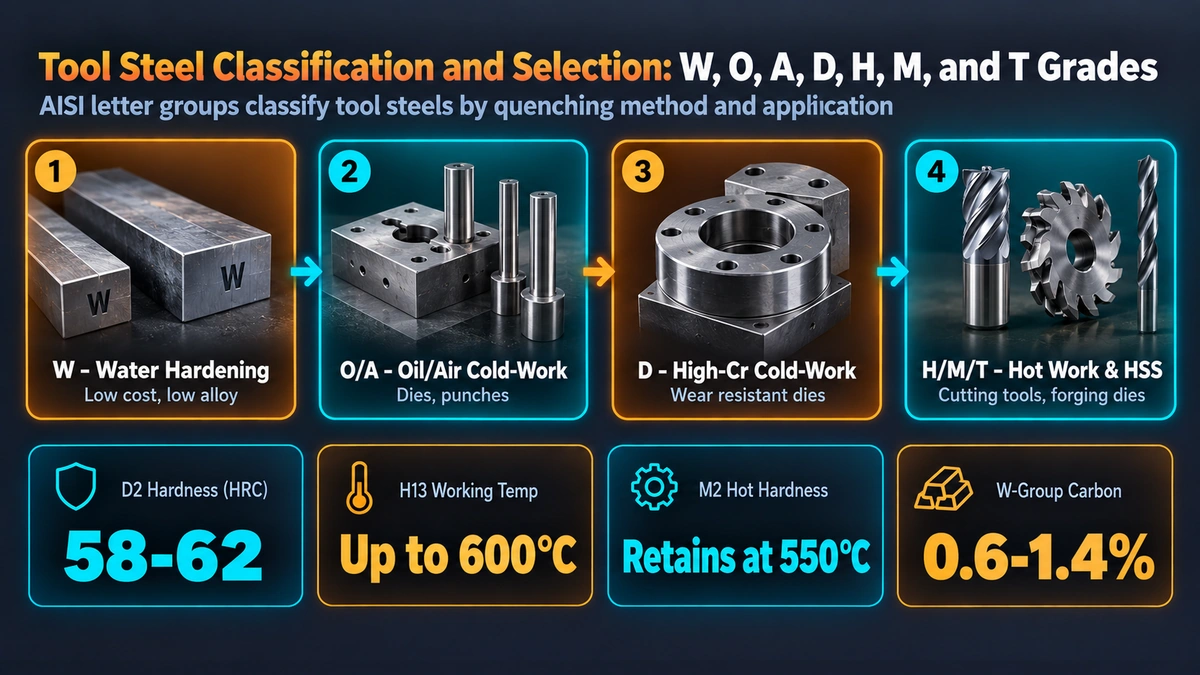
The American Iron and Steel Institute (AISI) classification system, codified in ASTM A600 (high speed steels) and recognised industry-wide, assigns a letter–number designation to each tool steel grade. The letter identifies the family type, and the number distinguishes grades within that family. This system is widely used in North America, with approximate equivalents in European (EN ISO 4957) and Japanese (JIS G4404) standards.
| AISI Prefix | Full Name | Quench Medium | Typical Service Temp. | Key Property Balance |
|---|---|---|---|---|
| W | Water-Hardening | Water / brine | <150°C | Highest toughness, lowest alloy cost |
| O | Oil-Hardening | Oil | <200°C | Good toughness, moderate wear resistance |
| A | Air-Hardening | Air / still air | <250°C | Minimal distortion, moderate wear resistance |
| D | High-C, High-Cr Die | Air / oil | <300°C | Maximum wear resistance in cold work |
| H | Hot-Work | Air / oil / gas | 400–650°C | Hot hardness, thermal fatigue resistance |
| M | Molybdenum High Speed | Air / oil (high temp) | Up to ~600°C | Red hardness, wear resistance, grindability |
| T | Tungsten High Speed | Air / oil (high temp) | Up to ~600°C | Red hardness, dimensional stability, grindability |
The system also includes shock-resistant (S), mold steels (P), and special-purpose (L, F) families, though W, O, A, D, H, M, and T account for the overwhelming majority of commercial production. Grade selection begins by identifying the dominant service requirement — cold forming, cutting, hot forming, or moulding — and then optimising within that family on the basis of section size, distortion tolerance, and surface treatment requirements.
W Grades: Water-Hardening Tool Steels
W-grade tool steels are essentially high-carbon plain-carbon or slightly alloyed steels. W1 contains 0.70–1.50% C (depending on sub-grade) with only minor Mn and Si; W2 adds ~0.25% V for grain refinement and improved toughness; W5 contains ~0.5% Cr for slightly deeper hardenability. The extremely shallow hardenability of W grades means that water or brine quenching produces a hard martensitic surface layer and a tough, pearlitic core in sections above approximately 25 mm — a case/core structure that is either an advantage (shock-loaded tools) or a constraint (large sections requiring through-hardening).
Composition and Hardenability
The low alloy content of W steels means the critical cooling rate is high: hardenability is typically expressed as a Jominy distance of J1/2 < 5 mm at 50 HRC. This shallow hardenability limits section size to approximately 25–50 mm for through-hardened applications. Carbon content is the primary lever for hardness: the achievable as-quenched martensitic hardness increases with carbon up to approximately 1.0% C (where it reaches ~65 HRC), then plateaus or declines slightly as retained austenite content increases.
Heat Treatment of W Grades
W1 (1.0% C) Heat Treatment Cycle:
  Harden:   790–815°C (austenitise), soak 5–15 min
  Quench:   Water or brine (quench rate critical)
  Temper:   150–200°C × 1 h → 62–65 HRC (surface)
  Core:     Remains at 30–40 HRC (tough pearlite/bainite)
The abrupt thermal shock of water quenching produces significant residual stresses and high quench crack risk in complex geometries. Pre-heating to 650–700°C before transferring to the austenitising furnace minimises thermal shock. Tempering at 150–200°C relieves quench stress without significantly sacrificing hardness; higher temper temperatures soften too rapidly due to the low alloy content. W grades are applied to chisels, centre punches, blanking punches with simple geometry, and woodworking tools.
O Grades: Oil-Hardening Tool Steels
Oil-hardening tool steels contain sufficient alloy (typically Mn, Cr, W, and/or V) to harden fully in oil or polymer quench, reducing distortion and quench crack risk compared with W grades. O1 is the workhorse grade: 0.90% C, 1.0% Mn, 0.5% Cr, 0.5% W, with a standard austenitising temperature of 790–815°C. The slower quench medium (oil versus water) reduces quench severity, allowing harder and more dimensionally consistent tooling, particularly in sections up to 75 mm diameter.
O1 vs O2 vs O6
| Grade | C% | Mn% | Cr% | W% | Distinguishing Feature |
|---|---|---|---|---|---|
| O1 | 0.90 | 1.0 | 0.50 | 0.50 | General purpose, balanced properties |
| O2 | 0.90 | 1.60 | – | – | Higher Mn for air cooling in thin sections |
| O6 | 1.45 | 0.80 | – | – | Graphitic C: free graphite improves machinability and lubricity |
| O7 | 1.20 | 1.0 | 0.75 | 1.75 | Higher W for slightly better hot hardness; edge retention |
O6 is unique among tool steels in containing free graphite in the annealed microstructure, providing built-in lubricity advantageous in gauges and bushings. The graphite precipitates form because total carbon exceeds the graphite eutectic solubility limit under very slow controlled annealing. O grades are widely used for punches, dies, gauges, taps, reamers, and light-duty blanking dies where distortion must be tightly controlled but extreme wear resistance is not demanded.
A Grades: Air-Hardening Medium-Alloy Cold-Work Tool Steels
A-grade tool steels harden by cooling in still or forced air from the austenitising temperature, producing the lowest dimensional change and quench stress of any hardened tool steel family. A2 is the most widely used grade: 1.0% C, 5.2% Cr, 1.0% Mo, 0.25% V. The 5% Cr and 1% Mo substantially depress the critical cooling rate, enabling through-hardening of sections up to approximately 150 mm by air cooling alone. Chromium carbides contribute moderate abrasion resistance, and the relatively low austenitising temperature (950–970°C) keeps grain size fine.
A2: The Industry-Standard Air-Hardening Grade
A2 Heat Treatment:
  Preheat:       650°C × 30 min (equalise temperature)
  Austenitise:   950–970°C × 20–30 min (section dependent)
  Quench:        Still air or slow fan; cool to below 65°C before temper
  Temper:        175–540°C; typical precision tools: 175–200°C → 60–62 HRC
  Distortion:    Typically <0.025 mm per 100 mm (dimensional change)
  Section:       Through-hardens to ~150 mm Ø in air
The stability of A2 in air quench makes it the preferred grade for long punches and intricate die inserts where oil quenching would cause warping or cracking. At 175°C temper, A2 provides 60–62 HRC. At higher temper temperatures (200–300°C), hardness drops to 57–60 HRC but toughness improves significantly for applications involving impact loading. A2 is used in blanking dies, trimming dies, precision thread rolls, gauges, form tools, and cold extrusion punches.
A7 contains significantly more carbon (2.25%) and vanadium (4.75%), generating a high volume fraction of extremely hard VC carbides that provide wear resistance approaching D grades but with improved toughness due to the finer carbide distribution achievable with higher vanadium. A7 is selected when abrasive wear is the dominant failure mode and D2 provides insufficient toughness.
D Grades: High-Carbon, High-Chromium Cold-Work Die Steels
D-grade tool steels contain 1.4–2.35% C and 11.5–13.5% Cr, placing them in the ledeburitic composition range. This very high combined carbon and chromium content produces a large volume fraction (~20–30% by area) of chromium carbides (Cr7C3 and mixed (Cr,Fe)7C3) in the as-cast and annealed microstructure. These carbides, with hardness of approximately 1600–1800 HV, provide the outstanding abrasion resistance for which D grades are renowned. D2 is the most widely used grade globally and one of the most important cold-work tool steels.
D2: Composition, Carbide Metallurgy, and Heat Treatment
| Grade | C% | Cr% | Mo% | V% | Co% | Key Character |
|---|---|---|---|---|---|---|
| D2 | 1.50 | 12.0 | 0.95 | 0.90 | – | Benchmark; air hardens, 58–62 HRC |
| D3 | 2.25 | 12.0 | – | – | – | Higher C, oil quench, max wear resistance |
| D4 | 2.25 | 12.0 | 0.80 | – | – | As D3 + Mo for air hardening capability |
| D5 | 1.50 | 12.0 | 0.95 | – | 3.0 | Co addition for improved hot hardness |
| D7 | 2.35 | 12.5 | 0.80 | 4.0 | – | Maximum wear; high VC carbide fraction |
Austenitising temperature is critical for D2: below 1000°C, insufficient carbide dissolution limits hardness to <58 HRC. Above 1050°C, austenite grain coarsening and excess retained austenite after quenching reduce both hardness and toughness. The optimal range 1010–1040°C must be held for 15–45 min depending on section size to achieve the target carbon and chromium concentration in austenite.
Secondary Hardening and Tempering of D2
D2 exhibits a mild secondary hardening peak at 450–525°C due to precipitation of fine Mo2C and VC carbides from the martensite. However, tempering in the secondary hardening range for cold-work applications is unusual; most D2 tooling is double-tempered at 150–200°C to achieve 60–62 HRC with adequate toughness for blanking and forming. Retained austenite content after standard quenching from 1030°C is typically 20–30%; cryogenic treatment at −80 to −196°C reduces this to <3%, improves dimensional stability, and is recommended for precision gauges and critical forming dies.
D2 Heat Treatment:
  Preheat:      600°C × 30 min, then 850°C × 20 min
  Austenitise:  1010–1040°C × 15–45 min (section-dependent)
  Quench:       Air cool (still or slow fan); Mf ≈ −30°C
  Cryo (opt.):  −80°C to −196°C × 2 h immediately after quench
  Temper:       Double temper: 150–200°C × 2 h + 2 h
  Final HRC:    60–62 (standard), 58–60 (with higher temper for toughness)
D grades dominate high-volume blanking and stamping dies for sheet metal forming, thread-rolling dies, wire-drawing dies, cold-forming punches, and cutting blades where millions of parts are produced and abrasive wear is the principal failure mechanism. D2 represents the upper bound of practical wear resistance available from conventional cold-work die steels; grades requiring yet higher wear resistance transition to powder-metallurgy (PM) tool steels such as CPM 10V or CPM 15V.
H Grades: Hot-Work Tool Steels
Hot-work tool steels must withstand elevated service temperatures (typically 300–650°C) while maintaining adequate hardness, strength, and toughness. They are designed to resist thermal fatigue (heat-checking) from cyclic heating and cooling, resist washout by flowing hot metal, and maintain dimensional stability under sustained load at temperature. H grades are divided into three sub-families based on dominant alloying element: chromium (H10–H19), tungsten (H20–H26), and molybdenum (H40–H43).
H13: The Benchmark Hot-Work Grade
H13 (0.38% C, 5.2% Cr, 1.35% Mo, 1.0% V, 1.0% Si) is unquestionably the most widely used hot-work steel globally, dominating pressure die casting dies for aluminium, magnesium, and zinc alloys, aluminium and copper extrusion tooling, and hot forging dies. Its success stems from an optimised property combination that no other grade has bettered in cost-performance terms:
| Property | H13 Value (as heat treated) | Design Significance |
|---|---|---|
| Hardness (die casting) | 44–48 HRC | Resist washout and erosion by molten Al |
| Impact toughness (CVN) | 14–20 J at 44 HRC | Resist mechanical fatigue from shot pressure |
| Thermal conductivity | ~24 W/(m·K) at 20°C | Efficient die cooling; affects cycle time |
| Softening resistance | Retains >40 HRC after 100 h at 600°C | Resistance to temper softening during service |
| SDAS (prim. dendr.) | Premium grade: <12 μm | Fine microstructure = better fatigue life |
H13 Heat Treatment
H13 Heat Treatment Cycle:
  Preheat:       600°C × 1 h, then 850°C × 30 min
  Austenitise:   1010–1040°C × 20–40 min
  Quench:        High-pressure gas (N2 at ≥5 bar recommended for premium dies)
                 or oil quench + immediate temper
  Temper:        Double temper: 560–600°C × 2 h + 2 h → 44–48 HRC for die casting
                              or 45–48 HRC (extrusion) / 48–52 HRC (hot forging)
  Note:          Cool to below 65°C between temper cycles
Premium H13 specifications for die casting (e.g., NADCA 207 standard) impose tight cleanliness limits (sulphur ≤0.003%, total oxygen ≤15 ppm), narrow hardness tolerance (±1 HRC), and a minimum Charpy impact value at service hardness. Gas quenching from vacuum furnaces is preferred over oil quenching because it produces more uniform cooling across large die blocks, reducing residual stress and distortion, and avoiding the fire and contamination hazards of oil.
H11, H21, H42: Comparison
| Grade | C% | Cr% | W% | Mo% | V% | Application |
|---|---|---|---|---|---|---|
| H11 | 0.35 | 5.0 | – | 1.5 | 0.4 | Aircraft components, structural die castings; highest toughness in H-Cr family |
| H13 | 0.38 | 5.2 | – | 1.35 | 1.0 | Pressure die casting, extrusion, hot forging; benchmark grade |
| H21 | 0.35 | 3.5 | 9.0 | – | – | Brass/copper die casting; high W for hot hardness in very high-temp service |
| H42 | 0.60 | 4.0 | 6.0 | 5.0 | 2.0 | Hot shear blades, trim dies; bridges hot work and high speed families |
M Grades: Molybdenum-Series High Speed Steels
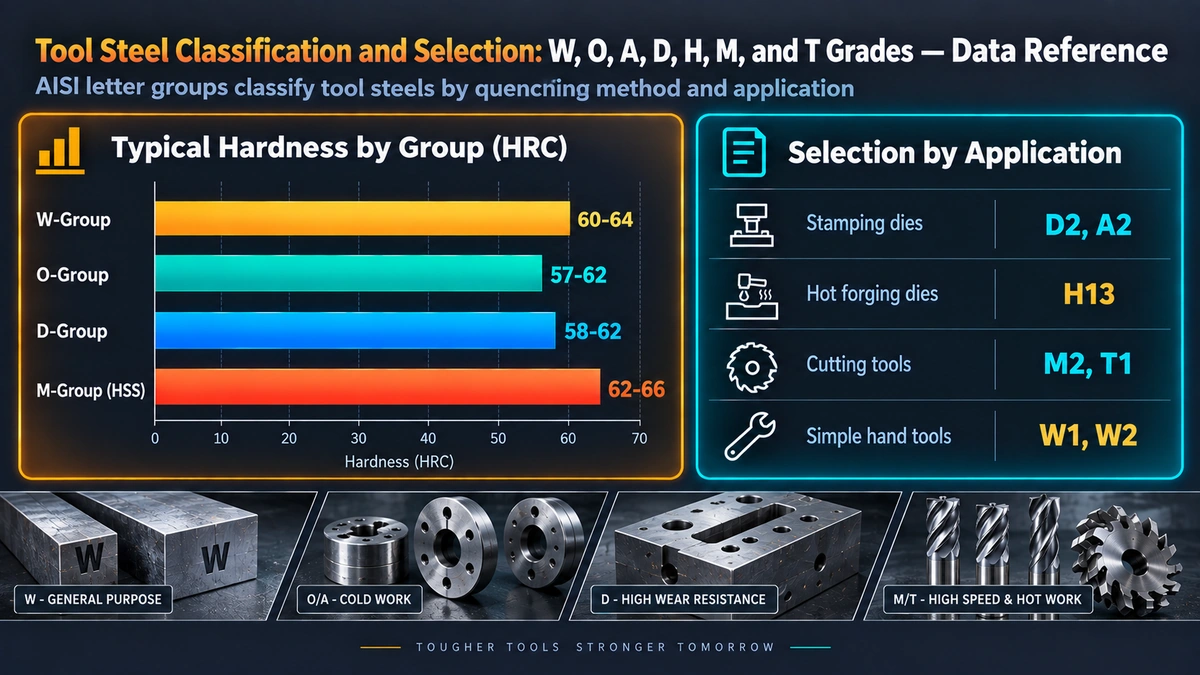
High speed steels (HSS) are defined by their ability to maintain cutting-edge hardness (>60 HRC) at elevated chip temperatures up to approximately 600°C — the property commonly called red hardness or hot hardness. This property arises from a matrix highly alloyed with carbide-forming elements (Mo, W, Cr, V) that form thermally stable secondary carbides (M2C, MC, M6C) during tempering, and a martensite matrix strengthened by these alloy elements in solid solution. Molybdenum-series (M grades) constitute approximately 90% of HSS production globally, having largely displaced the tungsten series (T grades) since the 1950s on cost grounds (Mo density is about half that of W).
M2: The Standard High Speed Steel
M2 (0.85% C, 4.2% Cr, 5.0% Mo, 6.4% W, 1.9% V) is the industry reference grade against which all other cutting tool materials are benchmarked. Its balanced composition provides an optimal combination of:
Secondary Hardening in M2
The heat treatment of M2 is significantly more complex than cold work grades due to the need to dissolve large alloy carbides at high austenitising temperature while controlling grain growth, and the secondary hardening requirement during tempering. Key parameters are:
M2 Heat Treatment:
  Preheat:       500–600°C, then 850–900°C × 15–30 min (equalise)
  Austenitise:   1200–1230°C × 2–5 min (very short soak — grain growth risk)
  Quench:        Air / salt bath (560°C) / oil (sections >25 mm)
  As-quenched:   ~64–66 HRC (but high retained austenite ~20–30%)
  Temper 1:      540–560°C × 1 h → partial RA transform + carbide precipitation
  Temper 2:      540–560°C × 1 h → further RA transform
  Temper 3:      540–560°C × 1 h → final RA <2%, secondary hardness peak
  Final HRC:     64–67 HRC (secondary hardness peak)
  Note:          Cool to <65°C between each temper cycle
The high austenitising temperature (1200–1230°C) is necessary to dissolve sufficient W, Mo, V, and C into the austenite matrix; insufficient dissolution leads to a low secondary hardening response and poor cutting performance. However, the short soak time (2–5 min) is critical: M2 austenite grain grows very rapidly above 1220°C, and a coarse grain size increases brittleness and reduces toughness. Precise temperature control (±5°C) and thin workpiece loading are essential in salt bath or vacuum furnace processing. For information on the underlying martensite transformation in these steels, see the detailed guide to martensite formation in steel.
M4, M7, M42: Specialist Grades
| Grade | C% | Mo% | W% | V% | Co% | Application Niche |
|---|---|---|---|---|---|---|
| M4 | 1.30 | 4.5 | 5.5 | 4.0 | – | High VC carbide: abrasive materials, fibreglass, graphite machining |
| M7 | 1.00 | 8.75 | 1.75 | 2.0 | – | Drills, taps: better grindability and toughness than M2 in small sections |
| M42 | 1.10 | 9.5 | 1.5 | 1.15 | 8.0 | Hardened steels, superalloys: 68–70 HRC, highest HSS hot hardness |
| M48 | 1.42 | 5.0 | 9.5 | 3.0 | 8.25 | Premium Co-V grade; heavy milling of difficult alloys |
T Grades: Tungsten-Series High Speed Steels
T-grade high speed steels represent the original HSS family, introduced at the turn of the 20th century. T1 (0.75% C, 4.0% Cr, 18% W, 1.1% V) was the first commercial HSS, and T15 remains the premium wrought HSS grade available today. The high tungsten content generates large primary M6C (Fe3W3C) carbides, which are harder to dissolve at austenitising temperature but contribute to outstanding abrasion resistance after heat treatment.
T1 vs T15
T1 is the direct tungsten-series counterpart to M2, providing comparable cutting performance but slightly higher dimensional stability during heat treatment (useful where tight tolerances are critical). T15 is a premium grade: 1.55% C, 4.0% Cr, 12% W, 5.0% V, 5.0% Co. The very high vanadium content (5%) generates a high volume fraction of MC carbides (approximately 2600–2800 HV), giving T15 exceptional resistance to abrasive wear. T15 achieves 65–68 HRC and maintains cutting performance in severe applications including hard turning, milling of tool steels, and high-speed broaching. T grades are generally less cost-efficient than M grades today but maintain a role in applications demanding maximum hot hardness and wear resistance where performance outweighs material cost.
Tool Steel Selection: Decision Framework
Selecting the optimal tool steel requires systematic assessment of the service parameter triangle — the interaction of wear resistance, toughness, and hot hardness. These three properties cannot be simultaneously maximised in a single composition; improving one typically requires a trade-off with at least one of the others. The following decision framework organises selection by dominant failure mode.
Failure Mode-Based Selection
| Dominant Failure Mode | Recommended Grade(s) | Reasoning |
|---|---|---|
| Abrasive wear (ambient temp.) | D2, D7, A7, PM grades | High carbide volume fraction; D7/PM for maximum wear resistance |
| Chipping / brittle fracture | S1, S5, A8, O1 | Lower hardness (54–58 HRC), higher toughness; shock-resistant S grades specifically designed for impact |
| Thermal fatigue / heat checking | H13, H11 | High Cr, Mo, V: thermal fatigue resistance + hot strength |
| Washout at high temp | H21, H26 (W-type) | W-alloyed H grades for higher service temperature (>600°C) |
| Cutting-edge wear at low speed | M2, T1 | Standard HSS for drills, milling cutters, taps |
| Cutting-edge wear at high speed | M42, T15, PM-HSS | Co addition (M42) or PM processing for extreme hot hardness |
| Adhesive wear / galling | D2 + PVD coating, PM A-grades | Hard surface layer reduces metal-to-metal contact |
| Distortion sensitivity | A2, A6, D2 (air-hardening grades) | Minimal dimensional change; avoids oil quench |
Section Size and Hardenability Considerations
Hardenability — the depth to which a steel can be hardened — is the dominant selection constraint for larger sections. W grades through-harden reliably only to ~25 mm; O grades to ~75 mm; A and D grades (air-hardening) to sections well above 150 mm. High speed steels, due to their very high alloy content, through-harden in any practical section size. The relevant guide on quenching and tempering of steel gives a detailed account of how alloy content controls hardenability through the Jominy test. For hot work grades, austenitising and gas quenching of large die blocks (>400 mm) requires validated thermal profiles to ensure adequate cooling rates at the die centre.
Surface Treatment Compatibility
Tool steel selection must consider compatibility with downstream surface treatments. H13 and D2 are routinely gas nitrided (salt bath or plasma) to 900–1100 HV surface hardness; the chromium content promotes a dense chromium nitride (CrN) compound layer that resists soldering and erosion in die casting. PVD coatings (TiN, TiAlN, AlCrN) are applied to both cold and hot work grades as well as HSS to extend wear life by factors of 2–10x. The substrate hardness must exceed ~54 HRC to support the coating load without plastic deformation; this is why softer grades (below 54 HRC) are not routinely PVD-coated. The hardness testing guide covers conversion between HRC, HV, and HB scales applicable to tool steel quality verification.
Powder Metallurgy Tool Steels
Conventional ingot-cast tool steels suffer from coarse primary carbide segregation: in D2, primary Cr7C3 carbides can reach 20–50 μm in length, reducing toughness and creating directional property anisotropy in wrought product. Powder metallurgy (PM) tool steels — produced by hot isostatic pressing (HIP) of gas-atomised powder — eliminate segregation entirely because each powder particle solidifies at the same composition. The result is a uniform, fine carbide distribution (<5 μm) with isotropic properties and significantly improved toughness at equivalent hardness.
Key PM Tool Steel Grades
| PM Grade (Crucible) | AISI Equiv. | C% | Cr% | V% | Characteristic |
|---|---|---|---|---|---|
| CPM 10V | — | 2.45 | 5.25 | 9.75 | Benchmark PM cold work; ~80% more VC than D2 |
| CPM 15V | — | 3.40 | 5.25 | 14.50 | Maximum VC fraction; abrasive plastics/composites |
| CPM M4 | M4 | 1.42 | 4.00 | 4.00 | PM version of M4: finer carbides, better toughness |
| CPM Rex 76 | — | 1.50 | 3.75 | 3.10 | Co+V HSS; exceeds M42 in hot hardness and wear |
The improvement in toughness from PM processing is substantial: CPM 10V at 60 HRC exhibits approximately 2–3x the Charpy toughness of conventionally cast D2 at equivalent hardness. This toughness benefit allows PM grades to be used at higher hardness levels than ingot D2 without brittle fracture risk, or alternatively permits more complex die geometries with thinner sections. The Charpy impact test is the standard method for quantifying the toughness benefit in production quality control. PM grades also provide near-net-shape fabrication potential for complex geometries, reducing material waste for high-alloy compositions that are otherwise expensive to machine.
Industrial Applications by Grade Family
Cold Forming and Blanking
High-volume sheet metal blanking and forming dies represent the largest single application segment for cold work tool steels. D2 dominates this sector: a typical progressive die set for automotive body components may stamp several million parts from high-strength steel (600–1000 MPa tensile strength) before requiring regrinding, with tool life measured by the number of hits before unacceptable edge rollover develops. For extremely abrasive materials (silicon-rich electrical steels, hardened stainless, composite panels), PM grades such as CPM 10V or Vanadis 10 (Uddeholm) are specified. Dies for thick-section structural blanking where impact loading is significant use A2 or S-grade steels with lower hardness (55–58 HRC) for toughness. The guide to wear-resistant steels provides comparative data on tribological performance relevant to tooling selection.
High Speed Machining
M2 HSS remains extensively used for drills, taps, reamers, milling cutters, broaches, and gear hobs in general machining applications. Despite the growth of cemented carbide tooling (WC-Co grades), HSS retains competitive advantages in applications requiring high toughness (interrupted cuts, drilling of hard spots), complex geometry tool fabrication (spiral-fluted broaches, form milling cutters), and re-sharpening economy. M42 and PM-HSS grades are specified for difficult-to-machine superalloys (Inconel, Hastelloy), titanium alloys, and hardened steels (>45 HRC) where carbon carbide tooling fracture risk is prohibitive at low cutting speeds.
Hot Forming and Die Casting
Pressure die casting dies for aluminium alloys use H13 almost universally. A typical automotive component die operates through 100,000–200,000 shots before die-face heat-checking (thermal fatigue cracking) necessitates rework or replacement. Die life is a function of steel cleanliness, hardness, nitriding treatment, cooling channel design, and shot parameters (metal temperature, injection speed, die temperature). Hot forging dies use H13, H11, or in severe service (superalloy isothermal forging), superalloy die materials. Extrusion tooling for aluminium profiles uses H13 container liners and bearings nitrided to resist aluminium soldering. The metallurgical mechanisms of thermal fatigue are closely related to those discussed in the corrosion fatigue guide regarding cyclic damage accumulation.
Precision Gauging and Measurement Tools
O6 (graphitic carbon tool steel), O1, and A2 are preferred for precision gauges, plug gauges, ring gauges, and measuring tools where extreme dimensional stability across temperature ranges and in service is paramount. The free graphite in O6 provides self-lubrication and prevents gauge face pick-up on the workpiece. Cryogenic treatment after quenching eliminates residual retained austenite, which could otherwise transform gradually in service and cause dimensional drift. These applications also favour the use of tungsten carbide inserts or DLC (diamond-like carbon) coatings on steel gauge bodies for the highest wear and dimensional performance.
Relevant Standards and Specifications
| Standard | Scope |
|---|---|
| ASTM A600 | High-speed tool steel: composition, dimensions, mechanical properties |
| ASTM A681 | Alloy tool steels (W, O, A, D, H, S, P, F, L grades): composition and requirements |
| EN ISO 4957 | European tool steels: composition, heat treatment data, designation equivalence |
| JIS G4404 | Japanese alloy tool steels: composition and mechanical properties |
| NADCA 207 | North American Die Casting Association: premium and superior H13 cleanliness and toughness requirements |
| ASM Handbook Vol. 4D | Heat treating of irons and steels: full heat treatment data for all AISI grades |
The relationship between alloy composition and transformation kinetics during heat treatment is best understood through the iron-carbon phase diagram and the more complex multi-component equilibria of alloy tool steels. The martensite formation article provides the theoretical basis for the hardening response of all tool steel grades. For the retained austenite problem that is central to HSS and high-Cr die steel heat treatment, the retained austenite guide covers measurement and control methods in detail.
Frequently Asked Questions
What does the AISI letter prefix mean in tool steel classification?
What is the difference between cold work and hot work tool steels?
Why does D2 tool steel need a soak time at austenitising temperature?
What is secondary hardening in high speed steels?
How does the chromium content of H13 compare with D2, and why does it matter?
What are the advantages of A2 over O1 tool steel for cold work tooling?
Why are multiple tempers recommended for high speed steel?
What is the role of vanadium in tool steel metallurgy?
How is tool steel selected for a pressure die casting die?
What is the significance of M42 cobalt-containing high speed steel?
Recommended References
Tool Steels — Roberts, Krauss & Kennedy (ASM, 5th Ed.)
The definitive reference on tool steel metallurgy: composition, heat treatment, properties, and application for all AISI grade families.
View on AmazonASM Handbook Vol. 4D: Heat Treating of Irons & Steels
Authoritative heat treatment data covering all tool steel families: austenitising temperatures, quench media, tempering cycles, hardenability curves.
View on AmazonSteels: Microstructure and Properties — Bhadeshia & Honeycombe (4th Ed.)
Graduate-level treatment of steel metallurgy including martensite, bainite, carbide precipitation, and hardening reactions fundamental to tool steel behaviour.
View on AmazonFundamentals of Tool Design — ASTME (SME, 6th Ed.)
Engineering-level guide covering die design, tool material selection, die casting, forming, and machining tooling with material selection criteria for different operations.
View on AmazonDisclosure: MetallurgyZone participates in the Amazon Associates programme. If you purchase through these links, we may earn a small commission at no extra cost to you. This helps support free technical content on this site.
Further Reading
Martensite Formation in Steel
Crystallography, Ms temperature, and mechanical properties of the hardening reaction fundamental to all tool steel grades.
RARetained Austenite in Steel
Formation, measurement, cryogenic treatment, and the effect of retained austenite on tool steel dimensional stability.
QTQuenching and Tempering
Heat treatment cycles, cooling media, and the hardness-toughness relationships critical to tool steel selection.
ICIron-Carbon Phase Diagram
Thermodynamic foundation for understanding carbide stability, austenitising behaviour, and transformation reactions in tool steels.
HTHardness Testing Methods
Rockwell, Vickers, Brinell, and Leeb hardness scales and their application to tool steel quality verification.
WRWear-Resistant Steels
Abrasion-resistant plate steels and white irons compared with tool steel grades for high-wear applications.
UHUltra-High Strength Steels
4340, 300M, and secondary-hardening steels that share metallurgical features with tool steel heat treatment.
PHPrecipitation Hardening Stainless
17-4PH, 15-5PH, and related grades used in tooling and die components requiring corrosion resistance.
