Shape Memory Alloys: Nitinol Physics, Superelasticity, and Medical Applications
Shape memory alloys (SMAs) are a class of functional metallic materials that exhibit two extraordinary behaviours — the shape memory effect and superelasticity — both arising from a reversible thermoelastic martensitic transformation. Nitinol (NiTi), the near-equiatomic nickel-titanium intermetallic, is the dominant commercial SMA, combining clinically useful transformation temperatures, large recoverable strains (>8%), and proven biocompatibility. This article provides a graduate-level treatment of the underlying transformation physics, microstructural mechanisms, functional properties, processing, and medical device applications of Nitinol.
Key Takeaways
- Nitinol’s functional behaviour stems from a reversible B2 austenite ↔ B19′ martensite transformation driven by temperature or applied stress.
- Four critical temperatures (Ms, Mf, As, Af) define the operating window; all shift strongly with Ni content (~10 K per 0.1 at.% Ni near 50 at.% Ni).
- Superelasticity occurs isothermally above Af via stress-induced martensite; strains up to ~8% are fully recovered on unloading.
- The one-way shape memory effect recovers strain on heating; the two-way effect (acquired by thermo-mechanical training) operates on both heating and cooling.
- A stable TiO2-rich passive oxide underpins Nitinol’s biocompatibility; electropolishing and passivation are standard in medical device fabrication.
- Key medical applications include self-expanding cardiovascular stents, guidewires, orthodontic archwires, and surgical retrieval devices; fatigue at cyclic strains below 0.4% is the primary design constraint.
Crystal Structure of NiTi: Austenite and Martensite Phases
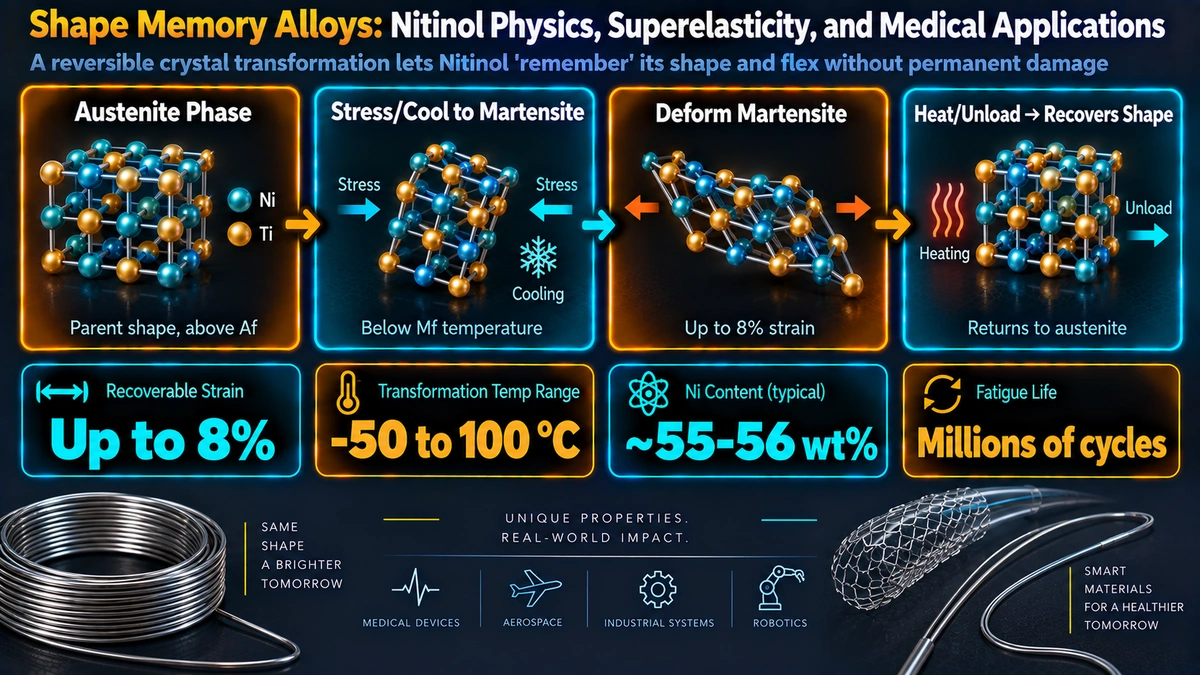
Nitinol adopts two primary crystal structures, and the reversible transition between them is the physical engine of all shape memory behaviour.
B2 Austenite (High-Temperature Parent Phase)
Above Af, Nitinol exists in the B2 ordered cubic structure (space group Pm̅3m, CsCl-type). Ni and Ti atoms occupy alternating corner and body-centre positions of a cubic unit cell with a lattice parameter of approximately 3.015 Å. The B2 phase is elastically soft in the <100> direction and shows anomalous elastic behaviour — the shear modulus C′ = (C11 − C12)/2 decreases on cooling toward Ms, a hallmark of an incipient martensitic instability. This elastic softening is detectable by ultrasonic measurements and coincides with precursor diffuse scattering phenomena observed by electron diffraction.
B19′ Martensite (Low-Temperature Product Phase)
The thermodynamically stable low-temperature phase is the B19′ monoclinic martensite (space group P21/m). The monoclinic unit cell contains 4 atoms with lattice parameters: a = 2.889 Å, b = 4.120 Å, c = 4.622 Å, and a monoclinic angle β ≈ 96.8°. The B19′ structure can be visualised as a slightly distorted orthorhombic B19 structure with an additional shuffling of (100) planes. The B2→B19′ transformation involves a lattice correspondence, a lattice invariant shear (accomplished by twinning rather than slip), and a lattice distortion — the three elements of the Wechsler-Lieberman-Read (WLR) crystallographic theory of martensite.
The accommodation of the transformation strain by twinning (rather than dislocation generation) is the key to thermoelastic reversibility. Compound twins on {011} and {001} planes are the dominant twinning modes in B19′ NiTi; these detwin under modest applied stresses, enabling large macroscopic strains without permanent slip damage.
The R-Phase Intermediate
In Ni-rich, aged, or thermally cycled NiTi, a trigonal intermediate phase — the R-phase (rhombohedral, space group R̅3) — can appear between B2 and B19′. The B2→R transformation involves a lattice distortion along <111> with very low associated strain (∼1%) and an extremely narrow thermal hysteresis of 2–5 K. The R-phase transformation temperature can be controlled independently of Ms by aging, making R-phase actuators attractive for highly reproducible, narrow-hysteresis applications. The B2→R transformation is typically detected as a distinct exothermic peak by DSC and as a change in electrical resistivity.
Transformation Temperatures and Their Dependence on Composition
The four critical temperatures — Ms (martensite start), Mf (martensite finish), As (austenite start), Af (austenite finish) — define the functional operating window of any Nitinol component.
| Temperature | Symbol | Definition | Typical NiTi Range |
|---|---|---|---|
| Martensite Start | Ms | Temperature at which austenite begins to transform to martensite on cooling | −50 to +100 °C |
| Martensite Finish | Mf | Temperature at which transformation to martensite is complete | Ms − 20 to −40 K |
| Austenite Start | As | Temperature at which martensite begins to revert to austenite on heating | Ms + 10 to +20 K |
| Austenite Finish | Af | Temperature at which reversion to austenite is complete | As + 10 to +30 K |
Effect of Nickel Content
Transformation temperatures in near-equiatomic NiTi are extraordinarily sensitive to Ni content. For alloys in the 50.0–51.0 at.% Ni range:
dMs/d[Ni] ≈ −10 K per 0.1 at.% Ni  (near 50 at.% Ni)

Example:
  50.0 at.% Ni  →  Ms ≈ +65 °C
  50.5 at.% Ni  →  Ms ≈ +15 °C
  51.0 at.% Ni  →  Ms ≈ −35 °C
This extreme compositional sensitivity demands tight melt control to ±0.05 at.% Ni. Post-processing verification by differential scanning calorimetry (DSC) is therefore mandatory for medical-grade Nitinol (per ASTM F2082). Titanium excess relative to equiatomic composition raises transformation temperatures, while nickel excess progressively depresses them. Cold working and aging can further shift temperatures by 20–40 K through precipitation of Ni4Ti3 particles that deplete the matrix of nickel.
Effect of Ternary Alloying Additions
Ternary additions allow modification of transformation temperatures and mechanical properties without the extreme Ni-composition sensitivity:
| Element | Substitution site | Effect on Ms | Primary Application |
|---|---|---|---|
| Cu (up to 10 at.%) | Ni | Modest increase; narrow hysteresis | Actuators requiring narrow hysteresis |
| Hf (>10 at.%) | Ti | Substantial increase (up to +400 °C) | High-temperature SMA (HTSMA) |
| Zr (>5 at.%) | Ti | Moderate increase | HTSMA, lower cost than Hf |
| Fe (1–5 at.%) | Ni | Strong decrease, stabilises R-phase | Cryogenic actuators, pipe coupling |
| Nb (>5 at.%) | Ti | Strong decrease | Pipe couplings (Tinel); wide hysteresis |
The Shape Memory Effect: Mechanisms and Types
One-Way Shape Memory Effect (OWSME)
The one-way shape memory effect is the most widely exploited SMA behaviour. The mechanism proceeds in three steps:
- Shape setting: The component is formed into a desired geometry and annealed to set that geometry as the “memorised” parent shape in the B2 austenite phase.
- Deformation in the martensitic state: Cooling below Mf produces self-accommodating twinned martensite with no macroscopic shape change. Applying a mechanical load detwinns the martensite — twin boundaries migrate to produce a stress-preferred martensite variant configuration — accommodating strains of 4–8% without plasticity. When the load is removed, the deformed shape is retained because the reoriented martensite variants are metastable without a thermal driving force.
- Recovery on heating: Heating above Af drives the reverse B19′→B2 transformation. Because the crystallographic correspondence is unique, each martensite variant reverts to the original austenite orientation, recovering the memorised shape. Recovery strains up to 8% are achieved; the driving force is the reduction in Gibbs free energy of the B2 phase above Af.
Two-Way Shape Memory Effect (TWSME)
In the OWSME, the material only “remembers” the high-temperature austenite shape. The two-way shape memory effect allows the alloy to adopt two distinct shapes — one above Af, one below Mf — without any applied external force. TWSME is not intrinsic to NiTi; it is acquired through thermo-mechanical training protocols that introduce a preferred population of dislocation structures or stabilised martensite variants. Typical training methods include: repeated thermal cycling under constant stress, repeated SME cycling, and constrained cycling. Training generates internal stress fields that bias the martensite variant selection on cooling, producing a net shape change. However, TWSME strain magnitudes are smaller (typically 1–3%) and the effect degrades with cycling due to dislocation accumulation.
All-Round Shape Memory Effect
A special case sometimes observed in copper-based SMAs and occasionally in NiTi with specific microstructures, the all-round effect produces opposite shape changes on heating and cooling through a mechanism involving internal stress states generated by a second-phase precipitate. It remains a research curiosity rather than an engineering tool.
Superelasticity (Pseudoelasticity): Physics and Stress-Strain Behaviour
Superelasticity occurs when Nitinol is mechanically loaded at temperatures above Af in the fully austenitic state. Rather than deforming by conventional dislocation slip (which is irreversible), the applied stress drives the formation of stress-induced martensite (SIM) by a thermoelastic mechanism. On unloading, the stored elastic energy of the strained austenite matrix drives the back-transformation, recovering the original shape isothermally.
Stress-Strain Response
A superelastic loading-unloading cycle in NiTi shows four characteristic regimes:
- Elastic loading of austenite (linear, EA ≈ 70–83 GPa in B2 NiTi)
- Forward SIM plateau: nearly flat stress plateau at the critical stress σcr,f as B2 converts to B19′ under load. Strain proceeds 5–8% at nearly constant stress.
- Elastic loading of stress-induced martensite (EM ≈ 28–41 GPa)
- Unloading plateau: B19′ reverts to B2 at a lower critical stress σcr,r. The area between forward and reverse plateaux represents the mechanical hysteresis energy (typically 10–20 MJ/m³).
Clausius-Clapeyron relationship for stress-induced martensite:

   dσ/dT = − ΔH / (T₀ · ε₀)

Where:
  σ   = critical stress for SIM formation (MPa)
  T   = temperature (K)
  ΔH  = latent heat of transformation (J/mol)
  T₀  = equilibrium transformation temperature (K)
  ε₀  = transformation strain

In NiTi: dσ/dT ≈ 6–8 MPa/K
Therefore: σ_cr,f increases with temperature above Af

For linear approximation above Af:
  σ_cr,f(T) = σ_cr,f(A_f) + (dσ/dT) × (T − A_f)
This Clausius-Clapeyron relationship explains why the superelastic window has both a lower bound (T must exceed Af for full SIM reversion on unloading) and an upper bound (above Md, the critical stress exceeds the yield stress of austenite and irreversible slip occurs instead of SIM formation). The practical superelastic window for body-temperature applications (37 °C) requires Af to be tuned to 0–20 °C, achieved by composition control and shape-setting anneal temperature selection.
Recoverable Strain Magnitude
The theoretical maximum transformation strain for NiTi B2→B19′ is determined by the lattice deformation tensor and is approximately 10.7% along the most favourable crystallographic direction. In practice, polycrystalline Nitinol recovers 6–8% strain superelastically, with the remainder consumed by elastic misfit and incomplete texture alignment. Single-crystal NiTi oriented along <001> can approach the theoretical maximum.
Processing and Microstructure Control
Melting and Ingot Production
Nitinol is invariably produced by vacuum melting — vacuum induction melting (VIM), vacuum arc remelting (VAR), or a combination — to minimise oxygen, nitrogen, and carbon contamination. Oxygen and nitrogen react preferentially with titanium to form TiO and TiN inclusions; carbon forms TiC particles. Both TiC and Ti4Ni2Ox inclusions act as fatigue crack initiation sites in cyclic-service medical devices and are subject to strict ASTM F2063 cleanliness requirements. O + N content should be <200 ppm for medical grade material; C <50 ppm.
Thermo-Mechanical Processing
NiTi ingots are first hot-worked (hot forging or extrusion at 700–950 °C) to break down the cast structure and produce wrought microstructure. Subsequent cold drawing or cold rolling with intermediate anneals (600–800 °C in vacuum) progresses the material toward wire, tube, or sheet forms. Cold work introduces dislocations that stabilise the martensite phase, raising Ms; a final annealing treatment is required to restore the desired transformation temperatures. Work hardening increases yield strength — cold-drawn wire can achieve UTS of 1500–1900 MPa — but at the cost of reduced ductility and altered transformation temperatures if over-annealed.
Shape Setting and Functional Training
The “remembered” shape is set by constraining the Nitinol component in the target geometry and annealing at 450–550 °C for 1–30 minutes. This anneal relieves the dislocation structure introduced by cold work, establishes the preferred martensite variant structure, and locks in the austenite memory shape. Shape-setting temperature and time govern the balance between recovery of cold work and stability of transformation temperatures; higher temperatures and longer times coarsen the microstructure and can raise Af.
Precipitation Hardening by Ni₄Ti₃
Aging Ni-rich NiTi (≥50.5 at.% Ni) at 300–500 °C precipitates coherent Ni4Ti3 lenticular particles on {111}B2 planes. These particles:
- Deplete the surrounding matrix of nickel, raising local Ms
- Generate coherency stress fields that influence martensite variant selection (stabilise R-phase)
- Strengthen the matrix by precipitation hardening (Δσy up to 200–400 MPa)
- Can be used to tune Af — a practitioner strategy for adjusting transformation temperatures post-fabrication
Continued aging at higher temperatures leads to Ni4Ti3 → Ni3Ti2 → Ni3Ti overaging sequence, progressively coarsening the precipitate and reducing the matrix nickel depletion effect.
Mechanical Properties of Nitinol
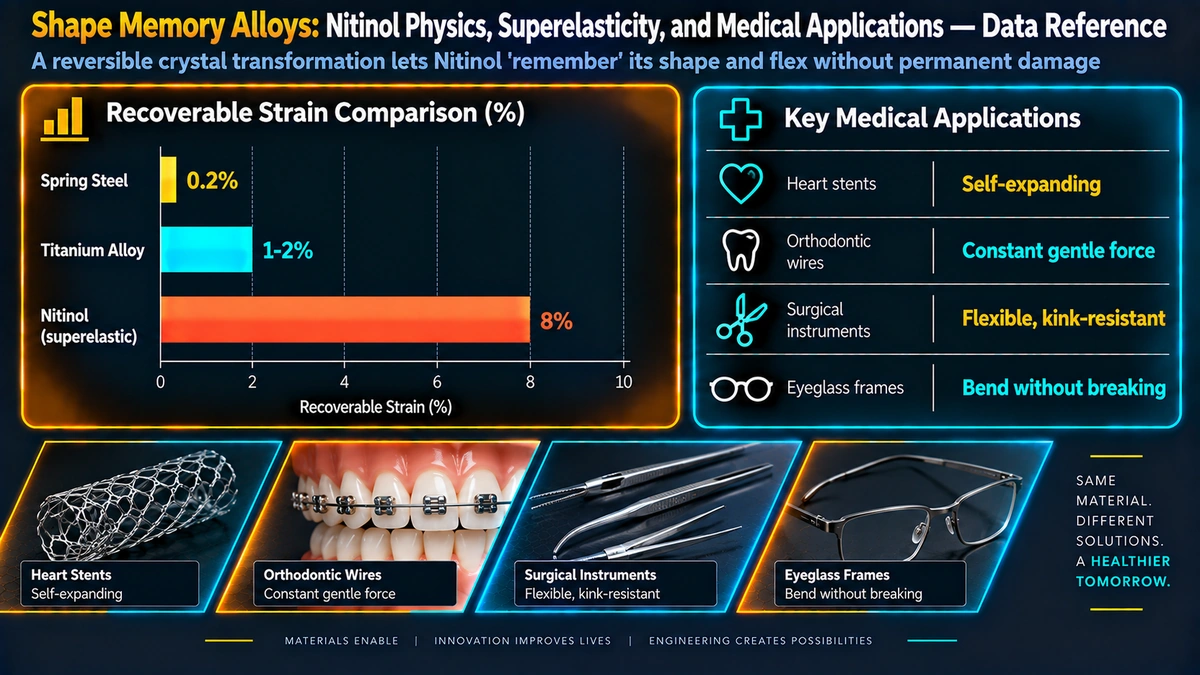
| Property | Austenite (B2) | Martensite (B19′) |
|---|---|---|
| Young’s Modulus | 70–83 GPa | 28–41 GPa |
| Yield Strength (0.2%) | 100–800 MPa (varies with cold work) | 50–300 MPa (detwinning stress) |
| UTS | 800–1900 MPa | 800–1500 MPa |
| Elongation to fracture | 15–50 % | 20–60 % |
| Recoverable strain (SE) | Up to 8 % | N/A (SME: 4–8 %) |
| Density | 6.45–6.50 g/cm³ | |
| Hardness | ≈300–350 HV | ≈200–280 HV |
| Thermal conductivity | 18 W/(m·K) | 8.5 W/(m·K) |
| Electrical resistivity | ≈80–100 μΩ·cm | ≈60–80 μΩ·cm |
The large modulus ratio EA/EM ≈ 2–3 means that the mechanical behaviour changes substantially across the transformation. The low detwinning stress of martensite (σdetwin ≈ 50–150 MPa) is what enables macroscopic shape change at modest applied stresses — a critical property for orthodontic and endovascular applications where devices must be deformed and delivered through small-diameter catheters or delivery systems before self-expanding at body temperature.
Biocompatibility and Corrosion Behaviour
Surface Oxide and Nickel Ion Release
Nickel toxicity concerns dominated early clinical discussion of Nitinol. However, NiTi spontaneously forms a 2–5 nm TiO2-rich surface oxide that is highly stable in physiological fluids (pH 7.4, 37 °C, 0.9% NaCl). This oxide layer is thermodynamically favoured because titanium has a substantially more negative standard free energy of oxidation than nickel (ΔG°(TiO2) << ΔG°(NiO)), driving titanium to preferentially occupy the oxide surface. X-ray photoelectron spectroscopy (XPS) studies confirm that the outermost 2 nm is essentially TiO2 with only trace NixOy, providing an effective diffusion barrier against nickel ion egress.
Under fretting or pitting conditions that locally disrupt this oxide, Ni release rates increase. For this reason, electropolishing (which removes the mechanically damaged surface layer and thickens the passive oxide) followed by HNO3-based passivation treatment is standard in medical device fabrication. Electropolished Nitinol exhibits Ni release rates of 0.1–1.0 μg/cm²/day in simulated body fluid — comparable to or lower than AISI 316L stainless steel. ISO 10993 biocompatibility evaluation (cytotoxicity, sensitisation, genotoxicity) is required for all implantable Nitinol devices.
Fatigue Life in Vivo
Cardiovascular Nitinol devices (stents, filters, occluders) experience pulsatile loading from hemodynamic forces and musculoskeletal motion superimposed on a mean implantation strain. The mean strain – strain amplitude diagram (Pelton-Nitinol fatigue framework) defines the safe operating zone:
Strain amplitude for infinite life assumption:  ε_a < 0.4%
Conservative design (accounting for inclusions): ε_a < 0.3%
Mean strain range in typical stent designs:      ε_m = 0.3 – 3.0%
Fatigue initiates at surface defects, laser-cut burrs, or internal TiC/Ti4Ni2Ox inclusions. Fractographic characterisation per ASTM F2129 and rotary beam fatigue testing per FDA guidance are standard pre-clinical requirements. The unique combination of large mean strain (implantation) plus cyclic strain amplitude distinguishes NiTi fatigue from conventional metallic fatigue and requires SMA-specific design methodologies.
Medical Device Applications
Self-Expanding Cardiovascular Stents
Nitinol self-expanding stents — introduced commercially in the 1990s — revolutionised peripheral vascular intervention. The stent is crimped to a reduced diameter in the martensitic or superelastic state and loaded into a delivery catheter. Upon deployment, the body-temperature environment (37 °C, above Af of body-temperature Nitinol, typically Af = 5–15 °C) drives superelastic expansion of the stent against the vessel wall. The chronic outward force (COF) of a superelastic stent is determined by the unloading plateau stress, which is relatively constant over a wide diameter range — a significant advantage over balloon-expandable stainless steel stents whose radial force drops steeply with oversizing. Applications include: iliac, femoral, carotid, renal, and hepatic arteries; tracheobronchial stenting; esophageal stenting; and transcatheter heart valve frames.
Orthodontic Archwires
NiTi orthodontic archwires exploit the temperature-activated shape memory effect. The wire is formed in the desired arch shape (austenite memory), then cooled below Mf (martensite) to allow ligation to malaligned teeth with reduced insertion force. Body temperature activates the SME, and the wire progressively applies a nearly constant low force as it recovers toward the memorised arch form. The constant-force plateau of a superelastic NiTi wire (≈ 50–150 g·f) closely matches the optimal orthodontic tooth-movement force range, outperforming stainless steel and Elgiloy wires that require frequent adjustment as alignment progresses.
Guidewires and Access Devices
Nitinol’s kink resistance (from superelastic strain recovery) makes it ideal for interventional guidewires that must navigate tortuous vascular anatomy. Unlike stainless steel, Nitinol guidewires recover from bends exceeding 90° without permanent deformation. Nitinol hypotube (thin-walled tube) is used in electrophysiology catheters, basket retrieval devices, and endoscopic retrieval forceps. Heat-affected zones from laser cutting of Nitinol tube must be characterised and controlled to avoid localised transformation temperature changes.
Bone Staples and Orthopaedic Fixation
Nitinol bone staples exploit the thermal SME for osteotomy fixation and fracture approximation. The staple legs are flared in the cooled (martensitic) state, allowing insertion into pre-drilled holes. Body temperature drives SME recovery, drawing the staple legs together and applying continuous compressive stress across the fracture interface — eliminating the need for separate compression screw hardware. Similar principles are applied in Nitinol spinal implant rod connectors and scoliosis correction rods.
Other Notable Applications
Beyond medicine, Nitinol applications include: pipe couplings (hydraulic and pneumatic fittings in aerospace — shrunk below Mf, installed over mating pipe ends, then allowed to warm and grip); actuators (thermal actuators for HVAC vent control, robotics, and aerospace morphing structures); vibration damping (the mechanical hysteresis of the superelastic cycle dissipates vibration energy); and seismic bracing (experimental applications exploiting both large recoverable strain and damping).
Testing and Characterisation Methods
Characterisation of Nitinol functional properties requires specialised test methods not applicable to conventional alloys:
| Method | Standard | What it measures |
|---|---|---|
| Differential Scanning Calorimetry (DSC) | ASTM F2004 | Ms, Mf, As, Af, latent heat, R-phase peaks |
| Bend and Free Recovery (BFR) | ASTM F2082 | Af by visual observation of shape recovery |
| Tension testing (SE) | ASTM F2516 | Upper plateau stress, lower plateau stress, permanent set, % elongation |
| Rotary beam fatigue | FDA guidance / ASTM F2477 | Fatigue life at defined mean strain and strain amplitude |
| Corrosion (potentiodynamic) | ASTM F2129 | Pitting potential, passivation, corrosion current |
| Nickel ion release | ISO 10993-15 | Ni release rate in simulated body fluid |
| X-ray diffraction | — | Phase identification (B2/B19′/R-phase), texture analysis |
The Clausius-Clapeyron relationship, measured by tension testing at multiple temperatures, is particularly useful for validating that Af falls correctly below body temperature (essential for superelastic devices). The slope dσ/dT should be 6–8 MPa/K for medical-grade equiatomic NiTi and can be used to back-calculate Af from plateau stress measurements at room and body temperature.
Internal structure and inclusion characterisation involves hardness testing, scanning electron microscopy with EDS, and synchrotron X-ray tomography for 3D inclusion mapping in critical medical device components. Textural characterisation by EBSD reveals preferred martensite variant distributions that correlate with functional property anisotropy in drawn wire and tube.
The thermoelastic martensitic transformation in NiTi is a subclass of the broader family of martensitic transformations in metals, but differs fundamentally from the athermal, irreversible martensitic transformation in steels. Understanding both classes of transformation requires familiarity with iron-carbon phase equilibria and grain boundary and crystallographic concepts. For comparison with other quench-sensitive alloy systems, transformation start temperatures play an equally critical role in microstructure selection, as explored in the context of bainite formation and controlled annealing practice.
Corrosion behaviour of Nitinol in physiological environments shares conceptual similarities with the passive film breakdown mechanisms discussed in the general corrosion mechanisms guide and pitting corrosion article on this site. Fatigue testing methodology follows principles outlined in impact testing and broader microstructure evaluation frameworks.
Frequently Asked Questions
What is the shape memory effect in Nitinol?
What are the four critical transformation temperatures in shape memory alloys?
How does superelasticity differ from the shape memory effect?
How does nickel content affect the transformation temperatures of Nitinol?
What is the R-phase transformation and why does it matter?
Why is Nitinol biocompatible for medical implants?
What manufacturing processes are used to produce Nitinol medical devices?
What are the main failure modes of Nitinol medical devices?
Can Nitinol be welded or joined?
What standards govern Nitinol for cardiovascular devices?
Recommended References and Textbooks
Shape Memory Alloys: Handbook — Christian Lexcellent
Comprehensive coverage of SMA thermomechanics, constitutive modelling, and engineering applications including NiTi devices.
View on AmazonNitinol: The Alloy with a Memory — ASM International
ASM reference covering Nitinol metallurgy, processing, characterisation, and medical device applications from industry experts.
View on AmazonMaterials Science & Engineering: An Introduction — Callister & Rethwisch
Core undergraduate textbook covering phase transformations, martensitic transformations, and functional materials including SMAs.
View on AmazonBiomedical Materials — Roger Narayan (Ed.)
Comprehensive reference on biomedical implant materials including NiTi, titanium alloys, corrosion, and regulatory frameworks.
View on AmazonDisclosure: MetallurgyZone participates in the Amazon Associates programme. If you purchase through these links, we may earn a small commission at no extra cost to you. This helps support free technical content on this site.
Further Reading and Related Topics
Martensite Formation in Steel
Athermal martensitic transformation, habit plane, and strengthening mechanisms in Fe-C alloys.
Iron-Carbon Phase Diagram
Complete guide to Fe-C equilibrium, critical temperatures, and phase field boundaries.
Bainite Microstructure in Steel
Upper and lower bainite formation, morphology, and property relationships.
Grain Boundaries: Types, Energy, Segregation
Low-angle vs. high-angle boundaries, grain boundary energy and engineering significance.
Corrosion Mechanisms
Electrochemical fundamentals, passivity, and corrosion mechanism classification.
Pitting Corrosion
Pitting initiation, propagation, pitting potential, and prevention strategies.
HAZ Microstructure
Heat-affected zone thermal cycle, microstructure evolution, and property implications.
Hardness Testing Methods
Vickers, Brinell, Rockwell, and nanoindentation — test selection and conversion guidance.
