Maraging Steels: Ultra-High Strength Through Intermetallic Precipitation
Maraging steels are an exceptional class of ultra-high strength iron-nickel alloys that achieve yield strengths of 1400–2400 MPa without relying on carbon for hardening. Strengthening derives entirely from the coherent precipitation of nanometre-scale intermetallic compounds — principally Ni3Mo and Ni3Ti — within a soft, low-carbon lath martensite matrix. This article covers alloy compositions, precipitation kinetics, heat treatment practice, mechanical properties, and the aerospace, tooling, and defence applications where maraging steels are uniquely qualified.
Key Takeaways
- Maraging = martensite + aging: a two-step cycle (820°C solution anneal → 480–490°C age) produces yield strengths up to 2400 MPa with minimal dimensional change.
- Carbon is kept below 0.03 wt% to maintain a tough, weldable matrix; all strength comes from intermetallic precipitation, not carbon supersaturation.
- Primary strengthening precipitates are Ni3Mo and Ni3Ti; cobalt amplifies precipitation by lowering molybdenum solubility in martensite.
- The four standard 18Ni grades (200, 250, 300, 350 ksi) span fracture toughness KIc from ~120 down to ~55 MPa·m0.5.
- Excellent weldability (no cold cracking risk) and near-zero distortion during aging make maraging steels uniquely suited to precision aerospace components and die-casting tooling.
- Reverted austenite — formed during over-aging — can toughen or soften the alloy depending on volume fraction; controlling aging temperature is critical.
What Are Maraging Steels?
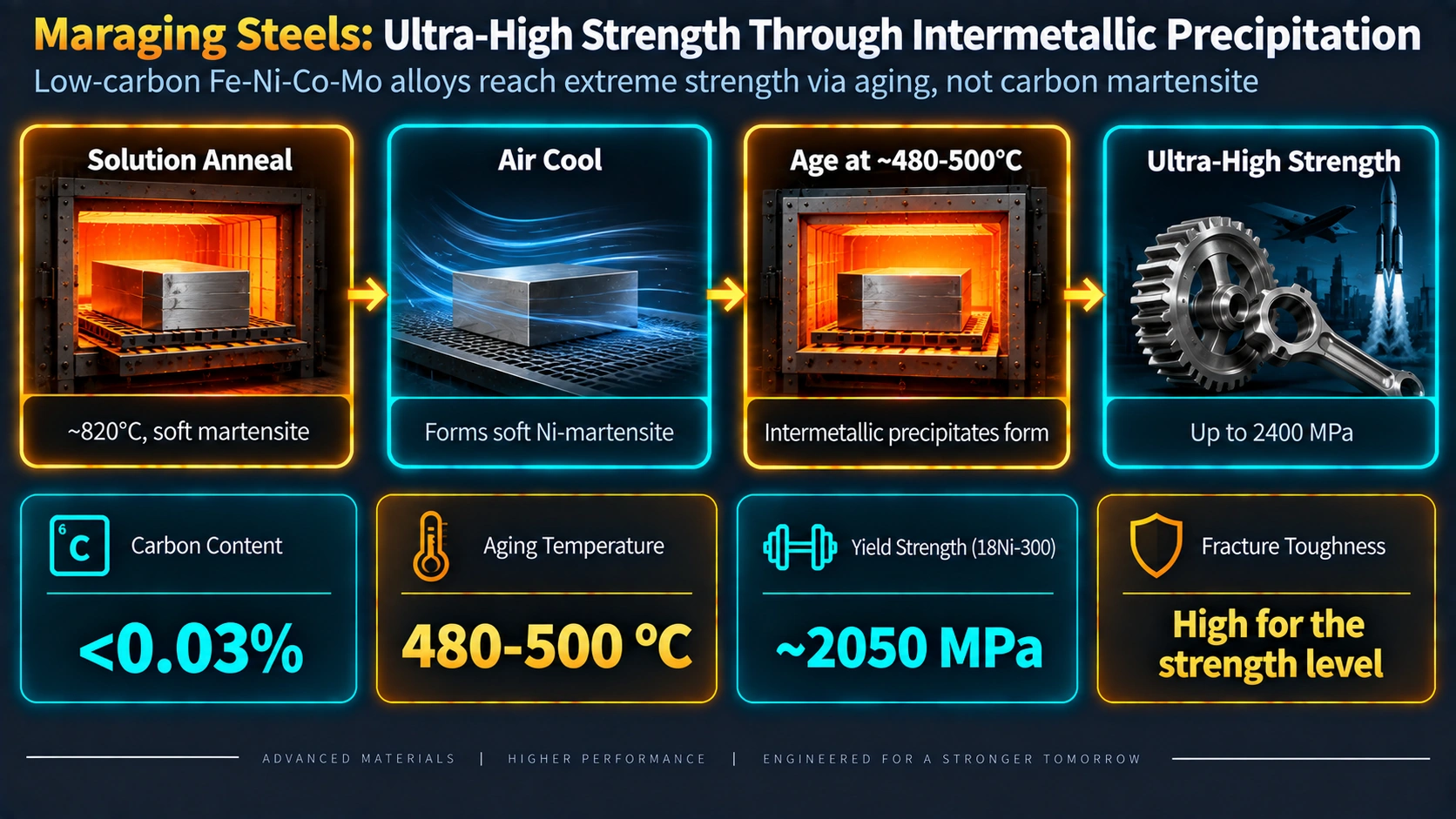
The term maraging combines martensite and aging — a name coined at the International Nickel Company (INCO) in the late 1950s when the alloy family was first developed. Maraging steels are iron-nickel alloys containing 17–19 wt% Ni with very low carbon (<0.03 wt%), supplemented by cobalt, molybdenum, titanium, and aluminium in varying proportions depending on grade. Their distinguishing feature is a two-stage strengthening mechanism that is entirely decoupled from carbon: martensite forms first on air cooling to provide the precipitation substrate; the martensite is then aged at moderate temperature to precipitate fine intermetallic compounds that restrict dislocation motion and elevate yield strength.
Conventional high-strength steels derive strength from carbon in solid solution or as carbide precipitates, which limits toughness and weldability. Maraging steels circumvent this trade-off, producing yield strengths competitive with the strongest tool steels while retaining fracture toughness KIc values two to four times superior and carbon equivalents well below the threshold for hydrogen-induced cold cracking.
Historical Development
Initial 18Ni maraging alloys were patented by Decker, Eash, and Goldman at INCO in 1962. The earliest commercial grades had yield strengths around 1380 MPa (200 ksi). Systematic composition optimisation through the 1960s produced the 250 and 300 ksi grades that became standard. The 350 ksi grade followed in the early 1970s for specialist ballistic and aerospace applications. The inclusion of cobalt as a key alloying element was recognised as essential for maximising precipitate density at the highest strength levels. From the 1990s onwards, work to replace cobalt with higher titanium or aluminium additions produced cobalt-free variants, though these remain niche compared to the standard 18Ni compositions.
Alloy Compositions
Standard 18Ni maraging steel compositions are defined in ASTM A538/A538M (wrought products) and AMS 6512/6514 series specifications. The four commercial grades are designated by their nominal 0.2% proof strength in ksi.
| Grade | Ni (wt%) | Co (wt%) | Mo (wt%) | Ti (wt%) | Al (wt%) | C max (wt%) |
|---|---|---|---|---|---|---|
| 18Ni(200) | 17–19 | 8–9 | 3.0–3.5 | 0.15–0.25 | 0.05–0.15 | 0.03 |
| 18Ni(250) | 17–19 | 7–8.5 | 4.6–5.1 | 0.3–0.5 | 0.05–0.15 | 0.03 |
| 18Ni(300) | 18–19 | 8.5–9.5 | 4.6–5.2 | 0.55–0.8 | 0.05–0.15 | 0.03 |
| 18Ni(350) | 17.5–18.5 | 11.5–12.5 | 4.6–5.2 | 1.3–1.6 | 0.05–0.15 | 0.03 |
All grades also contain residual silicon (<0.1 wt%), manganese (<0.1 wt%), phosphorus (<0.01 wt%), and sulphur (<0.01 wt%) as tightly controlled impurities; these promote grain boundary embrittlement at elevated phosphorus and sulphur levels. Titanium content increases progressively from Grade 200 to 350 and is the primary lever for elevating strength within the family, in conjunction with cobalt and molybdenum increases.
Role of Individual Alloying Elements
Nickel (17–19 wt%)
Nickel stabilises the BCC martensite at room temperature, lowers the martensite start temperature (Ms) to approximately 310–330°C, and provides the solute reservoir for Ni3Mo and Ni3Ti precipitation. Nickel also improves toughness by inhibiting cleavage fracture and increasing the surface energy of crack fronts in BCC iron.
Cobalt (7–12 wt%)
Cobalt itself does not form a strengthening precipitate. Its critical role is reducing the solubility of molybdenum in the BCC iron-nickel matrix, which drives more extensive Ni3Mo precipitation during aging and increases precipitate number density. Cobalt also raises Ms slightly, helping ensure a fully martensitic microstructure on air cooling from the solution anneal. Higher cobalt content (11–12 wt%) is necessary in Grade 350 to sustain precipitation density at the elevated titanium level.
Molybdenum (3–5.2 wt%)
Molybdenum is the primary precipitate-forming element in lower-strength grades. It partitions into Ni3Mo and Fe2Mo (Laves phase) precipitates during aging. Molybdenum also strengthens the martensite matrix through solid-solution hardening prior to and during early aging, contributing to the excellent combination of strength and toughness at Grades 200 and 250.
Titanium (0.15–1.6 wt%)
Titanium becomes the dominant strengthening agent in Grades 300 and 350 through Ni3Ti precipitation. Ni3Ti has a hexagonal (D024) crystal structure and produces a high coherency misfit strain in the BCC matrix, contributing strongly to yield strength through coherency hardening. Titanium levels above approximately 1.8 wt% cause embrittlement through TiN and Ti(C,N) formation and excessive reversion of austenite.
Aluminium (0.05–0.15 wt%)
Aluminium acts as a deoxidiser and scavenges oxygen and nitrogen during melting and casting. It also forms Ni3Al precipitates that contribute modest additional strengthening. Aluminium improves the thermal stability of austenite reversion by slightly raising the reversion start temperature.
Martensite Formation and Microstructure
The martensite that forms in 18Ni maraging steels on air cooling from 820°C is lath martensite, not the plate martensite typical of higher-carbon steels. Lath martensite consists of parallel arrays of elongated laths (0.1–1.0 μm wide, several hundred microns long) arranged in packets within prior austenite grains. The BCC crystal structure of the laths has a Kurdjumov-Sachs (K-S) orientation relationship with the parent austenite: {111}γ // {011}α′ and <110>γ // <111>α′.
Because carbon content is below 0.03 wt%, the martensite lattice is essentially undistorted BCC (not BCT). The hardness of the as-air-cooled martensite is only 28–32 HRC — comparable to a medium-carbon annealed steel — and the material is readily machinable. No quenching media (oil, polymer, water) is required because the Ms is well above room temperature and air cooling is sufficient to pass through the martensite transformation range without isothermal arrest.
Precipitation Hardening Mechanism
Aging at 480–490°C drives the nucleation and growth of nanometre-scale intermetallic precipitates within the lath martensite. The precipitation sequence and kinetics are composition-dependent; in standard 18Ni(300), the following sequence has been characterised by small-angle X-ray scattering (SAXS), atom probe tomography (APT), and transmission electron microscopy (TEM):
Precipitation Sequence
Stage 1 (0–30 min): Spinodal decomposition-like clustering of Ni and Mo within the martensite matrix. Atom probe studies (Murayama et al., 2002) confirm Mo and Ni co-clusters of 1–2 nm diameter form within the first minutes of aging.
Stage 2 (30 min–3 h): Ni3Mo forms with an orthorhombic structure (Ni3Mo, D022), coherent with the BCC matrix. Coherency strains produce the maximum strengthening increment. Ni3Ti begins nucleating at lath and packet boundaries where titanium diffusivity is higher.
Stage 3 (3–6 h peak aging): Ni3Ti precipitates coarsen to 3–5 nm; Ni3Mo partially transforms to semi-coherent Fe2Mo (Laves). Ni3Al contributes additional fine precipitation. Yield strength reaches its maximum at this stage.
Stage 4 (over-aging >6 h or >510°C): Coarsening of precipitates reduces the number density and coherency. Reverted austenite nucleates at lath boundaries, reducing the net strength. See the discussion of reverted austenite below.
Strengthening contributions (18Ni 300 grade, peak aging):

  Precipitation hardening (Ni3Mo + Ni3Ti):  ~800–900 MPa
  Solid solution strengthening (Ni, Co, Mo in matrix):  ~300–400 MPa
  Dislocation strengthening (lath martensite substructure): ~200–300 MPa
  Grain/packet size strengthening (Hall-Petch):  ~100–150 MPa
  ──────────────────────────────────────────────
  Total 0.2% proof strength:  ~1900 MPa (Grade 300)

Orowan bypass stress (precipitate contribution):
  Δσ_ppt = M × (0.4 × G × b) / (π × λ × √(1-ν)) × ln(2r̄/b)

  where: M = Taylor factor (~3.06 BCC)
         G = shear modulus Fe (81 GPa)
         b = Burgers vector (0.248 nm)
         λ = inter-precipitate spacing (nm scale, measured by TEM/SAXS)
         r̄ = mean precipitate radius
         ν = Poisson's ratio (0.29)
Coherency Hardening vs. Orowan Bypassing
At early aging stages, precipitates are coherent and dislocations shear through them, producing coherency hardening proportional to precipitate radius. Once precipitates exceed a critical size (≈3–4 nm), the dislocation bows around them and bypasses via the Orowan mechanism, leaving dislocation loops. Peak aging corresponds to the transition from shearing to bypassing, which maximises the overall strengthening increment. This is why the peak aging time must be controlled precisely — earlier or later results in sub-maximum strength.
Heat Treatment Practice
Solution Annealing
Solution annealing at 820 ± 14°C dissolves all precipitates formed during previous processing, produces a homogeneous austenite, and refines the prior austenite grain size by dissolution of titanium nitrides. Time at temperature is 1 h per 25 mm of section (minimum 1 h, maximum 8 h for very large sections). The atmosphere should be neutral (argon, nitrogen) or vacuum to prevent oxidation and titanium depletion at the surface. After solution annealing, air cooling is sufficient.
Aging
Aging is performed at 480–490°C for 3–6 hours with air cooling. Temperature uniformity within ±6°C across the furnace load is essential; a 10°C over-temperature causes measurable strength loss through accelerated coarsening. For the highest-strength grades (300, 350), a 3-hour aging cycle at 485°C is typical for thin sections; 6 hours is used for sections exceeding 100 mm to ensure full thermal soak. The aging treatment can be repeated if insufficient properties are obtained, unlike quench-and-temper steels where re-treatment risks cracking.
Re-solution and Re-aging
If a maraging steel component has been inadvertently over-aged, or if distortion correction requires cold working after aging, a full re-solution anneal at 820°C followed by fresh aging restores properties completely. This ability to re-heat-treat without degradation is a significant advantage over precipitation hardening stainless steels such as 17-4 PH, which show progressive embrittlement on repeated cycles.
Reverted Austenite: Formation, Effects, and Control
During aging, regions of the matrix adjacent to lath boundaries gradually become enriched in nickel through short-range diffusion. Nickel is a potent austenite stabiliser; if nickel enrichment at a boundary is sufficient to lower the martensite start temperature Ms below room temperature locally, those regions will transform to FCC austenite on cooling. This austenite, which reformed within a martensitic matrix during an aging heat treatment, is termed reverted or retained austenite in the maraging context.
Effect on Mechanical Properties
Small amounts of reverted austenite (1–5 vol%) improve fracture toughness by absorbing energy at crack tips through a transformation-induced plasticity (TRIP) mechanism. This is deliberately exploited in Grade 200 to achieve KIc values exceeding 110 MPa·m0.5. However, reverted austenite beyond ~10 vol% markedly reduces yield strength because the soft FCC austenite regions form preferential yielding sites. For Grade 350 components requiring maximum yield strength, aging must be tightly controlled to limit reverted austenite below 2 vol%.
Reverted austenite detection by X-ray diffraction:

  f_γ = (I_γ / R_γ) / [(I_α / R_α) + (I_γ / R_γ)]

  where: f_γ = volume fraction austenite
         I_γ = integrated FCC (200)γ or (220)γ peak intensity
         I_α = integrated BCC (200)α or (211)α peak intensity
         R_γ, R_α = theoretical scattering factors per unit volume
                    (tabulated in ASTM E975)

Typical: f_γ < 2% at peak aging (3–6h at 485°C)
         f_γ  5–15% at over-aging (3h at 530°C)
Mechanical Properties
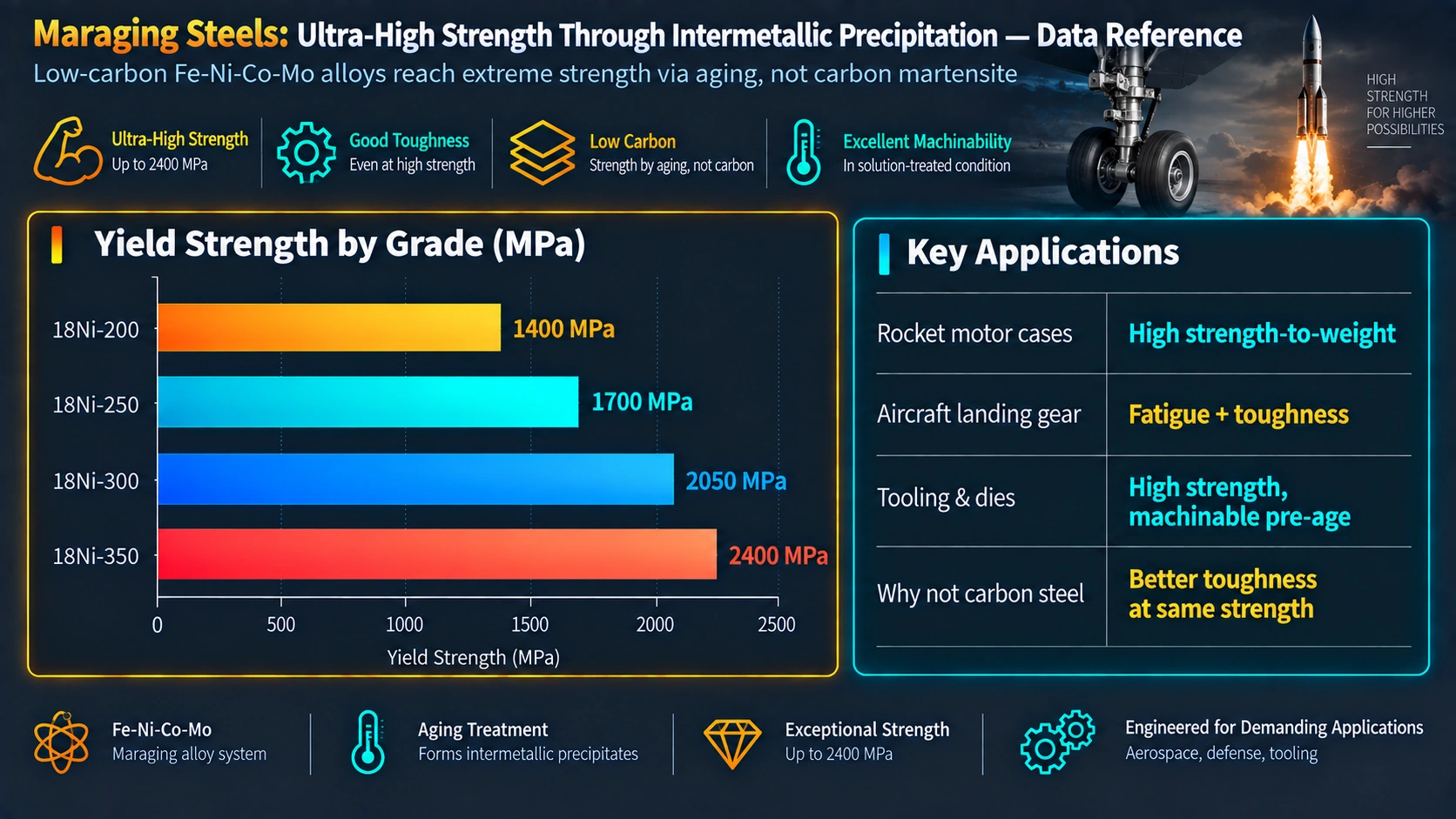
| Grade | 0.2% YS (MPa) | UTS (MPa) | El. (%) | RA (%) | KIc (MPa·m0.5) | Hardness (HRC) |
|---|---|---|---|---|---|---|
| 18Ni(200) | 1380 | 1430 | 10 | 60 | 110–120 | 40–43 |
| 18Ni(250) | 1720 | 1790 | 8 | 55 | 90–100 | 48–52 |
| 18Ni(300) | 1900 | 1960 | 7 | 40 | 70–80 | 52–56 |
| 18Ni(350) | 2400 | 2450 | 6 | 25 | 40–55 | 58–62 |
Values are for standard bar or plate product tested longitudinally at 25°C after the standard 820°C solution anneal and 3–6 h aging at 485°C. Short-transverse (ST) fracture toughness is typically 20–30% lower than the longitudinal direction due to elongated prior austenite grain structure in rolled product. Fatigue crack growth rates in maraging steels are comparable to or slightly higher than 4340 steel at equivalent stress intensity range (ΔK) values.
Corrosion Resistance
Maraging steels have corrosion resistance only modestly better than low-alloy carbon steels in ambient atmospheric conditions. They are subject to general corrosion in aqueous environments and are susceptible to stress corrosion cracking (SCC) in chloride environments at high stress intensities (KIscc typically 50–70 MPa·m0.5 for Grade 300). For corrosion-resistant applications, maraging steels are often plated (cadmium, chrome, nickel) or coated. A separate family of corrosion-resistant maraging steels (Custom 465, Custom 475 by Carpenter Technology) achieves similar strength with stainless-grade corrosion resistance by raising chromium content, though the strengthening mechanism and processing differ from standard 18Ni grades.
Comparison: Maraging Steel vs. Competing Ultra-High Strength Steels
| Property | 18Ni(300) Maraging | 4340 Q&T (HRC 54) | 300M (VAR) | Aermet 100 |
|---|---|---|---|---|
| YS (MPa) | 1900 | 1790 | 1900 | 1724 |
| UTS (MPa) | 1960 | 1900 | 2000 | 1965 |
| KIc (MPa·m0.5) | 77 | 50–60 | 60–70 | 126 |
| Carbon (wt%) | <0.03 | 0.38–0.43 | 0.40–0.45 | 0.23 |
| Weldability | Excellent | Fair (preheat req.) | Fair–Poor | Good |
| Distortion on hardening | Minimal | Moderate–High | Moderate–High | Low |
| Machinability (soft condition) | Excellent | Poor (as quenched) | Poor | Moderate |
| Relative cost | High | Low | Moderate | Very High |
Aermet 100 (developed by Carpenter Technology) outperforms 18Ni(300) on fracture toughness but is substantially more expensive and less established in the supply chain. For applications where both high yield strength and excellent weldability are non-negotiable — rocket motor cases, spacecraft components, premium tooling — 18Ni(300) remains the industry workhorse. Learn more about quenching and tempering of conventional high-strength steels for context on the competing approach.
Weldability and Joining
The near-zero carbon content gives maraging steels a carbon equivalent (CEIIW) well below 0.2, so hydrogen-induced cold cracking is not a concern even without preheat. Weld joints are made with the alloy in the solution-annealed (soft) condition using:
- GTAW (TIG): Preferred process for precision components; matching filler wire (e.g., INCO Fillet 65 or ERNiFeCr-2 equivalent)
- GMAW (MIG): Used for thicker sections; requires shielding gas purity >99.998% Ar or Ar-He
- EBW and LBW: Used for high-precision joints where zero filler addition and narrow HAZ are required
- Diffusion bonding: Applied to complex structural assemblies where weld access is impossible
After welding, a full re-solution anneal at 820°C and aging at 485°C restores full strength across the weld metal and heat-affected zone. If re-solution is impractical, aging alone still restores 80–90% of base metal strength in the HAZ but the weld metal properties depend on filler composition. The HAZ does not form brittle untempered martensite (unlike conventional high-carbon steels) because maraging martensite is inherently tough in the as-transformed condition. For a deeper treatment of welding metallurgy concepts see the heat-affected zone microstructure guide and hydrogen-induced cracking reference.
Industrial Applications
Aerospace and Defence
The original and still dominant application for maraging steels is aerospace structures. 18Ni(300) is used for solid rocket motor casings (Saturn V ullage motors used maraging steel; modern launch vehicle motor cases continue this tradition), airframe fittings, wing pivot pins, and landing gear components where the strength-to-weight ratio, weldability, and toughness combination is unmatched. The ability to machine complex geometry in the soft state, weld sub-assemblies, and then age the entire structure to full strength is uniquely exploited in this sector.
Die-Casting and Plastics Tooling
18Ni(300) and 18Ni(350) are used extensively for die-casting dies (aluminium, zinc, magnesium alloys) and injection moulding tooling where the combination of high hot-strength (retained to ~300°C), low thermal conductivity (compared with hot-work tool steels), and negligible distortion on hardening allows precise cavity dimensions without post-hardening grinding. The fatigue resistance of maraging steels under repeated thermal cycling (die-casting thermal shock) is superior to conventional H13 for some cavity geometries.
Ordnance and Ballistics
Gun barrels, cannon components, and penetrator cores have exploited maraging steels in specialist military applications. The combination of very high yield strength and controlled fracture toughness prevents brittle fracture under the rapid pressure cycling of firing events. Export controls (ITAR and EAR in the US; dual-use regulations in the EU) restrict the availability of maraging steel above certain thicknesses and tensile strengths for this reason.
High-Performance Motorsport
Formula 1 and top-tier motorsport applications include gear cluster shafts, bevel gears, and suspension rockers in 18Ni(250) or 18Ni(300), where the specific yield strength (YS / density) exceeds that of titanium alloys such as Ti-6Al-4V at equivalent safety factors. The excellent machinability in the soft state reduces cycle times for complex gearbox components.
Precision Springs and Instrumentation
For watch mainsprings, gyroscope components, and precision instrument flexures, the combination of high elastic energy storage density (proportional to YS2/E), low modulus variation with temperature, and excellent dimensional stability during aging makes maraging steel the material of choice where conventional spring steels (such as 302/304 stainless or high-carbon steel) are insufficient.
See the martensite formation in steel article for foundational understanding of the martensite transformation, and the annealing and normalising guide for context on solution anneal effects in steel systems. The hardness testing methods article covers HRC measurement practice relevant to verifying maraging steel heat treatment response.
Testing, Quality Assurance, and Standards
Maraging steel products are typically manufactured and tested to the following specifications. Tensile testing to ASTM E8/E8M (sub-size specimens often required for thin sections); hardness testing per ASTM E18 (HRC) or ASTM E384 (microhardness); fracture toughness per ASTM E399 (KIc) or ASTM E1820 (JIc); Charpy impact testing per ASTM E23 (note: Charpy CVN is less discriminating than KIc for this alloy class; refer to the Charpy impact testing guide). Chemical composition verification is by optical emission spectrometry (OES) or inductively coupled plasma (ICP) spectrometry.
| Standard | Coverage |
|---|---|
| ASTM A538/A538M | Pressure vessel plate, sheet, and strip — 18Ni maraging steel |
| AMS 6512 | Sheet, strip, and plate — 18Ni(250) grade |
| AMS 6514 | Sheet, strip, and plate — 18Ni(300) grade |
| AMS 6521 | Bars, forgings, and rings — 18Ni(250) |
| AMS 6523 | Bars, forgings, and rings — 18Ni(300) |
| MIL-S-46850D | US military specification — maraging steels for ordnance |
| DEF STAN 95-41 | UK defence standard — maraging steel bar and forging |
Additive Manufacturing of Maraging Steels
18Ni(300) maraging steel powder (gas-atomised, D50 ~ 35 μm) is one of the most widely qualified materials for laser powder bed fusion (L-PBF) and directed energy deposition (DED) additive manufacturing. The low carbon content and absence of hot-cracking susceptibility make it highly printable. As-built parts in L-PBF 18Ni(300) have tensile strength comparable to conventionally forged material after the same solution anneal and aging cycle, provided print parameters are optimised to minimise lack-of-fusion porosity (<0.1 vol%).
A particular advantage in additive manufacturing is the ability to incorporate internal conformal cooling channels in die-casting tooling inserts. These channels cannot be machined by conventional means; L-PBF allows complex 3D channel networks to be embedded in the tool body, dramatically reducing cycle time and thermal fatigue damage in die-casting. The standard 820°C anneal and 485°C aging cycle is applied to the finished printed part without modification.
Frequently Asked Questions
What does 'maraging' mean and where does the term come from?
Why is carbon kept so low in maraging steels?
What are the four standard 18Ni grades and how do they differ?
Which intermetallic phases precipitate during maraging and what strengthening do they provide?
Why is maraging steel easier to machine than conventional high-strength steels?
What happens if maraging steel is aged at too high a temperature?
What is reverted austenite and is it always harmful?
What is the role of cobalt in maraging steels and can it be eliminated?
How are maraging steels used in additive manufacturing?
Do maraging steels require any preheat before welding?
Recommended References
Disclosure: MetallurgyZone participates in the Amazon Associates programme. If you purchase through these links, we may earn a small commission at no extra cost to you. This helps support free technical content on this site.
Further Reading
