AISI 1018 Steel: Properties and Applications
AISI 1018 is the most widely stocked general-purpose low-carbon steel grade in North American bar and plate supply, valued for its reliable combination of good machinability, excellent weldability, and moderate strength. This reference covers its chemical composition, mechanical and physical properties, microstructure, heat treatment options, and typical applications.
Key Takeaways
- AISI 1018 is a low-carbon (mild) steel, nominally 0.15-0.20% carbon and 0.60-0.90% manganese, placing it well below the eutectoid composition on the iron-carbon phase diagram.
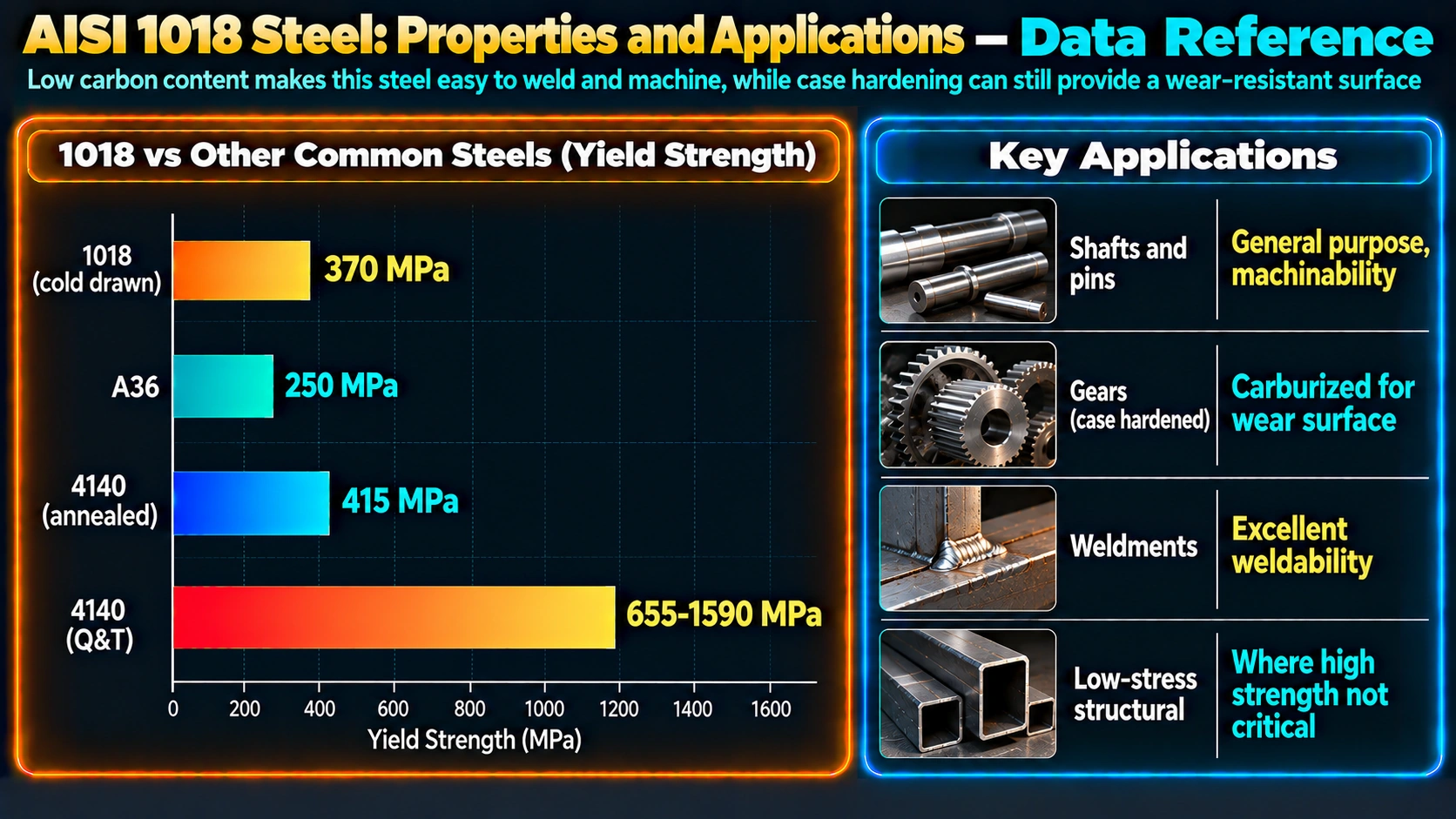
- Cold-drawn 1018 has higher strength (typically 370 MPa yield, 440 MPa tensile) and a smoother finish than hot-rolled 1018, due to work hardening during the drawing process.
- Its low carbon content makes 1018 unsuitable for meaningful through-hardening by quench and temper, but well suited to case hardening (carburizing) for wear-resistant surfaces over a tough core.
- 1018 has excellent weldability with all common arc processes and typically requires no preheat, owing to its low carbon equivalent.
- Machinability is good, commonly cited around 70% relative to the AISI B1112 reference steel, behind dedicated free-machining grades like 12L14 but ahead of most alloy steels.
- Typical applications include shafts, pins, gears, bushings, dowels, sprockets, and case-hardened wear components across general machine building and fabrication.
Chemical Composition
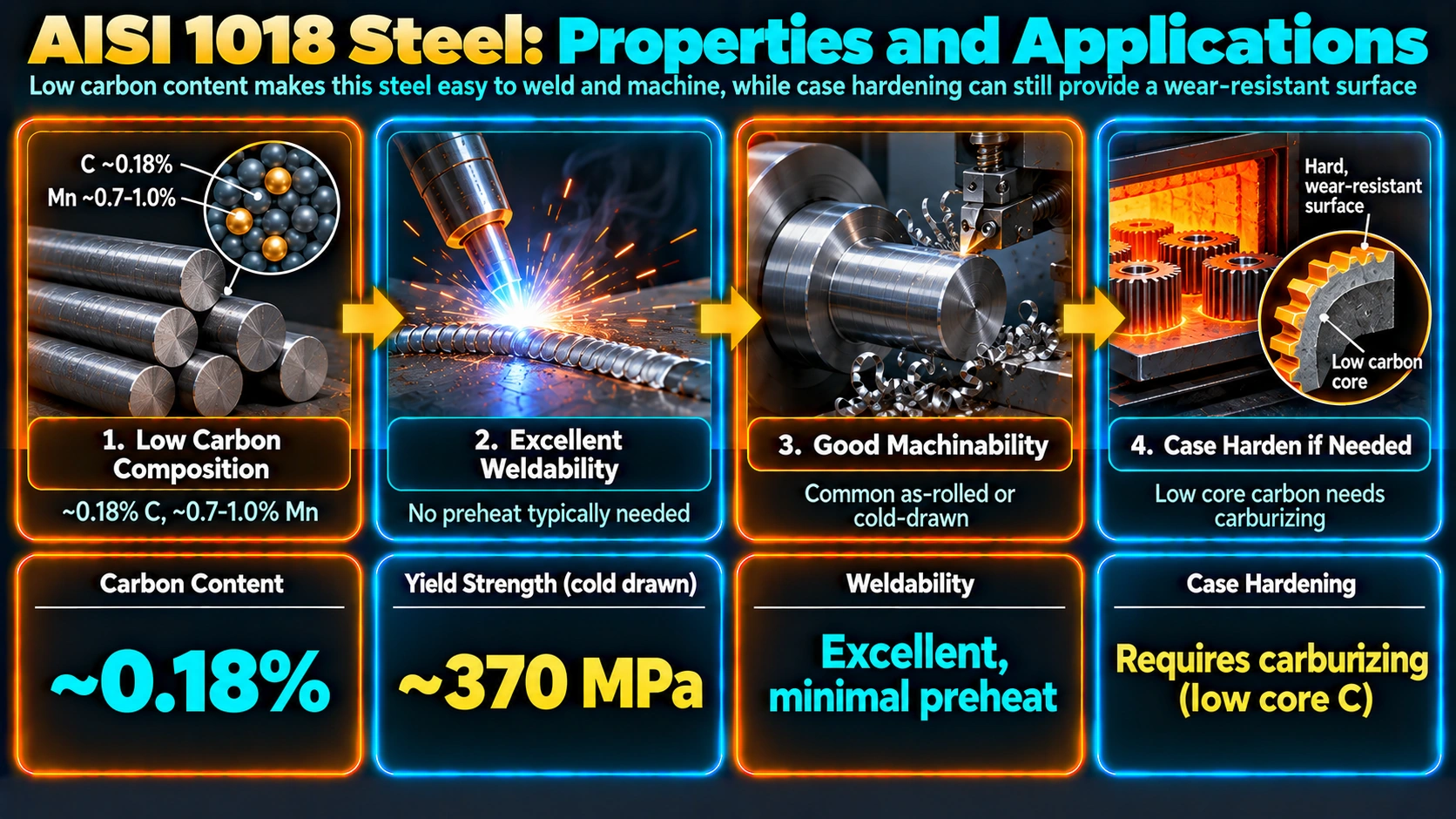
AISI 1018 is a plain carbon steel with a nominal composition defined by SAE/AISI specification. As with all standard grades, actual heat-to-heat composition varies within the specified range and should be confirmed against the mill certificate for critical applications.
| Element | Typical Range (wt%) |
|---|---|
| Carbon (C) | 0.15 – 0.20 |
| Manganese (Mn) | 0.60 – 0.90 |
| Phosphorus (P) | 0.04 max |
| Sulfur (S) | 0.05 max |
| Iron (Fe) | Balance |
Mechanical Properties
Mechanical properties depend significantly on processing condition, primarily whether the bar is supplied hot-rolled or cold-drawn, and on bar size. The following are typical published values for reference; guaranteed minimums for a specific order should be taken from the applicable ASTM specification (commonly ASTM A108 for cold-finished bar) and the mill certificate.
| Property | Hot-Rolled (typical) | Cold-Drawn (typical) |
|---|---|---|
| Tensile strength | ~440 MPa (64 ksi) | ~440-540 MPa (64-78 ksi) |
| Yield strength | ~220-250 MPa (32-36 ksi) | ~370-440 MPa (54-64 ksi) |
| Elongation (2 in.) | ~18-20% | ~12-15% |
| Reduction of area | ~40% | ~40-50% |
| Brinell hardness | ~110-120 HB | ~125-135 HB |
Physical Properties
| Property | Typical Value |
|---|---|
| Density | 7.87 g/cm³ |
| Melting range | ~1450-1520°C |
| Thermal conductivity | ~51.9 W/m·K |
| Specific heat capacity | ~486 J/kg·K |
| Electrical resistivity | ~15.9 µΩ·cm |
| Elastic (Young’s) modulus | ~200 GPa |
Microstructure and Metallurgy
At approximately 0.18% carbon, AISI 1018 sits far to the left of the eutectoid composition (0.77% C) on the iron-carbon phase diagram, classifying it as a hypoeutectoid steel. In the normalized or annealed condition, its microstructure consists predominantly of proeutectoid ferrite, with only a minor fraction, roughly 10-15% by volume, of pearlite forming at prior austenite grain boundaries during cooling. This low pearlite fraction is the underlying reason for 1018’s combination of good ductility and toughness with only moderate strength, and its low hardenability compared with medium- and high-carbon grades, consistent with general eutectoid reaction principles.
Heat Treatment
Through-Hardening: Not Generally Applicable
Because carbon content is well below the level needed to form a substantial volume of martensite on quenching, AISI 1018 does not respond meaningfully to conventional quench-and-temper through-hardening the way medium-carbon grades such as 1045 do; quenching produces only a modest hardness increase, not the significant strengthening seen in higher-carbon steels.
Case Hardening (Carburizing)
1018’s low core carbon content makes it a good candidate for carburizing: the surface layer is enriched with carbon, typically to 0.8-1.0%, in a carburizing furnace or pack at approximately 880-925°C, then quenched to form a hard, wear-resistant martensitic case, typically 0.5-1.5 mm deep depending on cycle time, while the low-carbon core remains soft and tough. This combination of hard case and tough core is ideal for gears, cams, pins, and other wear components subject to both surface wear and impact loading.
Normalizing and Annealing
Normalizing (heating to approximately 890-940°C followed by air cooling) refines grain size and relieves the effects of prior hot working or welding. Full annealing (heating to a similar range followed by slow furnace cooling) softens the material for maximum machinability or forming, though 1018 is already relatively soft and machinable even in the as-rolled or normalized condition.
Stress Relieving
Stress relief at approximately 595-650°C is used after heavy machining, cold working, or welding to reduce residual stress and improve dimensional stability without significantly altering strength or hardness.
Weldability
AISI 1018’s low carbon content gives it a low carbon equivalent and correspondingly excellent weldability with SMAW, GMAW, GTAW, and SAW processes. Preheat is generally unnecessary for typical section thicknesses, and post-weld heat treatment is rarely required for this grade alone, though preheat may still be needed when 1018 is joined to a higher-carbon or alloy steel, in which case the higher-hardenability side of the joint governs the requirement, consistent with general hydrogen cracking control principles.
Machinability
1018 machines well and is commonly cited with a machinability rating around 70% relative to AISI B1112 (a free-machining reference steel rated at 100%), giving good chip control and surface finish across turning, milling, and drilling operations. It is not as free-machining as leaded or resulfurized grades such as 12L14, but offers better weldability, toughness, and surface quality after machining than those dedicated free-machining grades typically provide.
Comparison to Related Low-Carbon Grades
| Grade | Nominal Carbon | Relative Strength | Notable Trait |
|---|---|---|---|
| 1010 | ~0.08-0.13% | Lower | Even better formability and weldability, lower strength |
| 1018 | ~0.15-0.20% | Baseline | Balanced machinability, weldability, moderate strength |
| 1020 | ~0.18-0.23% | Slightly higher | Marginally higher strength and hardenability than 1018 |
| 12L14 | ~0.15% (leaded) | Similar | Superior machinability, reduced weldability |
International Equivalents
Cross-standard equivalence for low-carbon steels is approximate, since exact composition ranges and specification requirements differ between standards bodies. The following are commonly cited approximate equivalents; critical or code-governed procurement should verify against the specific standard and material certificate.
| Standard | Approximate Equivalent |
|---|---|
| DIN / EN (Germany/Europe) | C15, Ck15 (~1.0401/1.1141) |
| BS (United Kingdom) | 080A15 – 080A17 |
| JIS (Japan) | S15C – S20C |
| GB (China) | 15, 20 steel |
Applications
AISI 1018 is used extensively across general machine building and fabrication, including shafts, axles, pins, dowels, gears, sprockets, bushings, spacers, tie rods, studs, rollers, retainer rings, fixtures, and case-hardened wear components such as cams and gear teeth. It is also widely used as a structural and prototyping bar and plate stock where weldability and machinability matter more than high strength, and as feedstock for cold-formed or machined parts that will later be selectively case hardened for wear resistance.
Frequently Asked Questions
What is AISI 1018 steel used for?
What is the difference between cold-drawn and hot-rolled 1018 steel?
Can AISI 1018 steel be hardened?
Is AISI 1018 steel weldable?
What is the machinability of AISI 1018 compared to other steels?
What is the chemical composition of AISI 1018 steel?
What is the difference between AISI 1018 and AISI 1020 steel?
What is the European or DIN equivalent of AISI 1018 steel?
Can AISI 1018 be case hardened?
What is the typical tensile and yield strength of AISI 1018 steel?
Recommended Reference Reading
Callister’s Materials Science and Engineering
Foundational reference for low-carbon steel microstructure and property relationships.
View on AmazonASM Handbook: Properties and Selection, Irons and Steels
Reference-grade composition and property data for standard steel grades including 1018.
View on AmazonHeat Treater’s Guide: Practices and Procedures for Irons and Steels
Practical carburizing, normalizing, and stress relief procedures for low-carbon grades.
View on AmazonMachinery’s Handbook
Widely used shop reference including machinability ratings and material selection data.
View on AmazonDisclosure: MetallurgyZone participates in the Amazon Associates programme. If you purchase through these links, we may earn a small commission at no extra cost to you. This helps support free technical content on this site.
Further Reading
