D2 Tool Steel: Properties and Heat Treatment
AISI D2 is the most widely specified high-carbon, high-chromium cold-work tool steel, chosen wherever a die or punch must survive long production runs against abrasive sheet stock without losing its dimensions. This guide covers D2’s composition, the physical metallurgy behind its air-hardening response, the heat treatment cycle engineers should specify, and where D2 fits against competing tool steel grades.
Key Takeaways
- D2 is a high-carbon (~1.5%), high-chromium (~12%) air-hardening cold-work die steel strengthened further by molybdenum and vanadium.
- Austenitizing at 980-1030°C followed by air or gas quenching produces 62-65 HRC as-quenched, but with significant retained austenite.
- Double or triple tempering is standard practice to transform retained austenite and stabilize dimensions before the tool enters service.
- A secondary hardening hump appears near 500-525°C during tempering, caused by fine molybdenum and vanadium carbide precipitation.
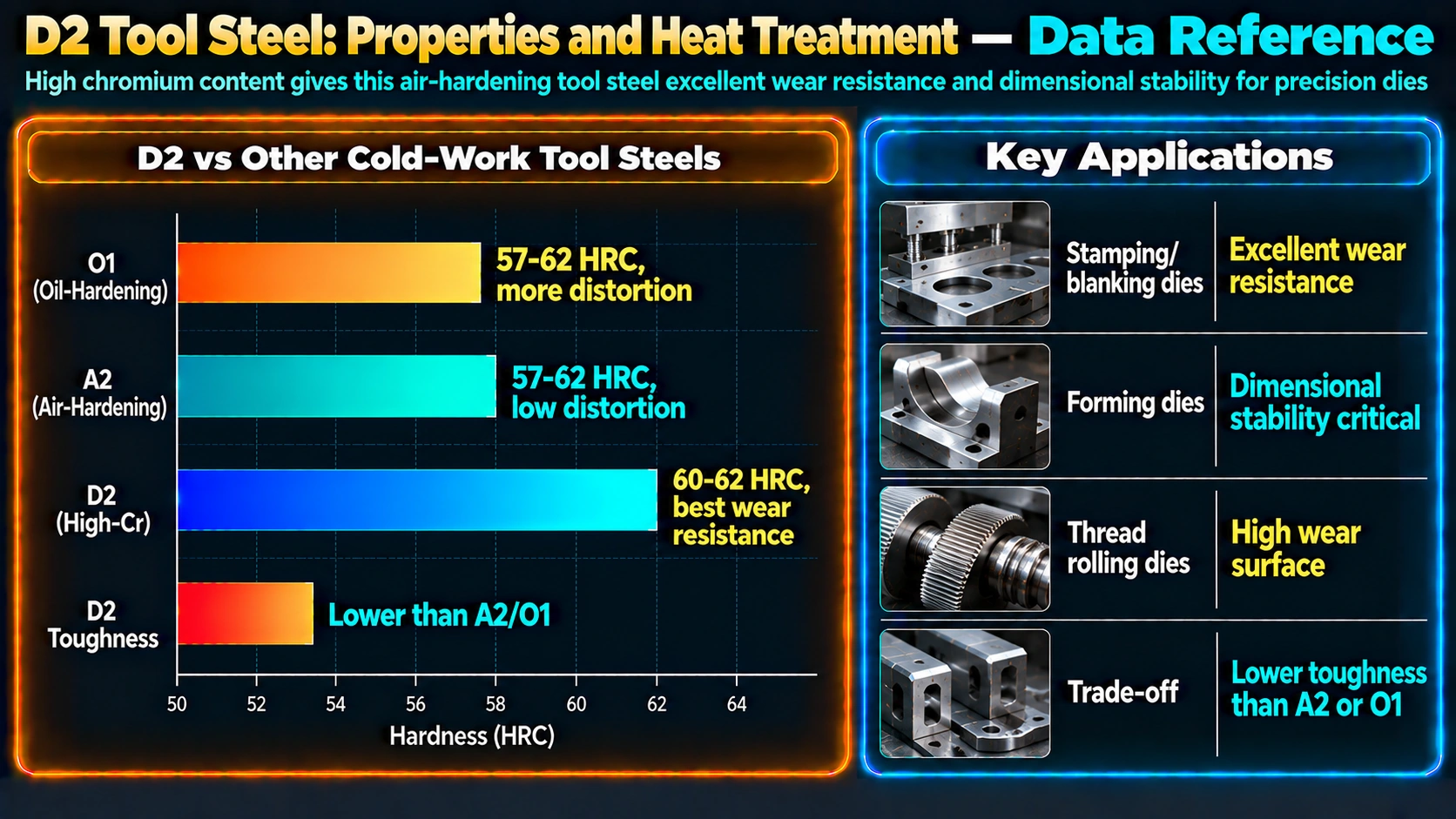
- D2’s large primary M7C3 carbides give excellent abrasive wear resistance but lower impact toughness than A2 or S7.
- D2 is not stainless; ~12% Cr gives only moderate corrosion resistance, not the film stability of 16%+ Cr stainless grades.
What Is D2 Tool Steel?
D2 belongs to the AISI D-series of air-hardening, high-carbon, high-chromium cold-work tool steels. The “D” designation itself signals the hardening mechanism: these grades contain enough chromium and molybdenum to achieve full martensitic hardening in still or forced air, without an oil or water quench. That characteristic, combined with a very high volume fraction of hard chromium-rich carbides, is what defines D2’s performance envelope: outstanding resistance to abrasive wear and excellent dimensional stability through hardening, traded against comparatively modest toughness.
D2 sits within the broader family covered in our iron-carbon phase diagram framework, but its behavior is dominated by alloy carbides rather than the plain Fe-Fe3C system, which is why its heat treatment response differs so sharply from plain carbon or low-alloy steels.
Chemical Composition
Nominal AISI/SAE D2 composition, expressed in weight percent, is summarized below. Actual mill certificates will show a value within each specified range rather than the midpoint.
| Element | Range (wt%) | Metallurgical role |
|---|---|---|
| Carbon (C) | 1.40 – 1.60 | Forms primary and secondary carbides; sets matrix hardenability |
| Chromium (Cr) | 11.00 – 13.00 | Forms M7C3 primary carbides; provides hardenability and moderate corrosion resistance |
| Molybdenum (Mo) | 0.70 – 1.20 | Deepens hardenability; contributes to secondary hardening carbides |
| Vanadium (V) | up to 1.10 | Forms fine MC carbides; restricts grain growth; boosts secondary hardening |
| Manganese (Mn) | 0.60 max | Deoxidizer; mild hardenability contribution |
| Silicon (Si) | 0.60 max | Deoxidizer |
| Phosphorus (P) | 0.030 max | Residual impurity, held low to limit temper embrittlement |
| Sulfur (S) | 0.030 max | Residual impurity, held low to preserve toughness |
The combination of ~1.5% C with ~12% Cr places D2 well above the ~0.77% C required for a plain eutectoid reaction, so a large fraction of primary carbide forms directly during solidification rather than solely from the eutectoid reaction on cooling.
Heat Treatment of D2 Tool Steel
Preheating
Because D2 is a rich alloy grade, thermal shock during heating can promote cracking, especially in tools with sharp sections or sizeable cross-sections. Standard practice is to preheat in the 760-870°C range and equalize before ramping to the austenitizing temperature.
Austenitizing
Austenitizing is carried out between 980°C and 1030°C, most commonly around 1010°C (1850°F). Time at temperature is governed by section thickness, typically 15-45 minutes once the load is through-heated, long enough to dissolve enough of the alloy carbides into austenite to develop hardenability and the secondary hardening reserve, without dissolving so much carbide that grain growth and excess retained austenite become uncontrolled.
Process Note
Higher austenitizing temperatures within the range increase as-quenched hardness and secondary hardening response but also increase retained austenite and reduce toughness. Most die shops select the lower half of the range (980-1000°C) unless maximum wear resistance is the priority.
Quenching
D2’s chromium and molybdenum content give it deep hardenability, so still air, forced air, or an inert-gas quench in a vacuum furnace is sufficient to form a fully martensitic structure through sections well beyond what plain carbon steels could through-harden. This is the practical benefit of the air-hardening D-series: dies can be hardened with minimal distortion and cracking risk compared with oil- or water-hardening grades such as O1.
Retained Austenite and Tempering
The same alloy content that gives D2 deep hardenability also depresses the martensite start (Ms) and martensite finish (Mf) temperatures. As a result, D2 typically retains 10-20% or more untransformed austenite after a single quench to room temperature. The Koistinen-Marburger relation describes how martensite fraction builds as temperature drops below Ms:
f_M = 1 − exp[−α(Ms − T)]

f_M   = volume fraction martensite formed
Ms    = martensite start temperature (°C)
T     = current temperature (°C), T < Ms
α    = rate constant, ≈ 0.011 °C⁻¹ (typical for alloy tool steels)
Because D2’s Ms sits well below that of plain carbon steels, a large fraction of austenite remains untransformed even at room temperature, and cooling below room temperature (cryogenic treatment) or tempering-induced transformation is needed to convert it. Left untreated, retained austenite can transform slowly in service, changing dimensions and cracking hardened edges.
Tempering is therefore performed in two or three cycles, each roughly 1-2 hours, with the tool cooled to room temperature between cycles. The first temper relieves quenching stress and converts some retained austenite to fresh, untempered martensite; the second temper then tempers that fresh martensite and continues converting any remaining austenite.
Tempering Temperature Selection
Low-temperature tempering (150-200°C) preserves near-maximum hardness (60-62 HRC) and is favored for blanking and forming dies where abrasive wear dominates. Tempering in the secondary hardening range (about 500-525°C) exploits fine, coherent molybdenum- and vanadium-rich carbide precipitation to recover hardness after the mid-range trough, and is used when a better balance of hardness and toughness is required. Tempering above roughly 540°C sacrifices hardness for toughness and is used mainly for tools subject to light impact.
Mechanical Properties and Microstructure
The defining microstructural feature of D2 is its population of primary M7C3 chromium carbides, typically several microns across, distributed in bands aligned with the original rolling or forging direction. These carbides are what deliver D2’s abrasive wear resistance, but their size and alignment also act as crack initiation sites, which is why D2 trails grades like A2 and S7 in impact toughness despite comparable or higher hardness. Secondary MC (vanadium-rich) and M2C/M6C (molybdenum-rich) carbides precipitate during tempering and are far finer, contributing to the secondary hardening response without the same toughness penalty.
Readers building intuition for how carbide morphology governs impact behavior may find it useful to review martensite formation in steel and how carbide distribution interacts with the martensitic matrix.
Comparison with Other Cold-Work Tool Steels
| Grade | Hardening method | Typical service HRC | Wear resistance | Toughness | Typical use |
|---|---|---|---|---|---|
| D2 | Air | 58-62 | Very high | Low-moderate | Blanking dies, thread rolling dies |
| A2 | Air | 57-62 | Moderate-high | Moderate | Punches, general die work |
| O1 | Oil | 57-62 | Moderate | Moderate | Low-volume dies, gauges, cutting tools |
| D3 | Oil/Air | 58-62 | Very high | Low | Heavy blanking, cold forming |
| M2 | Air/Oil | 60-65 | High (hot hardness) | Moderate | Cutting tools, drills, hot-working edges |
| S7 | Air | 54-58 | Moderate | Very high | Shock-loaded punches, chisels |
Against A2, D2’s roughly double carbon and chromium content produces a much larger carbide fraction: more abrasive wear resistance, but a real toughness penalty. Against D3 (higher carbon, no molybdenum), D2’s molybdenum addition improves hardenability and secondary hardening response. Against S7, D2 trades away impact resistance for wear life, which is why S7 is chosen for shock-loaded tooling and D2 for high-volume, low-impact blanking.
Corrosion Resistance and the “Semi-Stainless” Label
D2’s roughly 12% chromium content puts it well above the threshold needed for meaningful oxidation and mild corrosion resistance, and it is often marketed as “semi-stainless.” However, most of that chromium is tied up in carbides rather than dissolved in the matrix, so the free chromium available to stabilize a passive oxide film is significantly less than the total content suggests. D2 will resist light atmospheric rusting better than plain O1 or W1 steels, but it does not match true stainless grades with 16-18%+ chromium in solid solution. For background on how alloy content governs passive film stability, see our guide to corrosion mechanisms.
Grinding, Machining, and Dimensional Stability
The large primary carbide fraction that gives D2 its wear resistance also makes it noticeably harder to grind than lower-carbide grades, requiring softer grinding wheels, lighter cuts, and attention to grinding burn. Machining in the annealed condition (typically supplied around 210-250 HB) is straightforward with carbide tooling, but tool life drops sharply if machining is attempted after hardening.
Dimensional stability through hardening is one of D2’s strongest selling points relative to oil-hardening grades. Air quenching produces far more uniform cooling through a die section than oil or water quenching, minimizing the thermal gradients that drive distortion. Properly double-tempered D2 dies hold dimensions well enough that many blanking and forming dies can be finish-ground before hardening, with only light stock removal afterward.
Powder Metallurgy D2 (CPM D2 / PM D2)
Conventionally cast and wrought D2 develops carbide banding and coarse primary carbides during solidification and hot working. Powder-metallurgy variants, produced by gas atomization followed by hot isostatic pressing, solidify each powder particle independently at very high cooling rates, yielding a fine, uniform, non-banded carbide distribution. At equivalent hardness, PM D2 grades offer measurably better toughness and grindability than the standard wrought product, at a materials cost premium.
Weldability
D2 is difficult to weld. Its high carbon and alloy content promote a hard, crack-susceptible heat-affected zone, and rapid cooling after welding can produce untempered martensite prone to cold cracking. Repair welding, where unavoidable, calls for preheating to roughly the tool’s original preheat range, low heat input, matching or nickel-based filler metal, slow post-weld cooling, and an immediate post-weld temper. Readers unfamiliar with how thermal cycles reshape the microstructure adjacent to a weld should review our guide to heat-affected zone microstructure.
Industrial Applications
D2’s combination of high abrasive wear resistance, deep air-hardenability, and dimensional stability makes it the default choice across a wide range of cold-work tooling:
- Blanking, piercing, and trimming dies for sheet metal, especially long production runs
- Thread rolling dies and forming rolls
- Punches and die inserts subject to sliding abrasive wear
- Slitting knives and shear blades
- Cold extrusion and coining dies
- Gauges and wear plates where dimensional retention over time matters
Selection against a wear-resistance benchmark is often supported by comparative hardness testing across candidate grades, and, where impact resistance is also a concern, Charpy impact testing to quantify the toughness trade-off against alternatives such as A2 or S7.
Frequently Asked Questions
What is D2 tool steel?
What is the composition of D2 tool steel?
What hardness can D2 tool steel achieve?
Is D2 tool steel air hardening or oil hardening?
What is the difference between D2 and A2 tool steel?
Why does D2 tool steel need double tempering?
Is D2 tool steel stainless?
What are common applications of D2 tool steel?
Can D2 tool steel be welded?
What is CPM D2 or PM D2?
Recommended Reference Reading
Tool Steels (ASM International)
The standard reference on tool steel metallurgy, covering D-series, A-series, and high-speed grades in depth.
View on AmazonASM Heat Treater’s Guide
Practical austenitizing, quenching, and tempering data for irons and steels, including cold-work die steels.
View on AmazonMetals Handbook Desk Edition
A comprehensive single-volume reference spanning composition, properties, and processing across metal families.
View on AmazonCallister’s Materials Science and Engineering
The standard graduate-level materials science text covering phase transformations, carbides, and mechanical behavior.
View on AmazonDisclosure: MetallurgyZone participates in the Amazon Associates programme. If you purchase through these links, we may earn a small commission at no extra cost to you. This helps support free technical content on this site.
Further Reading
