O1 Tool Steel: Properties and Applications
AISI O1 is the workhorse oil-hardening cold-work tool steel: easy to machine and grind in the annealed condition, dependable through a straightforward oil-quench hardening cycle, and inexpensive relative to air-hardening or high-speed alternatives. This guide covers O1’s composition, its hardening behavior, where its shallow hardenability limits section size, and how it stacks up against the air-hardening grades commonly specified alongside it, including D2 tool steel.
Key Takeaways
- O1 is a manganese-chromium-tungsten cold-work tool steel with ~0.90% C, hardened by an oil quench rather than air.
- Austenitizing at 790-830°C followed by oil quenching gives 63-65 HRC as-quenched, with far less retained austenite than high-alloy grades like D2.
- Tempering hardness falls off smoothly with no secondary hardening hump, unlike molybdenum- or vanadium-rich grades.
- Shallow hardenability limits reliable through-hardening to roughly 25-50 mm section thickness.
- O1 machines and grinds more easily than D2 or A2 because its total carbide volume fraction is much lower.
- Oil quenching causes more distortion than the air quench used for A2 or D2, so precision parts are typically finish ground after hardening.
What Is O1 Tool Steel?
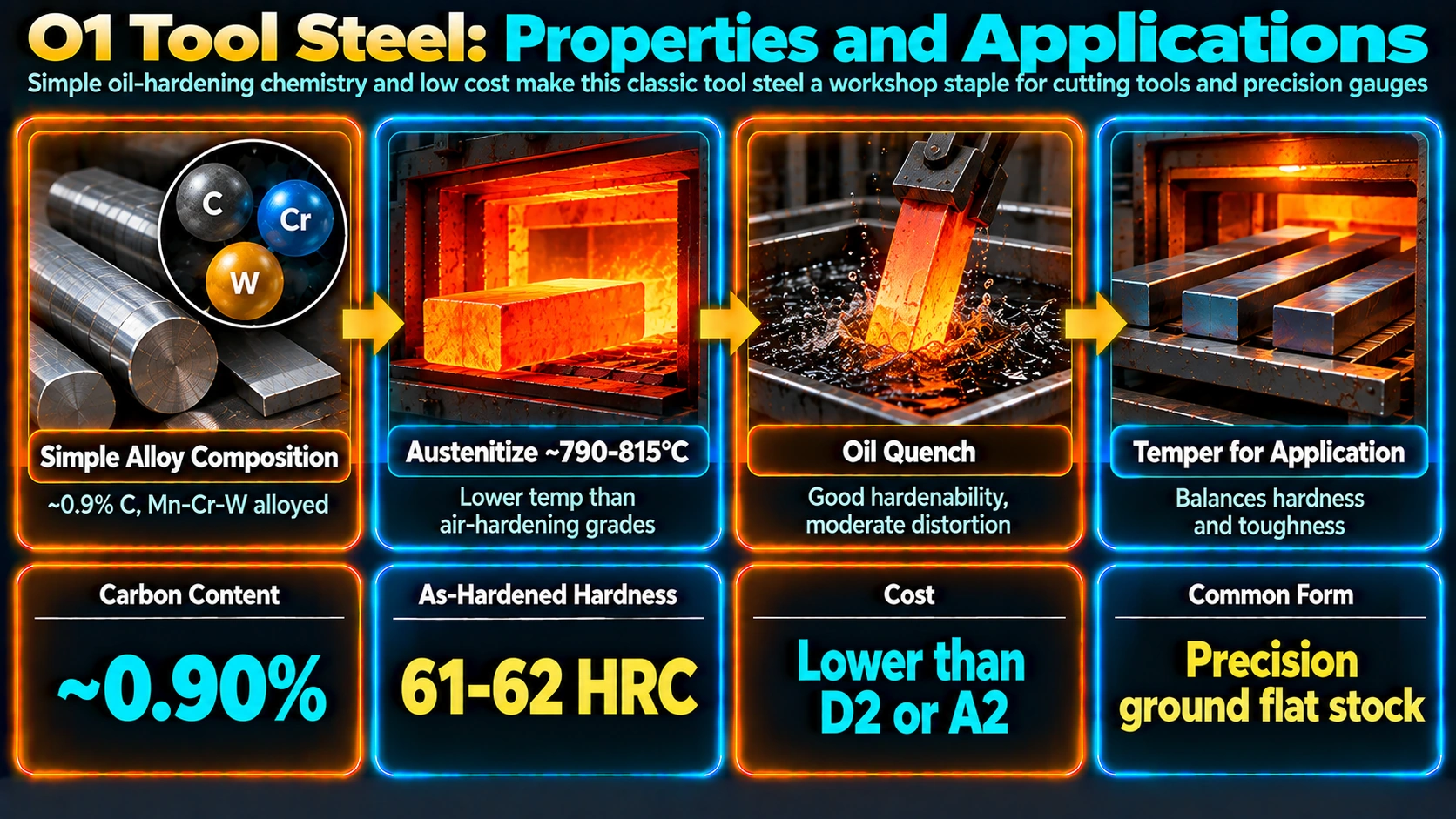
O1 belongs to the AISI O-series of oil-hardening cold-work tool steels, the traditional low-alloy counterpart to the air-hardening A-series and high-carbon high-chromium D-series. Where D2 relies on roughly 12% chromium to achieve deep, air-hardening hardenability and a large volume fraction of wear-resistant carbides, O1 uses a much leaner alloy addition of chromium, tungsten, and manganese, just enough to guarantee reliable martensitic hardening in an oil quench without the machinability penalty that heavy carbide loading brings.
This leaner alloying places O1 closer to the plain eutectoid composition than D2, and its transformation behavior can be understood as an incremental step up in hardenability and grain refinement above a plain high-carbon steel, rather than the carbide-dominated system that governs D2 or D3.
Chemical Composition
Nominal AISI/SAE O1 composition, expressed in weight percent:
| Element | Range (wt%) | Metallurgical role |
|---|---|---|
| Carbon (C) | 0.85 – 1.00 | Primary hardening element; controls as-quenched martensite hardness |
| Manganese (Mn) | 1.00 – 1.40 | Principal hardenability contributor in this grade; deoxidizer |
| Chromium (Cr) | 0.40 – 0.60 | Secondary hardenability boost; minor carbide formation |
| Tungsten (W) | 0.40 – 0.60 | Fine carbide formation; grain refinement; modest wear resistance |
| Vanadium (V) | up to 0.30 | Grain refinement via fine MC carbide; restricts austenite grain growth |
| Silicon (Si) | 0.50 max | Deoxidizer |
| Phosphorus (P) | 0.030 max | Residual impurity |
| Sulfur (S) | 0.030 max | Residual impurity |
Note the shift in hardenability strategy compared with D2: O1 leans on manganese, a comparatively economical hardenability agent, plus modest chromium and tungsten, rather than the heavy chromium loading that both hardens and carbide-strengthens D2.
Heat Treatment of O1 Tool Steel
Preheating
Because O1’s alloy content is modest, preheating is generally optional for typical die and tool sections and is reserved for large or geometrically complex parts where thermal gradients during heating could cause distortion or cracking. Where used, a preheat of roughly 650-760°C before ramping to the austenitizing temperature is sufficient.
Austenitizing
O1 is austenitized between 790°C and 830°C, commonly around 800°C (1475°F), with a soak of 15-30 minutes once the section is through-heated. This is a substantially lower austenitizing temperature than D2’s 980-1030°C range, reflecting O1’s much lower alloy carbide content: there is little to dissolve, and the priority is achieving full carbon solution in the austenite without excessive grain growth.
Quenching
O1 requires an oil quench. Its manganese, chromium, and tungsten content provide enough hardenability to form martensite in oil but not in air, which is the defining distinction from air-hardening grades like A2 and D2. Oil quenching cools faster than air but slower and more uniformly than water or brine, balancing the need for full hardening against the risk of quench cracking that plain high-carbon steels face in water.
Hardenability Limit
O1’s hardenability is shallow relative to D2 or A2. Reliable through-hardening is generally limited to about 25-50 mm (1-2 in) section thickness with a standard oil quench; thicker sections risk a softer, pearlitic or bainitic core beneath a fully hardened case. Section-size limits should always be checked against the specific mill’s hardenability data before specifying O1 for a heavy die block.
Retained Austenite and Tempering Response
Because O1 carries far less alloy than D2, its martensite start temperature sits well above D2’s, and retained austenite after quenching is correspondingly modest, typically a few percent rather than the 10-20%+ seen in heavily alloyed grades. The same Koistinen-Marburger relation used to describe athermal martensite formation in any steel applies here, but with a higher Ms shifting more of the transformation to completion before reaching room temperature:
f_M = 1 − exp[−α(Ms − T)]

f_M   = volume fraction martensite formed
Ms    = martensite start temperature (°C); higher for O1 than for high-alloy D2
T     = current temperature (°C), T < Ms
α    = rate constant, ≈ 0.011 °C⁻¹ (typical for alloy tool steels)
In practice this means O1 rarely requires the double or triple tempering routine that D2 needs to fully convert retained austenite; a single temper cycle of 1-2 hours is usually sufficient, though a stress-relief-focused second temper is still good practice for precision tooling.
Tempering Temperature Selection
O1’s tempering response is a simple, continuous decrease in hardness as temperature rises, with no secondary hardening hump, because it lacks the strong molybdenum or vanadium carbide formers that produce that effect in D2 or M2. Tempering at 175-205°C retains near-maximum hardness (60-62 HRC) for wear-critical cutting edges. Tempering up to roughly 315-425°C trades hardness for toughness, useful for punches or dies subject to light shock. Above about 425°C, hardness drops substantially and O1 is rarely tempered that high in practice.
Mechanical Properties and Microstructure
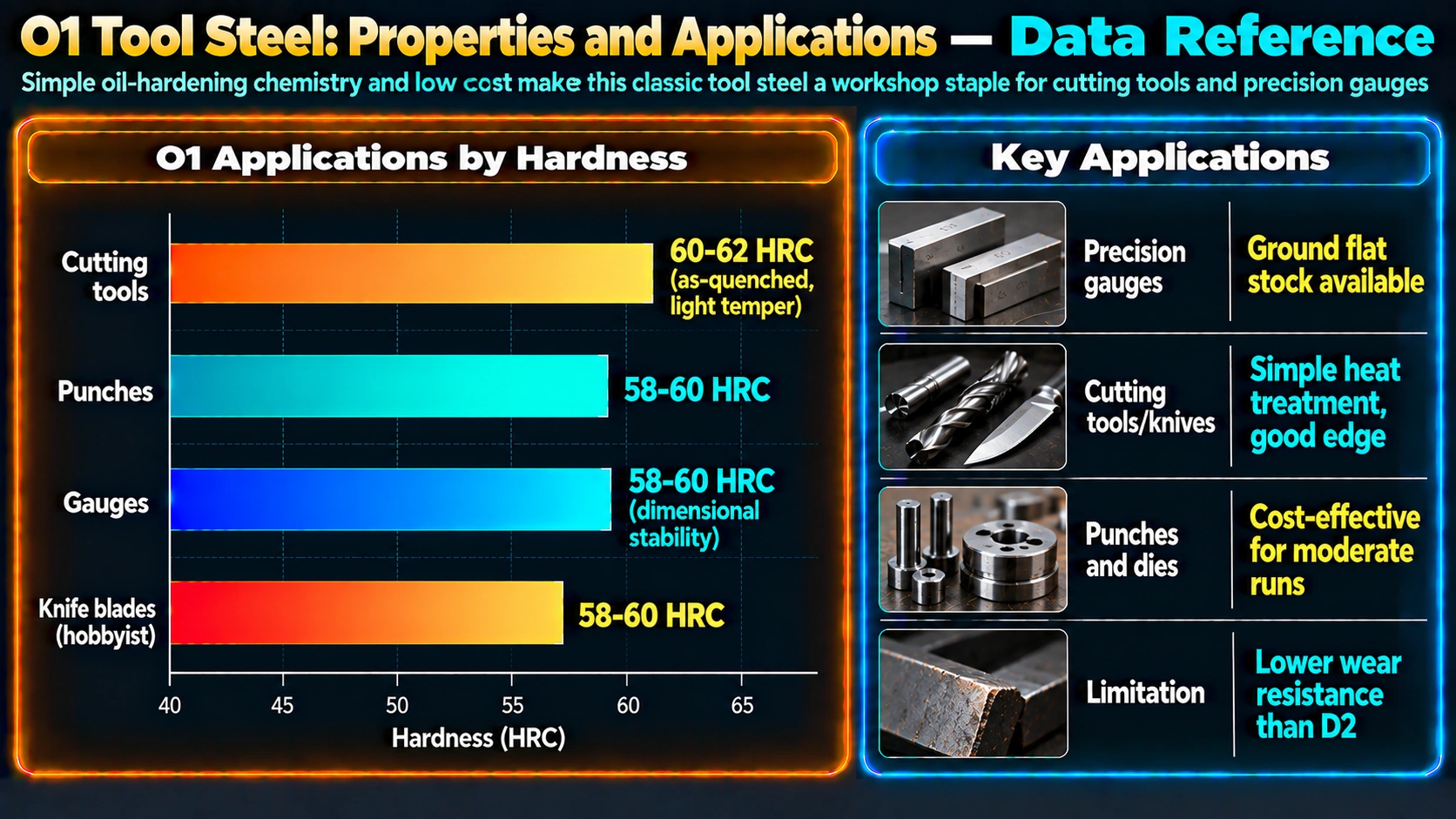
O1’s tempered martensite matrix carries a much lower total carbide fraction than D2, with small, well-dispersed tungsten- and vanadium-rich carbides rather than large primary chromium carbides. This gives O1 a finer, more homogeneous microstructure that machines, grinds, and polishes readily, and that resists edge chipping better than D2 at comparable hardness, though its abrasive wear resistance is correspondingly lower. Readers comparing carbide-driven wear behavior across grades may find it useful to revisit martensite formation in steel alongside our tool steel classification guide for how the AISI letter designations map to alloying strategy.
Comparison with Other Cold-Work Tool Steels
| Grade | Hardening method | Typical service HRC | Wear resistance | Machinability | Distortion risk |
|---|---|---|---|---|---|
| O1 | Oil | 57-62 | Moderate | Very good | Higher (oil quench) |
| A2 | Air | 57-62 | Moderate-high | Good | Low |
| D2 | Air | 58-62 | Very high | Fair-poor | Very low |
| W1 | Water | 60-65 | Low-moderate | Very good | Highest |
| S7 | Air | 54-58 | Moderate | Good | Low |
Against A2, O1 gives up some hardenability depth and distortion control in exchange for easier machining and lower material cost. Against W1, O1’s oil quench and modest alloy content give far better dimensional stability and lower cracking risk than a water-hardening plain carbon grade. Against D2, the comparison is a straightforward trade of wear resistance for machinability and cost, with D2 favored for long, abrasive production runs and O1 favored for lower-volume tooling, gauges, and parts requiring extensive machining before hardening.
Dimensional Stability and Distortion
Because O1 must be oil quenched rather than air quenched, it develops steeper thermal gradients through a section during cooling than A2 or D2, and correspondingly more size and shape change. Long, thin, or asymmetric tools are particularly prone to bowing. Standard practice is to leave grinding stock on critical dimensions before hardening and finish grind afterward, and to support long or thin sections in fixtures during the quench where practical. For applications demanding the tightest dimensional stability through hardening, air-hardening grades such as A2 or D2 are generally preferred over O1 despite the machinability trade-off.
Industrial Applications
O1’s combination of reliable hardening response, good machinability, and moderate cost makes it a default choice for tooling that does not need D2-level abrasive wear resistance:
- Gauges and precision measuring tools requiring dimensional stability at moderate hardness
- Bushings and wear plates in low- to medium-duty applications
- Forming and blanking dies for shorter production runs
- Woodworking tools, knives, and hand tool blades
- Punches, taps, reamers, and other cutting tools where machinability before hardening matters
- Fixtures and jigs requiring moderate hardness with easy shop-floor fabrication
Grade selection between O1 and higher-alloy alternatives is often supported by comparative hardness testing and, where wear life over production volume is the deciding factor, a direct cost-per-part comparison against D2’s higher material cost and lower machinability.
Frequently Asked Questions
What is O1 tool steel?
What is the composition of O1 tool steel?
What hardness can O1 tool steel achieve?
Is O1 tool steel oil hardening or air hardening?
What is the difference between O1 and D2 tool steel?
What is the maximum section size for through-hardening O1?
Does O1 tool steel show secondary hardening?
What distortion should be expected when hardening O1?
What are common applications of O1 tool steel?
How does O1 compare to A2 tool steel for machinability?
Recommended Reference Reading
Tool Steels (ASM International)
The standard reference on tool steel metallurgy, covering O-series, A-series, and D-series alloying strategy side by side.
View on AmazonASM Heat Treater’s Guide
Practical austenitizing, quenching, and tempering data for irons and steels, including oil-hardening tool steels.
View on AmazonMetals Handbook Desk Edition
A comprehensive single-volume reference spanning composition, properties, and processing across metal families.
View on AmazonCallister’s Materials Science and Engineering
The standard graduate-level materials science text covering hardenability, martensite formation, and mechanical behavior.
View on AmazonDisclosure: MetallurgyZone participates in the Amazon Associates programme. If you purchase through these links, we may earn a small commission at no extra cost to you. This helps support free technical content on this site.
Further Reading
