AISI 8620 Case Hardening Steel Guide
AISI 8620 is the most widely specified low-alloy case hardening steel for gears and driveline components, prized for the combination of a hard, wear-resistant carburized case and a tough, impact-resistant nickel-chromium-molybdenum core. This guide covers composition, the carburizing process, case and core properties, hardness profile, and applications.
Key Takeaways
- 8620 is a low-carbon (0.18-0.23%) Ni-Cr-Mo alloy steel specifically designed for carburizing, combining deep case/core hardenability with good core toughness.
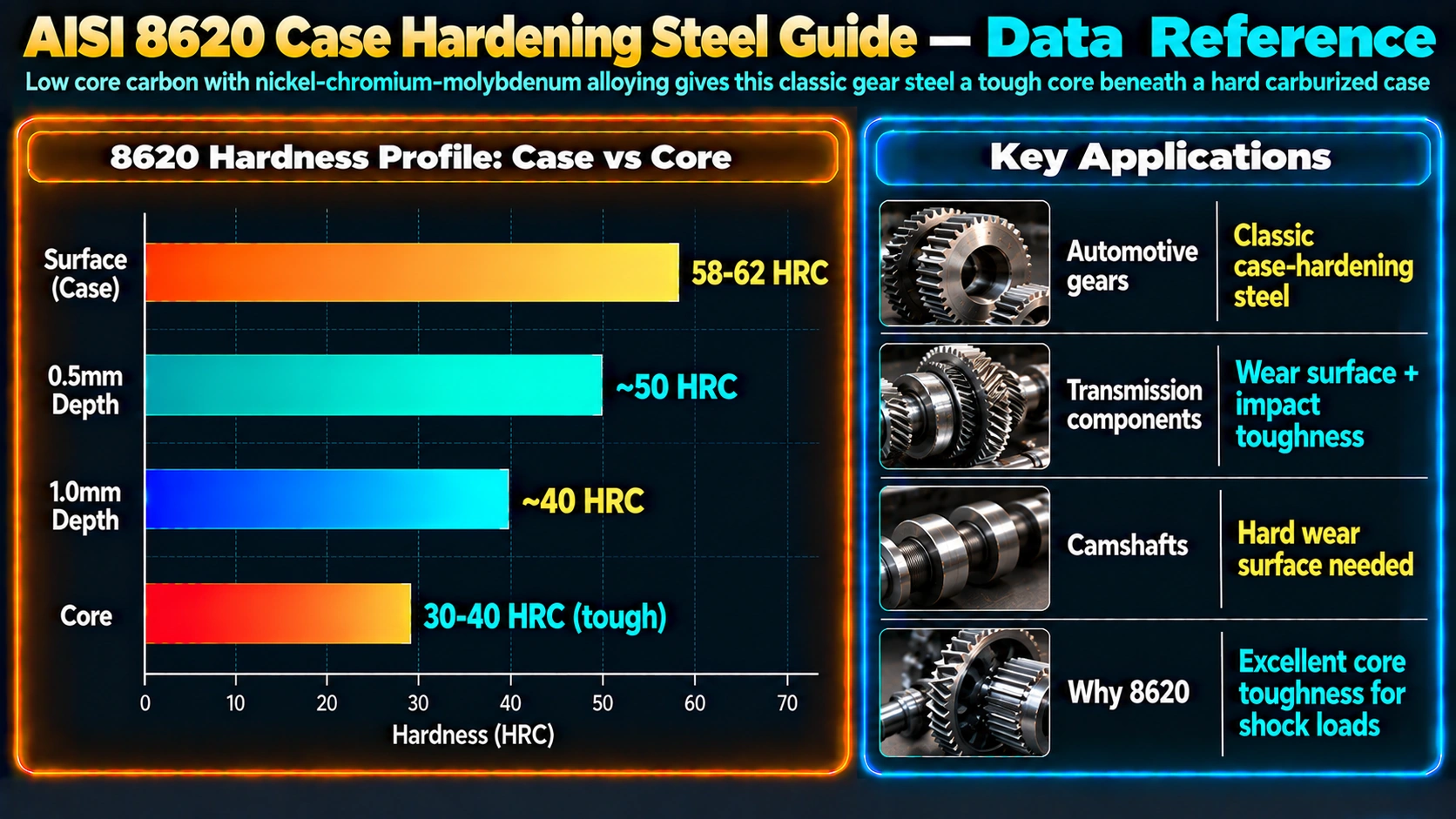
- Carburized and hardened 8620 typically reaches 58-62 HRC surface hardness with case depth of roughly 0.5-1.5 mm, over a tough core hardening to roughly 25-40 HRC.
- Carburizing is performed at approximately 900-930 C, followed by quenching (direct or reheat) and a low-temperature temper (150-200 C) that relieves stress without softening the case significantly.
- Nickel content gives 8620 better core toughness than plain carbon case steels like 1018, while remaining far more economical than higher-nickel aerospace-grade case steels like 9310.
- Fine-grain practice steel and, where needed, a reheat-and-quench cycle control the grain coarsening that occurs during extended time at carburizing temperature.
- Welding is performed only on unhardened, pre-carburized 8620; welding after case hardening would destroy the case and risk cracking the hard surface layer.
Chemical Composition
| Element | Typical Range (wt%) |
|---|---|
| Carbon (C) | 0.18 – 0.23 |
| Manganese (Mn) | 0.70 – 0.90 |
| Silicon (Si) | 0.15 – 0.35 |
| Nickel (Ni) | 0.40 – 0.70 |
| Chromium (Cr) | 0.40 – 0.60 |
| Molybdenum (Mo) | 0.15 – 0.25 |
| Phosphorus (P) | 0.035 max |
| Sulfur (S) | 0.040 max |
Why 8620 Is Designed for Case Hardening
8620’s base carbon content (0.18-0.23%) is deliberately kept low, in the same range as AISI 1018, so the core remains soft and tough rather than fully hardening on quenching. Its nickel, chromium, and molybdenum alloying additions serve a different purpose than in a through-hardening grade like 4340: rather than pushing core strength to a maximum, they raise hardenability enough that both the carburized case and the low-carbon core can form a useful, tough martensitic or bainitic structure on quenching, and nickel specifically preserves core impact toughness that a plain carbon case steel of the same carbon content would not retain as well.
Nickel
Improves core toughness and impact resistance, particularly important for gear teeth subject to shock loading in service, without significantly raising core hardness or brittleness.
Chromium
Improves hardenability of both case and core, helping ensure a fully martensitic case forms reliably on quenching even in production environments with some process variation.
Molybdenum
Further improves hardenability and helps maintain core toughness, with a secondary benefit of reduced temper embrittlement susceptibility compared with a nickel-chromium steel lacking molybdenum, similar to its role in AISI 4340.
Mechanical Properties
As-Supplied (Normalized) Core Material
| Property | Typical Value |
|---|---|
| Tensile strength | ~530 MPa (77 ksi) |
| Yield strength | ~385 MPa (56 ksi) |
| Elongation | ~30-31% |
| Brinell hardness | ~150 HB |
After Carburizing, Quenching, and Low-Temper
| Zone | Typical Hardness | Typical Tensile Strength |
|---|---|---|
| Case (surface) | ~58-62 HRC | Not typically tested directly (very thin, hard layer) |
| Core | ~25-40 HRC | ~700-1000 MPa |
The Carburizing Process
Carburizing Temperature and Time
8620 is carburized at approximately 900-930°C, well above the normal hardening temperature for through-hardening steels, to allow adequate carbon diffusion into the surface within a practical process time. Case depth increases approximately with the square root of time at a given temperature, so achieving deeper case depths requires disproportionately longer hold times, which is why case depth specifications are set based on actual service contact stress rather than simply maximized.
Approximate case depth relationship: depth ∝ √(time)
Carburizing Methods
Gas carburizing (typically using an endothermic or synthetic atmosphere enriched with a hydrocarbon gas) is the most common industrial method for high-volume production. Pack carburizing (packing parts in a carbon-rich solid compound) is used for lower-volume or specialty work. Vacuum carburizing offers cleaner, more uniform case depth control with reduced intergranular oxidation, increasingly used for high-value or precision gear applications.
Direct Quench vs Reheat and Quench
Direct quenching from the carburizing temperature is the most economical approach, but the carburizing temperature is high enough to coarsen austenite grain size, potentially reducing toughness. Where maximum core toughness is required, parts are instead cooled after carburizing, then reheated to a lower, optimized hardening temperature and quenched, refining the grain structure at the cost of an additional processing step.
Post-Quench Tempering
A low-temperature temper, typically 150-200°C, follows quenching to relieve residual stress from the case-core transformation mismatch and reduce the risk of quench cracking, without tempering high enough to significantly soften the wear-resistant case, in contrast to the higher tempering temperatures used to tune strength-toughness balance in through-hardening grades.
Common Pitfall
Specifying a case depth without reference to actual gear tooth geometry and contact stress is a frequent design error: too shallow a case under heavy contact loading can allow subsurface fatigue (case crushing), while an unnecessarily deep case adds cycle time and cost without functional benefit. Case depth should be engineered to the specific load case, not selected as a generic default.
Grain Coarsening and Fine-Grain Practice
Extended time at the high carburizing temperature promotes austenite grain growth, which can reduce impact toughness if uncontrolled. Fine-grain practice steel, aluminum-killed during steelmaking so that fine aluminum nitride particles pin grain boundaries and resist coarsening, is standard for case hardening grades like 8620, and is a major reason fine-grain melting practice is specified on case hardening steel purchase orders even though it is not always called out explicitly on through-hardening grades.
Comparison to Related Case Hardening Steels
| Grade | Approx. Nickel | Relative Core Toughness | Typical Use |
|---|---|---|---|
| 1018 / 1020 | None | Lower | Small, lightly loaded case-hardened parts |
| 8620 | 0.40-0.70% | Good | Automotive/industrial gears, general driveline |
| 4320 | ~1.65-2.00% | Higher | Heavier-duty gears, higher core strength needs |
| 9310 | ~3.0% | Highest | Aerospace gearbox gears (e.g. helicopter transmissions) |
Weldability and Machinability
Weldability
8620 has good weldability in the unhardened, pre-carburized (annealed or normalized) condition, though preheat is more commonly specified than for plain low-carbon steel due to its added hardenability from alloying. Welding is not performed after case hardening, since the weld thermal cycle would locally destroy the hardened case and risk cracking the very hard, brittle case layer.
Machinability
8620 machines well in the normalized or annealed condition, before carburizing, with a machinability rating typically cited in a similar range to other low-alloy steels of comparable hardness. Parts are fully machined to final or near-final dimension before carburizing, since the hardened case is very difficult to machine conventionally and is typically finished, where needed, by grinding.
International Equivalents
| Standard | Approximate Equivalent |
|---|---|
| DIN / EN (Germany/Europe) | 21NiCrMo2 |
| JIS (Japan) | SNCM220 |
As with other cross-standard comparisons, these are commonly cited approximations; critical or code-governed procurement should verify composition and mechanical property requirements against the specific standard and material certificate.
Applications
AISI 8620 is the standard material for automotive and industrial transmission and differential gears, camshafts, wrist pins, sprockets, chain pins, bearing races, and other components requiring a hard, wear-resistant working surface over a tough, shock-resistant core. It is widely stocked and processed at case hardening heat treaters, making it the default choice for new gear and driveline component designs unless a specific higher-alloy grade is required for extreme duty or aerospace-grade toughness requirements.
Frequently Asked Questions
What is AISI 8620 steel used for?
Why is 8620 used for case hardening instead of a plain carbon steel like 1018?
What is the typical case hardness and case depth for carburized 8620?
What core properties does 8620 have after carburizing and hardening?
What is the carburizing process for 8620 steel?
Should 8620 be tempered after carburizing and quenching?
What is the difference between 8620 and 4320/9310 case hardening steels?
Is AISI 8620 steel weldable?
What is the European or JIS equivalent of AISI 8620 steel?
What causes grain coarsening during carburizing and how is it controlled?
Recommended Reference Reading
ASM Handbook: Properties and Selection, Irons and Steels
Reference-grade composition and property data for case hardening steels including 8620.
View on AmazonHeat Treater’s Guide: Practices and Procedures for Irons and Steels
Practical carburizing, case depth control, and post-quench tempering procedures.
View on AmazonGear Materials, Properties, and Manufacture
Focused reference on gear steel selection, carburizing, and case hardening practice.
View on AmazonSteel Heat Treatment: Metallurgy and Technologies
In-depth coverage of carburizing metallurgy, grain control, and hardenability.
View on AmazonDisclosure: MetallurgyZone participates in the Amazon Associates programme. If you purchase through these links, we may earn a small commission at no extra cost to you. This helps support free technical content on this site.
Further Reading
