t8/5 Cooling Time in Welding Explained
t8/5, the time a weld takes to cool from 800 C to 500 C, is the single most important thermal parameter for predicting heat-affected zone hardness and toughness in structural and pipeline steel welding. This guide explains the two-dimensional and three-dimensional EN 1011-2 cooling time formulas, why the 800-500 C window is used, and includes a calculator for both heat flow regimes.
Key Takeaways
- t8/5 brackets the temperature range where austenite decomposes into ferrite, pearlite, bainite, or martensite in most structural and pipeline steels, making it a practical proxy for predicting HAZ microstructure.
- Three-dimensional (thick plate) cooling depends on heat input and preheat temperature only; two-dimensional (thin plate) cooling also depends strongly on plate thickness.
- In the two-dimensional regime, thinner plate can cool more slowly than thicker plate for the same linear heat input, since there is less material to conduct heat through the thickness.
- Preheat and interpass temperature are the primary practical levers for lengthening a too-short t8/5 on hardenable steel to reduce cracking risk.
- Pipeline welding for modern TMCP steels commonly targets a t8/5 window of roughly 5-25 seconds, though the actual allowable range always comes from the qualified WPS, not a general rule of thumb.
- These formulas are estimation tools for procedure design; code-critical qualification should confirm cooling behavior with thermocouple-measured cooling curves and hardness/toughness testing.
t8/5 Cooling Time Calculator
Estimation Tool – Verify for Code Work
This calculator implements the standard Rykalin-based EN 1011-2 (ISO/TR 17671-2) approach for estimation and procedure design purposes. For code-governed or safety-critical applications, confirm cooling behavior against the current edition of EN 1011-2 directly, or through thermocouple-measured cooling curves during welding procedure qualification.
Why 800-500 C Is the Reference Window
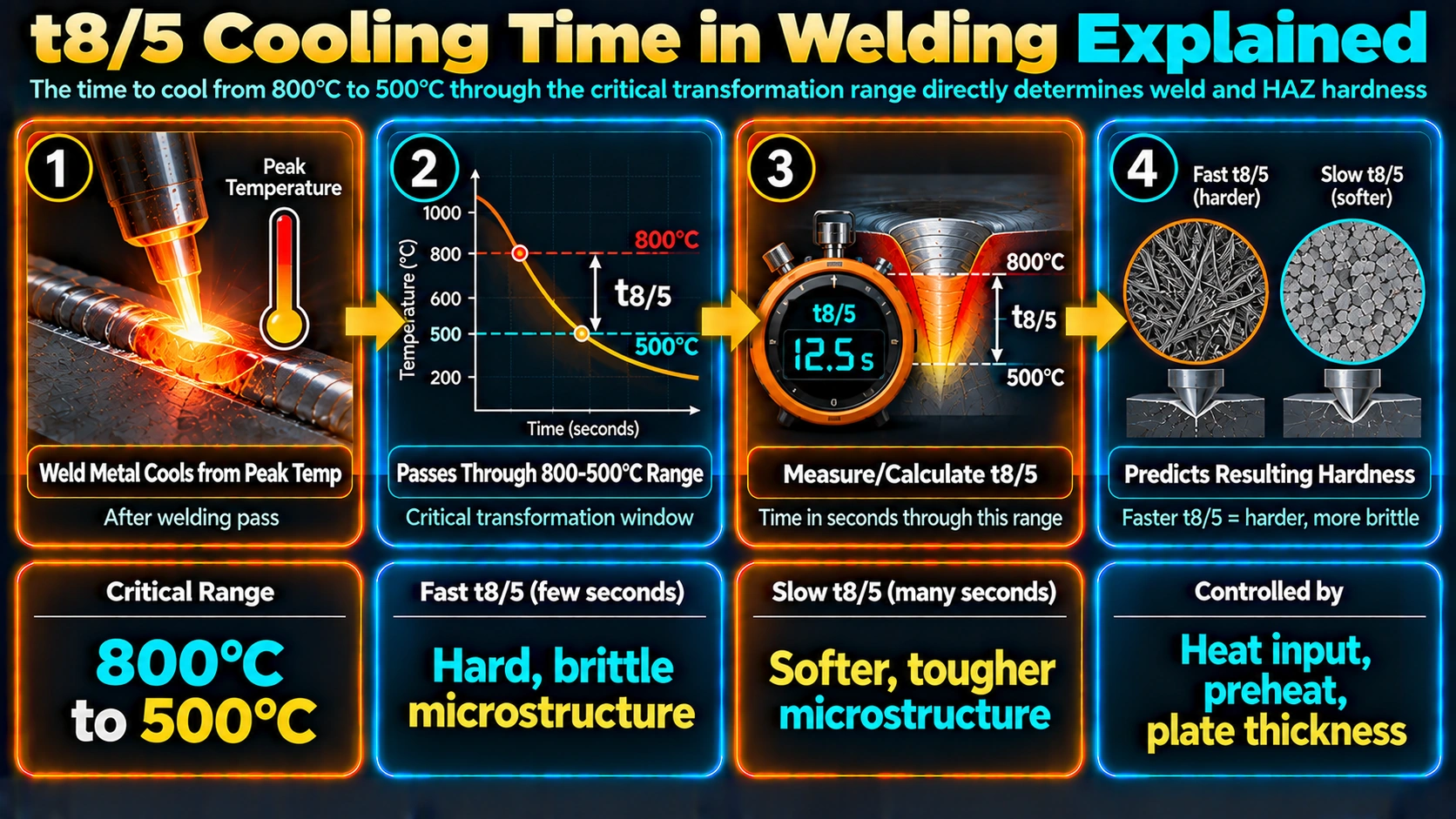
For most low-alloy and carbon-manganese structural steels, the decomposition of austenite into ferrite, pearlite, bainite, and martensite occurs predominantly within the 800-500 C range as the weld cools from its peak temperature. Using this fixed window as a reference, rather than the steel’s specific transformation start temperature (which varies with composition), gives welding engineers a standardized, composition-independent way to compare cooling severity across different steels, heat inputs, and joint geometries, which is why t8/5 rather than a composition-specific transformation temperature is the parameter specified in welding procedures and codes such as EN 1011-2 and related pipeline welding standards.
The EN 1011-2 Cooling Time Formulas
Both formulas are derived from the Rykalin analytical heat flow solutions for a moving point or line heat source, adapted into a practical engineering form. Q is net heat input (kJ/mm), T0 is preheat/interpass temperature (C), d is plate thickness (mm), and F is a joint shape factor.
Three-Dimensional Heat Flow (Thick Plate)
t8/5 = (4300 - 4.3 x T0) x 10^3 x Q x [1/(500-T0)^2 - 1/(800-T0)^2] x F2
This regime applies when the plate is thick enough that heat can conduct away in all three dimensions, including through the thickness, giving cooling behavior that is independent of thickness itself, driven only by heat input and preheat.
Two-Dimensional Heat Flow (Thin Plate)
t8/5 = (6700 - 5 x T0) x 10^4 x (Q/d)^2 x [1/(500-T0)^2 - 1/(800-T0)^2] x F3
This regime applies when the plate is too thin for significant through-thickness conduction, so cooling depends strongly on thickness d: thinner plate in this regime cools more slowly for the same linear heat input, since there is less material mass available to spread and absorb the heat away from the weld line.
Worked Example: 3D Case
Given: Q = 1.2 kJ/mm, T0 = 20 C, F2 = 1.0 (butt weld)

(4300 - 4.3 x 20) = 4214
1/(500-20)^2 - 1/(800-20)^2 = 1/480^2 - 1/780^2 = 2.696 x 10^-6

t8/5 = 4214 x 10^3 x 1.2 x 2.696 x 10^-6 x 1.0
     = approximately 13.6 seconds
Shape Factor (F2 / F3) by Joint Type
The shape factor accounts for additional heat sink paths that a real joint provides compared with the idealized reference case (a simple butt weld between two plates of equal thickness). More adjacent plates at a joint (such as a T-joint or cruciform joint) draw heat away faster, reducing t8/5 for the same heat input.
| Joint Configuration | Typical F Factor | Notes |
|---|---|---|
| Butt weld, 2 plates (reference case) | 1.0 | Standard baseline case |
| Bead on plate / surfacing | ~0.9 | Single plate, no second heat sink path |
| Fillet weld, T-joint, 3 plates | ~0.67 | Extra heat sink from third plate |
| Fillet weld, cross joint, 4 plates | ~0.45 | Fastest cooling of common joint types |
These are typical, widely cited approximations; for joint-specific or code-critical work, consult the current edition of EN 1011-2 Annex C for precise factors.
Effect of Preheat and Heat Input
Preheat and Interpass Temperature
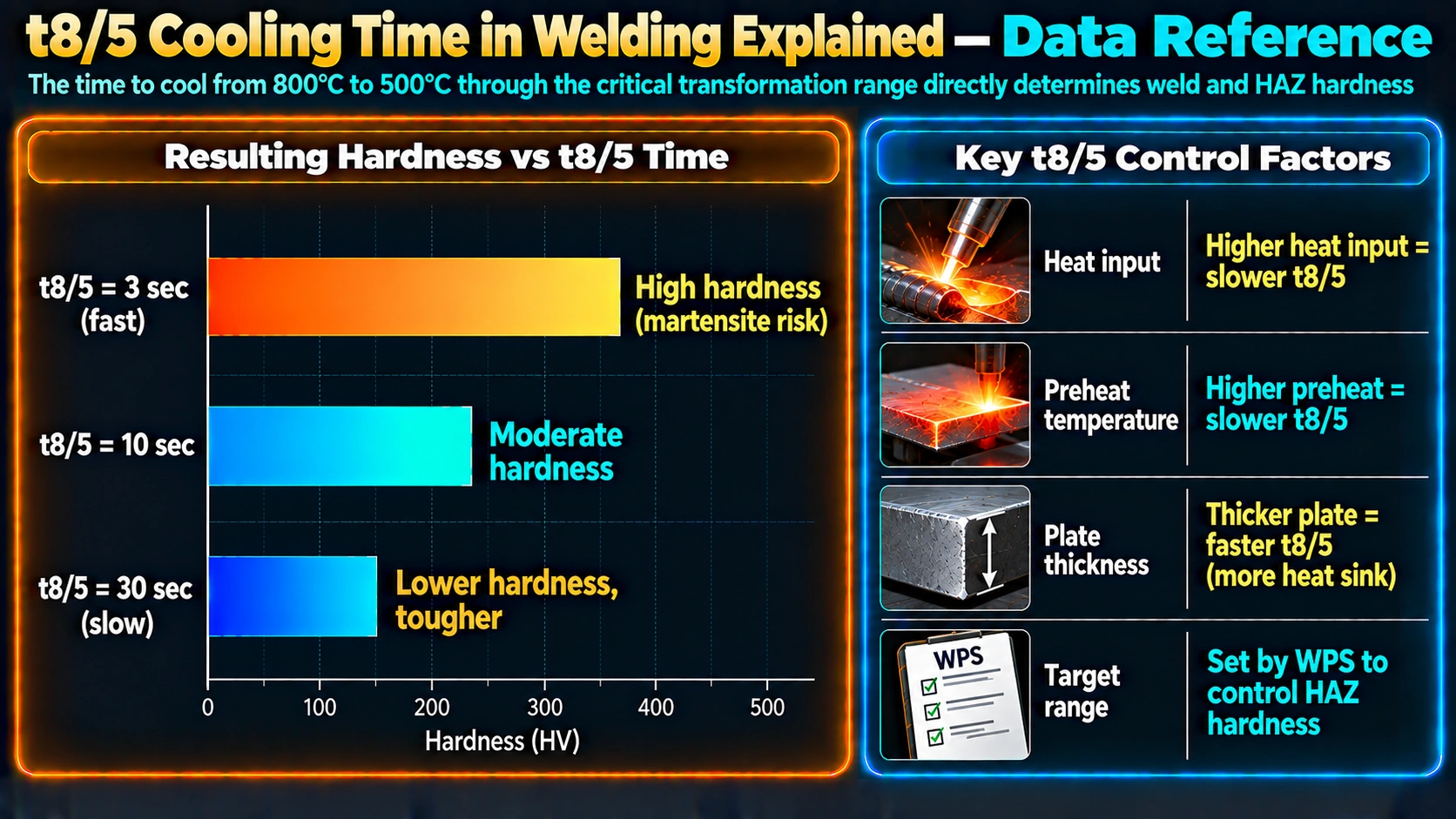
Raising T0 lengthens t8/5 substantially, since both formula terms involving T0 push cooling time upward as preheat increases, reflecting the reduced thermal gradient available to drive conduction away from the weld. This is the primary tool welding engineers use to control cooling rate on thick, hardenable steel where heat input alone cannot be increased without other penalties (such as excessive grain coarsening or reduced mechanical properties from an overly large weld bead).
Heat Input
Higher heat input Q lengthens t8/5 roughly linearly in the 3D case and roughly with the square in the 2D case, making heat input the second major lever, though changes to heat input also affect bead geometry, dilution (see the guide to weld dilution ratio), and productivity, so procedure qualification typically balances heat input and preheat together rather than adjusting either alone.
Consequences of Incorrect t8/5
Too Short (Fast Cooling)
Favors martensite and upper bainite in hardenable steels, raising HAZ hardness and increasing susceptibility to hydrogen-induced cold cracking, particularly relevant to the same mechanisms covered in the guide to hydrogen-induced cracking. Corrected by increasing preheat, interpass temperature, or heat input.
Too Long (Slow Cooling)
Allows excessive grain growth in the coarse-grained HAZ and can promote coarse transformation products with reduced impact toughness, a particular concern for low-temperature service such as Arctic pipeline or offshore applications. Corrected by reducing heat input or preheat, within the limits the procedure allows for cracking control.
Industrial Applications
t8/5 calculation and control is central to pipeline girth welding procedure qualification, offshore and structural steel fabrication with higher-strength, higher-hardenability grades, and pressure vessel and power plant piping welding where both hardness and toughness requirements must be met simultaneously. Welding procedure specifications for these applications typically state an allowable t8/5 range directly, derived from qualification testing that links measured cooling time to measured hardness and Charpy impact results, as discussed in the guide to Charpy impact testing.
Frequently Asked Questions
What is t8/5 in welding and why is it measured between 800 C and 500 C?
Why does t8/5 matter for weld HAZ properties?
What is the difference between two-dimensional and three-dimensional heat flow in t8/5 calculations?
How does preheat temperature affect t8/5?
What t8/5 range is typically targeted for pipeline welding?
What happens if t8/5 is too short?
What happens if t8/5 is too long?
How is heat input calculated for use in the t8/5 formula?
What is the shape factor (F2/F3) in the t8/5 formula?
Can t8/5 be measured directly during welding, or only calculated?
Recommended Reference Reading
Welding Metallurgy and Weldability
Covers cooling rate, transformation kinetics, and HAZ hardness prediction in depth.
View on AmazonWelding Metallurgy (Sindo Kou)
Reference-grade treatment of heat flow theory and CCT-based HAZ prediction.
View on AmazonPipeline Welding and Girth Weld Procedures
Practical procedure qualification context for API and pipeline t8/5 targets.
View on AmazonASM Handbook: Welding, Brazing, and Soldering
Reference-grade coverage of heat input, cooling rate, and procedure qualification.
View on AmazonDisclosure: MetallurgyZone participates in the Amazon Associates programme. If you purchase through these links, we may earn a small commission at no extra cost to you. This helps support free technical content on this site.
Further Reading
