ISO 9606 Welder Qualification: A Complete Guide
ISO 9606 is the international benchmark for testing and certifying an individual welder’s competence, used across Europe, the Middle East, and much of Asia-Pacific in place of, or alongside, ASME Section IX. This guide covers its scope, material grouping, test piece types, essential variables, and how its logic diverges from the ASME IX approach engineers coming from a North American background typically know first.
Key Takeaways
- ISO 9606-1 qualifies welders for steel; separate parts (9606-2, -3, -4, -5) cover aluminium, copper, nickel, and titanium alloys.
- Material grouping follows CEN ISO/TR 15608, not the ASME IX P-number/F-number/A-number system.
- Qualification is tied directly to a test piece and range of approval, rather than routed through a separately qualified WPS as in ASME IX.
- Position codes (PA, PB, PC, PE, PF, PG, plus pipe-specific PH/PJ) define the geometric difficulty the welder has proven they can handle.
- Qualification certificates run up to two years, contingent on six-monthly employer confirmation of continued competence.
- An ISO 9606 certificate does not automatically satisfy ASME IX, or vice versa — the essential variables and ranges of approval differ.
1. Scope of ISO 9606
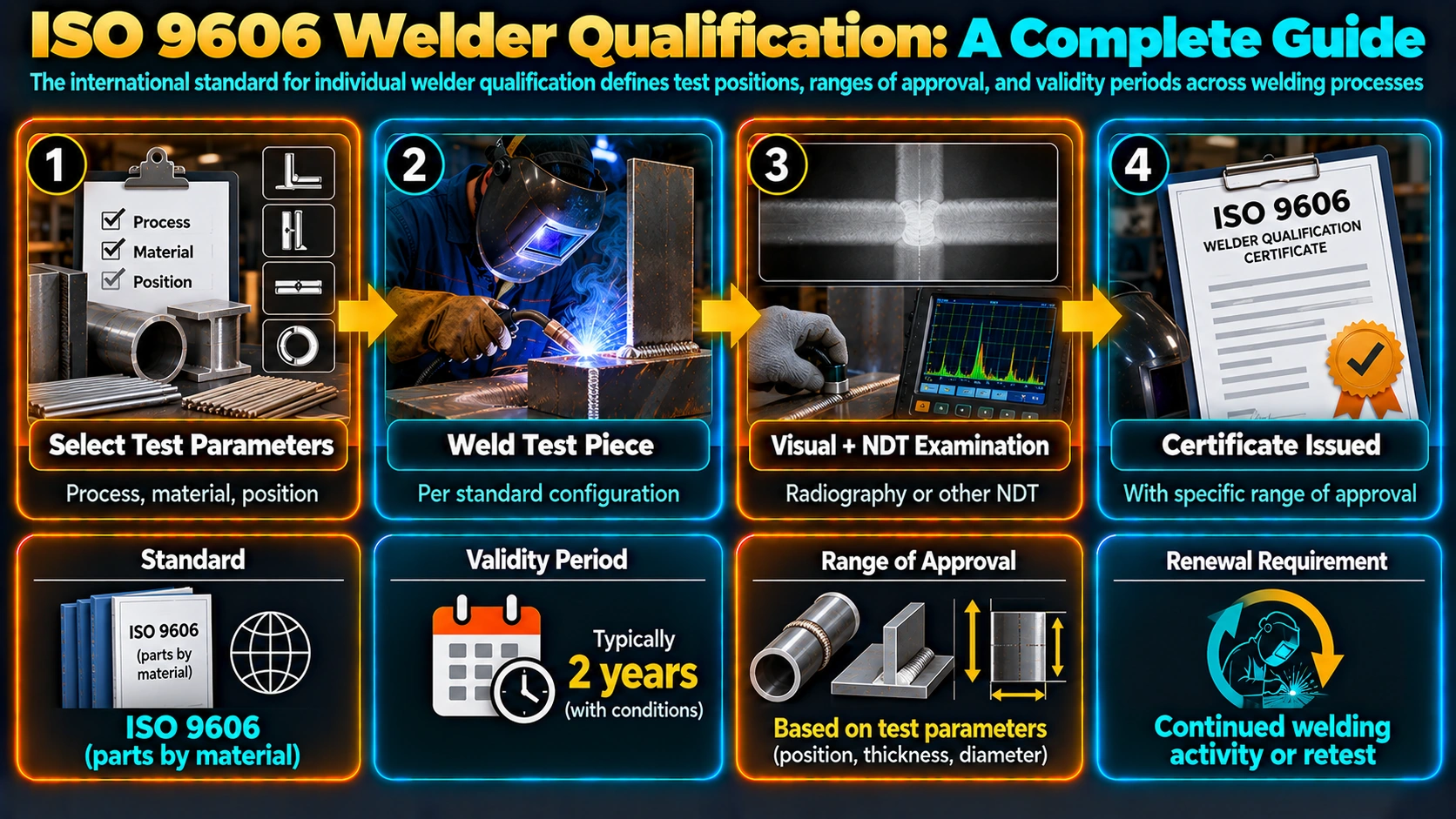
ISO 9606, Qualification testing of welders – Fusion welding, is a multi-part series that establishes how a welder’s manual skill is demonstrated and documented for a specific material family, process, and joint geometry. Part 1 addresses steels; subsequent parts cover aluminium and aluminium alloys, copper and copper alloys, nickel and nickel alloys, and titanium and titanium alloys, each with its own material grouping and test piece logic tailored to that alloy family’s weldability behaviour.
1.1 What the Standard Certifies
A welder qualification under ISO 9606 certifies the individual, not the procedure. It confirms that, for a defined range of approval — material group, thickness range, pipe diameter range, position, and filler metal type — the welder can consistently produce a sound weld, verified by destructive and non-destructive examination of a representative test piece.
2. Material Grouping (CEN ISO/TR 15608)
Rather than the ASME IX P-number system, ISO 9606-1 references the numbered material groups of CEN ISO/TR 15608, which sorts steels by composition and weldability behaviour rather than strictly by chemistry limits.
| Group | Typical Steels | Weldability Note |
|---|---|---|
| 1 | Non-alloy and fine-grain structural steels, ReH ≤ 460 MPa | Generally low preheat requirement |
| 2 | Fine-grain thermomechanically rolled steels | Heat input control matters for HAZ toughness |
| 3 | Quenched and tempered steels, high strength | Preheat and interpass control critical |
| 5 | Cr-Mo low-alloy creep-resisting steels | PWHT and hydrogen control emphasised |
| 8 | Austenitic stainless steels | Interpass temperature limits, sensitisation control |
| 10 | Duplex stainless steels | Heat input window narrower; phase balance sensitive |
A qualification obtained on a Group 8 test piece, for example, extends coverage to other Group 8 steels within the standard’s range-of-approval rules, but does not automatically cover a Group 1 carbon steel joint — see the compositional logic behind these groupings in the iron-carbon phase diagram discussion.
3. Test Piece Types and Essential Variables
3.1 Plate and Pipe Test Pieces
ISO 9606-1 specifies butt weld and fillet weld test pieces in both plate and pipe form. Test piece thickness is chosen so the resulting qualification, once the standard’s range-of-approval multipliers are applied, covers the production thickness range the employer actually needs. Pipe test pieces additionally fix an outside diameter, since small-diameter pipe forces the welder to maintain torch and electrode angle control continuously as the joint geometry rotates through multiple position codes within a single weld.
3.2 Essential Variables
- Welding process — SMAW, GMAW/FCAW (solid or flux/metal cored, with transfer mode noted), GTAW, SAW, and plasma arc, each qualified separately.
- Product type/filler metal — solid wire, flux cored with or without shielding gas, covered electrode type — since flux/slag-forming processes demand different puddle control skills than open-arc GMAW.
- Material group — per CEN ISO/TR 15608, as above.
- Weld type — butt weld or fillet weld, each with a distinct range-of-approval logic since fillet geometry doesn’t test root-pass penetration control the way a butt weld does.
- Position — the PA/PB/PC/PE/PF/PG position codes, with pipe-specific PH (45° fixed, welding upward) and PJ (45° fixed, welding downward) codes capturing the added difficulty of a rotated joint.
- Dimensions — test piece thickness and, for pipe, outside diameter, both of which set the qualified range via multiplier tables in the standard.
Range of approval example (plate butt weld, single-run or
multi-run as tested):
  Test thickness t  →  qualifies production thickness range
      approximately  0.5t  to  2t   (multi-run process)
      or per the specific table for single-run processes,
      which is typically narrower.

Exact multipliers depend on process, weld type, and whether
the test was single-run or multi-run — always confirm against
the current edition's Table of ranges, not from memory.
4. Examination and Acceptance
Every test weld undergoes visual examination first. Beyond that, ISO 9606-1 calls for either radiographic examination, or ultrasonic examination combined with bend testing, depending on process and joint type; fillet welds, which a radiograph cannot meaningfully interpret, are instead assessed by fracture test, macro-etch sectioning, or bend testing as applicable. Acceptance criteria for imperfections reference the relevant ISO 5817 quality level, which is where hardness and mechanical testing methodology intersects with pure weld-soundness inspection.
4.1 Comparison Table — ISO 9606-1 vs ASME Section IX
| Aspect | ISO 9606-1 | ASME Section IX |
|---|---|---|
| What is qualified | The welder, against a defined test piece | The welder (WPQ), drawing essential variables from an already-qualified WPS |
| Material grouping | CEN ISO/TR 15608 groups/subgroups | P-number, Group number, F-number, A-number |
| Position coding | PA/PB/PC/PE/PF/PG, PH/PJ for pipe | 1G–6G (pipe), 1F–4F (fillet) |
| Certificate validity | Up to 2 years, 6-monthly confirmation | Indefinite, subject to a 6-month lapse-in-process rule |
| Governing scope | International, widely referenced in EN/ISO fabrication codes | North American default; referenced by ASME B31, Section VIII, etc. |
5. Certificate Validity and Renewal
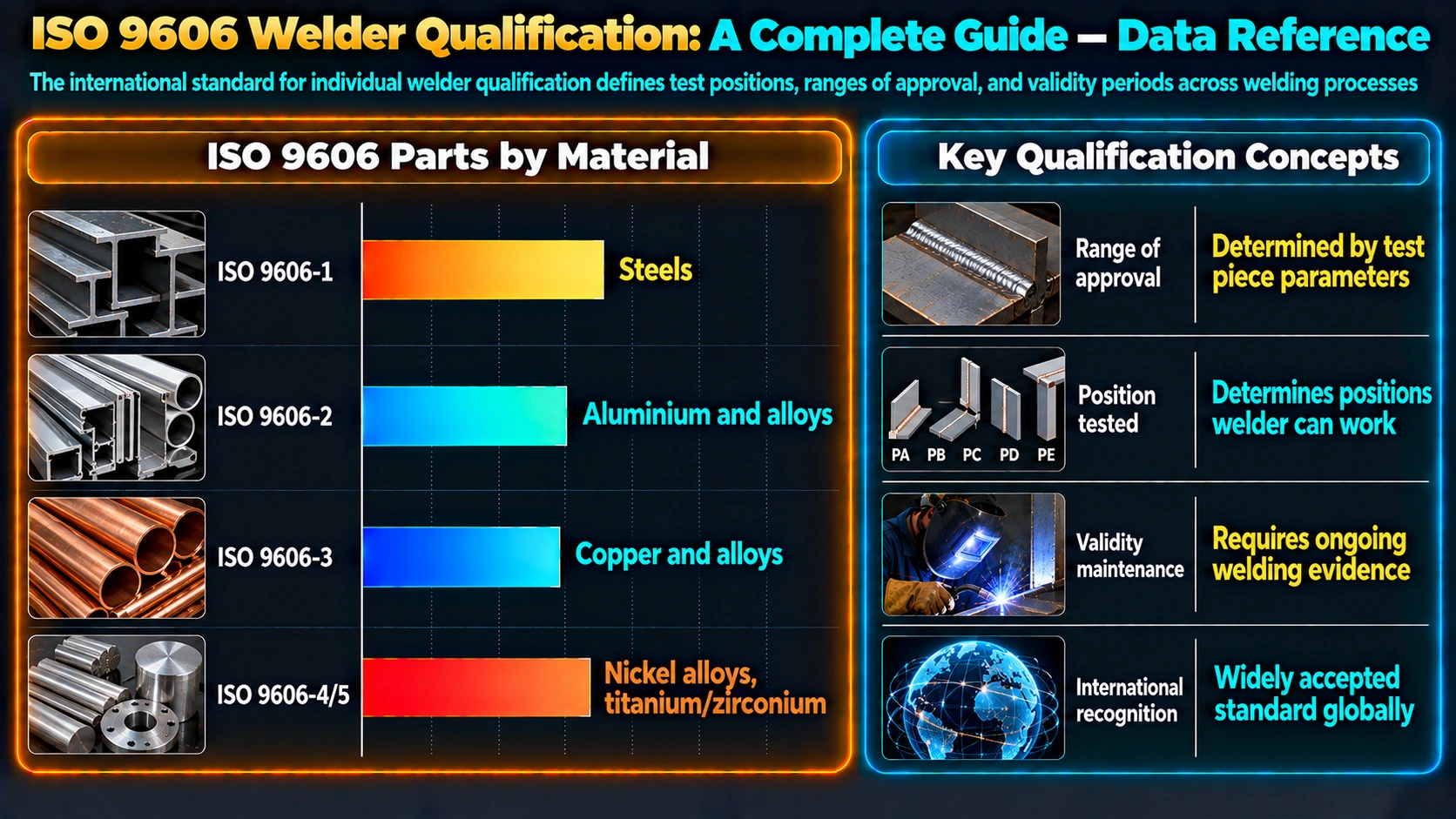
An ISO 9606 welder qualification certificate is generally valid for up to two years from the qualification test date. Continuity within that window depends on the employer or a responsible examiner confirming, roughly every six months, that the welder has continued working within the qualified process, material group, and position without evidence of unsatisfactory performance — a lapse or documented quality issue can trigger early revalidation regardless of the nominal two-year window.
6. Industrial Applications and Significance
ISO 9606 is the reference point for welder certification across most European fabrication codes (including EN 1090 structural steelwork execution) and is widely accepted or directly referenced on international EPC projects, pipeline works, and pressure equipment fabricated to PED or comparable regimes. Because its material grouping, position codes, and range-of-approval logic differ structurally from ASME IX, a fabricator working across both systems needs distinct qualification records for each — a welder holding a valid ISO 9606-1 certificate for a Group 8 stainless pipe joint is not thereby qualified under ASME IX for the equivalent P-8 material without a separate WPQ test. Understanding this distinction alongside a working knowledge of WPS development under ASME IX is essential for engineers managing multinational fabrication scopes.
7. Frequently Asked Questions
What is ISO 9606 and what does it cover?
How does ISO 9606-1 differ from ASME Section IX for welder qualification?
What are the material groups used in ISO 9606-1?
What welding positions does ISO 9606 use?
How long is an ISO 9606 welder qualification valid?
What test piece types does ISO 9606-1 use for plate and pipe?
What examinations does a welder undergo under ISO 9606?
Does an ISO 9606 qualification automatically satisfy ASME IX requirements?
Recommended Reference Materials
International Welding Standards Handbook
Cross-reference guide covering ISO, EN, and comparable international welding codes.
View on AmazonWelding Inspection and Quality Control Reference
Covers ISO 5817 acceptance levels and NDT interpretation for qualification testing.
View on AmazonASME Section IX Reference Guide
Useful side-by-side companion when comparing WPQ logic against ISO 9606.
View on AmazonWelding Metallurgy Reference Text
Background on material grouping behaviour behind CEN ISO/TR 15608.
View on AmazonDisclosure: MetallurgyZone participates in the Amazon Associates programme. If you purchase through these links, we may earn a small commission at no extra cost to you. This helps support free technical content on this site.
Further Reading
