ASME Section IX Welding Qualification Explained
ASME Section IX is the qualification standard that governs how welding procedures and welding personnel are proven capable before they are used on code-governed construction, forming the WPS/PQR/WPQ documentation chain that every CWI inspector and welding engineer works with directly. This tutorial explains what each document represents, how essential, nonessential, and supplementary essential variables control requalification, and how P-Numbers, F-Numbers, and A-Numbers let a single qualification cover a defined range of materials and consumables.
Key Takeaways
- ASME Section IX qualifies welding, brazing, and fusing procedures and personnel; it is invoked by reference from codes like BPVC Sections I, IV, VIII and ASME B31 piping codes rather than standing alone.
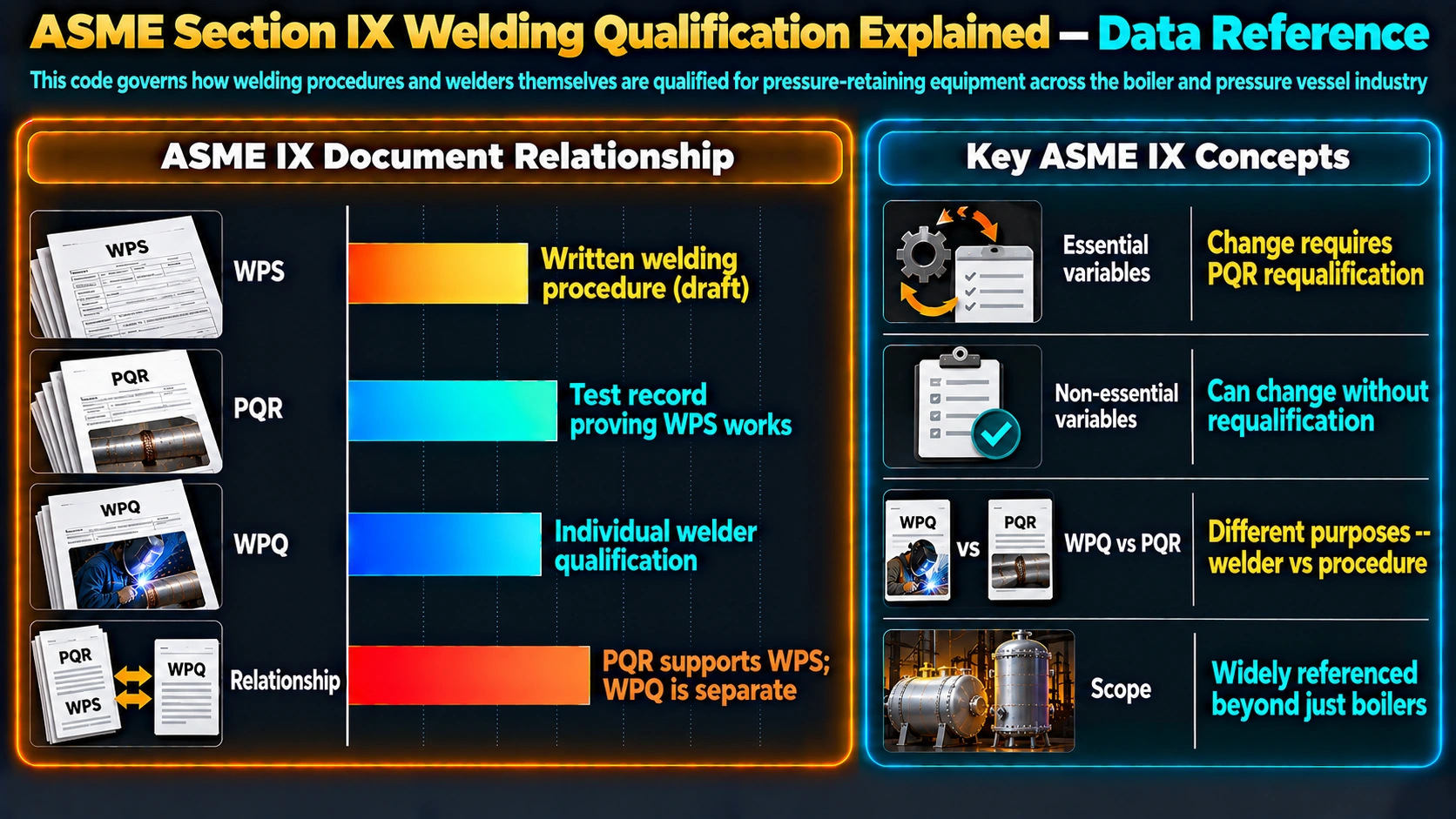
- A WPS is the written welding instruction; a PQR is the test record that qualifies the WPS; a WPQ documents that a specific welder can execute a qualified WPS competently.
- Essential variables require requalification if changed beyond their qualified range; nonessential variables can change with documentation only; supplementary essential variables apply only when notch toughness is required.
- P-Numbers, F-Numbers, and A-Numbers group base metals, filler metals, and weld metal chemistry respectively, letting one qualification cover a defined range of materials rather than a single exact grade.
- PQR qualification testing verifies mechanical properties (tension, bend, and impact where required); WPQ testing verifies welder skill only, since the procedure’s properties are already proven.
- A welder’s WPQ remains valid indefinitely unless the process goes unused for more than six months or there is specific reason to question the welder’s ability.
What Is ASME Section IX
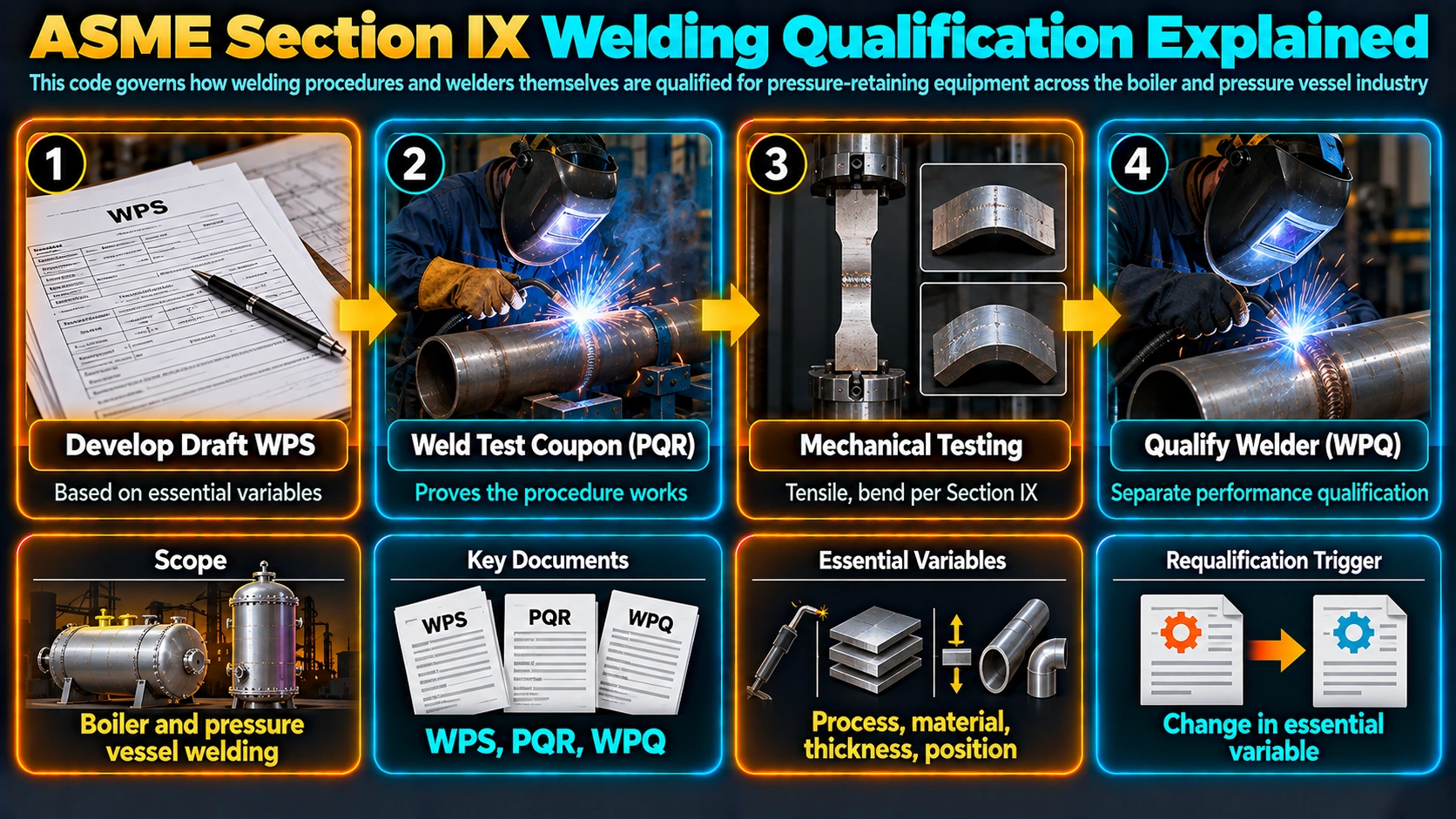
ASME BPVC Section IX, “Welding, Brazing, and Fusing Qualifications,” sets out the requirements for qualifying the procedures and the personnel used to join materials by welding, brazing, or thermoplastic fusing. It does not itself specify design, fabrication, or inspection requirements for a boiler, pressure vessel, or piping system; instead, other codes and standards, including BPVC Sections I, IV, and VIII, and ASME B31.1 and B31.3 piping codes, invoke Section IX by reference to establish how the welding used in their construction must be qualified.
Section IX Structure
Section IX is organized into parts covering each joining category: Part QW addresses welding, Part QB addresses brazing, and Part QF addresses fusing of thermoplastics. Within Part QW, the general requirements are set out first, followed by QW-200 covering welding procedure qualifications, QW-300 covering welder and welding operator performance qualifications, and QW-400 defining the welding variables (essential, nonessential, and supplementary essential) organized by welding process. Reference tables including P-Numbers (QW/QB-422), F-Numbers (QW-432), and A-Numbers (QW-442), along with sample WPS and PQR forms, are provided in QW-400 and QW-450.
The WPS, PQR, and WPQ Relationship
Welding Procedure Specification (WPS)
A WPS is the written document a welder follows on the shop floor: it specifies the welding process, base and filler metals, joint design, preheat and interpass temperature, electrical parameters, technique, and post-weld heat treatment, among other variables. A WPS by itself is not proof that it produces sound, code-compliant welds; it must be supported by a PQR.
Procedure Qualification Record (PQR)
A PQR documents the actual parameters used, and the actual test results obtained, from a specific test weld made to prove out a proposed WPS. PQR testing typically includes tension testing, guided bend testing (root, face, and/or side bends depending on thickness and process), and, where notch toughness is a project requirement, Charpy impact testing consistent with the principles in the Charpy impact testing guide. A single successful PQR can support one or more WPSs, provided the WPS falls within the range of essential variables the PQR actually qualified.
Welder/Welding Operator Performance Qualification (WPQ)
A WPQ demonstrates that a specific individual welder or welding operator can produce a sound weld while following an already-qualified WPS. Because the WPS’s mechanical properties were already validated through the PQR, WPQ testing is narrower and focused on skill: typically guided bend tests or radiographic examination of a test weld, without the tension or impact testing a PQR requires.
Essential, Nonessential, and Supplementary Essential Variables
Every welding process in Section IX has an associated table of variables classified by how a change to that variable affects the weld.
| Variable type | Effect of a change | Action required |
|---|---|---|
| Essential | Considered likely to affect mechanical properties | Requires WPS requalification (new PQR) |
| Supplementary essential | Affects notch toughness only | Requires requalification only when impact testing is a project requirement |
| Nonessential | Not considered to significantly affect mechanical properties | WPS revision only; no requalification needed |
Examples of commonly encountered essential variables include a change in base metal P-Number grouping, a change in filler metal F-Number grouping, or a change in welding process; nonessential variable changes might include, for example, a minor adjustment to joint design detail or certain position changes within an already-qualified range, per the specific variable tables for the process in use.
P-Numbers, F-Numbers, and A-Numbers
P-Numbers (Base Metal Grouping)
P-Numbers group base metals that share broadly similar weldability characteristics, so that qualifying a procedure on one material within a P-Number group generally qualifies that procedure for other materials within the same group, avoiding a separate PQR for every individual material grade a fabricator uses. Common examples include P-1 for carbon and low-alloy steels of a certain strength range, and higher P-Numbers for increasingly alloyed or more difficult-to-weld base metals such as austenitic stainless steels and nickel alloys.
F-Numbers (Filler Metal Grouping)
F-Numbers group filler metals by usability characteristics relevant to the welder’s ability to deposit sound weld metal, primarily grouping consumables with similar operating characteristics rather than by chemical composition, which reduces the number of separate welder performance qualifications needed across a range of similar filler metals.
A-Numbers (Weld Metal Chemical Analysis)
A-Numbers group deposited weld metal by chemical composition, which is the relevant grouping for procedure qualification since weld metal chemistry, rather than filler metal usability alone, governs the mechanical and corrosion properties of the finished weld.
Qualification Ranges: Position and Thickness
Qualifying a WPS or WPQ in a given position and material thickness does not limit production welding to that exact position and thickness alone; QW-403 and QW-405 (and related tables) define the range of thicknesses and positions a given qualification test actually covers, so a single well-chosen test can qualify a usefully broad range of production applications rather than requiring a separate test for every combination encountered in the field.
Welder Qualification Continuity
Frequently Asked Questions
What does ASME Section IX cover?
What is the difference between a WPS, a PQR, and a WPQ?
What is the difference between essential and nonessential variables?
What are P-Numbers in ASME Section IX?
What testing is required to qualify a WPS versus a welder?
Does a welder qualification under ASME Section IX ever expire?
What is a supplementary essential variable?
Is ASME Section IX itself a fabrication code?
Recommended Reference Reading
ASME BPVC Section IX (current edition)
The primary code text for welding, brazing, and fusing qualification requirements.
View on AmazonCWI Exam Prep and Reference Guide
Study reference covering Section IX qualification topics for CWI certification.
View on AmazonWelding Inspection Handbook (AWS)
Practical inspection reference covering WPS, PQR, and WPQ documentation review.
View on AmazonWelding Metallurgy (Kou)
Metallurgical reference underlying why essential variables affect weld properties.
View on AmazonDisclosure: WeldFabWorld participates in the Amazon Associates programme. If you purchase through these links, we may earn a small commission at no extra cost to you. This helps support free technical content on this site.
Further Reading
