17-4 PH Stainless Steel: Properties and Heat Treatment
17-4 PH is the most widely used precipitation-hardening stainless steel, prized for delivering high strength approaching alloy steel levels while retaining useful corrosion resistance and, unlike conventional quench-hardened martensitic grades, doing so with minimal distortion. This guide extends our general precipitation hardening stainless steel overview with the specific composition, heat treatment conditions, and properties of 17-4 PH.
Key Takeaways
- 17-4 PH (UNS S17400) is a martensitic precipitation-hardening stainless steel with ~16.5% Cr, ~4% Ni, and ~4% Cu.
- It transforms to martensite on air cooling from solution treatment (1040°C), then is strengthened by aging, not by a second quench.
- Standard aging conditions run from H900 (highest strength, 482°C) to H1150 (best toughness and corrosion resistance, 621°C).
- Strengthening comes from fine, coherent copper-rich precipitates nucleating within the martensite matrix during aging.
- Aging causes minimal dimensional change compared with conventional quench hardening, a major advantage for near-net-shape parts.
- 17-4 PH is ferromagnetic in all conditions and offers corrosion resistance closer to 304 than to 316.
What Is 17-4 PH Stainless Steel?
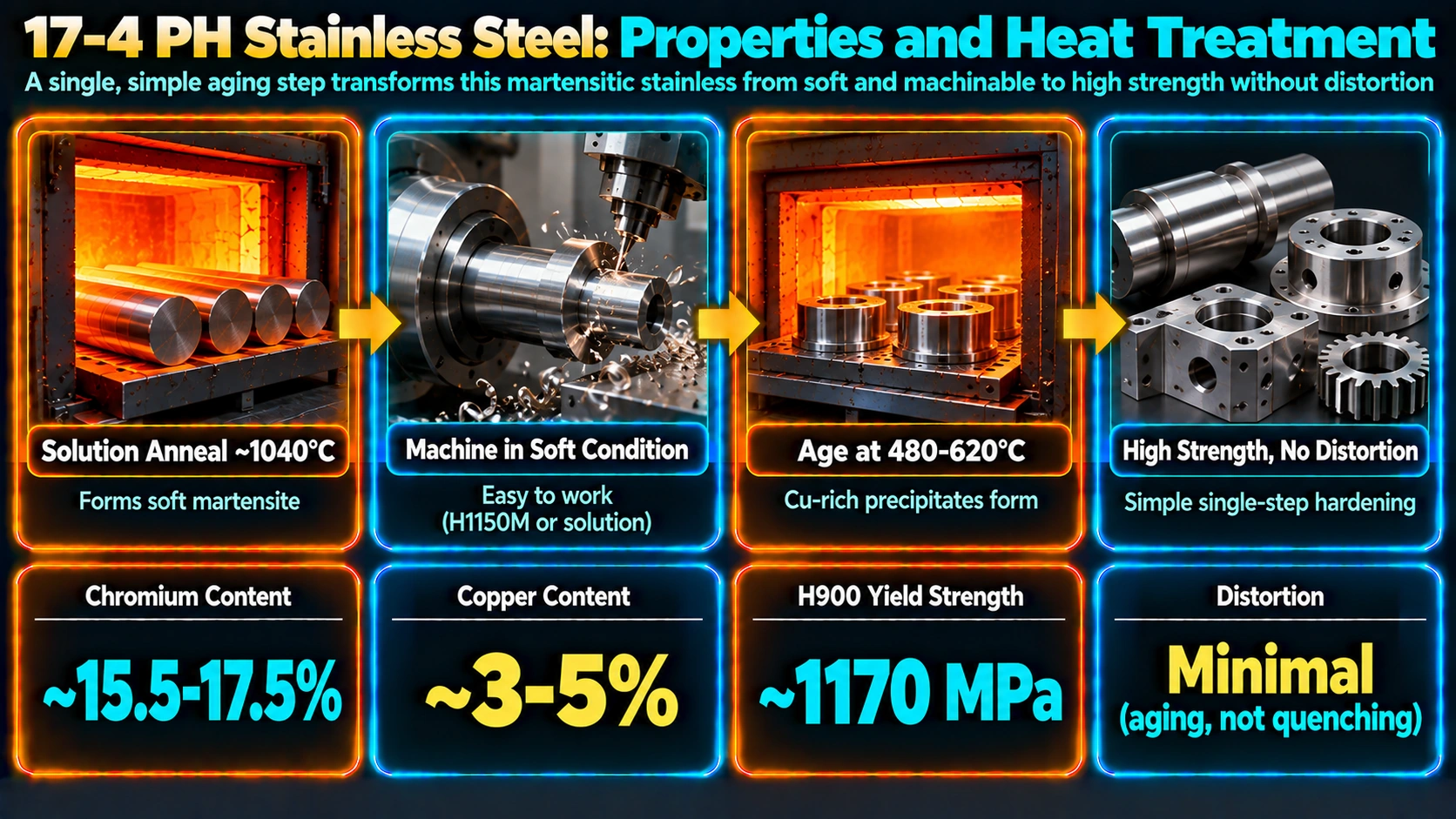
17-4 PH belongs to the martensitic subclass of precipitation-hardening stainless steels, distinct from the semi-austenitic PH grades such as 17-7 PH, which require an intermediate conditioning treatment to trigger transformation, and from austenitic PH grades such as A-286, which never transform to martensite at all. On cooling from the solution treatment temperature, 17-4 PH transforms directly to a low-carbon martensite, essentially self-hardening in air without any quench. That martensite is then strengthened separately, by aging at a comparatively low temperature to precipitate fine copper-rich particles, a mechanism entirely different from the diffusional carbide precipitation that governs tempering in conventional martensitic steels such as those covered in our martensite formation guide.
Chemical Composition
Nominal 17-4 PH (UNS S17400) composition, expressed in weight percent:
| Element | Range (wt%) | Metallurgical role |
|---|---|---|
| Chromium (Cr) | 15.00 – 17.50 | Corrosion resistance; ferrite/martensite stabilizer |
| Nickel (Ni) | 3.00 – 5.00 | Promotes martensitic transformation on cooling; toughness |
| Copper (Cu) | 3.00 – 5.00 | Forms the copper-rich precipitates responsible for age hardening |
| Niobium + Tantalum (Nb+Ta) | 0.15 – 0.45 | Ties up carbon as stable carbides; refines grain; aids precipitation kinetics |
| Carbon (C) | 0.07 max | Kept low to limit chromium carbide formation and preserve corrosion resistance |
| Manganese (Mn) | 1.00 max | Deoxidizer; mild hardenability contribution |
| Silicon (Si) | 1.00 max | Deoxidizer |
| Phosphorus (P) | 0.040 max | Residual impurity |
| Sulfur (S) | 0.030 max | Residual impurity |
The defining alloying choice is copper: at 3-5%, it exceeds copper’s solubility limit in the martensitic matrix at aging temperatures, providing the thermodynamic driving force for the fine-scale precipitation that gives this grade its name.
Heat Treatment: Solution Treatment and Aging
Solution Treatment (Condition A)
17-4 PH is solution treated at approximately 1040°C (1900°F), dissolving copper and niobium into solid solution in the austenite, then air cooled. Because the alloy’s chromium and nickel content give it enough hardenability to transform fully to martensite in air, no separate quenching medium is needed at this stage. The resulting condition, called Condition A, is a supersaturated, relatively soft martensite with modest strength and good machinability compared with the aged conditions that follow. Mills typically ship bar and plate stock in Condition A so that fabricators can machine features before committing to a final aging treatment.
Aging (H-Conditions)
From Condition A, mechanical properties are set entirely by a single aging step, holding the material at a chosen low temperature to allow copper-rich clusters to nucleate and grow within the martensite. Standard conditions are designated by their approximate aging temperature in degrees Fahrenheit:
| Condition | Aging temp | Time | UTS (approx.) | 0.2% YS (approx.) | Elongation | Hardness (approx.) |
|---|---|---|---|---|---|---|
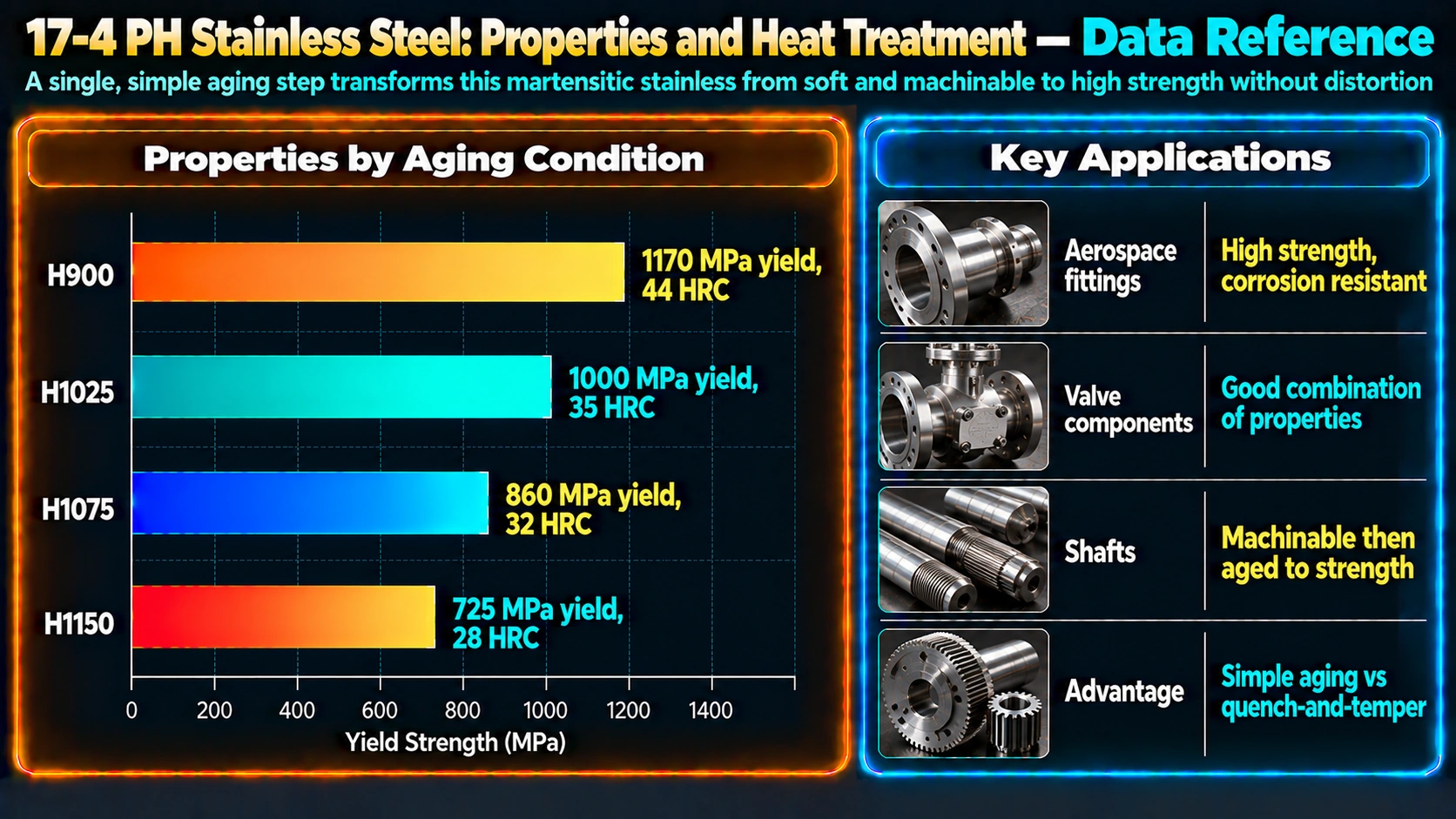
| H900 | 482°C (900°F) | 1 hr | 1310 MPa (190 ksi) | 1170 MPa (170 ksi) | ~14% | ~44 HRC |
| H925 | 496°C (925°F) | 4 hr | 1170 MPa (170 ksi) | 1070 MPa (155 ksi) | ~15% | ~40-43 HRC |
| H1025 | 551°C (1025°F) | 4 hr | 1070 MPa (155 ksi) | 1000 MPa (145 ksi) | ~16% | ~35-40 HRC |
| H1075 | 579°C (1075°F) | 4 hr | 1000 MPa (145 ksi) | 860 MPa (125 ksi) | ~16-18% | ~32-38 HRC |
| H1100 | 593°C (1100°F) | 4 hr | 965 MPa (140 ksi) | 795 MPa (115 ksi) | ~17% | ~30-35 HRC |
| H1150 | 621°C (1150°F) | 4 hr | 930 MPa (135 ksi) | 725 MPa (105 ksi) | ~16-18% | ~28-33 HRC |
Values above are typical, representative figures; always verify against the governing specification (ASTM A564, AMS 5643/5622, or equivalent) for a given product form and section size. Note the pattern: as aging temperature increases, strength and hardness fall while ductility and toughness rise, mirroring the trade-off seen in conventional tempering, but achieved here through precipitate coarsening rather than carbide dissolution and matrix softening.
Double Aging (H1150-DA / H1150M)
For applications demanding the best achievable combination of toughness and corrosion resistance, some specifications call for a double-aging treatment: an initial higher-temperature age followed by a second lower-temperature age. This refines and homogenizes the precipitate structure further, improving impact toughness and resistance to hydrogen embrittlement and stress corrosion cracking beyond a single H1150 treatment.
The Precipitation Strengthening Mechanism
Aging drives fine, initially coherent copper-rich particles, only a few nanometers across, to nucleate throughout the martensitic matrix. These particles resist dislocation motion in the same general way that any dispersed second phase strengthens a metal: dislocations must either shear through coherent, deformable particles or bow around larger, incoherent ones. The classic Orowan bowing relation captures the size- and spacing-dependence of that resistance once precipitates have grown enough to be effectively impenetrable:
Δσ ≈ G b / L

Δσ = strengthening increment from Orowan bypass
G   = shear modulus of the matrix
b   = Burgers vector of the gliding dislocation
L   = average inter-precipitate spacing
At the fine, closely spaced precipitate sizes present at peak aging (roughly H900), spacing L is small and the strengthening increment is large; as aging temperature and time increase, the precipitates coarsen, L increases, and the Orowan contribution falls, which is the underlying reason strength drops steadily from H900 through H1150. Readers building general intuition for how dispersed second phases govern strength may find our strengthening mechanisms guide useful background alongside this grade-specific discussion.
Corrosion Resistance
17-4 PH’s corrosion resistance sits below that of the common austenitic grades, generally comparable to 304 rather than 316, because its chromium content is somewhat lower and it contains no molybdenum. It performs adequately in mild atmospheric, freshwater, and many mild chemical environments, but is not the first choice for chloride-rich or strongly acidic service where 316 stainless steel would be preferred. Higher aging temperatures (H1075 through H1150) generally give somewhat better corrosion and stress-corrosion-cracking resistance than the peak-strength H900 condition, since coarser, more widely spaced precipitates and lower internal stress reduce susceptibility to localized attack and hydrogen-assisted cracking.
Magnetic Behavior
Unlike the austenitic 304/316 family, 17-4 PH is ferromagnetic in every standard condition, Condition A and all aged H-conditions alike, because its matrix is martensitic rather than austenitic. This is a useful field identification cue: a magnet readily distinguishes 17-4 PH stock from austenitic stainless of similar appearance.
Machining and Dimensional Stability
A major practical advantage of 17-4 PH over conventional quench-and-temper alloy steels is process sequencing: parts are typically machined close to final dimensions in the relatively soft, machinable Condition A, then age hardened afterward. Because aging is a solid-state precipitation reaction with no accompanying phase transformation or quench, it produces very little dimensional change, in sharp contrast to the significant movement seen when a conventional alloy steel is hardened by austenitizing and quenching after machining. This makes 17-4 PH attractive for precision components such as valve stems, pump shafts, and gears that must hold tight tolerances through final heat treatment.
Comparison with Related PH and Martensitic Grades
| Grade | Type | Strengthening | Corrosion resistance | Typical use |
|---|---|---|---|---|
| 17-4 PH | Martensitic PH | Cu-rich precipitates | Moderate (~304 level) | Aerospace shafts, valve/pump components |
| 15-5 PH | Martensitic PH | Cu-rich precipitates | Moderate (~304 level) | Same as 17-4 PH, better transverse toughness |
| 17-7 PH | Semi-austenitic PH | Ni3Al/ NiAl-type precipitates after conditioning | Moderate-good | Springs, thin sheet, diaphragms |
| 410 | Martensitic (conventional) | Carbide tempering response | Lower | Cutlery, low-cost valve trim |
| 440C | Martensitic (conventional) | Carbide tempering response | Lower-moderate | Bearings, high-hardness wear parts |
Against 15-5 PH, the two grades are metallurgically close cousins; 15-5 PH’s electroslag or vacuum-arc remelting route typically yields a cleaner, more homogeneous microstructure with somewhat better transverse ductility and toughness at equivalent strength, at a modest cost premium. Against conventional martensitic grades like 410 or 440C, 17-4 PH’s precipitation mechanism avoids the large dimensional changes and cracking risk of a conventional water or oil quench, at the cost of a materials price premium driven by its copper and nickel content.
Weldability
17-4 PH welds considerably better than high-carbon martensitic stainless grades because its strength is not tied to carbon-driven hardenability. Welding is normally performed in the solution-annealed Condition A using a matching filler metal, and the assembly is typically re-solution-treated and re-aged afterward to restore uniform strength through the fusion zone and heat-affected zone. Where a full post-weld heat treatment is impractical, welding in an aged condition followed by a single re-aging step at the original or a slightly higher H-temperature is sometimes used, accepting some localized softening in the immediate weld zone.
Industrial Applications
17-4 PH’s combination of high strength, moderate corrosion resistance, and low-distortion hardening makes it a default choice wherever those three requirements converge:
- Aircraft and aerospace structural components, brackets, and fasteners
- Turbine blades and shafts in moderate-temperature service
- Valve and pump components, stems, and trim in oil, gas, and chemical processing
- Oilfield and downhole tooling requiring strength with corrosion resistance
- Nuclear reactor internals
- Surgical and dental instruments
- Precision gears, shafts, and injection molding tooling components
Grade and condition selection is commonly validated with hardness testing against the target H-condition specification, and with Charpy impact testing when toughness at the lower end of the H-condition range (H1100/H1150) is a design requirement.
Frequently Asked Questions
What is 17-4 PH stainless steel?
What does the 17-4 and PH mean?
What do the H900, H1025, and H1150 designations mean?
Is 17-4 PH stainless steel magnetic?
How does 17-4 PH compare to 316 stainless steel for corrosion resistance?
Can 17-4 PH stainless steel be welded?
What causes the strengthening in 17-4 PH stainless steel?
Should I choose H900 or H1150 for 17-4 PH?
Is 17-4 PH stainless steel easy to machine?
What is the difference between 17-4 PH and 15-5 PH?
Recommended Reference Reading
ASM Handbook: Heat Treating
Reference data on solution treatment and aging cycles for precipitation-hardening stainless steels.
View on AmazonStainless Steels for Design Engineers (ASM)
A practical engineering reference covering PH, austenitic, and martensitic stainless grade selection.
View on AmazonMetals Handbook Desk Edition
A comprehensive single-volume reference spanning composition, properties, and processing across metal families.
View on AmazonCallister’s Materials Science and Engineering
The standard graduate-level materials science text covering precipitation hardening and dislocation strengthening theory.
View on AmazonDisclosure: MetallurgyZone participates in the Amazon Associates programme. If you purchase through these links, we may earn a small commission at no extra cost to you. This helps support free technical content on this site.
Further Reading
