304 vs 316 Stainless Steel: Key Differences
304 and 316 are the two most widely used austenitic stainless steels, and the choice between them comes down almost entirely to one alloying addition: molybdenum. This guide compares their composition, corrosion behavior, mechanical properties, weldability, and cost so you can match the right grade to the environment your part will actually see.
Key Takeaways
- 316 differs from 304 mainly by the addition of 2-3% molybdenum and a somewhat higher nickel range.
- Molybdenum gives 316 substantially better resistance to pitting and crevice corrosion in chloride-containing environments.
- Both grades are austenitic, essentially non-magnetic when annealed, and share very similar base mechanical properties.
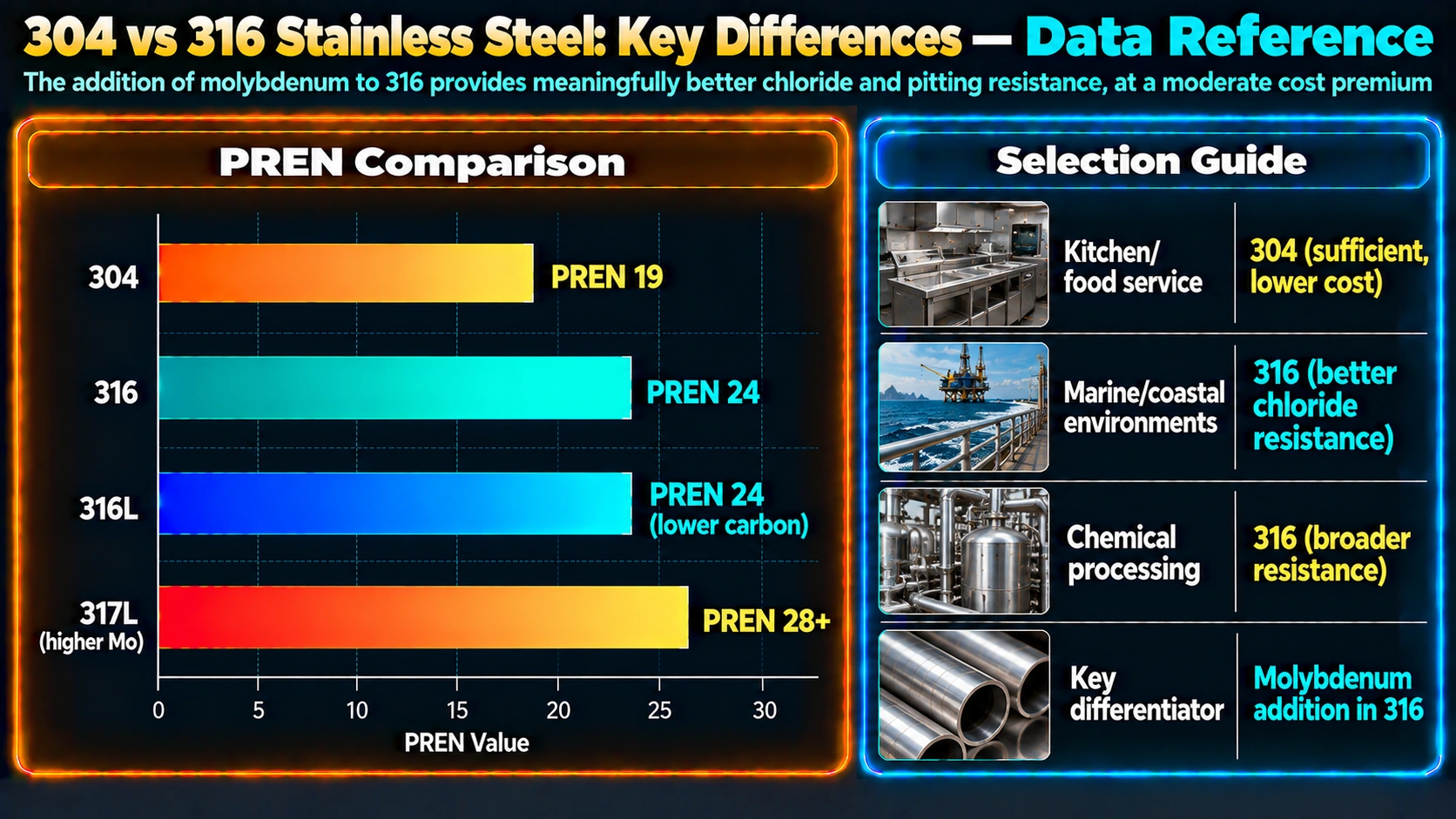
- 316’s PREN (pitting resistance equivalent number) runs roughly 24-26 versus roughly 18-19 for 304.
- 316 costs more than 304, driven by its molybdenum and higher nickel content.
- 304 is the correct default for most dry, mild, or general-purpose service; 316 is the correct default once chlorides, marine exposure, or aggressive cleaning chemicals are involved.
What Are 304 and 316 Stainless Steel?
Both grades belong to the austenitic stainless steel family: face-centered-cubic, chromium-nickel alloys that stay austenitic at room temperature because nickel stabilizes that phase down from the high-temperature region where it would otherwise transform. Their corrosion resistance comes from a thin, self-healing chromium oxide passive film, the same mechanism covered in our guide to corrosion mechanisms. 304 (UNS S30400) is the general-purpose grade that made austenitic stainless ubiquitous in food service, architecture, and light industry. 316 (UNS S31600) is the same basic alloy system with molybdenum added specifically to strengthen that passive film against chloride attack.
Composition Comparison
| Element | 304 (wt%) | 316 (wt%) |
|---|---|---|
| Carbon (C) | 0.08 max | 0.08 max |
| Chromium (Cr) | 18.00 – 20.00 | 16.00 – 18.00 |
| Nickel (Ni) | 8.00 – 10.50 | 10.00 – 14.00 |
| Molybdenum (Mo) | None specified | 2.00 – 3.00 |
| Manganese (Mn) | 2.00 max | 2.00 max |
| Silicon (Si) | 1.00 max | 1.00 max |
| Phosphorus (P) | 0.045 max | 0.045 max |
| Sulfur (S) | 0.030 max | 0.030 max |
| Nitrogen (N) | 0.10 max | 0.10 max |
Note that 316 actually carries slightly less chromium than 304, on average. It does not rely on more chromium for its corrosion advantage; it relies on molybdenum reinforcing the passive film’s resistance to chloride-induced local breakdown, combined with a somewhat richer nickel range that further stabilizes the austenite matrix.
Corrosion Resistance and PREN
Molybdenum works by stabilizing the passive oxide film against the localized breakdown that chloride ions cause, delaying the onset of pitting and improving repassivation once a pit initiates. This effect is quantified by the pitting resistance equivalent number, an empirical index widely used to rank stainless grades:
PREN = %Cr + 3.3 × %Mo + 16 × %N

304 (typical): 19 + 3.3(0) + 16(0.04)  ≈ 19.6
316 (typical): 17 + 3.3(2.5) + 16(0.04) ≈ 25.6
Higher PREN corresponds to better resistance to pitting initiation in chloride environments. The roughly five- to six-point PREN gap between 304 and 316 is consistent with 316’s well-documented field performance advantage in seawater, de-icing salt exposure, and chloride-bearing process streams, while in dry indoor environments with no significant chloride exposure the practical difference between the two grades is far smaller.
Pitting and Crevice Corrosion in Chloride Environments
Chloride ions preferentially adsorb onto weak spots in the passive film, driving local film breakdown, autocatalytic acidification inside the resulting pit, and continued metal dissolution if the pit cannot repassivate. Molybdenum in 316 is believed to work partly by promoting formation of a more stable, molybdenum-enriched oxide within the pit, raising the chloride concentration and potential needed to sustain propagation. Crevice corrosion, which occurs in the same way inside gaskets, threads, and deposits where oxygen and chloride concentration differ from the bulk environment, follows the same pattern: 316 tolerates more aggressive crevice conditions before initiating attack than 304.
Mechanical Properties
| Property (annealed) | 304 | 316 |
|---|---|---|
| Tensile strength (min) | 515 MPa (75 ksi) | 515 MPa (75 ksi) |
| Yield strength, 0.2% offset (min) | 205 MPa (30 ksi) | 205 MPa (30 ksi) |
| Elongation (min) | 40% | 40% |
| Hardness (max) | 92 HRB | 95 HRB |
| Crystal structure | Austenitic (FCC) | Austenitic (FCC) |
| Magnetic response (annealed) | Essentially non-magnetic | Essentially non-magnetic |
Base strength and ductility are essentially indistinguishable between the two grades in the annealed condition; the mechanical property columns above overlap almost completely. This is expected, since both alloys share the same austenitic matrix and neither relies on strengthening mechanisms beyond solid solution strengthening and modest work hardening. For background on how cold work affects both grades similarly, see our guide to strengthening mechanisms.
Weldability and Sensitization
304 and 316 weld similarly well using standard austenitic stainless practice, typically GTAW or GMAW with matching or slightly over-alloyed filler metal, and neither requires preheat or post-weld heat treatment for stress relief. Both grades share the same risk during welding: if held in the 425-870°C sensitization range for too long, chromium can combine with carbon to precipitate chromium carbides at grain boundaries, locally depleting chromium and leaving the material vulnerable to intergranular corrosion. This is why low-carbon L-grade variants, 304L and 316L, are specified whenever heavy welding is involved; their carbon content is held to 0.03% maximum, sharply reducing the driving force for carbide precipitation. Readers unfamiliar with the general austenitic welding response can review our heat-affected zone microstructure guide, noting that austenitic stainless behaves very differently from the martensitic transformation response covered there for carbon and low-alloy steels.
Where 304 and 316 must be joined to each other, a compatible filler such as 316L or an over-alloyed 309 is standard practice, matching or exceeding the corrosion resistance of the leaner base metal in the joint.
Magnetic Behavior
In the fully annealed condition, both grades are essentially non-magnetic, consistent with their stable austenitic structure. Cold working, however, can trigger strain-induced transformation of some austenite to martensite, which is ferromagnetic, and this shows up as a mild magnetic response in heavily formed parts such as deep-drawn sinks or cold-headed fasteners. Because 316’s higher nickel content more strongly stabilizes austenite against this strain-induced transformation than 304’s leaner nickel range, 316 parts generally show somewhat less magnetic pickup after equivalent cold work than 304 parts, though neither grade is intended to be magnetic in normal service.
Cost Considerations
316 is consistently more expensive than 304, generally by a meaningful double-digit percentage, driven by two factors: the added 2-3% molybdenum, which trades on its own separate commodity market and carries a persistent premium over iron and chromium, and 316’s richer nickel range. Because both nickel and molybdenum prices are volatile relative to carbon steel inputs, the price gap between 304 and 316 stock can widen or narrow significantly with commodity cycles, but 316 essentially never becomes the cheaper option. Specifying 316 by default “to be safe” on projects where 304 would perform adequately is a common source of avoidable material cost.
Choosing Between 304 and 316
| Environment / application | Recommended grade | Reasoning |
|---|---|---|
| Kitchen equipment, indoor food service | 304 | Low chloride exposure; 304 corrosion resistance is more than adequate |
| Architectural trim, indoor fixtures | 304 | Cost-effective; minimal chloride or marine exposure |
| Marine hardware, coastal structures | 316 | Chloride-laden atmosphere demands superior pitting resistance |
| Chemical processing with chlorides | 316 | Process chemistry directly attacks 304’s passive film |
| Pharmaceutical and medical equipment | 316 (often 316L) | Aggressive cleaning chemicals plus regulatory preference |
| Road salt / de-icing exposure | 316 | Chloride exposure comparable to marine service |
| General storage tanks, mild chemical service | 304 | Adequate resistance without paying the molybdenum premium |
Frequently Asked Questions
What is the main difference between 304 and 316 stainless steel?
Does 316 stainless steel corrode less than 304?
Is 316 stainless steel magnetic?
Why is 316 stainless steel more expensive than 304?
Can 304 and 316 stainless steel be welded together?
What is PREN and how do 304 and 316 compare?
Which grade should I use in a marine environment?
What is the difference between 304L and 316L?
Are 304 and 316 stainless steel food safe?
Recommended Reference Reading
Corrosion Engineering (Fontana)
The classic reference on corrosion mechanisms, including pitting, crevice attack, and passive film behavior in stainless steels.
View on AmazonASM Handbook: Corrosion
Comprehensive reference data on stainless steel corrosion performance across environments and alloy families.
View on AmazonMetals Handbook Desk Edition
A comprehensive single-volume reference spanning composition, properties, and processing across metal families.
View on AmazonCallister’s Materials Science and Engineering
The standard graduate-level materials science text covering phase stability, alloying, and corrosion fundamentals.
View on AmazonDisclosure: MetallurgyZone participates in the Amazon Associates programme. If you purchase through these links, we may earn a small commission at no extra cost to you. This helps support free technical content on this site.
Further Reading
