Tutorial: How to Read and Apply TTT and CCT Diagrams in Steel Heat Treatment
Time-Temperature-Transformation (TTT) and Continuous Cooling Transformation (CCT) diagrams are the working tools of the heat treatment metallurgist. They encode, in a single graphical form, the complete transformation kinetics of austenite for a given steel composition: which microstructural phases form, at what temperatures and times they begin and end forming, and how cooling rate determines the final hardness, strength, and toughness of the treated component. This tutorial walks through how these diagrams are constructed, how to read them step by step, and how to apply them to practical heat treatment design, hardenability assessment, and weld procedure qualification.
Key Takeaways
- A TTT diagram shows isothermal transformation behaviour; a CCT diagram shows continuous cooling transformation behaviour. The CCT is more directly applicable to most industrial heat treatment and welding operations.
- The C-curve nose shape arises from competing temperature dependences: low driving force near Ae1, low diffusivity near Ms — fastest transformation at the intermediate nose temperature (~550–600°C for plain carbon steel).
- Alloying elements (Mn, Cr, Mo, Ni, B) shift C-curves to longer times and lower temperatures, reducing the critical cooling rate required for martensite formation and increasing hardenability.
- To read a CCT diagram: draw the cooling curve on the same T-log(t) axes; each transformation region it enters adds a phase; the final microstructure is read at room temperature from the accumulated phase fractions.
- The weld HAZ CCT diagram differs from the base metal diagram due to higher austenitising temperature and coarser prior austenite grain size — always use HAZ-specific diagrams for weld microstructure prediction.
- The martensite start temperature Ms decreases with alloy content; steels with Ms below room temperature develop retained austenite that must be addressed by cryogenic treatment or temper cycling.
What Is a TTT Diagram and How Is It Constructed?
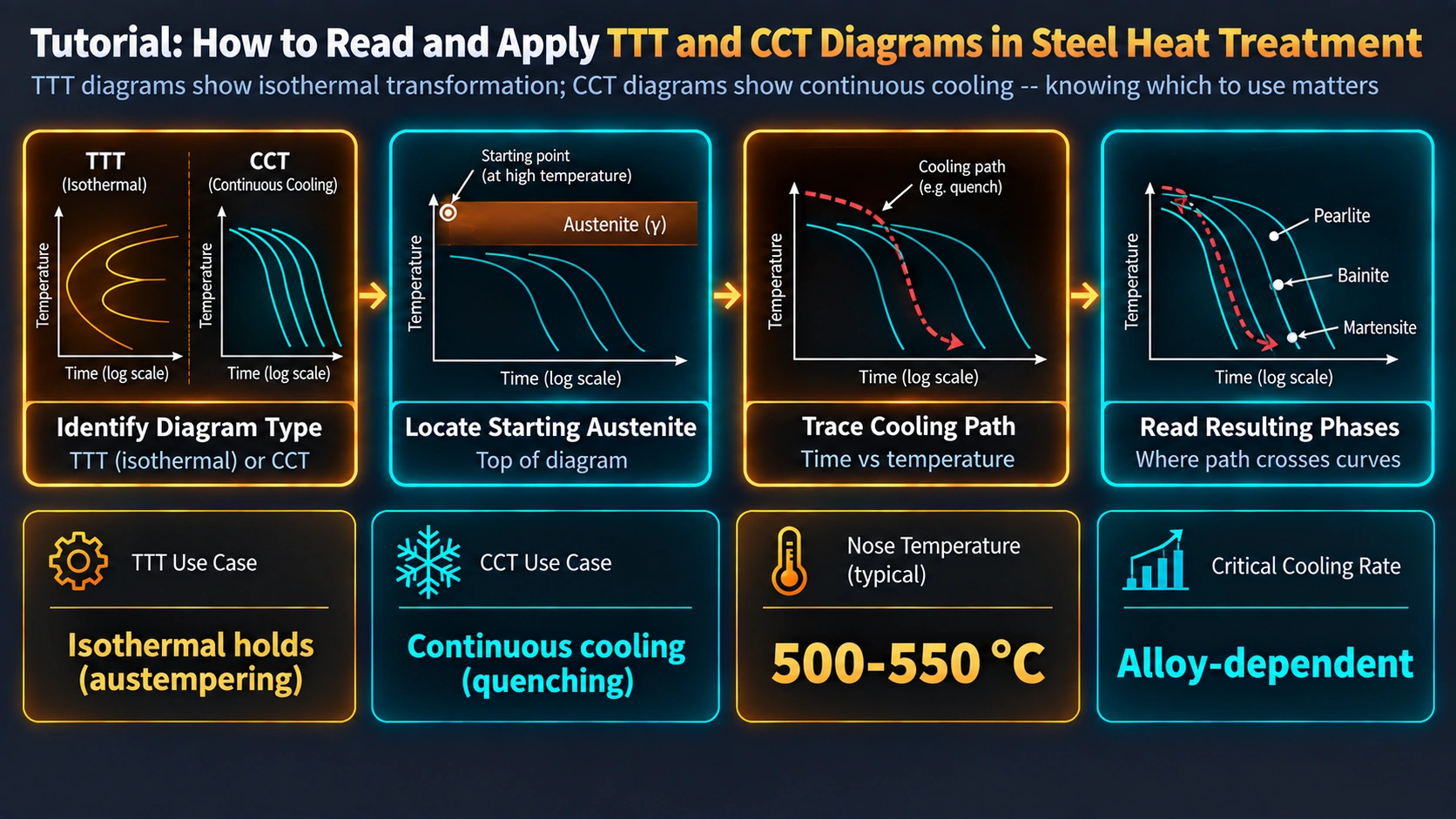
A TTT diagram maps the transformation behaviour of austenite when it is instantaneously quenched from the austenitising temperature to a series of fixed sub-critical temperatures and held isothermally. At each hold temperature, the start and finish of each transformation product (ferrite, pearlite, bainite, martensite) are detected by dilatometry (volume change on transformation), metallography, hardness measurement, or high-resolution in-situ X-ray diffraction. The times at which 1% and 99% transformation occurs define the C-curve start and finish at each temperature.
Construction by Dilatometry
The most common experimental technique for TTT diagram construction is high-speed dilatometry. A cylindrical specimen (typically 3–5 mm diameter, 10–15 mm long) is austenitised in a programmed furnace with inert gas atmosphere, quenched by gas jet to the target isothermal temperature in <1 second, and held while the specimen length is continuously measured by a linear variable differential transducer (LVDT). Austenite-to-product transformations involve volume changes (pearlite and ferrite expand, martensite expands more strongly) that appear as slope changes in the dilatation vs time curve.
The Physical Basis of the C-Curve Shape
The characteristic C-shape of the transformation start curve reflects the competing kinetics of two opposing temperature dependencies:
- Thermodynamic driving force (ΔG): The chemical free energy difference between austenite and the product phase increases with decreasing temperature below the Ae1 equilibrium temperature. Just below Ae1, ΔG is small and transformation is sluggish even though diffusion is fast.
- Atomic diffusivity (D): Diffusion of carbon and substitutional alloying atoms follows an Arrhenius relationship and decreases exponentially with temperature. Near Ms, diffusion is so slow that transformation is again sluggish even though the driving force is large.
The nose of the C-curve occurs at the intermediate temperature where the product D × ΔG is maximised — approximately 550–600°C for eutectoid steel and lower in temperature for alloy steels. The transformation rate at the nose defines the critical cooling rate: to avoid any diffusional transformation, the steel must be quenched faster than the rate that passes through the nose.
Nucleation and growth rate (simplified Avrami framework):
  Overall transformation rate ∝ N × G
  where:
    N = nucleation rate (nuclei per unit volume per second)
    G = growth rate (m/s)

  Temperature dependence:
    G ∝ D(T) × ΔG(T)    where D(T) = D₀ exp(−Q/RT) [Arrhenius]
    N ∝ exp(−ΔG*/kT)     where ΔG* = critical nucleation barrier

  At high T (near Ae₁):  ΔG(T) small → slow transformation
  At low T (near Ms):     D(T) small  → slow transformation
  At intermediate T:      product N×G maximised → nose of C-curve

Avrami equation for isothermal transformation fraction X:
  X = 1 − exp(−b × t^n)
  where b and n are temperature-dependent constants
  (n ≈ 3–4 for grain boundary nucleation and growth in 3D)
Reading a TTT Diagram: Step-by-Step Guide
Identify the axes and their scales
The vertical axis is temperature (°C or K), spanning from below Mf to above the Ae3 austenitising temperature. The horizontal axis is time in seconds on a logarithmic scale — typically from ~0.1 s to 105 s. The log scale compresses the enormous range of transformation times (from milliseconds for martensite to hours for ferrite in low-carbon steel) onto a readable chart. Never read time values off a TTT diagram without checking whether the scale is linear or logarithmic.
Locate the key reference temperatures
Identify the labelled horizontal lines: Ae1 (727°C for eutectoid, lower for hypereutectoid, higher for hypoeutectoid — the eutectoid temperature for the specific composition); Ae3 (upper austenite limit, above which ferrite dissolves into austenite on heating); Acm for hypereutectoid steels (cementite dissolution temperature); Ms (martensite start) and Mf (martensite finish). These lines define the temperature ranges of each phase field.
Identify the C-curve pairs for each transformation
Each phase region has a transformation start curve (solid line, typically 1% or 5% transformed) and a finish curve (dashed line, typically 95% or 99% transformed). The curves enclose a region: within this region, transformation is in progress. The pearlite C-curves are typically at higher temperature; bainite C-curves are at lower temperature. In many alloy steels (4140, 4340) the pearlite and bainite C-curves are separated by an “untransformed” gap, while in plain carbon steels they are merged into a single continuous C-curve. A separated bainite bay is significant because it means the steel can be austempered to produce 100% bainite without risk of pearlite formation.
Locate the nose of the diagram
The nose is the leftmost point of the transformation start curve — the temperature and time at which transformation begins fastest. For a given steel, the critical cooling rate is approximately equal to the nose temperature divided by the nose time: CCR ≈ (Ae1 − Tnose) / tnose. More precisely, it is the slope of the tangent from the austenitising temperature through the nose point on a T vs linear-time plot — but the nose-time approximation is adequate for most practical purposes.
Read the hardness annotations
Most published TTT diagrams annotate hardness values (HRC or HV) at representative isothermal hold temperatures. These represent the hardness of the fully transformed product at each temperature: fine pearlite near the nose gives moderate hardness (~40–45 HRC for eutectoid steel); coarse pearlite at high temperature gives low hardness (~25–30 HRC); lower bainite gives near-martensitic hardness (50–55 HRC); upper bainite gives intermediate hardness (35–45 HRC). As-quenched martensite hardness is read from the Ms to Mf range.
Check the austenitising conditions stated on the diagram
Every TTT diagram is specific to the austenitising temperature, hold time, and prior austenite grain size used in the experiment. These are stated in the diagram header or caption. A diagram measured at 900°C austenitising temperature for 0.5 h will differ significantly from one measured at 1100°C, because higher austenitising temperature dissolves more carbides, increases carbon in solution, and causes austenite grain growth — all of which shift C-curves to longer times. If you apply a TTT diagram to a heat treatment cycle with different austenitising conditions, the predictions are approximate only.
The CCT Diagram: Continuous Cooling Transformation
The CCT diagram is constructed by measuring transformation start and finish temperatures as a function of continuous cooling rate, not isothermal hold. It is the more practically applicable diagram because all real industrial heat treatment operations — quenching, controlled air cooling, furnace cooling — and all welding thermal cycles involve continuous cooling rather than isothermal holds.
How the CCT Diagram Differs from the TTT Diagram
The key difference is that during continuous cooling, the steel spends progressively less time at each temperature as it cools. Compared with isothermal holding at the same temperature, the steel has had less opportunity to transform by the time it reaches that temperature. The result is that CCT curves are displaced to longer times and lower temperatures compared with the corresponding TTT curves. A rough empirical rule is that the CCT start curve falls approximately 10–50°C below the corresponding TTT start curve at the same time, but this shift is composition- and temperature-dependent.
Relationship between TTT and CCT (Scheil additivity rule):
  For a continuous cooling path T(t), the fraction transformed is estimated
  by the additive rule (Scheil, 1935):

  ∫₀^t dt' / τ(T(t')) = 1    [transformation start condition]

  where τ(T) is the incubation time at temperature T from the TTT diagram.
  This integral is evaluated numerically by dividing the cooling curve
  into small time steps and summing fractional incubation periods.

  Practical implication:
  — Fast cooling segments spend little time at each T → small contribution
  — Slow cooling through the nose contributes most to the integral
  — If ∫ reaches 1.0, transformation starts regardless of cooling path

CCT construction method:
  1. Measure start/finish temperatures by dilatometry at multiple cooling rates
     (typically 0.05, 0.1, 0.5, 1, 5, 10, 50, 100, 500°C/s)
  2. Plot temperature vs log(time) for each cooling rate
  3. Mark start and finish points from dilatation deviations
  4. Connect start points: CCT start curve
  5. Add cooling rate lines and phase fraction annotations
How to Overlay a Cooling Curve on a CCT Diagram
The most important practical application of a CCT diagram is predicting the microstructure of a steel component after a specific heat treatment quench. The procedure is to draw the actual cooling curve — temperature versus time — on the same axes as the CCT diagram and read the phase regions it passes through.
Calculating a Continuous Cooling Curve
The cooling rate of a steel component depends on its geometry (thickness, diameter), the thermal properties of the steel, and the heat transfer coefficient of the quench medium. Three simplified models are widely used:
1. Newtonian cooling (thin sections, Bi < 0.1):
   T(t) = T_ambient + (T_initial − T_ambient) × exp(−h×A/(ρ×V×c_p) × t)
   Where: h = heat transfer coefficient (W/m²·K)
          A = surface area (m²), V = volume (m³)
          ρ = density (kg/m³), c_p = specific heat (J/kg·K)
   Valid for: thin sheet, wire, small particles where thermal gradient ≈ 0

2. Approximate cooling rate at surface (thick section):
   T_surface(t) ≈ T_quench + (T_austenitise − T_quench) × erf(x / (2√(α×t)))
   Where: α = thermal diffusivity = λ/(ρ×c_p) ≈ 5×10⁻⁶ m²/s for steel
          x = depth from surface
   Valid for: very thick section, short times

3. Rykalin t8/5 for weld HAZ (most used in practice):
   For 3D cooling (thick plate):
   t8/5 ≈ (6700 − 5×T₀) × Q × [1/(500−T₀)² − 1/(800−T₀)²] / (2π×λ)
   Where: Q = heat input (kJ/mm), T₀ = preheat (°C), λ ≈ 0.04 kJ/mm·s·K

   Typical t8/5 values (Q=1.5 kJ/mm, T₀=25°C):
   ~ 7 seconds → maps to CCR of (800−500)/7 ≈ 43°C/s
   On CCT diagram: draw a cooling line from Ae₃ reaching 500°C at t=7s
   → microstructure read from phase regions traversed
Step-by-Step: Reading the Resulting Microstructure
Draw the cooling curve on the CCT axes
Plot T vs t (log scale) on the CCT diagram. For a linear cooling rate CR (°C/s), T = Taustenitise − CR × t. On a log time axis this appears as a curve (not a straight line). For many practical purposes, a straight line on the log-time axes is an adequate approximation if the cooling rate does not change dramatically with temperature.
Identify each transformation region the cooling curve enters
Reading from high to low temperature, note each transformation region boundary the cooling curve crosses. Entering a region means that phase begins forming. When the cooling curve exits a region by crossing the finish curve, that transformation is complete. If the cooling curve exits by cooling below Ms before transformation finishes, the remainder transforms to martensite.
Read the phase fractions from the diagram annotations
Published CCT diagrams annotate phase fractions at the end of each transformation region, typically as percentages: “F 20% / B 30% / M 50%”. If your cooling curve falls between two annotated curves, interpolate. The sum of all phase fractions must total 100%. The hardness of the resulting mixed microstructure is estimated by linear rule of mixtures: HRCmix ≈ Σ(fi × HRCi).
Verify whether Ms is reached and estimate retained austenite
If the cooling curve reaches and passes below Ms, martensite forms athermatically. The fraction of martensite at any temperature T < Ms is given by the Koistinen–Marburger equation: fM = 1 − exp(−0.011 × (Ms − T)). For a room-temperature quench (T = 20°C): fM = 1 − exp(−0.011 × (Ms − 20)). Retained austenite = 1 − fM of the fraction that reached Ms.
Ms Temperature Calculation and Retained Austenite
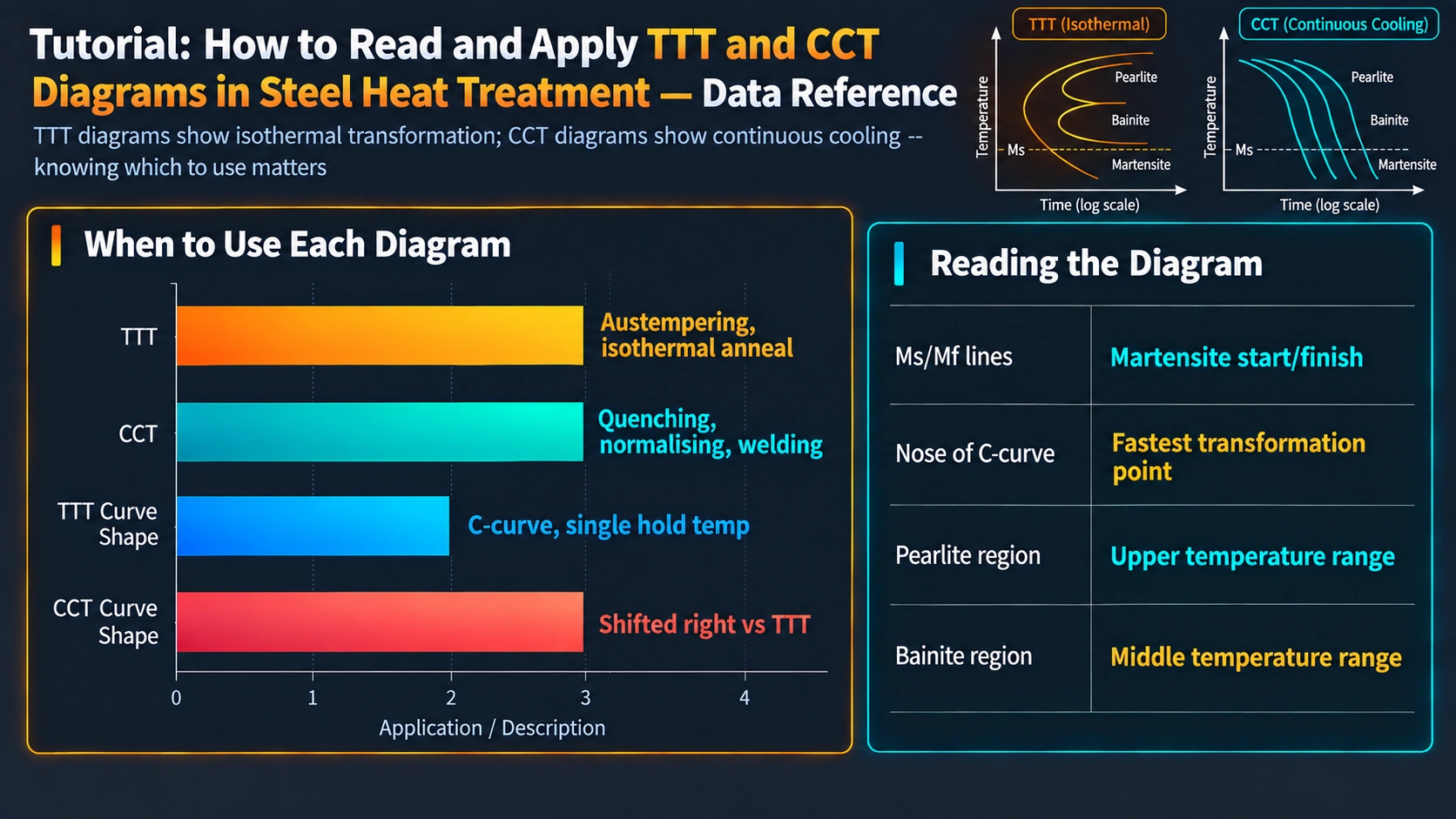
The martensite start temperature is one of the most critical parameters read from a TTT or CCT diagram. It determines how much of the austenite transforms to martensite during quenching to room temperature, and whether retained austenite is a concern. Several empirical equations have been published; the most widely used are:
Andrews (1965) — most widely used for low-to-medium alloy steels:
  Ms (°C) = 539 − 423×%C − 30.4×%Mn − 17.7×%Ni − 12.1×%Cr − 7.5×%Mo

Barbier (1998) — better for high-alloy steels:
  Ms (°C) = 565 − 600×(1−exp(−0.96×%C)) − 31×%Mn − 13×%Si
             − 10×%Cr − 18×%Ni − 12×%Mo − 8×%W + 30×%Al

Koistinen–Marburger martensite fraction at temperature T:
  f_M(T) = 1 − exp(−0.011 × (Ms − T))     [T < Ms]
  f_M(20°C) = 1 − exp(−0.011 × (Ms − 20))  [room temperature quench]

Retained austenite fraction after quench to room temperature:
  γ_R = 1 − f_M(20°C) = exp(−0.011 × (Ms − 20))

Examples:
  1040 steel (Ms ≈ 350°C): f_M(20°C) = 1−exp(−0.011×330) = 1−0.027 = 97.3%
    → Retained austenite ≈ 2.7% (negligible)

  4340 steel (Ms ≈ 300°C): f_M(20°C) = 1−exp(−0.011×280) = 1−0.046 = 95.4%
    → Retained austenite ≈ 4.6% (small but may affect dimensional stability)

  M2 high-speed steel (Ms ≈ −30°C): f_M(20°C) = 1−exp(−0.011×(−50)) = 1−1.73 → 0%
    → Room temperature quench does NOT transform to martensite
    → Sub-zero treatment (−78°C dry ice, or −196°C LN₂) required
Effect of Alloying Elements on TTT/CCT Position
| Element | Typical addition | Effect on pearlite C-curve | Effect on bainite C-curve | Effect on Ms | Primary mechanism |
|---|---|---|---|---|---|
| Carbon (C) | 0.20–0.60% | Shifts right; raises nose T slightly | Shifts right; lowers bainite range | Strongly decreases | Increases driving force; slows diffusion; stabilises austenite |
| Manganese (Mn) | 0.5–1.8% | Strong rightward shift | Moderate rightward shift | Decreases (~30°C/%) | Slows ferrite nucleation; solid solution hardening of austenite |
| Chromium (Cr) | 0.5–2.0% | Strong rightward shift (both pearlite and bainite) | Strong rightward shift | Decreases (~12°C/%) | Stabilises carbides; slows diffusion; forms substitutional alloy carbides |
| Molybdenum (Mo) | 0.15–0.50% | Strong rightward shift, especially bainite bay | Very strong rightward shift (creates bainite bay) | Decreases (~7.5°C/%) | Most effective at suppressing bainite; segregates to grain boundaries |
| Nickel (Ni) | 0.5–3.5% | Moderate rightward shift | Moderate rightward shift | Decreases (~18°C/%) | Stabilises austenite; reduces stacking fault energy; improves toughness |
| Silicon (Si) | 0.15–0.40% | Slight rightward shift | Strong effect on bainite: retards cementite formation, enables TRIP/bainite | Slight decrease | Does not partition to carbides; retards cementite precipitation in bainite |
| Vanadium (V) | 0.05–0.20% | Modest rightward shift if in solution | Modest effect | Slight decrease | Strong carbide former; primarily refines grain size; most dissolved at high T |
| Boron (B) | 5–30 ppm | Very strong rightward shift of ferrite/pearlite only | Little effect on bainite | Negligible | Segregates to grain boundaries; blocks ferrite nucleation at boundaries; must be in solution (not BN) |
CCT Diagrams for Weld HAZ: Why They Differ from Base Metal
The heat-affected zone (HAZ) of a weld undergoes a rapid, non-equilibrium thermal cycle quite unlike a conventional furnace heat treatment. The peak temperature varies with distance from the fusion boundary: from near the melting point at the fusion line to barely above Ac1 at the outer edge of the HAZ. The CCT diagram used to predict HAZ microstructure must therefore reflect the specific austenitising conditions of the HAZ sub-zone being analysed.
CGHAZ vs FGHAZ: Different CCT Diagrams
In the coarse-grained HAZ (CGHAZ), peak temperatures of 1200–1400°C dissolve all carbides and nitrides, eliminate grain boundary pinning particles, and allow rapid austenite grain growth to 100–300 μm. This has two effects on the CCT diagram:
- More carbon and alloy in solution: dissolved carbides increase the effective carbon equivalent, shifting C-curves further right and increasing hardenability.
- Coarser grain size: fewer grain boundary nucleation sites per unit volume shift C-curves to longer times, further increasing hardenability.
The result is that the CGHAZ is significantly more hardenable than the base metal, meaning a lower cooling rate (longer t8/5) is required before the ferrite/pearlite transformation dominates. At normal heat input levels (0.5–2.0 kJ/mm), the CGHAZ often transforms partially or fully to martensite or lower bainite, explaining why the CGHAZ is typically the hardest and most crack-susceptible region in a weld. The HAZ microstructure article provides detailed treatment of the sub-zone structures, while the hydrogen-induced cracking guide addresses the consequences of hard CGHAZ microstructures in the presence of diffusible hydrogen.
Weld HAZ CCT application — worked example:
  Steel: API 5L X65 pipeline, CE(IIW) = 0.43
  Process: SMAW (η = 0.8), preheat T₀ = 50°C
  Heat input Q = 1.4 kJ/mm

  t8/5 (Rykalin 3D, thick plate):
  t8/5 = (6700 − 5×50) × 1.4 × [1/(500−50)² − 1/(800−50)²] / (2π×0.04)
       = (6700−250) × 1.4 × [1/202500 − 1/562500] / 0.2513
       = 6450 × 1.4 × [4.938×10⁻⁶ − 1.778×10⁻⁶] / 0.2513
       = 9030 × 3.16×10⁻⁶ / 0.2513
       ≈ 9030 × 1.258×10⁻⁵
       ≈ 11.4 seconds

  Average cooling rate from 800→500°C: 300°C / 11.4s = 26°C/s

  On the X65 CGHAZ CCT diagram, CR = 26°C/s:
  → Intersects bainite start at ~500°C
  → Produces predominantly lower bainite + some martensite
  → Expected hardness: ~290–320 HV10 (below 248 HV NACE limit: PASS ✓)

  If preheat reduced to 0°C (T₀ = 0°C), same Q = 1.4 kJ/mm:
  t8/5 recalculates to ~8.5s → CR = 35°C/s
  → More martensite in CGHAZ, hardness ~340–360 HV (EXCEEDS NACE limit ✗)
  → Minimum preheat is justified and required
Practical Applications of TTT and CCT Diagrams
Heat Treatment Process Design
When designing a quench-and-temper heat treatment for a steel component, the CCT diagram tells you the minimum quench severity (cooling rate at the centre of the thickest section) required to achieve the target microstructure. For a target of >90% martensite in the centre of a 50 mm diameter bar, you read from the CCT diagram the minimum cooling rate for martensite formation, calculate the Jominy position that corresponds to that cooling rate, and verify from the Jominy curve that the bar centre reaches adequate hardness. For the Jominy calculation from composition, use the Jominy hardenability calculator.
Austempering and Martempering
TTT diagrams are directly applicable to austempering (isothermal transformation in the bainite region to produce a tough, wear-resistant bainitic structure without distortion) and martempering (interrupted quench to just above Ms, hold for temperature equalisation, then cool to martensite — reducing thermal gradients and distortion). For austempering, the TTT diagram shows the temperature and time window within which the desired bainite forms completely before martensite can form: the window between the bainite start and finish curves at the target temperature.
Weld Preheat and Interpass Temperature Selection
As shown in the worked example above, the CCT diagram combined with the Rykalin t8/5 equation provides the quantitative basis for selecting minimum preheat temperatures. By choosing a preheat that produces a t8/5 placing the cooling curve to the right of the martensite region of the HAZ CCT diagram, the risk of hard martensitic HAZ (and hydrogen-induced cracking) is minimised. The preheat temperature calculator implements this methodology per EN 1011-2.
Normalising and Annealing Temperature Selection
For annealing operations, the CCT diagram confirms what microstructure will form at a specific furnace cooling rate. Full annealing (furnace cooling through the pearlite field) produces coarse lamellar pearlite — maximum softness and machinability. Normalising (still-air cooling) produces a finer pearlite and some ferrite — higher strength than annealed, suitable for most structural applications. The annealing and normalising guide covers the practical heat treatment cycle design for each condition.
Frequently Asked Questions
What is the difference between a TTT diagram and a CCT diagram?
Why do the C-curves have their characteristic nose shape?
How do alloying elements shift the TTT/CCT curves?
What is the critical cooling rate and how do you read it from a CCT diagram?
What is the martensite start temperature Ms and how is it calculated?
How do you overlay a cooling curve onto a CCT diagram?
Why is the CCT diagram for a weld HAZ different from the base metal?
What are the main practical limitations of TTT and CCT diagrams?
How are TTT and CCT diagrams used in weld procedure qualification?
Recommended References
Further Reading
