High-Entropy Alloys: Principles, The Cantor Alloy, and Engineering Potential
High-entropy alloys (HEAs) represent one of the most significant paradigm shifts in alloy design of the past two decades. Rather than building around a single principal element, HEAs incorporate five or more elements in near-equimolar proportions, exploiting configurational entropy to stabilise simple solid solution phases over complex intermetallics. This article covers the thermodynamic and kinetic foundations of HEAs, the seminal CrMnFeCoNi Cantor alloy, phase stability prediction methods, refractory HEA systems, fabrication routes, and the emerging engineering applications where these alloys offer genuine property advantages over conventional materials.
Key Takeaways
- HEAs contain 5 or more principal elements at 5–35 at.%, yielding configurational entropy ΔSmix ≥ 1.5R, which stabilises single-phase solid solutions.
- Four core effects drive HEA behaviour: high entropy, severe lattice distortion, sluggish diffusion, and the cocktail effect.
- The equimolar CrMnFeCoNi Cantor alloy (FCC) achieves fracture toughness values exceeding 200 MPa·m½ at cryogenic temperatures — among the highest of any metallic material.
- Valence electron concentration (VEC) predicts phase stability: FCC favoured at VEC ≥ 8, BCC at VEC < 6.87.
- Refractory HEAs based on W, Mo, Nb, and Ta retain strength above 1000°C but require improved oxidation resistance before turbine deployment.
- CALPHAD thermodynamic modelling is essential for HEA phase field prediction and alloy design; not all multi-principal element compositions form single-phase structures.
Definition and Classification of High-Entropy Alloys
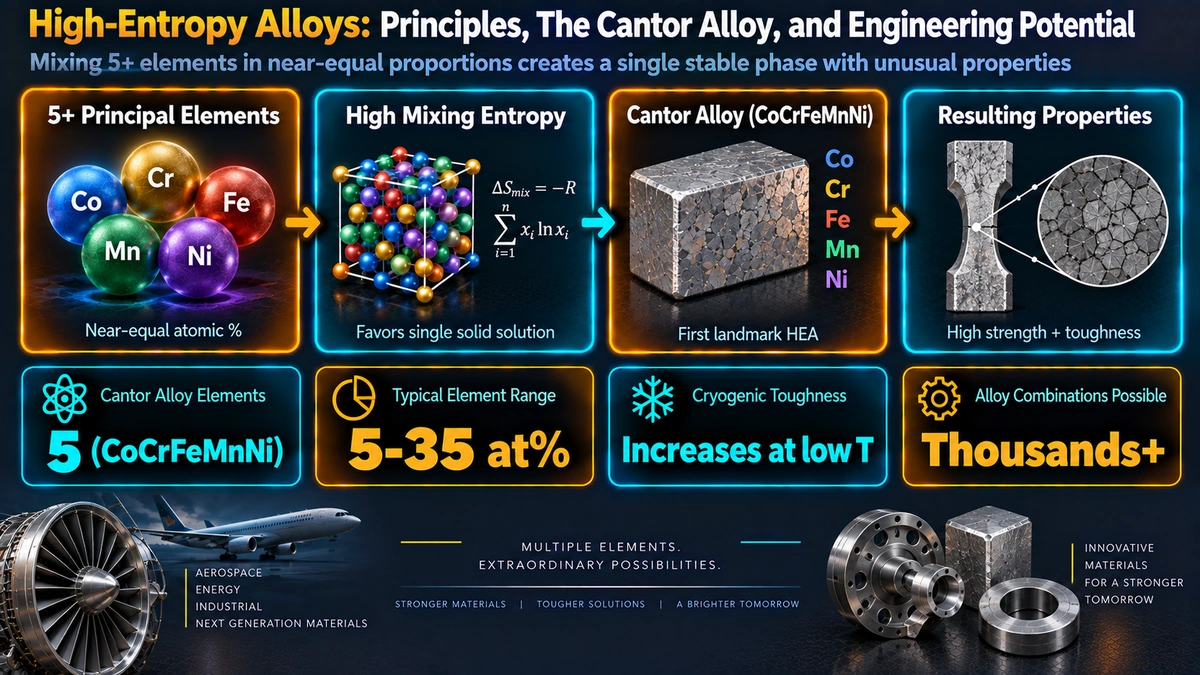
The term "high-entropy alloy" was coined independently by Brian Cantor (Oxford) and Jien-Wei Yeh (NTHU, Taiwan) in 2004. Both groups recognised that alloys with multiple principal elements in near-equimolar ratios could form surprisingly simple microstructures — often a single BCC or FCC phase — rather than the forests of intermetallics predicted by multi-component phase diagrams. The unifying concept is that configurational entropy, scaling with the number and distribution of component species, can dominate the Gibbs energy of mixing and suppress intermetallic formation.
A formal definition requires:
- Five or more principal elements
- Each element present at 5–35 at.%
- Configurational entropy of mixing ΔSmix ≥ 1.5R (where R = 8.314 J/mol·K)
Medium-entropy alloys (MEAs), containing three or four principal elements with ΔSmix in the range 1.0R–1.5R, have emerged as an important sub-class. The CrCoNi ternary MEA, derived from the Cantor alloy by removing Mn and Fe, exhibits even higher fracture toughness than its five-component parent at low temperatures, demonstrating that entropy alone does not dictate performance — composition and microstructure remain decisive.
Multi-Principal Element Alloys (MPEAs)
The broader term "multi-principal element alloy" (MPEA) is now preferred in many research communities, as it avoids the implication that high entropy is the sole or primary design driver. This shift reflects growing understanding that the original four core effects — particularly the entropy stabilisation and sluggish diffusion arguments — have been nuanced or partially challenged by subsequent computational and experimental work.
Thermodynamic Foundations
Gibbs Energy of Mixing
Phase stability in any alloy system is governed by the Gibbs energy of mixing:
ΔG_mix = ΔH_mix − TΔS_mix
For a solid solution to be thermodynamically stable over competing phases (intermetallics, ordered compounds), ΔGmix must be more negative than for those alternatives. In conventional alloys, the enthalpic term ΔHmix dominates at low and moderate temperatures, driving formation of ordered compounds or phase separation. In HEAs, the large ΔSmix term — maximised by high elemental diversity — increasingly dominates at elevated temperatures, suppressing ordered phase formation above some critical temperature.
Configurational Entropy Calculation
For an ideal, equimolar n-component alloy, mixing entropy is:
ΔS_mix = −R × Σ(x_i × ln x_i)

Equimolar 5-component (e.g. CrMnFeCoNi):
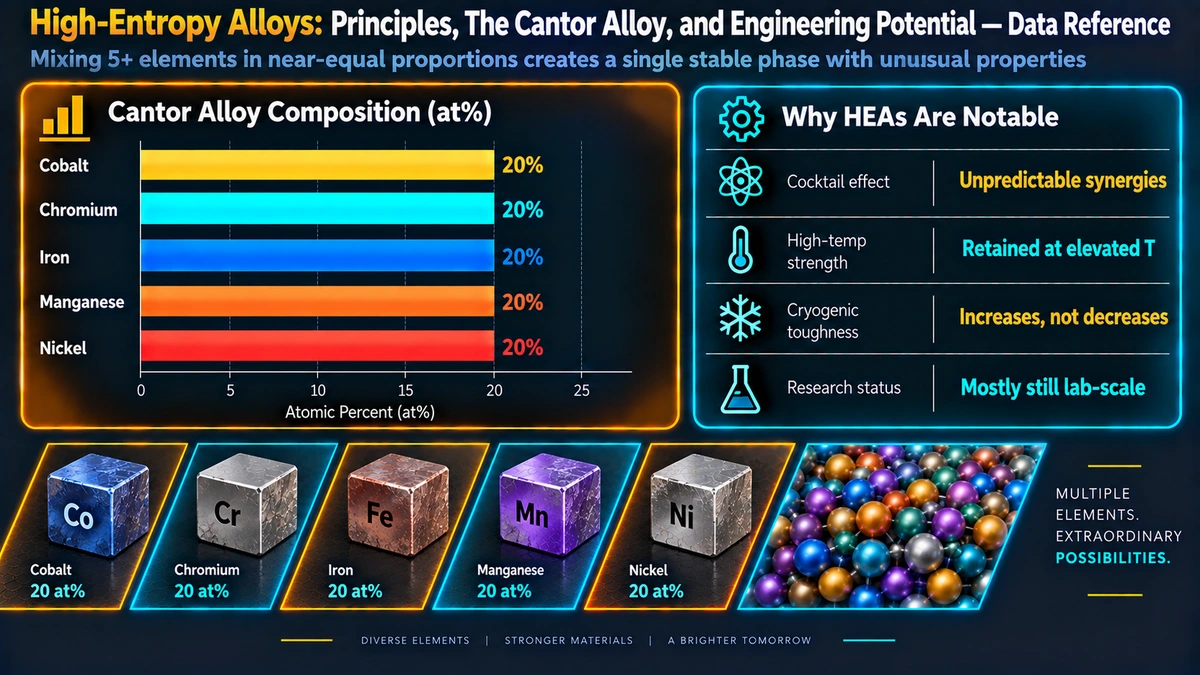
  x_i = 0.20 for each element
  ΔS_mix = −R × 5 × (0.20 × ln 0.20)
             = −R × 5 × (0.20 × −1.6094)
             = R × ln(5)
             = 1.609R ≈ 13.38 J/mol·K

Threshold for "high entropy": ΔS_mix ≥ 1.5R = 12.47 J/mol·K
Non-equimolar compositions that still contain 5+ elements can also qualify as HEAs if their entropy exceeds the threshold. In practice, maximum entropy is achieved at equimolar compositions, but deviation from equimolarity can be used to tune properties without abandoning the HEA concept.
The Ω Stability Parameter
Zhang et al. introduced the Ω parameter as a practical design criterion combining entropy and enthalpy contributions:
Ω = T_m × ΔS_mix / |ΔH_mix|

Where:
  T_m = composition-weighted average melting point (K)
  ΔS_mix = configurational entropy (J/mol·K)
  ΔH_mix = enthalpy of mixing from Miedema model (J/mol)

Criterion: Ω ≥ 1.1 and δ (atomic size mismatch) ≤ 6.6%
  favours single-phase solid solution formation
Phase Stability Prediction: VEC and CALPHAD
Valence Electron Concentration
Guo et al. (2011) established an empirical correlation between the average valence electron concentration (VEC) and the equilibrium crystal structure of HEA solid solutions in 3d transition metal systems:
VEC = Σ(x_i × VEC_i)

Phase stability rules (3d transition metal HEAs):
  VEC ≥ 8.0     →  FCC stable
  6.87 ≤ VEC < 8.0 →  FCC + BCC dual-phase region
  VEC < 6.87    →  BCC stable
| Composition | VEC | Predicted Structure | Observed Structure |
|---|---|---|---|
| CrMnFeCoNi (Cantor) | 8.0 | FCC | Single FCC |
| CoCrFeMnNi + 10Al | 7.8 | FCC borderline | FCC + BCC/B2 |
| AlCoCrFeNi (equimolar) | 7.54 | FCC + BCC | BCC/B2 + FCC |
| MoNbTaVW | 5.4 | BCC | Single BCC |
| MoNbTaW | 5.25 | BCC | Single BCC |
| CrCoNi (MEA) | 8.67 | FCC | Single FCC |
CALPHAD Modelling
CALPHAD (CALculation of PHAse Diagrams) provides rigorous thermodynamic predictions by extrapolating assessed binary and ternary interaction parameters to higher-order systems. Software packages such as Thermo-Calc with the TCHEA (high-entropy alloy) database or Pandat are now standard tools in HEA design workflows. CALPHAD correctly predicts the single-phase field boundaries, spinodal decomposition tendencies, and precipitation reactions that purely entropy-based screening misses.
A key lesson from CALPHAD studies is that many nominally "high-entropy" compositions are not actually single-phase at service temperatures. The equimolar AlCoCrCuFeNi, once cited as an HEA prototype, shows Cu-rich FCC spinodal decomposition because the Cu–Co and Cu–Fe mixing enthalpies are strongly positive. Phase selection in real HEAs is always a competition between entropic stabilisation and enthalpic driving forces for ordered or segregated phases. Learn more about thermodynamic alloy design at our guide on the iron-carbon phase diagram as foundational context.
The CrMnFeCoNi Cantor Alloy
The equimolar CrMnFeCoNi five-component alloy — universally known as the Cantor alloy — was first reported by Brian Cantor and co-workers in 2004 and has since become the reference composition against which virtually all other HEAs are benchmarked. Produced by arc melting, drop casting, and thermo-mechanical processing, it forms a single-phase FCC solid solution that is stable from room temperature up to approximately 900°C, above which Cr-rich sigma phase begins to precipitate at grain boundaries.
Mechanical Properties of the Cantor Alloy
| Property | Value / Range | Test Condition |
|---|---|---|
| 0.2% Proof Strength (Rp0.2) | ~200 MPa | Room temperature, annealed |
| Ultimate Tensile Strength (Rm) | ~490–520 MPa | Room temperature, annealed |
| Elongation to fracture | ~60% | Room temperature, annealed |
| Fracture toughness (KIc) | >200 MPa·m½ | Cryogenic (77 K) |
| Hardness (as-cast) | ~130 HV | Vickers, 10 kgf |
| Density | ~8.0 g/cm3 | Calculated from rule of mixtures |
| Stacking Fault Energy (SFE) | ~20–35 mJ/m2 | Low SFE activates TWIP deformation |
The Cantor alloy's most striking feature is the cryogenic strengthening-without-embrittlement response. At 77 K, both yield strength and fracture toughness improve simultaneously — a behaviour attributed to the activation of deformation twinning (the TWIP effect) at low temperatures, where the low stacking fault energy promotes partial dislocation separation and twin boundary multiplication. This is fundamentally different from conventional FCC metals, which simply strengthen at low temperature with a modest toughness penalty.
The role of grain boundaries in the Cantor alloy is significant: Mn and Cr tend to segregate to grain boundaries, reducing boundary cohesion and activating intergranular corrosion in aggressive environments. This is one motivation for the CrCoNi ternary MEA, which removes the problematic Mn while retaining or improving most other properties.
Deformation Mechanisms
HEA deformation at room temperature proceeds primarily by planar slip of full dislocations on {111}<110> systems, as in conventional FCC metals. The key distinction is the increased lattice friction stress (Peierls-Nabarro-type) arising from the fluctuating potential energy landscape of the distorted lattice. At low temperatures, extended dissociation of dislocations into partial pairs on stacking fault ribbons promotes twin nucleation, transitioning the dominant mechanism from slip to twinning-induced plasticity (TWIP). This mechanism transition underpins the extraordinary cryogenic damage tolerance and is a direct consequence of the severe lattice distortion core effect. See also our article on martensite formation for comparison of deformation-induced phase transformations in steel systems.
AlCoCrFeNi Alloys: Effects of Al Addition
The systematic addition of Al to the CoCrFeNi base has been extensively studied as a model system for understanding composition effects in FCC HEAs. Al is a BCC-stabilising element (VEC = 3), and its addition progressively shifts phase stability from single-phase FCC through a dual FCC+BCC region to single-phase BCC/B2 as Al content increases:
| Al Content (at.%) | Phase Constitution | Hardness (HV) | Notes |
|---|---|---|---|
| 0 | Single FCC | ~130 | Ductile, low strength |
| 11 (Al0.5CoCrFeNi) | FCC + BCC/B2 | ~300 | Dual phase, balanced properties |
| 20 (equimolar AlCoCrFeNi) | Predominantly BCC/B2 | ~490 | High strength, reduced ductility |
| 30 | BCC/B2 + σ-phase | ~530 | Brittle at room temperature |
The BCC/B2 microstructure in high-Al compositions consists of an A2 disordered BCC matrix with coherent B2 (CsCl-type ordered) precipitates, in direct analogy to the γ/γ′ microstructure of nickel superalloys. This analogy has motivated research into precipitation-strengthened HEAs designed to combine multi-principal element solid solution strengthening with coherent precipitate hardening.
Refractory High-Entropy Alloys
Refractory HEAs (RHEAs) replace the 3d transition metal principals with refractory elements drawn from groups IV–VI: Ti, Zr, Hf (group IV); V, Nb, Ta (group V); Cr, Mo, W (group VI). The first RHEA to be characterised systematically was the equimolar MoNbTaW tetranary by Senkov et al. (2010, 2011), which demonstrated retention of significant compressive yield strength at temperatures where nickel superalloys fail completely.
Mechanical Performance of Key RHEA Systems
| Alloy System | Structure | YS at RT (MPa) | YS at 1000°C (MPa) | YS at 1600°C (MPa) |
|---|---|---|---|---|
| MoNbTaW | BCC | ~1058 | ~405 | ~405 |
| MoNbTaVW | BCC | ~1246 | ~694 | ~477 |
| HfNbTaTiZr | BCC | ~929 | ~295 | — |
| IN718 (superalloy) | FCC + γ′′ | ~1185 | ~500 | <50 |
The critical limitation of W- and Mo-containing RHEAs is oxidation resistance. Above 400–500°C in air, MoO3 (m.p. 795°C) and WO3 volatilise rapidly, causing catastrophic mass loss. This "pesting" behaviour prevents direct deployment in oxidising atmospheres without protective coatings. Research strategies include: (a) Al additions to promote a protective Al2O3 scale, (b) Si additions for SiO2 scale formation, (c) silicide or MCrAlY overlay coatings, and (d) alloy design using the CALPHAD-coupled thermodynamic database for oxide stability. For further context on high-temperature materials, see our article on creep testing and stress rupture.
HfNbTaTiZr and Low-Density RHEAs
The HfNbTaTiZr system, reported by Senkov et al. (2011), offers an intermediate density (~9.6 g/cm³ vs ~13.8 g/cm³ for MoNbTaW) with good ductility at room temperature. It forms a disordered BCC single phase and exhibits yield strengths around 929 MPa at room temperature with 10% compressive ductility. The inclusion of Hf, however, raises both cost and density. Compositional variants excluding Hf, and those incorporating Ti as a primary light-refractory element, are under active investigation as lower-density alternatives. The refractory metals guide on this site provides element-level properties as a design reference.
Strengthening Mechanisms in HEAs
The total yield strength of an HEA is the superposition of contributions from multiple strengthening mechanisms, analogous to conventional alloys but with modified magnitudes due to the multi-principal element nature:
σ_y = σ_0 + Δσ_SS + Δσ_GB + Δσ_precip + Δσ_disl

Where:
  σ_0       = lattice friction stress (Peierls-Nabarro)
  Δσ_SS     = solid solution strengthening from lattice distortion
  Δσ_GB     = Hall-Petch grain boundary contribution = k_y × d^(-0.5)
  Δσ_precip = precipitation hardening from coherent second phases
  Δσ_disl   = dislocation forest hardening = MαGbρ^(0.5)
In single-phase HEAs without deliberate precipitation, solid solution strengthening from lattice distortion dominates. The magnitude exceeds that predicted by simple binary Vegard's law contributions because every lattice site is a "solute" site, maximising the interaction between dislocations and the fluctuating strain field. This is quantitatively captured in the Labusch and Fleischer solid solution strengthening models applied to HEA multi-component systems by Varvenne et al. (2016). The hardness testing methods article covers the experimental characterisation of these strength contributions.
Precipitation Hardening in HEAs
Second-generation HEA design increasingly exploits precipitate strengthening. The L12-ordered (Ni,Co)3(Al,Ti) phase, isostructural with the γ′ precipitate in nickel superalloys, has been stabilised in FCC CrCoNi-based HEAs through targeted Al and Ti additions. These Alx(CrCoFeNi) + Ti systems achieve yield strengths exceeding 1.5 GPa after ageing treatments, while retaining acceptable ductility. The quenching and tempering analogy from steel heat treatment is instructive: the same principle of supersaturation followed by controlled precipitation applies, though the precipitation kinetics in HEAs are moderated by the sluggish diffusion effect.
Fabrication Methods
Vacuum Arc Melting
Laboratory HEA synthesis almost universally employs vacuum arc melting (VAM) in a water-cooled copper hearth under purified argon. Multiple re-melting passes (typically 5–8) are required to achieve compositional homogeneity; the high melting points and density differences between constituent elements promote segregation during single-pass melting. Cast buttons are then thermo-mechanically processed — hot rolling at 1000–1200°C followed by cold rolling and annealing — to produce a recrystallised, uniform microstructure suitable for mechanical testing. For context on solidification and segregation phenomena, see our article on metal casting processes.
Powder Metallurgy Routes
Powder metallurgy (PM) offers significant advantages for HEA production: pre-alloyed powders from gas atomisation ensure chemical homogeneity at the powder particle scale, avoiding the macro-segregation inherent in cast routes. Consolidation by hot isostatic pressing (HIP), spark plasma sintering (SPS), or hot pressing produces near-fully dense compacts with fine, equiaxed grain structures and correspondingly superior combinations of strength and toughness. The PM route also enables the production of functionally graded compositions and the incorporation of reinforcing phases (ODS or carbide dispersoids) not achievable by conventional melting. Our article on powder metallurgy covers the process fundamentals in detail.
Additive Manufacturing
Laser powder bed fusion (LPBF) and directed energy deposition (DED) are emerging as HEA fabrication routes offering near-net-shape capability and site-specific composition control. The rapid solidification rates inherent in LPBF (105–106 K/s) suppress equilibrium phase separation and extend solid solubility, yielding finer microstructures than cast equivalents. HEA thin-film deposition by magnetron co-sputtering from elemental targets or alloy targets has enabled high-throughput compositional libraries — HEA "chips" with continuous composition gradients — that dramatically accelerate the alloy discovery process when combined with automated property mapping.
Corrosion and Oxidation Behaviour
The corrosion resistance of FCC HEAs is generally superior to 316L austenitic stainless steel in many environments, attributed to the formation of a complex, multi-cation passive film richer in Cr2O3 and CoO than that on binary or ternary alloys. The Cantor alloy and its derivatives show pitting potentials comparable to or exceeding 316L in NaCl solutions. The pitting corrosion mechanisms that govern stainless steel failure also apply to HEAs, with Mn-rich inclusions or Mn-depleted zones at grain boundaries acting as preferential pitting initiation sites.
High-temperature oxidation of CrMnFeCoNi at 700–1000°C produces a Cr2O3-based scale. Above 900°C, Cr volatilisation and Mn-rich spinel (MnCr2O4) formation degrade scale adhesion, requiring protective coating strategies for sustained high-temperature service. For further discussion of corrosion mechanisms, see our article on corrosion mechanisms.
Engineering Applications and Industrial Readiness
Cryogenic Structural Applications
The Cantor alloy's outstanding fracture toughness at 77 K (liquid nitrogen temperature) and 20 K (liquid hydrogen temperature) makes it an attractive candidate for cryogenic pressure vessels, liquefied natural gas (LNG) containment, and liquid hydrogen storage infrastructure. The combination of high strength, exceptional ductility, and extreme toughness at cryogenic temperatures rivals and in some metrics surpasses 9Ni cryogenic steel and austenitic stainless steels currently used in these applications. Read our article on low-temperature steels for cryogenic service for direct comparison.
Hard Coatings and Surface Engineering
HEA nitride coatings — notably (AlCrTiSiV)N, (AlCrMoSiTi)N, and related multi-element nitride systems — deposited by physical vapour deposition (PVD) or cathodic arc have demonstrated hardnesses exceeding 30 GPa and excellent thermal stability to 1000°C. The multi-element nitride solid solution resists decomposition and grain coarsening at elevated temperatures, conferring superior hot hardness retention compared to binary TiN or ternary TiAlN coatings on cutting tools. Our article on CVD/PVD cutting tool coatings covers the deposition processes and coating architectures.
Nuclear Applications
The sluggish diffusion effect in HEAs retards radiation damage annihilation and defect clustering, suggesting superior radiation damage tolerance compared to conventional structural alloys. Experimental irradiation studies on CrMnFeCoNi and CrFeCoNi alloys confirm reduced void swelling and dislocation loop formation relative to pure nickel under equivalent ion dose. This attribute, combined with the potential for tuning composition to minimise activation products under neutron irradiation, positions HEAs as candidates for Generation IV fission and fusion reactor structural components.
Wear-Resistant Hardfacing
BCC and dual-phase HEAs with high hardness (CoCrFeMnNi + WC composites, AlCoCrFeNi overlays) are under investigation as wear-resistant hardfacing materials for mining equipment, cutting tools, and erosion-resistant components. The multi-element composition provides a route to hard wear-resistant microstructures without relying solely on carbide or boride reinforcement. See our article on hardfacing alloys for the conventional materials baseline.
Frequently Asked Questions
What defines a high-entropy alloy?
What are the four core effects of HEAs?
What is the Cantor alloy and why is it significant?
How is configurational entropy calculated for an HEA?
What are refractory high-entropy alloys?
Do all HEAs form single-phase solid solutions?
How does valence electron concentration (VEC) predict HEA phase stability?
What fabrication methods are used to produce HEAs?
What are the primary engineering applications of HEAs currently?
How do HEAs compare to conventional nickel superalloys in high-temperature performance?
Recommended Reference Books
Disclosure: MetallurgyZone participates in the Amazon Associates programme. If you purchase through these links, we may earn a small commission at no extra cost to you. This helps support free technical content on this site.
Further Reading
